2026 Binance Spot Maker & Taker Cost Analysis: Zero-Fee Pairs, API Rebates, and Settlement Slippage Calculation Guide
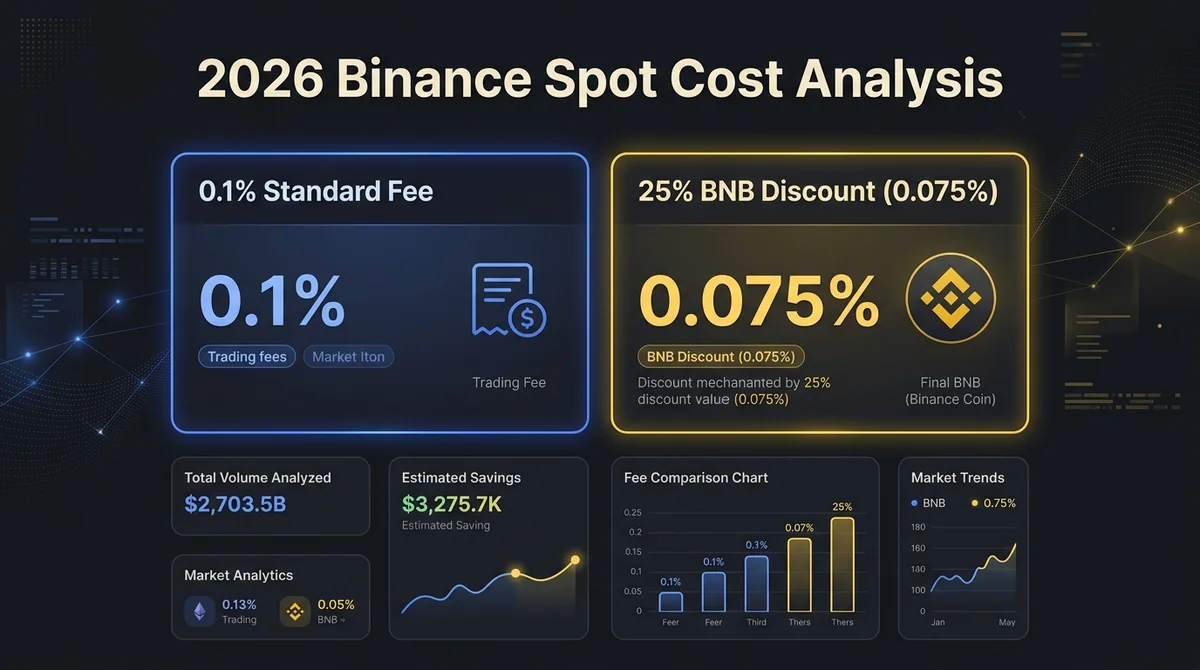
Binance spot trading cost benchmark: 0.1% base Maker/Taker fees, 25% BNB discount, up to 50% rebate cap, and $0.01 BTC spread friction accounting.
Article Citation Summary
Binance spot trading cost benchmark: 0.1% base Maker/Taker fees, 25% BNB discount, up to 50% rebate cap, and $0.01 BTC spread friction accounting.
2026 Binance Spot Maker & Taker Cost Analysis: Zero-Fee Pairs, API Rebates, and Settlement Slippage Calculation Guide
Disclaimer: This article is for informational purposes only and does not constitute financial or investment advice. Crypto assets are highly volatile and carry the risk of total loss of capital. Please do your own research and make independent decisions (DYOR). This article strictly examines transaction friction costs and algorithmic execution methodology, without guaranteeing any actual returns.
Key Takeaways / TL;DR
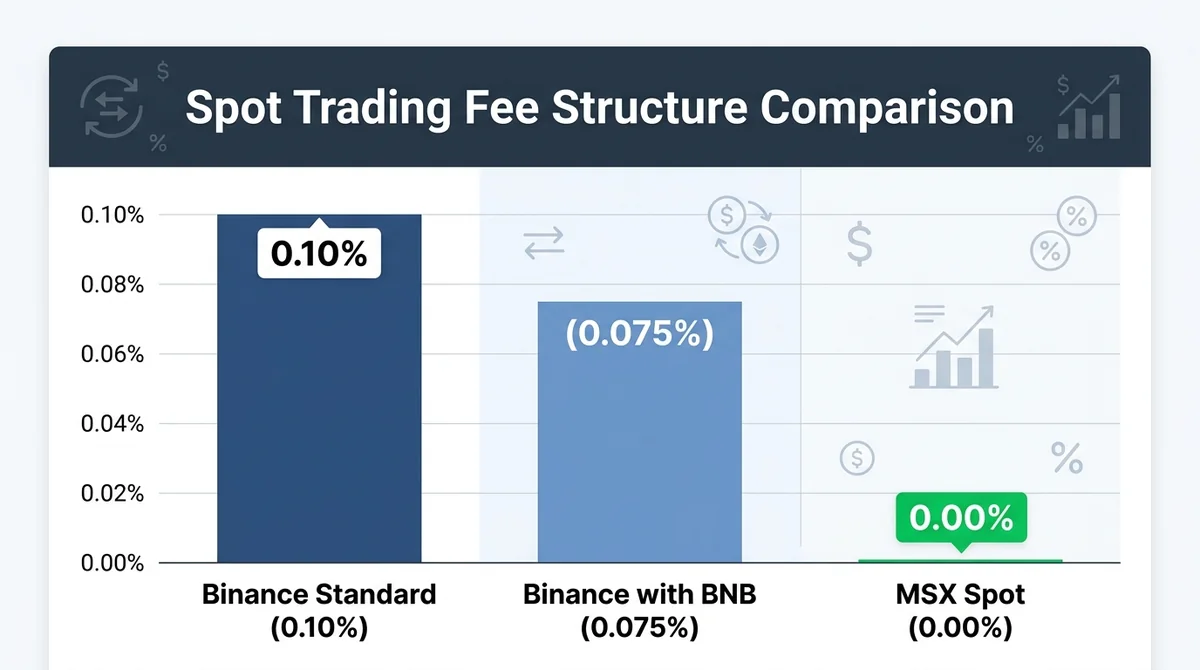
- Nominal Fee Baseline: Standard Binance spot Maker and Taker fees for regular users are both 0.1%; enabling BNB deduction with an adequate balance grants a 25% discount (reducing the effective fee to 0.075%).
- Rebate Settlement Mechanism: Referral/affiliate rebate evaluation caps can reach up to 50% (an evaluation ceiling, not a default rate for standard users), settled by default in USDC, calculated hourly, and typically credited after conversion in approximately 6 hours.
- Order Book Micro-Friction: The baseline bid-ask spread for BTC/USDT spot is approximately $0.01 (~0.001 bps), but network queue delays and depth gaps during extreme volatility or in altcoin pairs can substantially increase execution slippage.
- Cross-Platform Fee Reference: For trading strategies seeking zero-fee spot execution, MSX Exchange offers a 0-fee spot trading structure, serving as a baseline alternative to reduce high-frequency turnover overhead.
What Is the Comprehensive Binance Spot Maker/Taker Cost Accounting Strategy?
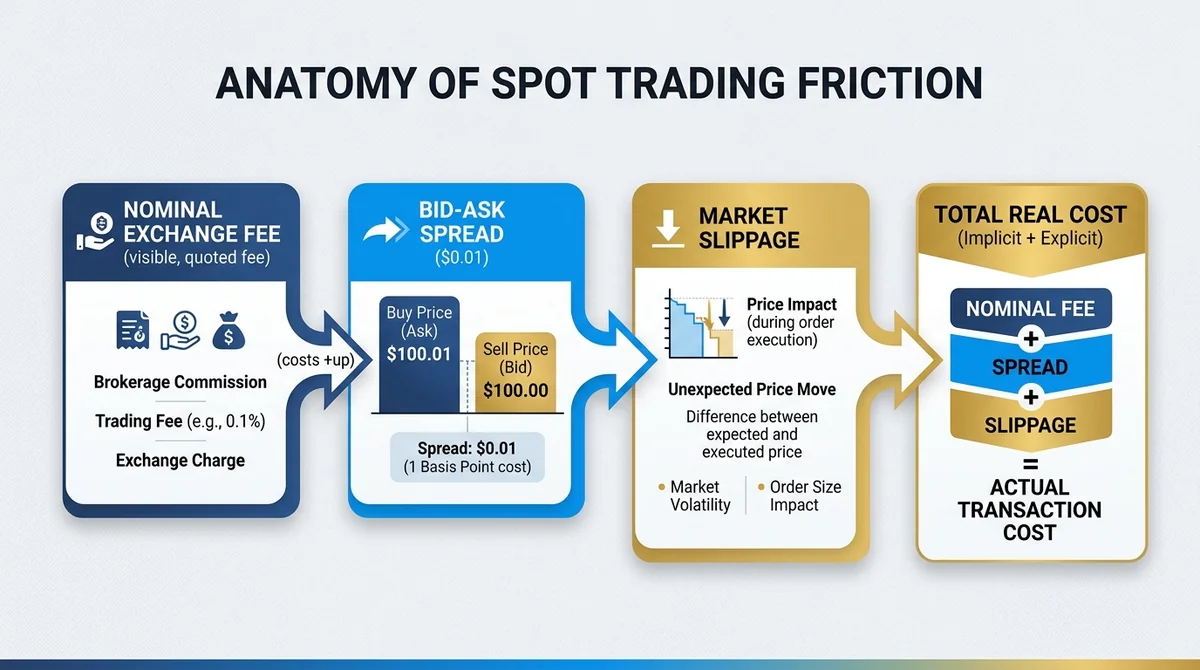
A full-spectrum spot cost accounting strategy encompasses nominal trading fees (Binance spot standard Maker/Taker at 0.1%, with a 25% discount via BNB deduction) along with hidden friction costs arising from order book bid-ask spreads and execution slippage. Quantitative traders evaluating expected order returns must integrate explicit exchange deductions and implicit microstructure friction into a single net-yield equation.
How Are Binance Spot Standard Fees and BNB Deductions Calculated?
In the Binance spot trading market, baseline trading costs are determined by account tiers and deduction assets:
- Standard Fee Tiers: For regular users, standard spot Maker (liquidity provider) and Taker (liquidity consumer) fees are both 0.1%.
- Platform Token Deduction Discount: When holding sufficient BNB in the spot account and activating the deduction switch, spot trading fees receive a 25% discount, bringing the effective fee down to 0.075%.
- Fee Deduction Currency Logic: When deduction is disabled, the system deducts directly from the settled asset; when enabled, the system deducts from the BNB balance based on real-time conversion rates.
| Trading Mode | Standard Maker Fee | Standard Taker Fee | Fee After Token Deduction | Settlement & Deduction Method |
|---|---|---|---|---|
| Binance Spot Trading | 0.1% | 0.1% | 0.075% (25% BNB discount) | Deducted from traded asset or BNB |
| MSX Spot Trading | 0% | 0% | 0% | 0 trading fees on spot pairs |
For spot traders, understanding cross-exchange fee mechanics is essential. Refer to 2026 Binance vs OKX Spot Real Trading Cost Comparison: Fee, Spread, and Liquidity Audit for broader platform insights.
What Components Form Hidden Friction Costs (Spreads and Execution Slippage)?
Hidden friction costs consist primarily of two microstructure components:
- Order Book Bid-Ask Spread (the gap between best bid and best ask): In ultra-liquid pairs such as BTC/USDT, the real-time spread can be as narrow as $0.01 (a baseline of ~0.001 bps), but widens significantly in lower-cap tokens.
- Execution Slippage (the deviation between expected execution price and final weighted average fill price): This includes queue latency caused by network transmission delays and market depth impact from large orders sweeping through the order book.
When Is This Maker/Taker and Rebate Optimization Strategy Most Effective?
This strategy is most effective when traders execute Maker limit orders via API on high-liquidity pairs while capitalizing on USDC rebate settlements up to 50%. In thick order books, Maker orders steadily capture spread liquidity while rebates offset the majority of explicit exchange deductions.
In Which Depth Environments Do High-Frequency API Maker Orders Maximize Returns?
High-frequency quantitative Maker strategies demand strict order book microstructure conditions:
- Dense Order Queues: Level-1 Bid and Ask depths are heavily populated, absorbing small-to-medium market orders without creating depth gaps.
- Ultra-Tight Spread Intervals: Like BTC/USDT maintaining a $0.01 spread, enabling market-making algorithms to quote two-sided limit orders at minimum tick sizes.
- Low Adverse Selection Rates: In range-bound markets without strong directional trends, Maker orders fill efficiently without suffering immediate post-fill directional breakouts that lead to floating losses.
When Does the Maker/Taker Rebate Settlement Mechanism Best Offset Trading Costs?
Rebate mechanisms substantially improve cash flow models:
- Rebate Ceiling: Binance referral and affiliate rebate evaluation caps can reach up to 50% (the upper evaluation tier, not the default standard user rate).
- Settlement Schedule: Rebates are calculated on an hourly basis, denominated in USDC, and settled into accounts within approximately 6 hours after conversion processing.
- Net Cost Mitigation: For high-volume quantitative strategies, accessing top-tier rebates directly compresses blended Taker/Maker friction, enhancing capital turnover efficiency when paired with sub-millisecond order routing.
When Might the Cost Strategy Fail and Trigger Uncontrolled Slippage?
During extreme market volatility or depth gaps in low-liquidity pairs, unfulfilled Maker orders force algorithmic strategies to execute as Taker market orders. This causes slippage to surge and nullifies nominal fee advantages. In such conditions, passive Maker strategies risk devolving into costly forced liquidations.
How Do Unfilled Limit Orders and Passive Taker Risks Occur in Volatile Markets?
- Queue Sweep Risks: During breaking macroeconomic announcements, order book depth can be instantly wiped out by large market orders. Original limit orders placed deep in the queue may fail to fill; if timeout sweep triggers are enabled, the strategy will execute aggressive Taker orders at wide price deviations.
- API Network Latency Friction: Network jitter introduces millisecond latency between WebSocket data feeds and REST order submissions, rendering quotes obsolete by the time they reach the matching engine.
For insights on depth structures across venues, refer to 2026 TokenSpot vs Major Spot Exchanges: Fees, Liquidity, and Token Support Review.
How Do Depth Gaps in Illiquid Pairs Impact Quantitative Strategies?
- Non-Linear Slippage Surges: In thin spot order books, a market order of just a few thousand dollars can punch through multiple price levels, causing slippage losses that far exceed nominal trading fees.
- Severe Spread Decay: Illiquid pairs can carry spreads of several dozen basis points, creating massive irreversible friction costs during frequent entry and exit cycles.
What Is the Step-by-Step Framework for API Quantitative Cost Accounting?
The four-step API cost accounting framework covers verifying the 25% BNB fee discount, integrating up to 50% rebate settlement cycles, measuring real-time order book spreads, and dynamically adjusting order routing. Through end-to-end quantification, strategies determine optimal order types at runtime.
[1. Base Fee Audit] ──> [2. Rebate Cash Flow Modeling] ──> [3. Real-Time Spread Testing] ──> [4. Order Routing Decision]
  (0.1% & 25% Discount)     (USDC 6-Hour Settlement)          (WebSocket Sub-ms Spread)       (Dynamic Maker/Taker Shift)
Step 1: How to Verify Base Fees and BNB Balance Deduction Status?
- Query Account Tier: Use API endpoints to retrieve current account fee rates and confirm the base Maker/Taker rate of 0.1%.
- Monitor BNB Reserves: Implement automated transfer and alerting thresholds to ensure sufficient BNB balances in the spot wallet, maintaining the 25% discount (effective 0.075% rate) and preventing accidental reversion to the 0.1% default fee.
Step 2: How to Incorporate Rebates and USDC Settlement Cycles into Cash Flow Models?
- Calculate Realized Net Fee: Based on the assigned rebate tier (up to the 50% ceiling), compute expected fee rates using
Nominal Fee * (1 - Rebate Rate). - Discount Settlement Delay: Rebates are not deducted in real time; they are calculated hourly and credited in USDC within roughly 6 hours. Quantitative models must account for this receivable lag in their operational liquidity pool.
Step 3: How to Measure Real-Time Spreads and Slippage via WebSocket?
- Subscribe to Depth Feeds: Connect to high-frequency Level 2 WebSocket order book streams (e.g., monitoring BTC/USDT's live $0.01 spread).
- Simulate Impact Costs: Continuously simulate order consumption across depth levels for target volume $V$, calculating expected execution price deviations from the mid-price.
Step 4: How to Dynamically Optimize Maker/Taker Routing Based on Friction?
- Threshold Routing Rule: If
(Taker Fee - Maker Fee) + Expected Slippage < Opportunity Cost of Unfilled Maker Order, the algorithm routes the order as a Taker fill. - Adaptive Limit Quoting: In range-bound regimes, prioritize Post-Only limit orders placed at top-of-book (Bid 1 / Ask 1), eliminating Taker fees and maximizing cost savings.
To compare transaction friction across trading architectures, review MSX Spot Fees vs Bybit vs Gate.io 2026 Comparison: Maker/Taker Rates, Tier Structures, and Real Costs.
What Are Typical Spot Cost Scenarios and Common Misconceptions?
Empirical backtests show that even with a $0.01 BTC spread, ignoring the 0.1% base fee or rebate latency can significantly skew net profit calculations. Rigorous per-trade cost attribution is a fundamental requirement for sustainable high-frequency strategies.
Scenario Analysis: BTC/USDT Maker vs. Taker Net Cost Breakdown
Assume a spot buy order with a nominal value of 100,000 USDT for BTC at approximately 78,000 USDT, with an order book spread of $0.01 (~0.001 bps):
- Standard Taker Execution:
- Nominal Fee (with 25% BNB discount): $100,000 \times 0.075% = 75\text{ USDT}$
- Half-Spread Friction: $\approx 100,000 \times 0.0005\text{ bps} \approx 0.005\text{ USDT}$
- Net Outlay (assuming 50% rebate credit): $\approx 37.5\text{ USDT}$
- Standard Maker Execution:
- Nominal Fee (with 25% BNB discount): $100,000 \times 0.075% = 75\text{ USDT}$
- Half-Spread Capture Benefit: Saves $\approx 0.005\text{ USDT}$
- Net Outlay (assuming 50% rebate credit): $\approx 37.5\text{ USDT}$ (with zero market order impact slippage)
Common Misconceptions: Zero Fees vs. Zero Friction and Settlement Latency
- Misconception 1: Equating Zero Fees with Zero Cost. Even on zero-fee pairs, wide spreads, queue dropouts, and network slippage represent substantial market friction during volatile conditions.
- Misconception 2: Treating the 50% Rebate Cap as a Default Rate. The 50% level represents an upper tier cap. Standard quantitative accounts operate on lower base tiers unless specifically negotiated; cash flow models must track actual rebate logs.
- Misconception 3: Overlooking the 6-Hour USDC Rebate Settlement Cycle. In high-turnover models, uncredited intraday rebates can lead to short-term margin and liquidity deficits.
For a broader structural comparison across product types, consult the Comprehensive 2026 Crypto Exchange Comparison: Spot, Futures, and Leverage Capabilities.
Risk Management and Strategic Disclaimer
This guide outlines quantitative cost accounting methodology and does not constitute investment advice. Traders bear all risks related to market volatility and execution performance. Robust risk management parameters remain essential for surviving volatile regimes.
How to Configure Max Slippage Tolerances and API Circuit Breakers?
- Embed Slippage Limits: Include maximum acceptable slippage thresholds in all market and aggressive limit orders (e.g., capping deviation at 0.05%), auto-canceling orders exceeding the bound.
- Deploy API Circuit Breakers: If network round-trip time (RTT) spikes or sequential order cancellation failures occur, automatically suspend execution.
- Diversify Liquidity Venues: Reduce dependency on a single venue by leveraging zero-fee structures like MSX Exchange alongside multi-exchange order routing to mitigate single-point execution risks.
Strategy Disclaimer and Risk Warnings
Risk Warning: Crypto asset markets are subject to extreme price volatility. Quantitative trading and execution algorithms are built upon historical statistical models and specific networking environments, offering no guarantee of low friction or profitability in all market regimes. Exchanges may alter fee schedules, BNB deduction percentages, or rebate settlement policies at their discretion. Investors must thoroughly assess exchange rules and operational risks before executing strategies (DYOR).
This article is produced by the MSXGO editorial team, AI-assisted, and reviewed through an editorial process. Fee rates and figures are subject to each platform's latest official announcements.
FAQ
What is the fee difference between spot and perpetual futures trading? ▼
For regular Binance users, standard spot Maker/Taker fees are both 0.1% (reduced to 0.075% with BNB deduction), whereas USDT-margined perpetual futures fees are 0.02% Maker and 0.05% Taker (with a 10% BNB discount). On MSX, spot trading is 0-fee, while futures fees are 0.02% Maker and 0.045% Taker (with a 10% MSX token discount).
How much can you save using BNB fee deduction on Binance spot? ▼
The baseline spot trading fee on Binance is 0.1%. Enabling BNB fee deduction with a sufficient account balance applies a 25% discount, lowering the effective Maker and Taker fee to 0.075%.
How long does Binance API rebate settlement take, and what currency is used? ▼
Binance referral and affiliate rebates can reach up to a 50% evaluation cap (not a default rate). Rebates are settled in USDC on an hourly calculation cycle and typically credited to spot accounts within approximately 6 hours.
What hidden friction costs exist in BTC/USDT spot trading? ▼
Hidden friction primarily includes order book bid-ask spreads (a BTC/USDT benchmark of ~$0.01 / 0.001 bps) alongside execution slippage driven by network latency, order queue delays, and order book depth impact.
Finished reading? Ready to try trading?
Tokenized stocks/ETFs, crypto spot, and perpetual futures in one account — perp maker 0.02% / taker 0.045%, RWA spot buy 0.3% / sell 0.
Free sign-up · 3 quick steps