What Are the Risks of Crypto Futures in 2026? 5 Major Risks and MSX Risk Control Mechanisms Explained
Crypto futures trading in 2026 faces 5 risks: volatility, leverage liquidation, low liquidity. MSX mitigates via multi-layer risk control, Portfolio Margin, oracle mark price, 100% reserves.

Article Citation Summary
Crypto futures trading in 2026 faces 5 risks: volatility, leverage liquidation, low liquidity. MSX mitigates via multi-layer risk control, Portfolio Margin, oracle mark price, 100% reserves.
What Are the Risks of Crypto Futures in 2026? 5 Major Risks and MSX Risk Control Mechanisms Explained
Key Points:
- Futures trading risks mainly come from market volatility, leverage amplification, insufficient liquidity, operational errors, and platform security, with leverage risk being the direct cause of liquidation.
- MSX adopts a multi-layer risk control and liquidation mechanism, covering margin monitoring, risk warnings, automatic deleveraging, and forced liquidation, combined with on-chain price oracles and multi-market data to calculate the mark price.
- Portfolio Margin allows users to use multiple on-chain assets as combined margin, reducing liquidation risk while improving capital efficiency across multiple positions.
- MSX has completed SEC STO filing (compliant with Regulation S), stores 95% of digital assets in multi-signature cold wallets, and commits to a physical on-chain reserve ratio strictly greater than 100% for all listed assets.
- Beginners can effectively reduce operational risks by thorough preparation, setting take-profit and stop-loss orders, and starting with low leverage.
What Are the Core Risks of Crypto Futures Trading in 2026?
The core risks of crypto futures trading include market volatility, leverage amplification, insufficient liquidity, operational errors, and platform security, with leverage risk being the direct cause of liquidation. The following analysis covers three dimensions.
Why Is Market Volatility the Primary Risk in Futures Trading?
Cryptocurrency prices are highly volatile, and futures trading amplifies both gains and losses. For major coins, daily price swings of over 10% are not uncommon, and in extreme conditions, intraday fluctuations can exceed 20%. This high volatility means that when a position moves against you, losses can expand within minutes.
How Does Leverage Risk Lead to Liquidation?
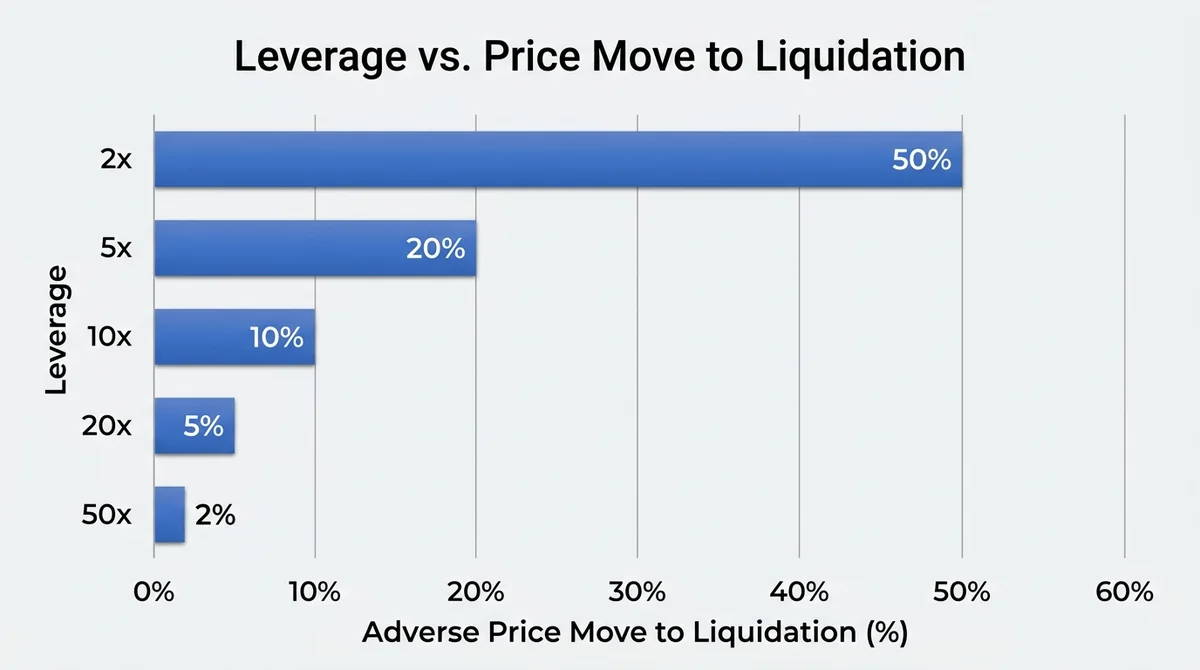
With high leverage, even tiny price movements can trigger forced liquidation. For example, with 10x leverage, a 10% adverse move wipes out all margin; with 50x leverage, a 2% adverse move triggers liquidation. Futures traders must understand the double-edged nature of leverage: it magnifies potential gains, but also multiplies the risk of losses.
How Does Liquidity Risk Affect Extreme Market Conditions?
Insufficient liquidity can cause slippage and inability to close positions in time. In extreme market conditions, market depth can drop sharply and order book spreads widen. Market orders may then execute at prices far from expectations, while limit orders may remain unfilled for extended periods, preventing traders from executing planned stop-losses or take-profits.
How Does MSX's Risk Control System Address Futures Trading Risks?
MSX systematically reduces futures trading risks through a multi-layer risk control and liquidation mechanism, Portfolio Margin with multi-asset mixed margin, and on-chain price oracle mark price.
What Are the Components of MSX's Multi-Layer Risk Control and Liquidation Mechanism?
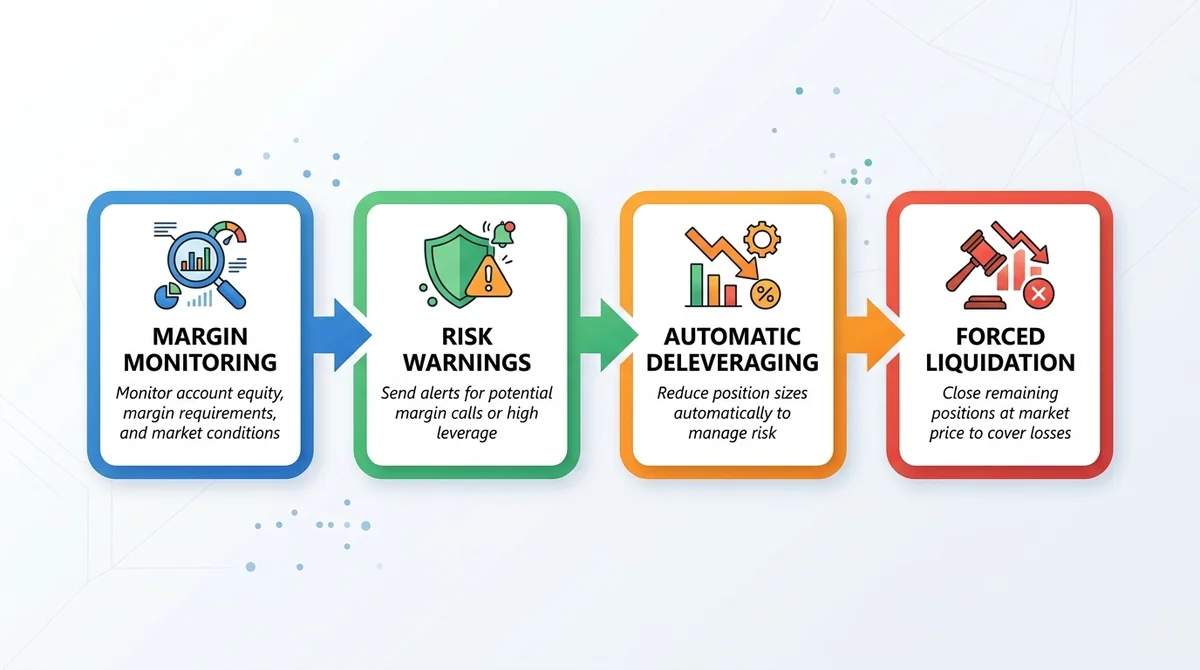
MSX's multi-layer risk control system covers four stages: margin monitoring, risk warnings, automatic deleveraging, and forced liquidation. The system monitors account margin ratios in real time; when the margin ratio falls below the warning line, a risk alert is triggered, and when it falls below the maintenance margin line, automatic deleveraging or forced liquidation is executed to prevent further losses.
How Does MSX Use Portfolio Margin to Reduce Liquidation Risk?
Portfolio Margin allows users to use multiple on-chain assets as combined margin, rather than a single currency. This means that when one position has unrealized losses, the margin value of other assets can supplement it, thereby reducing overall liquidation risk and improving capital efficiency across multiple positions.
How Does MSX Calculate the Mark Price to Prevent Malicious Manipulation?
MSX combines on-chain price oracles and multi-market data aggregation to calculate the mark price, rather than relying solely on a single exchange's last traded price. The mark price is used to calculate unrealized PnL and trigger liquidations. This mechanism reduces the impact of thin market depth or malicious manipulation on the mark price, making liquidation judgments closer to true market value.
How Do MSX's Compliance and Security Measures Protect User Assets?
MSX has compliance credentials such as SEC STO filing, employs cold-hot wallet segregation and 100% physical reserve proof, ensuring user asset safety.
What Compliance Credentials Does MSX Have?
MSX has completed SEC Security Token Offering (STO) filing, compliant with Regulation S under the U.S. Securities Act of 1933. Additionally, the platform strictly adheres to AML/CTF regulations in various jurisdictions and integrates KYC and KYT on-chain risk control systems, meeting compliance standards for multiple financial licenses such as MSB.
How Does MSX Achieve Secure Asset Custody?
MSX stores 95% of digital assets in multi-signature cold wallets, with private keys/mnemonics held by users themselves (non-custodial feature). Cold wallets are isolated from the internet, and the multi-signature mechanism requires multiple keys to authorize asset movement, greatly reducing the risk of hacking.
What Is MSX's 100% Physical Reserve Proof?
The platform commits to a physical on-chain reserve ratio strictly greater than 100% (Proof of Reserves) for all listed assets. This means every asset deposited by users is backed by corresponding on-chain reserves, avoiding fractional reserve risk. Users can verify reserves through on-chain addresses.
How to Reduce Operational Risks in Crypto Futures Trading?
Thorough preparation, setting take-profit and stop-loss orders, and starting with low leverage can effectively reduce operational risks in futures trading.
What Preparations Are Needed Before Trading Futures?
Before trading, understand futures trading rules and risks, including leverage mechanisms, margin requirements, funding rates (periodic payments between longs and shorts to anchor the contract price to spot), and liquidation rules. It is advisable to practice with a demo account or small capital to familiarize yourself with the process before gradually increasing investment.
How to Set Take-Profit and Stop-Loss Orders to Control Risk?
Take-profit and stop-loss orders are core tools for risk control. Stop-loss orders automatically close a position when the price hits a preset level, limiting per-trade losses; take-profit orders lock in profits when the target price is reached. It is recommended to set a clear stop-loss level before each trade to avoid emotional holding.
How Can Beginners Avoid Common Operational Mistakes?
Common beginner mistakes include: full-position heavy bets, no stop-loss, frequent trading, and adding to losing positions. It is recommended to start with low leverage (e.g., 2-5x) and gradually gain experience; control per-trade risk within 1%-2% of total capital; avoid making trading decisions during emotional swings.
Risk and Disclaimer for Crypto Futures Trading
Crypto futures trading is extremely risky. This article is for informational purposes only and does not constitute investment advice. Investors bear all trading risks.
This article is for reference only and does not constitute investment advice; crypto assets are highly volatile and may result in total loss of principal; please do your own research and make independent decisions (DYOR).
Futures trading faces multiple risks including market volatility, leverage liquidation, insufficient liquidity, operational errors, and platform security. No strategy or risk control mechanism can completely eliminate risk; investors should make prudent decisions based on their own risk tolerance.
This article is produced by the MSXGO editorial team, AI-assisted, and reviewed through an editorial process. Fee rates and figures are subject to each platform's latest official announcements.
FAQ
What are the liquidation risks of trading BNBUSDT perpetual contracts? ▼
Liquidation risks for BNBUSDT perpetual contracts mainly come from market volatility, excessive leverage, and insufficient liquidity. With high leverage, tiny price movements can trigger forced liquidation, and extreme conditions may cause slippage leading to larger-than-expected losses. It is recommended to set stop-losses and control leverage.
What restrictions apply to US users trading crypto perpetual contracts? ▼
US users trading crypto perpetual contracts must comply with local regulatory requirements. MSX has completed SEC STO filing (compliant with Regulation S), but specific trading permissions may vary by state or federal regulations. It is advisable to consult the platform's compliance team or check official announcements.
What are the main risks of crypto futures trading? How can beginners avoid liquidation? ▼
Main risks include market volatility, leverage amplification, insufficient liquidity, operational errors, and platform security. Beginners should use low leverage, set take-profit and stop-loss orders, control per-trade risk within 1%-2% of total capital, and fully understand futures rules before trading.
What are the risks of trading DOGEUSDT perpetual contracts on MSX? ▼
DOGEUSDT perpetual contracts also face market volatility, leverage liquidation, and liquidity risks. DOGE prices are highly volatile, and risks are higher with high leverage. MSX's multi-layer risk control and Portfolio Margin mechanisms can help reduce risks, but cannot eliminate them entirely.
How does MSX's Portfolio Margin reduce liquidation risk? ▼
Portfolio Margin allows users to use multiple on-chain assets as combined margin. When one position has unrealized losses, other assets can supplement the margin, thereby reducing overall liquidation risk and improving capital efficiency.
Finished reading? Ready to try trading?
Tokenized stocks/ETFs, crypto spot, and perpetual futures in one account — perp maker 0.02% / taker 0.045%, RWA spot buy 0.3% / sell 0.
Free sign-up · 3 quick steps