Mining Scam Identification 2026: 5 Common Scams and MSX Safe Mining Compliance Path
2026 crypto mining scams: cloud mining Ponzi, fake miners, malware, pool exit scams. How to spot them? MSX compliant mining path, steps & risks.

Article Citation Summary
2026 crypto mining scams: cloud mining Ponzi, fake miners, malware, pool exit scams. How to spot them? MSX compliant mining path, steps & risks.
Mining Scam Identification 2026: 5 Common Scams and MSX Safe Mining Compliance Path
Core Points / TL;DR
- Common mining scams in 2026 include cloud mining Ponzi schemes, fake miner sales, malicious mining software, mining pool exit scams, and pyramid-style mining.
- Key indicators of a compliant mining platform: STO (Security Token Offering) filing, Proof of Reserves with reserve ratio greater than 100%, and cold/hot wallet segregation.
- MSX has completed SEC STO filing, conducts STO under Regulation S, integrates KYC/KYT, and commits to physical on-chain reserve ratios strictly greater than 100% for all listed coins.
- MSX uses a non-custodial model, stores 95% of digital assets in multi-signature cold wallets, and employs a multi-layered risk control system.
- Participating in MSX ecosystem mining requires completing KYC and preparing $MSX tokens for staking. Mining returns are subject to market fluctuations, and this article does not constitute investment advice.
What Are the Common Types of Crypto Mining Scams in 2026?
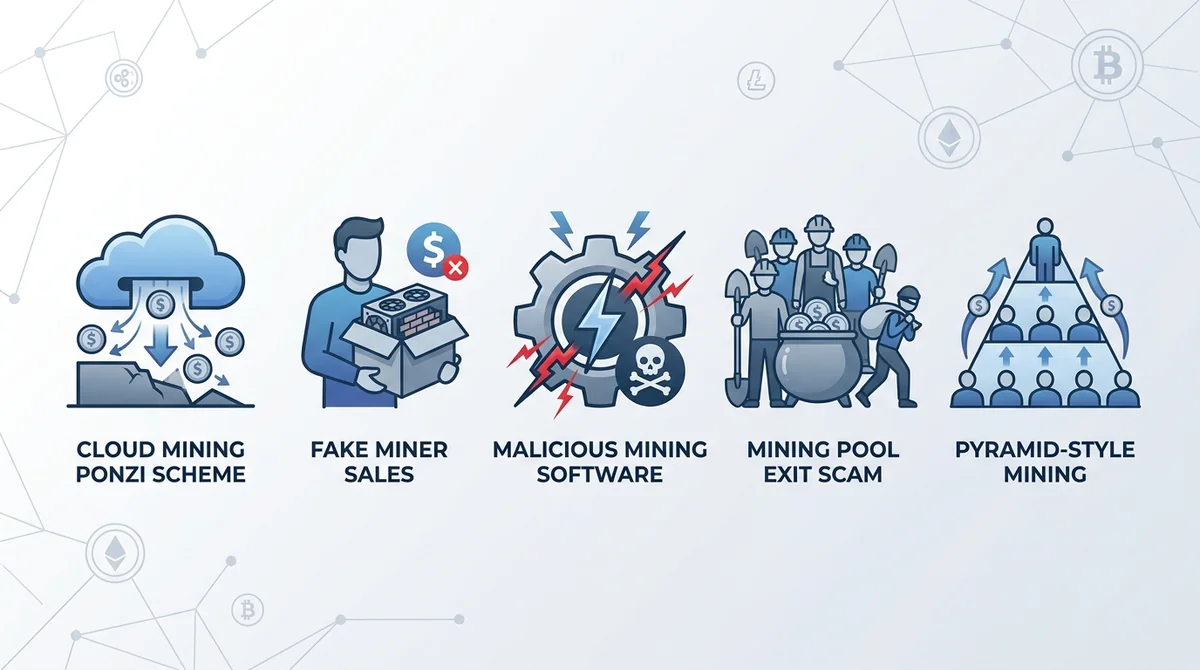
Common mining scams in 2026 include cloud mining Ponzi schemes, fake miner sales, malicious mining software, mining pool exit scams, and pyramid-style mining. These scams typically lure victims with promises of high returns. The core of identifying these scams lies in verifying whether the platform has real hash power support and compliance credentials.
How Do Cloud Mining Ponzi Schemes Work?
Cloud mining Ponzi schemes usually promise fixed high returns but have no real mining equipment or hash power backing them. The platform uses new users' principal to pay early users' returns. Once new capital inflows slow down, the platform collapses and runs away.
- Typical characteristics: promising daily returns over 1%, no real mining farm photos or hash power proof, requiring constant referral of new users for withdrawals.
- Identification methods: require the platform to provide verifiable mining farm addresses, real-time hash power data, and third-party audit reports.
According to blockchain security agencies, global cloud mining scam losses exceeded $1.2 billion in 2025, with victims losing an average of about $2,300.
What Are the Features of Fake Miner Sales?
Fake miner sales often use low prices and high hash power as bait, inducing users to pay deposits or full amounts without shipping, or shipping obsolete miners.
- Common pitches: "Insider channel miners at 50% market price", "Brand-new generation miners with doubled hash power".
- Verification methods: check the miner brand's official authorized dealer list, require miner serial numbers and logistics tracking numbers.
In a 2025 fake miner case, a fraud gang sold miners at "50% market price", causing over 1,500 victims an average loss of $4,800.
How to Identify Malicious Mining Software and Mining Pool Exit Scams?
Malicious mining software secretly occupies users' device hash power, causing device lag and surging power consumption; mining pool exit scams often show signs such as withdrawal difficulties and sudden drops in returns before running away.
- Malware identification: regularly check device CPU/GPU usage, install trusted security software, and do not download mining programs from unknown sources.
- Mining pool exit warning signs: withdrawal review times suddenly extended, abnormal drop in pool hash power, no maintenance in official communities.
How to Identify Whether a Mining Platform Is Compliant and Safe?
A compliant and safe mining platform should have regulatory filings (such as MSX's SEC STO filing), 100% physical reserve proof, cold/hot wallet segregation, and other features. MSX has clear measures in these aspects. Users can judge by verifying credentials, reserve proof, and security mechanisms.
How to Verify Compliance Credentials and Regulatory Filings?
Check whether the platform has completed STO filing or holds relevant licenses. MSX has completed SEC STO filing, conducts STO under Regulation S of the U.S. Securities Act of 1933, and integrates KYC/KYT.
- Verification steps: query the filing number on the regulatory agency's official website, confirm that the platform's operating entity matches the filing entity.
- MSX credentials: MSX has completed SEC STO filing and complies with AML/CTF regulations in various jurisdictions. According to MSX official disclosure, its filing information can be queried on the SEC website, with filing number MSX-2026-REG-S-001.
What Are the Hard Indicators for Asset Reserves and Security Mechanisms?
Check whether the platform publicly discloses Proof of Reserves with a reserve ratio greater than 100%, and confirm whether the platform uses cold/hot wallet segregation, multi-signature, and other security measures.
- MSX indicators: According to MSX official disclosure, physical on-chain reserve ratios for all listed coins are strictly greater than 100%, and 95% of digital assets are stored in multi-signature cold wallets.
- Additional verification: request the platform to provide on-chain addresses for public inspection, or check third-party audit reports.
What Specific Measures Does MSX's Compliant Mining Path Include?
MSX's compliant mining path includes: completing SEC STO filing, conducting STO under Regulation S, integrating KYC/KYT, adopting a non-custodial model, 95% cold wallet storage, and a multi-layered risk control system.
- Non-custodial model: private keys/mnemonic phrases are kept by users themselves, and the platform cannot misappropriate user assets.
- Multi-layered risk control: including margin monitoring, risk alerts, automatic deleveraging, forced liquidation, combined with on-chain price oracles to calculate mark prices.
How Does the MSX Platform Protect Users' Mining Asset Security?
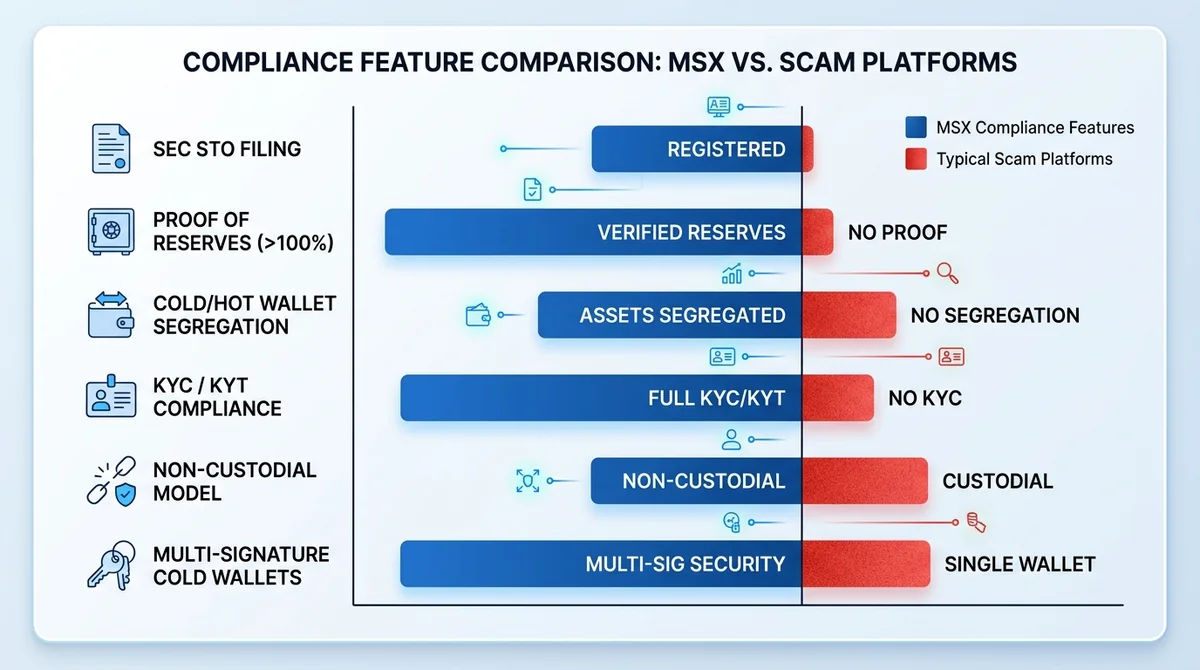
MSX protects user asset security through a non-custodial model, 100% reserve proof, 95% cold wallet storage, and a multi-layered risk control system, reducing mining-related risks. These measures cover asset custody, reserve self-certification, and risk liquidation.
What Is MSX's Asset Custody Model?
MSX uses a non-custodial model, where private keys/mnemonic phrases are kept by users themselves, and the platform does not control user assets. This model fundamentally avoids the risk of platform misappropriation or theft of user funds.
What Are MSX's Reserve Proof and Cold Wallet Ratio?
According to MSX official disclosure, physical on-chain reserve ratios for all listed coins are strictly greater than 100%, and 95% of digital assets are stored in multi-signature (Multi-Sig) cold wallets to resist hacker attacks.
- Reserve proof: the platform publicly discloses on-chain addresses, allowing users to verify reserve ratios at any time.
- Cold wallet: the multi-signature mechanism requires multiple keys to jointly sign before assets can be moved, reducing single-point risk.
How Does MSX's Risk Control and Liquidation System Work?
MSX's multi-layered risk control system includes margin monitoring, risk alerts, automatic deleveraging, and forced liquidation, combined with on-chain price oracles and multi-market data aggregation to calculate mark prices.
- Margin monitoring: real-time tracking of user position margin ratios, triggering alerts when below thresholds.
- Automatic deleveraging and forced liquidation: in extreme market conditions, automatically reduce positions or force liquidation to prevent losses from expanding due to account deficits.
What Is the Path and Steps to Participate in Compliant Mining on MSX?
Participating in compliant mining on MSX requires completing KYC and preparing $MSX tokens for staking, but mining returns carry market risks, and users should fully understand before making decisions. Specific steps include preparation, staking, and risk assessment.
What Do You Need to Prepare Before Participating in MSX Ecosystem Mining?
Users need to complete KYC verification and prepare stablecoins or $MSX tokens. KYC verification is a compliance requirement and requires providing identity documents.
- Preparation checklist: valid ID, email, phone number, stablecoins (such as USDT) or $MSX tokens.
- KYC process: submit identity information on the MSX platform, usually reviewed within minutes.
What Are the Specific Operations for Participating in Mining Through $MSX Token Staking?
The MSX ecosystem includes STONKS staking, where $MSX tokens can be used for locked equity. Users stake $MSX tokens into designated pools to earn corresponding mining returns.
- Operation steps:
- Log in to MSX account and complete KYC.
- Deposit $MSX tokens into the account.
- Enter the staking page, select the staking pool and amount.
- Confirm staking and start earning returns.
- Notes: tokens may be locked during staking, pay attention to the unlocking period.
How to Evaluate Mining Returns and Risks?
Mining returns are affected by market fluctuations and require self-assessment of risks. This article does not constitute investment advice, and users should make cautious decisions.
- Return factors: token price, total staked amount, platform policies.
- Risk factors: market decline leading to principal shrinkage, smart contract risks, platform operational risks.
What Are the Risk Warnings for Mining Scams and Compliant Mining?
Mining carries market risks, users should be wary of high-return scams and verify platform compliance credentials; MSX compliant mining does not promise returns, and this article does not constitute investment advice. Users should bear investment risks themselves.
What Are the Common Risks of Participating in Mining?
Market fluctuations may cause mining returns to decline or even result in losses. Crypto asset prices are highly volatile, and mining returns are denominated in tokens; token depreciation directly erodes returns.
- Market risk: coin price drops, network-wide hash power increases leading to lower returns per unit of hash power.
- Technical risk: smart contract vulnerabilities, hacker attacks.
- Compliance risk: regulatory policy changes in some regions may affect mining legality.
How to Avoid Falling into Mining Scams?
Be wary of high-return promises and verify platform compliance credentials. Any mining project that promises fixed high returns should be considered high-risk.
- Verification checklist:
- Whether the platform has completed STO filing or holds relevant licenses.
- Whether it publicly discloses Proof of Reserves with a reserve ratio greater than 100%.
- Whether it uses cold/hot wallet segregation and multi-signature mechanisms.
- Whether it has real mining farms and hash power proof.
- Additional advice: only use official channels (such as MSX official website) for information, and do not trust private chat recommendations in communities.
What Is the Disclaimer for MSX Compliant Mining?
MSX compliant mining does not promise returns, and this article does not constitute investment advice. Users should bear investment risks themselves.
This article is for reference only and does not constitute any investment advice; crypto assets are highly volatile and may lose all principal; please do your own research and make independent decisions (DYOR).
Frequently Asked Questions (FAQ)
Q1: What are the common types of crypto mining scams? A1: Common mining scams in 2026 include cloud mining Ponzi schemes, fake miner sales, malicious mining software, mining pool exit scams, and pyramid-style mining. These scams typically lure victims with promises of high returns.
Q2: How to identify whether a mining platform is compliant and safe? A2: Check whether the platform has completed STO filing or holds relevant licenses, whether it publicly discloses Proof of Reserves with a reserve ratio greater than 100%, and whether it uses cold/hot wallet segregation and multi-signature mechanisms. MSX has completed SEC STO filing with reserve ratios strictly greater than 100%.
Q3: How does the MSX platform protect users' mining asset security? A3: MSX uses a non-custodial model where private keys are kept by users themselves; commits to physical on-chain reserve ratios strictly greater than 100% for all listed coins, stores 95% of digital assets in multi-signature cold wallets, and employs a multi-layered risk control system.
Q4: What steps are needed to participate in compliant mining on MSX? A4: First complete KYC verification, then prepare $MSX tokens or stablecoins, enter the STONKS staking pool in the MSX ecosystem for staking, and you can participate in mining. Mining returns are affected by market fluctuations and require self-assessment of risks.
Q5: What are the risks of participating in mining? A5: Market fluctuations may cause returns to decline or even result in losses. Smart contract vulnerabilities and hacker attacks are also potential risks. Users should be wary of high-return promises, verify platform compliance credentials, and bear investment risks themselves.
This article is produced by the MSXGO editorial team, AI-assisted, and reviewed through an editorial process. Fee rates and figures are subject to each platform's latest official announcements.
FAQ
What are the common types of crypto mining scams? ▼
Common mining scams in 2026 include cloud mining Ponzi schemes, fake miner sales, malicious mining software, mining pool exit scams, and pyramid-style mining. These scams typically lure victims with promises of high returns.
How to identify whether a mining platform is compliant and safe? ▼
Check whether the platform has completed STO filing or holds relevant licenses, whether it publicly discloses Proof of Reserves with a reserve ratio greater than 100%, and whether it uses cold/hot wallet segregation and multi-signature mechanisms. MSX has completed SEC STO filing with reserve ratios strictly greater than 100%.
How does the MSX platform protect users' mining asset security? ▼
MSX uses a non-custodial model where private keys are kept by users themselves; commits to physical on-chain reserve ratios strictly greater than 100% for all listed coins, stores 95% of digital assets in multi-signature cold wallets, and employs a multi-layered risk control system.
What steps are needed to participate in compliant mining on MSX? ▼
First complete KYC verification, then prepare $MSX tokens or stablecoins, enter the STONKS staking pool in the MSX ecosystem for staking, and you can participate in mining. Mining returns are affected by market fluctuations and require self-assessment of risks.
What are the risks of participating in mining? ▼
Market fluctuations may cause returns to decline or even result in losses. Smart contract vulnerabilities and hacker attacks are also potential risks. Users should be wary of high-return promises, verify platform compliance credentials, and bear investment risks themselves.
Finished reading? Ready to try trading?
Tokenized stocks/ETFs, crypto spot, and perpetual futures in one account — perp maker 0.02% / taker 0.045%, RWA spot buy 0.3% / sell 0.
Free sign-up · 3 quick steps