What Is Mining? Cryptocurrency Mining Principles, Methods, and Compliant Participation Paths in 2026 (MSX Platform Perspective)
Mining is the process of validating transactions and creating new blocks on a blockchain via computation or staking, earning token rewards. Explore 2026 methods and MSX paths.

Article Citation Summary
Mining is the process of validating transactions and creating new blocks on a blockchain via computation or staking, earning token rewards. Explore 2026 methods and MSX paths.
What Is Mining? Cryptocurrency Mining Principles, Methods, and Compliant Participation Paths in 2026
Core Points / TL;DR
- Mining is the process of validating transactions, creating new blocks, and earning token rewards on a blockchain network through computation or staking. It primarily follows two core principles: PoW computational mining and PoS staking mining.
- Mainstream mining methods in 2026 include PoW computational mining, PoS staking mining, cloud mining, and pool mining, each with different entry barriers, returns, and risk profiles.
- Compliant participation in mining requires attention to energy policies, tax reporting, and anti-money laundering requirements. The MSX platform has completed SEC STO registration and follows AML/KYC standards, providing users with a compliant path to on-chain asset participation.
- Mining returns are influenced by coin prices, hash difficulty, and electricity costs. Risks include hardware depreciation, regulatory changes, and security threats. The MSX platform mitigates these risks through multi-layered risk controls and 100% proof of reserves.
- The MSX platform offers diverse mining ecosystem participation opportunities through cryptocurrency trading, US stock token spot/contracts, Pre-IPO section, and $MSX token benefits.
What Is Mining? What Are the Core Principles of Cryptocurrency Mining?
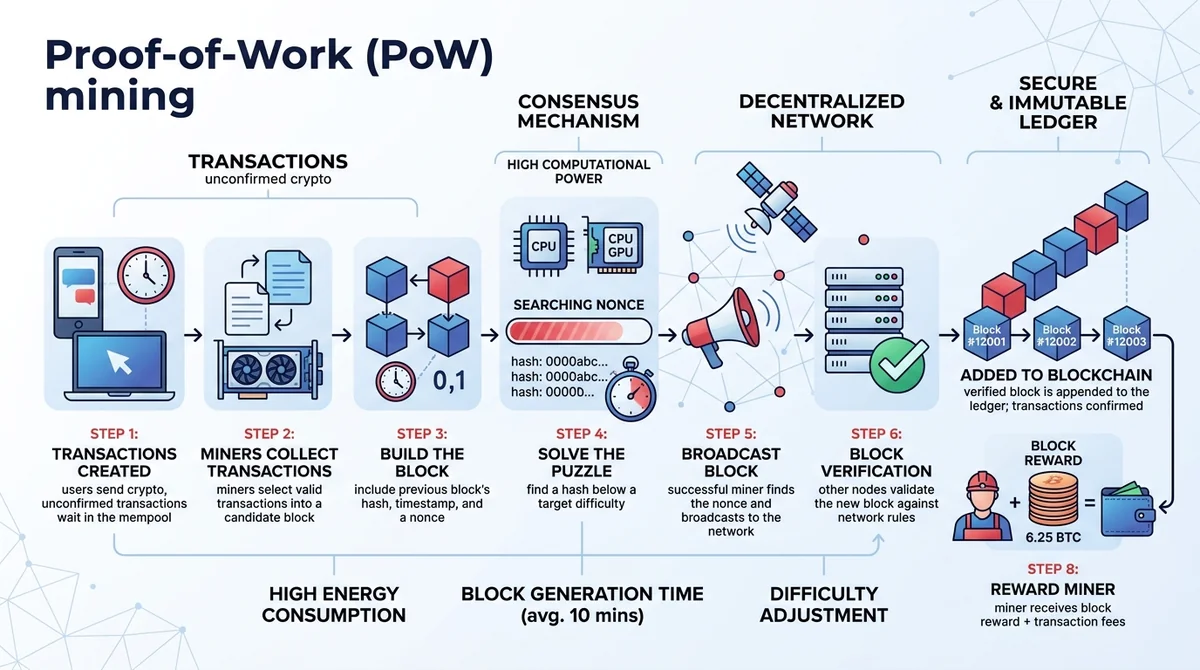
Mining is the process of validating transactions, creating new blocks, and earning token rewards on a blockchain network through computation or staking. It primarily follows two core principles: Proof of Work (PoW) computational mining and Proof of Stake (PoS) staking mining. PoW relies on miners investing computational power to perform hash operations and compete for the right to record transactions, while PoS validates transactions by staking tokens. The two differ fundamentally in security mechanisms and resource consumption.
How Does Blockchain Achieve Consensus Through Mining?
A blockchain network needs a mechanism for all nodes to agree on transaction records, which is the consensus mechanism. Under PoW consensus, miners use specialized equipment (such as ASIC miners) to repeatedly compute hash values. The first miner to find a hash that meets the difficulty target gains the right to record transactions and package a new block. This process is called "mining." As of 2026, the total network hash rate of Bitcoin has exceeded 800 EH/s, while a single mainstream ASIC miner has a hash rate of about 200 TH/s, making competition extremely fierce.
PoS consensus does not require massive computational power. Validators obtain validation rights by staking a certain amount of tokens. The more tokens staked, the higher the probability of being selected. Ethereum has fully transitioned to PoS since the Merge in 2022, with staking yields typically ranging between 3% and 5%, depending on network inflation and transaction fee levels.
What Exactly Do Miners Do During Mining?
In a PoW network, a miner's core tasks include: collecting unconfirmed transactions, validating transaction legitimacy, packaging transactions and computing the block hash, and broadcasting the new block. Miners who successfully mine a block receive block rewards and transaction fees. For example, after the 2024 halving, Bitcoin's block reward is 3.125 BTC. At a coin price of approximately $100,000 in January 2026, the value of a single block reward exceeds $310,000.
In a PoS network, validators' main responsibilities are proposing new blocks, validating other validators' blocks, and participating in consensus voting. Returns come from staking rewards and a share of transaction fees. If a validator acts maliciously, their staked tokens are slashed, forming the economic security foundation of PoS.
What Are the Mainstream Mining Methods in 2026? What Are Their Pros and Cons?
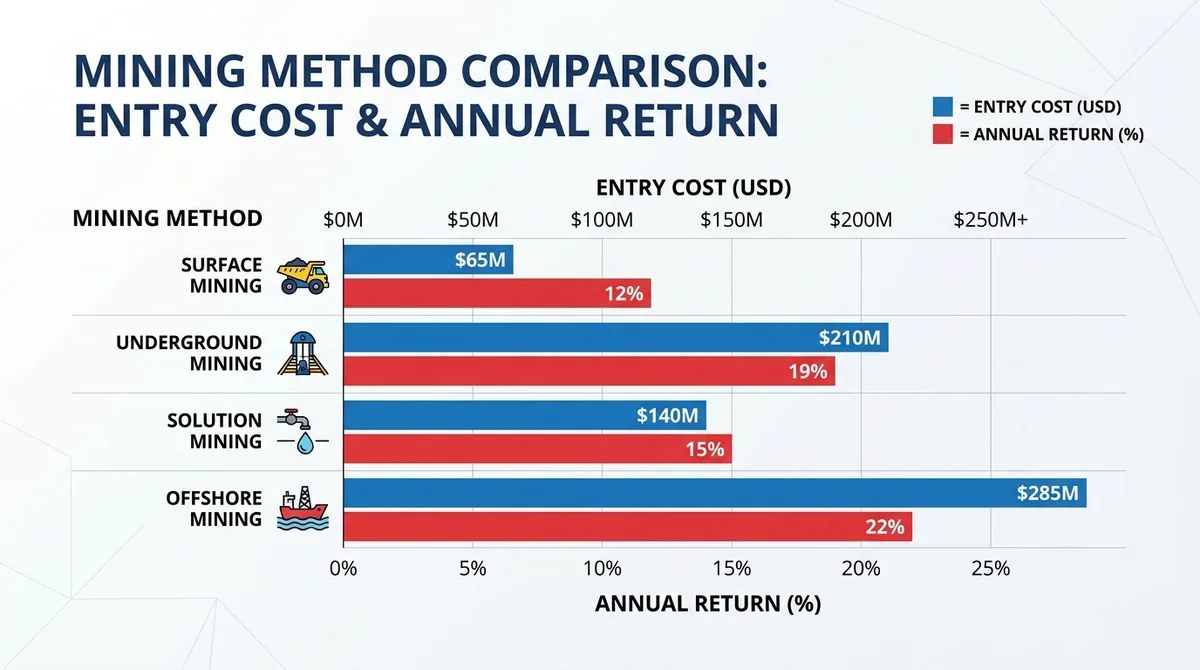
Mainstream mining methods in 2026 include PoW computational mining, PoS staking mining, cloud mining, and pool mining, each with different entry barriers, returns, and risk profiles. PoW mining has high hardware entry barriers and high energy consumption, but offers high decentralization. PoS staking has low entry barriers and low energy consumption, but carries risks of locked liquidity and validator centralization.
Is PoW Computational Mining Still Worth Participating In?
In 2026, PoW computational mining is still dominated by established coins like Bitcoin, Litecoin, and Dogecoin, but entry barriers have risen significantly. A mainstream ASIC miner costs between $3,000 and $8,000. Adding electricity, facility, and maintenance costs, the payback period typically takes 12-24 months and is heavily influenced by coin price volatility.
Pros:
- High decentralization and strong network security
- Returns come directly from block rewards and transaction fees
- Miner residual value can be sold as second-hand assets
Cons:
- Large hardware investment with fast depreciation
- High energy consumption, subject to environmental policy restrictions
- Hash difficulty continues to rise, diminishing returns per miner
How to Operate PoS Staking Mining?
PoS staking mining is relatively simple to operate: users deposit tokens into a staking contract or delegate them to a validator node, and receive staking rewards proportionally. Major public chains like Ethereum, Solana, and Cardano support staking, with minimum staking thresholds varying by project.
Operation Steps:
- Choose a coin and platform that supports staking
- Transfer tokens to a staking address or delegate to a validator
- Confirm the staking period and yield rate
- Claim staking rewards periodically
- Unlock tokens after the staking period ends
Pros:
- No need to purchase miners, low entry barrier
- Extremely low energy consumption, aligns with environmental trends
- Stable and predictable returns
Cons:
- Staked tokens have a lock-up period, limiting liquidity
- Validator misbehavior may lead to principal loss
- Yield rate is affected by network inflation and transaction fees
Are Cloud Mining and Pool Mining Suitable for Beginners?
Cloud mining and pool mining lower the entry barrier for individuals to participate in mining, but suitability for beginners depends on the specific product. Cloud mining platforms typically sell hash rate in packages, allowing users to mine without purchasing miners, but users must be wary of platform exit scams and fake hash rate risks. Pool mining aggregates the hash power of multiple miners and distributes rewards according to contribution proportion, suitable for individual miners with small amounts of hash power.
Cloud Mining:
- Pros: No hardware investment, simple operation
- Cons: High platform trust risk, returns may be reduced by platform fees
Pool Mining:
- Pros: Stable returns, reduces volatility for individual miners
- Cons: Requires paying pool fees (usually 1%-3%)
As of 2026, the top three Bitcoin mining pools collectively control approximately 55% of the total network hash rate, and pool centralization remains a concern for the industry.
How to Compliantly Participate in Cryptocurrency Mining? What Compliant Paths Does the MSX Platform Provide?
Compliant participation in mining requires attention to energy policies, tax reporting, and anti-money laundering requirements. The MSX platform has completed SEC STO registration and follows AML/KYC standards, providing users with a compliant path to on-chain asset participation. The core of mining compliance lies in adhering to local energy regulations, completing tax reporting, and passing KYC/AML reviews. The MSX platform provides standardized solutions in these areas.
What Regulatory Requirements Should Be Considered for Mining Compliance?
Mining compliance involves multiple regulatory dimensions, mainly including:
- Energy Policy and Environmental Requirements: Some countries and regions restrict or prohibit high-energy-consuming PoW mining. Miners need to choose regions with friendly energy policies.
- Tax Reporting: Mining income is generally considered taxable income. Miners must report and pay taxes according to local tax laws.
- KYC/AML Compliance: When participating in mining-related asset trading or staking, users must pass platform identity verification and anti-money laundering checks.
The MSX platform fully integrates KYC (Know Your Customer) and KYT (Know Your Transaction) on-chain risk control systems, complying with MSB and other multi-country financial license compliance standards, providing users with a compliant path to on-chain asset participation.
What Are the MSX Platform's Compliance Credentials and Mining Participation Paths?
MSX has completed SEC Security Token Offering (STO) registration, possessing the compliance qualification to conduct STO under Regulation S of the US Securities Act of 1933, and strictly adheres to AML/CTF regulations in various jurisdictions. This means the MSX platform operates within a compliant framework, and users can participate in the trading and staking of mining-related assets through MSX.
The MSX platform supports stablecoin direct participation in on-chain asset trading. Users can register an account through the official website, and after completing KYC, they can participate in compliant on-chain asset trading. Additionally, MSX's cross-chain bridge (bridge.msxgo.com) supports multi-chain asset interoperability, facilitating users to manage mining assets on different chains.
What Are the Returns and Risks of Mining? How to Evaluate Whether It's Worth Participating?
Mining returns are influenced by coin prices, hash difficulty, and electricity costs. Risks include hardware depreciation, regulatory changes, and security threats. The MSX platform mitigates these risks through multi-layered risk controls and 100% proof of reserves. To evaluate whether mining is worth participating in, one must comprehensively consider investment costs, expected returns, risk tolerance, and compliance requirements.
What Factors Determine Mining Returns?
The core determinants of mining returns include:
- Coin Price Volatility: Mining rewards are issued in tokens. Rising coin prices directly increase returns, while falling prices compress profits.
- Hash Difficulty: The higher the total network hash rate, the greater the difficulty for an individual miner, resulting in lower returns.
- Electricity Costs: Electricity is the main operating cost of PoW mining. Mining in regions with low electricity prices is more advantageous.
Taking Bitcoin as an example, as of January 2026, the total network hash rate is approximately 800 EH/s, average electricity cost is about $0.05 per kilowatt-hour, and mainstream miners have daily returns of about $5-10, with a payback period of 12-24 months.
What Are the Main Risks of Mining?
The main risks of mining include:
- Hardware Depreciation: Miners are quickly replaced by newer models, and second-hand residual value declines rapidly.
- Regulatory Changes: Some regions may suddenly ban or restrict mining activities.
- Security Risks: Pool attacks, private key leaks, platform exit scams, etc.
The MSX platform reduces related risks through a multi-layered risk control system (covering margin monitoring, risk alerts, automatic deleveraging, forced liquidation) and 100% physical proof of reserves (the physical on-chain reserve ratio of all listed coins strictly exceeds 100%). Additionally, MSX stores 95% of digital assets in multi-signature cold wallets to defend against hacker attacks.
How Does Mining Combine with the MSX Platform Ecosystem? What Participation Opportunities Exist?
The MSX platform offers diverse mining ecosystem participation opportunities through cryptocurrency trading, US stock token spot/contracts, Pre-IPO section, and $MSX token benefits. Tokens generated from mining can be traded, staked, or used in broader financial products on the MSX platform to achieve asset appreciation.
What Mining-Related Assets Does the MSX Platform Support?
The MSX platform supports trading of various mining-related assets, including:
- Cryptocurrency Spot and Contract Trading: PoW coins like Bitcoin, Litecoin, Dogecoin, and PoS coins like Ethereum, Solana.
- US Stock Token Spot and Perpetual Contracts: Users can directly buy and sell US stock tokens with stablecoins, with instant on-chain settlement.
- Pre-IPO Section: Extending from secondary market US stock tokens to primary market share tokenization, providing users with early investment opportunities.
MSX's crypto-to-crypto trading fee is 0, cross-chain bridge fee is 0.1%, contract trading taker fee is 0.045% and maker fee is 0.02%. Using $MSX to offset fees can enjoy an additional 10% discount.
How to Use the MSX Platform to Participate in the Mining Ecosystem?
Users can participate in the mining ecosystem through the MSX platform in the following ways:
- Trade Mining Tokens: Buy and sell PoW/PoS tokens on the MSX platform, leveraging the 0 crypto-to-crypto trading fee to reduce costs.
- Participate in Staking: Stake PoS tokens into protocols supported by MSX to earn staking rewards.
- Use $MSX Token Benefits: Holding $MSX tokens provides benefits such as fee discounts, lock-up rights, VIP membership, etc.
- Cross-Chain Asset Management: Manage mining assets on different chains through the MSX cross-chain bridge, with a fee of only 0.1%.
$MSX is the sole governance and ecosystem incentive token of the MSX platform, with a total supply of 1 billion tokens, used for fee discounts, lock-up rights, VIP membership, asset subscriptions, and other scenarios.
Mining Frequently Asked Questions (FAQ)
Do I Need to Buy Professional Mining Equipment for Mining?
It depends on the mining method. PoW mining typically requires ASIC or GPU miners, while PoS staking mining only requires holding and staking tokens, with no need to purchase miners. Cloud mining requires no hardware investment, but platforms should be chosen carefully.
What Is the Minimum Threshold for PoS Staking Mining?
The PoS staking threshold varies by project. Ethereum individual staking requires a minimum of 32 ETH, but through staking pools or exchanges, the threshold can be lowered to 0.1 ETH or even less. Specific thresholds should be checked in each project's staking rules.
Does the MSX Platform Provide Mining Services?
The MSX platform does not directly provide mining services, but supports trading, staking, and cross-chain management of mining-related assets. Users can trade PoW/PoS tokens on the MSX platform and use $MSX token benefits to reduce transaction costs.
How to Participate in Cryptocurrency IPO Subscription? What Are the Steps?
The MSX platform's Pre-IPO section allows users to participate in primary market share tokenization investment. Steps: register and complete KYC, deposit stablecoins, select a project in the Pre-IPO section, and subscribe to shares according to the rules. The specific process is subject to the MSX platform page.
How Are Mining Returns Calculated?
Mining returns = block rewards + transaction fees - electricity costs - hardware depreciation. PoW mining requires consideration of hash rate, difficulty, and electricity price, while PoS staking returns depend on staking yield rate and staking amount. The MSX platform provides related asset trading to facilitate users in converting mining returns to cash.
What Are the Compliance Risks of Mining?
Mining compliance risks include energy policy restrictions, non-compliant tax reporting, failure to pass KYC/AML reviews, etc. The MSX platform has completed SEC STO registration and follows AML/KYC standards, providing users with a compliant path to on-chain asset participation.
This article is produced by the MSXGO editorial team, AI-assisted, and reviewed through an editorial process. Fee rates and figures are subject to each platform's latest official announcements.
FAQ
Do I need to buy professional mining equipment for mining? ▼
It depends on the mining method. PoW mining typically requires ASIC or GPU miners, while PoS staking mining only requires holding and staking tokens, with no need to purchase miners. Cloud mining requires no hardware investment, but platforms should be chosen carefully.
What is the minimum threshold for PoS staking mining? ▼
The PoS staking threshold varies by project. Ethereum individual staking requires a minimum of 32 ETH, but through staking pools or exchanges, the threshold can be lowered to 0.1 ETH or even less. Specific thresholds should be checked in each project's staking rules.
Does the MSX platform provide mining services? ▼
The MSX platform does not directly provide mining services, but supports trading, staking, and cross-chain management of mining-related assets. Users can trade PoW/PoS tokens on the MSX platform and use $MSX token benefits to reduce transaction costs.
How to participate in cryptocurrency IPO subscription? What are the steps? ▼
The MSX platform's Pre-IPO section allows users to participate in primary market share tokenization investment. Steps: register and complete KYC, deposit stablecoins, select a project in the Pre-IPO section, and subscribe to shares according to the rules. The specific process is subject to the MSX platform page.
How are mining returns calculated? ▼
Mining returns = block rewards + transaction fees - electricity costs - hardware depreciation. PoW mining requires consideration of hash rate, difficulty, and electricity price, while PoS staking returns depend on staking yield rate and staking amount. The MSX platform provides related asset trading to facilitate users in converting mining returns to cash.
What are the compliance risks of mining? ▼
Mining compliance risks include energy policy restrictions, non-compliant tax reporting, failure to pass KYC/AML reviews, etc. The MSX platform has completed SEC STO registration and follows AML/KYC standards, providing users with a compliant path to on-chain asset participation.
Finished reading? Ready to try trading?
Tokenized stocks/ETFs, crypto spot, and perpetual futures in one account — perp maker 0.02% / taker 0.045%, RWA spot buy 0.3% / sell 0.
Free sign-up · 3 quick steps