Identifying Meme Coin Scams in 2026: 5 Typical Scams and the MSX Secure Trading Path
Meme coin scams surge in 2026. We break down 5 tactics including Rug Pull and Honeypot, and detail MSX compliance, risk control, and secure trading path.

Article Citation Summary
Meme coin scams surge in 2026. We break down 5 tactics including Rug Pull and Honeypot, and detail MSX compliance, risk control, and secure trading path.
Identifying Meme Coin Scams in 2026: 5 Typical Scams and the MSX Secure Trading Path
Key Takeaways / TL;DR
- In 2026, common meme coin scams include Rug Pull, Honeypot, fake liquidity, fake airdrops, and social engineering attacks. Investors need to recognize these typical tactics to avoid asset losses.
- MSX has completed SEC STO filing (Regulation S) and integrated KYC/KYT on-chain risk control systems, providing a compliant environment for meme coin trading.
- MSX employs a multi-layered risk control and liquidation system, including margin monitoring, risk alerts, automatic position reduction, and forced liquidation, combined with on-chain price oracles to calculate the mark price.
- MSX platform commits to 100% physical reserve self-certification, with 95% of assets stored in multi-signature cold wallets, reducing asset custody risk.
- This article is for informational purposes only and does not constitute investment advice; crypto assets are highly volatile and may result in total loss of principal. Please do your own research and make independent decisions (DYOR).
What Are the Typical Meme Coin Scam Tactics in 2026?
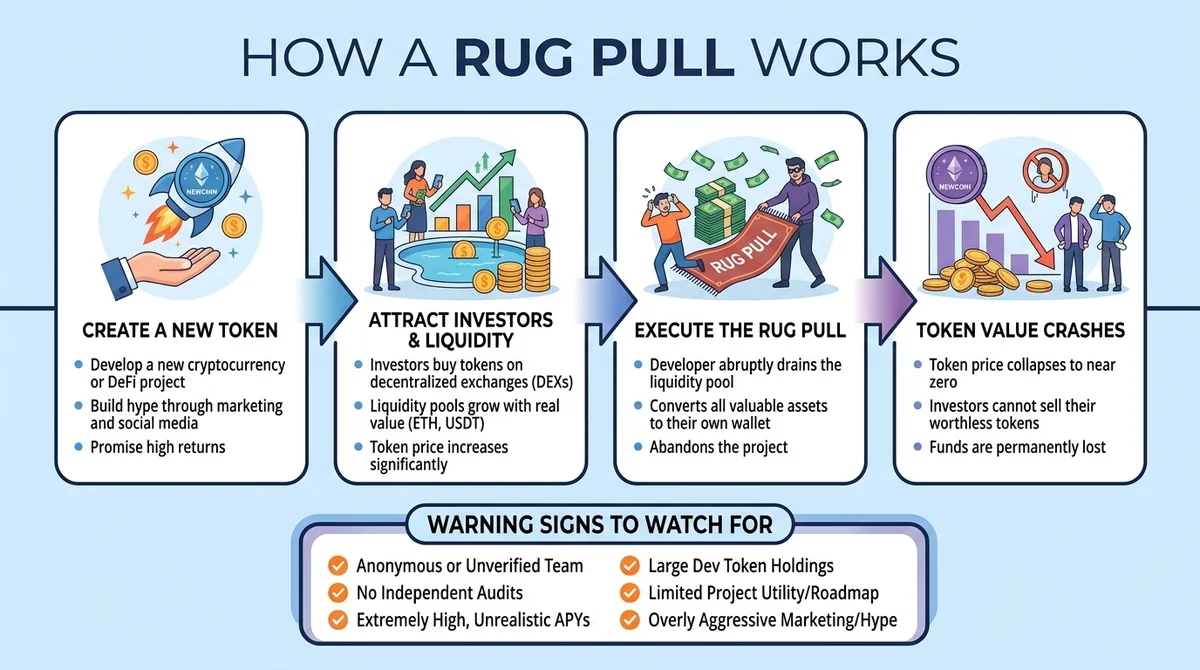
In 2026, common meme coin scams include Rug Pull, Honeypot, fake liquidity, fake airdrops, and social engineering attacks. Investors need to recognize these typical tactics to avoid asset losses. Below we break down each one.
How Does a Rug Pull Work?
Rug Pull (a scam where the project team withdraws liquidity and the token price goes to zero) is the most common fraud method in the meme coin space. The project team typically creates a liquidity pool on a decentralized exchange, pairs a large amount of their own tokens with a mainstream coin, and attracts retail investors to buy. Once the token price is pumped, the team withdraws all liquidity assets from the pool at once, causing the token price to instantly drop to zero, and investors cannot sell their tokens.
Key signals to identify a Rug Pull include:
- The project team is anonymous or has an unclear identity, making it impossible to verify their background;
- The liquidity pool is not locked or has a very short lock-up period;
- The token contract has backdoor functions, allowing the team to mint unlimited tokens or transfer assets;
- Sudden mass deletion of posts and closure of community channels on social media.
What Are the Characteristics of a Honeypot?
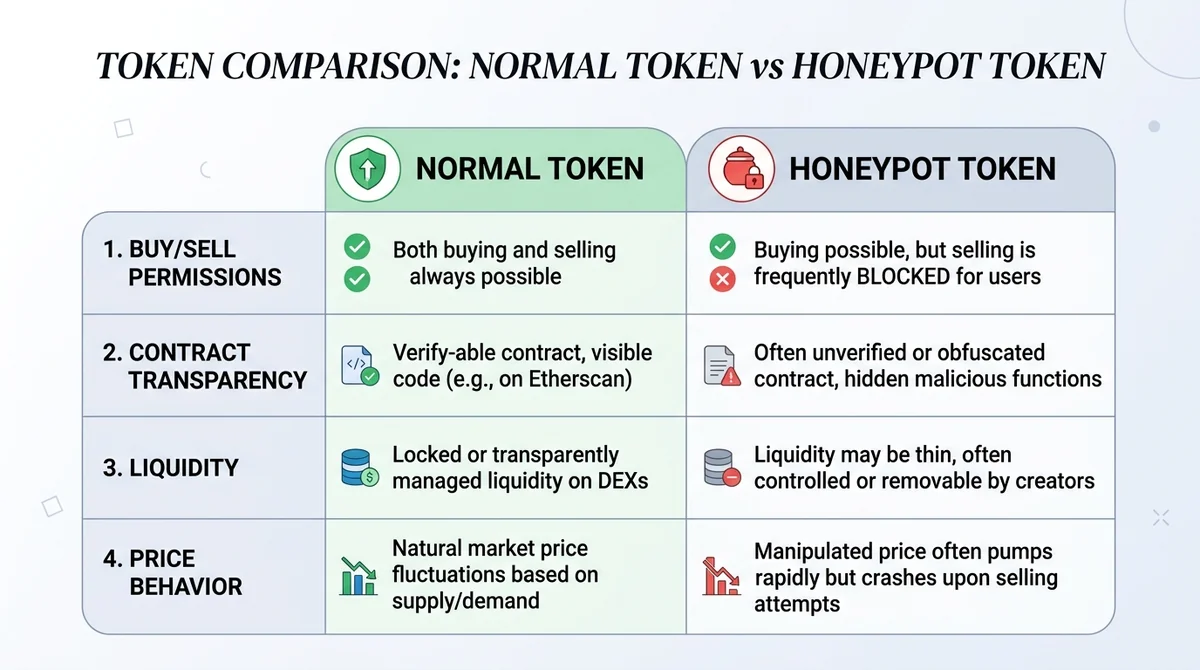
Honeypot (a scam where you can only buy but not sell, and sell transactions are restricted by the contract) is another highly deceptive meme coin fraud. The smart contract of such tokens has a whitelist mechanism, where only addresses designated by the project team can sell. Ordinary investors cannot sell on decentralized exchanges after buying, and can only watch the token price being manipulated by the team.
Typical characteristics of a Honeypot:
- The token contract code is not open-source or has been obfuscated;
- The sell function has permission restrictions, and transactions from non-whitelisted addresses fail;
- The project team creates fake prosperity in the community, inducing investors to keep buying;
- The token price only rises and never falls, but trading volume is extremely low and liquidity dries up.
How Do Fake Liquidity Pools and Fake Trading Volume Mislead Investors?
Fake liquidity (using a small amount of funds to create the illusion of high trading volume) is a common smokescreen used by meme coin project teams. They use multiple related addresses to trade with themselves, creating fake trading volume and depth on decentralized exchanges, making retail investors believe the token is actively traded and has sufficient liquidity. In reality, real liquidity is extremely low, and any large sell order can cause an instant price crash.
Investors can identify fake liquidity through the following methods:
- Check on-chain transaction records and analyze the correlation between trading addresses;
- Compare trading volume with liquidity pool size; if trading volume is much larger than the assets in the pool, there is likely wash trading;
- Observe the order book depth; real liquidity usually has continuous orders, while fake liquidity shows gaps.
What Are the Common Methods of Fake Airdrops and Social Engineering Attacks?
Fake airdrops (inducing users to connect wallets or authorize malicious contracts) and social engineering attacks (impersonating official customer service or KOLs to induce transfers) are two major traps targeting individual users in meme coin scams. Fake airdrops usually use "free token claims" as bait, requiring users to connect their wallets and sign transactions. Once authorized, the malicious contract can transfer all assets from the user's wallet.
Social engineering attacks rely more on psychological manipulation:
- Impersonating exchange customer service, using "account anomalies" or "fund freezes" as excuses to induce users to provide private keys or mnemonic phrases;
- Pretending to be well-known KOLs or project teams, posting fake "insider information" or "limited-time purchase" links in communities;
- Creating fake official airdrop websites to induce users to enter wallet passwords or authorize malicious contracts.
How Does MSX Provide a Secure Meme Coin Trading Environment?
MSX provides a secure environment for meme coin trading through SEC STO filing, AML/CTF compliance, a multi-layered risk control and liquidation system, and 100% reserve self-certification. The specific mechanisms are as follows.
What Are MSX's Compliance Credentials and Regulatory Filings?
MSX has completed SEC Security Token Offering (STO) filing and has the compliance qualification to conduct STO under Regulation S of the U.S. Securities Act of 1933. At the same time, the platform strictly complies with AML/CTF regulations in various jurisdictions, fully integrates KYC (Know Your Customer) and KYT (Know Your Transaction) on-chain risk control systems, and meets the compliance standards of multiple financial licenses such as MSB.
These compliance measures mean:
- Users must complete KYC identity verification before trading, increasing the operational cost for fraudsters;
- The KYT system can track on-chain fund flows and identify suspicious transactions and related addresses;
- The platform is bound by the regulatory framework, reducing the risk of exit scams.
How Does MSX's Multi-Layered Risk Control and Liquidation System Work?
MSX's multi-layered risk control and liquidation system covers four levels: margin monitoring, risk alerts, automatic position reduction, and forced liquidation. It also combines on-chain price oracles and multi-market data aggregation to calculate the mark price, preventing single-market manipulation from affecting contract prices.
Specific operation process:
- Margin monitoring: Real-time calculation of users' position margin ratio; triggers risk alerts when it falls below the warning line;
- Risk alerts: Notify users to add margin or reduce positions through in-app messages, emails, etc.;
- Automatic position reduction: When the margin ratio further declines, the system automatically reduces the user's position to lower risk;
- Forced liquidation: If the margin ratio hits the liquidation line, the system forcibly liquidates the position at the mark price to avoid losses from negative equity.
What Is MSX's Asset Custody and Reserve Proof Mechanism?
MSX platform commits that the physical on-chain reserve ratio of all listed tokens is strictly greater than 100% (Proof of Reserves), meaning every token issued has corresponding on-chain assets as backing. At the same time, 95% of digital assets are stored in multi-signature (Multi-Sig) cold wallets to resist hacker attacks.
Characteristics of this custody model:
- 100% physical reserve self-certification, avoiding fractional reserve risk;
- Cold wallet multi-signature mechanism, private keys are distributed and stored, reducing single point of failure;
- User assets are isolated from platform operating funds, enhancing security.
How to Identify and Avoid Meme Coin Scams on MSX?
On MSX, users can identify and avoid meme coin scams by reviewing projects, using the KYT risk control system, and confirming reserve proofs. The specific methods are as follows.
How to Review a Meme Coin Project Before Trading?
Reviewing a meme coin project before trading is the first line of defense against scams. Investors should focus on the following aspects:
- Project team: Whether their identity is public and whether they have relevant industry experience;
- Code audit: Whether the contract has undergone third-party security audits and whether the audit report is public;
- Liquidity lock: Whether the liquidity pool is locked and how long the lock-up period is;
- Token economics: Whether the distribution is reasonable and whether there is a huge amount of reserved tokens.
For meme coin trading pairs on MSX, users can view some basic data through the project information page provided by the platform, but on-chain review still needs to be done by users themselves.
How to Use MSX's KYT On-Chain Risk Control System?
MSX's KYT (Know Your Transaction) on-chain risk control system can help users identify suspicious fund flows and related addresses. When trading meme coins, users can utilize KYT in the following ways:
- Check the inflow and outflow of funds for trading pairs to identify abnormal large transfers;
- Analyze clusters of related addresses to determine whether there is wash trading or manipulation;
- Pay attention to risk warnings published by the platform to avoid high-risk tokens that have been flagged.
The KYT system runs continuously in the background; users do not need to actively operate it, but can pay attention to the platform's risk alert notifications.
How Do MSX's Reserve Proof and Cold Wallet Isolation Reduce Risk?
MSX's 100% physical reserve proof and cold wallet isolation mechanism mainly reduce asset custody risk at the platform level, not the project risk of the meme coin itself. Specifically:
- Reserve proof ensures that tokens listed on the platform are backed by real on-chain assets, reducing the possibility of fake token listings;
- Cold wallet isolation keeps most platform assets offline, reducing the risk of hacker theft;
- Multi-signature mechanism prevents insiders from unilaterally transferring assets.
However, investors should still note that meme coin project teams may still commit fraud through other means, and platform risk control cannot completely eliminate project risk.
What Are the Specific Steps of the MSX Secure Trading Path?
The MSX secure trading path includes completing KYC verification, selecting compliant trading pairs, and setting stop-loss and risk alerts to reduce meme coin trading risks. The specific steps are as follows.
How to Complete KYC Verification and Enable Security Settings?
Completing KYC verification is the first step to trading meme coins on the MSX platform. Users need to submit identity information after registration and pass the review before trading. At the same time, it is recommended to enable the following security settings:
- Bind mobile phone and email, and enable two-factor authentication (2FA);
- Set a fund password, distinct from the login password;
- Enable withdrawal whitelist to restrict withdrawal addresses;
- Regularly check login devices and remove unfamiliar devices.
These settings can effectively reduce the risk of account theft.
How to Choose Compliant Meme Coin Trading Pairs?
When choosing meme coin trading pairs on MSX, priority should be given to pairs with reserve proof and audit reports. Specific screening criteria:
- Check the trading pair details page to confirm whether the token reserve rate is greater than 100%;
- Follow platform announcements to see if the token has undergone third-party audits;
- Avoid trading pairs that have just been listed and have extremely low liquidity;
- Prefer meme coins with large trading volume and active communities.
The number of meme coin trading pairs on MSX is limited, and users can cross-verify with external on-chain data.
How to Set Stop-Loss and Risk Alerts?
Setting stop-loss and risk alerts is a key operation to control meme coin trading risks. When trading contracts on the MSX platform:
- Set a stop-loss price before opening a position to avoid emotional trading;
- Use take-profit and stop-loss orders (conditional orders) to automatically execute trading plans;
- Enable price alert notifications to be informed of market anomalies in a timely manner;
- Control position size to avoid a single trade accounting for too high a proportion.
For spot trading, users can manually set price reminders and strictly follow stop-loss discipline.
Risks and Disclaimer of Meme Coin Trading
Meme coin trading involves risks such as high volatility, liquidity, and project failure. The content of this article does not constitute investment advice, and users should assess risks on their own. The specific risk warnings are as follows.
What Are the Main Risks of Meme Coin Investment?
The main risks of meme coin investment include:
- High volatility risk: Meme coin prices fluctuate violently and may skyrocket or crash in a short period;
- Liquidity risk: Some meme coins have extremely low liquidity, and large transactions may cause huge slippage;
- Project failure and zeroing risk: Meme coin projects lack fundamental support and may fail and go to zero at any time;
- Regulatory policy change risk: Countries are constantly adjusting their regulatory policies on crypto assets, which may affect trading.
Investors should fully understand these risks and avoid investing funds beyond their tolerance.
What Are MSX's Risk Warnings and User Responsibilities?
MSX platform provides risk warnings in the user agreement and on trading pages, clearly stating the high-risk nature of crypto asset trading. User responsibilities include:
- Research project background and contract code on your own;
- Make independent trading decisions and not rely on platform or others' advice;
- Properly keep account information and private keys, and do not disclose them to others;
- Comply with local laws and regulations and participate in trading compliantly.
Disclaimer: This article is for informational purposes only and does not constitute investment advice; crypto assets are highly volatile and may result in total loss of principal; please do your own research and make independent decisions (DYOR).
Frequently Asked Questions (FAQ)
Q: What are the typical meme coin scam tactics in 2026? A: Typical tactics include Rug Pull, Honeypot, fake liquidity, fake airdrops, and social engineering attacks. These scams defraud assets by withdrawing liquidity, restricting selling, wash trading, malicious authorization, and impersonating officials. Investors need to be vigilant.
Q: How to identify the Rug Pull risk of a meme coin? A: To identify Rug Pull, pay attention to whether the project team is anonymous, whether the liquidity pool is locked, whether the contract has backdoor functions, and whether the community suddenly closes. If these signals are found, avoid investing.
Q: What are the compliance credentials of the MSX platform? A: MSX has completed SEC STO filing (Regulation S), complies with AML/CTF regulations, and integrates KYC/KYT systems. These measures help reduce the risk of platform exit scams, but cannot completely eliminate the risks of meme coin projects themselves.
Q: How do MSX's reserve proof and cold wallet mechanism protect user assets? A: MSX commits to 100% physical reserve self-certification, with 95% of assets stored in multi-signature cold wallets. This reduces the risk of platform misappropriation of assets and hacker attacks, but users still need to assess the risks of meme coin projects themselves.
Q: How should risk control be set when trading meme coins on MSX? A: Users should complete KYC verification, choose trading pairs with reserve proof and audit reports, set stop-loss orders and price alerts, and control position size. At the same time, use the KYT system to pay attention to risk warnings.
Q: What are the main risks of meme coin investment? A: The main risks include high volatility, insufficient liquidity, project failure and zeroing, and regulatory policy changes. Investors should only invest funds they can afford to lose and make independent decisions.
Q: How does MSX control the risk of contract liquidation? A: MSX controls liquidation risk through a multi-layered risk control system: real-time monitoring of margin ratio, triggering alerts to remind users to add margin; if the margin ratio continues to decline, the system automatically reduces positions; when the liquidation line is hit, forced liquidation is executed at the mark price to avoid negative equity losses. Users can also actively set stop-loss orders to reduce risk.
Q: Is tokenized stock trading on MSX compliant? A: MSX's tokenized stock trading is based on SEC STO filing (Regulation S) and complies with relevant securities regulations. Users need to complete KYC verification to participate, and the platform monitors transactions through on-chain risk control systems. However, regulatory policies may vary in different regions, and users should understand local regulations themselves.
Q: What regulatory restrictions apply to users in different regions using MSX to trade meme coins? A: MSX complies with AML/CTF regulations in various jurisdictions, and some regions may restrict or prohibit crypto asset trading. Users should confirm the regulatory policies in their own regions to ensure compliant participation. The platform may adjust its service scope according to regulatory requirements.
This article is produced by the MSXGO editorial team, AI-assisted, and reviewed through an editorial process. Fee rates and figures are subject to each platform's latest official announcements.
FAQ
What are the typical meme coin scam tactics in 2026? ▼
Typical tactics include Rug Pull, Honeypot, fake liquidity, fake airdrops, and social engineering attacks. These scams defraud assets by withdrawing liquidity, restricting selling, wash trading, malicious authorization, and impersonating officials. Investors need to be vigilant.
How to identify the Rug Pull risk of a meme coin? ▼
To identify Rug Pull, pay attention to whether the project team is anonymous, whether the liquidity pool is locked, whether the contract has backdoor functions, and whether the community suddenly closes. If these signals are found, avoid investing.
What are the compliance credentials of the MSX platform? ▼
MSX has completed SEC STO filing (Regulation S), complies with AML/CTF regulations, and integrates KYC/KYT systems. These measures help reduce the risk of platform exit scams, but cannot completely eliminate the risks of meme coin projects themselves.
How do MSX's reserve proof and cold wallet mechanism protect user assets? ▼
MSX commits to 100% physical reserve self-certification, with 95% of assets stored in multi-signature cold wallets. This reduces the risk of platform misappropriation of assets and hacker attacks, but users still need to assess the risks of meme coin projects themselves.
How should risk control be set when trading meme coins on MSX? ▼
Users should complete KYC verification, choose trading pairs with reserve proof and audit reports, set stop-loss orders and price alerts, and control position size. At the same time, use the KYT system to pay attention to risk warnings.
What are the main risks of meme coin investment? ▼
The main risks include high volatility, insufficient liquidity, project failure and zeroing, and regulatory policy changes. Investors should only invest funds they can afford to lose and make independent decisions.
Finished reading? Ready to try trading?
Tokenized stocks/ETFs, crypto spot, and perpetual futures in one account — perp maker 0.02% / taker 0.045%, RWA spot buy 0.3% / sell 0.
Free sign-up · 3 quick steps