2026 RWA Investment Risk Panorama: 8 Dimensions from Asset Custody to Liquidity Risk and MSX Risk Control Evidence
RWA investments face custody, liquidity, compliance and other risks in 2026. MSX mitigates via 100% reserves, cold wallets, SEC STO filing, but claims lack third-party audits.

Article Citation Summary
RWA investments face custody, liquidity, compliance and other risks in 2026. MSX mitigates via 100% reserves, cold wallets, SEC STO filing, but claims lack third-party audits.
2026 RWA Investment Risk Panorama: 8 Dimensions from Asset Custody to Liquidity Risk and MSX Risk Control Evidence
Core Points / TL;DR
- 8 Major RWA Investment Risks: asset custody, liquidity, compliance, market, technology, counterparty, valuation, and operational risks; investors must assess comprehensively.
- Asset Custody Risk: private key custody, exchange exit scams, and smart contract vulnerabilities are main threats; MSX addresses with 100% physical reserve self-attestation and 95% cold wallet segregation (but reserve proof and cold wallet ratio are platform self-reported, not independently audited).
- Liquidity Risk: tokenized asset secondary market depth is insufficient, exit difficult; MSX connects traditional finance liquidity and top market makers for order book depth (but actual liquidity not quantified).
- Compliance Risk: securities laws, AML, cross-border regulatory differences are core obstacles; MSX has completed SEC STO filing and integrated KYC/KYT systems (filing details not public).
- Counterparty and Valuation Risk: issuer default and opaque off-chain asset pricing; MSX claims tens of millions to hundreds of millions USD official own funds as safety cushion (no third-party audit verification).
What Are the 8 Major Risk Dimensions of RWA Investment?
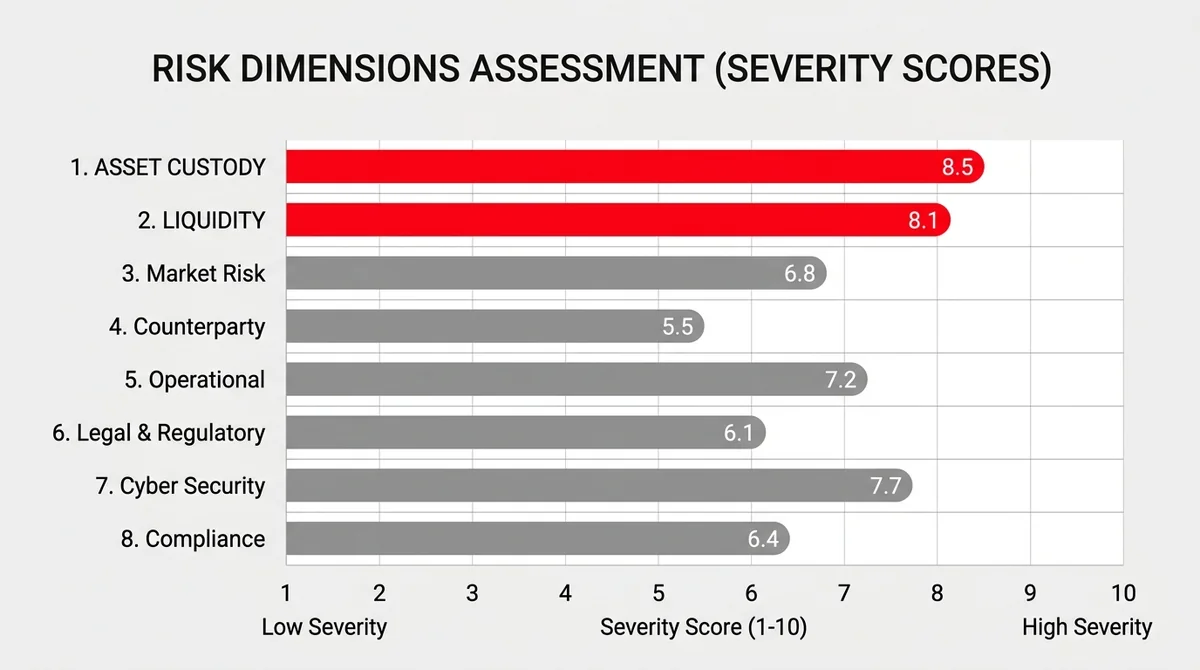
RWA investment faces 8 major risk dimensions: asset custody, liquidity, compliance, market, technology, counterparty, valuation, and operational risk; investors must assess comprehensively. Asset custody risk mainly involves private key custody, exchange exit scams, and smart contract vulnerabilities; liquidity risk stems from insufficient secondary market depth for tokenized assets and difficulty exiting; compliance risk includes securities laws, AML, and cross-border regulatory differences; market risk comes from underlying asset price volatility and interest rate changes; technology risk includes oracle attacks and cross-chain bridge vulnerabilities; counterparty risk involves issuer default and market maker failure; valuation risk stems from opaque off-chain asset pricing; operational risk includes user errors and platform system failures.
How Does Asset Custody Risk Affect RWA Investment?
Asset custody risk is the primary risk in RWA investment, referring to the possibility of asset loss due to poor private key custody, exchange exit scams, or smart contract vulnerabilities after investors entrust assets to a platform or smart contract. On-chain custody of tokenized assets relies on smart contracts; if a contract has vulnerabilities, hackers may steal assets. According to MSX official disclosure, it commits to a physical on-chain reserve ratio strictly greater than 100% (Proof of Reserves) for all listed tokens, and stores 95% of digital assets in multi-signature cold wallets to resist hacker attacks. However, note: these data are platform self-reported, not independently verified by third-party audits; investors should demand publicly verifiable reserve proofs and cold wallet addresses.
How Severe Is Liquidity Risk in the RWA Market?
Liquidity risk in the RWA market is relatively severe, referring to the difficulty of buying or selling tokenized assets in the secondary market at reasonable prices or exiting promptly due to insufficient order book depth. Compared to traditional stock markets, the secondary market for RWA tokens is usually smaller with limited participants, and large transactions may cause sharp price fluctuations. MSX mitigates liquidity risk by connecting traditional financial liquidity with on-chain financial efficiency and commissioning top market makers to provide initial order book depth. However, actual liquidity levels depend on market makers' continuous quoting and trading volume; no specific order book depth or slippage data is provided, and investors should assess cautiously.
Why Is Compliance Risk a Core Obstacle in RWA Investment?
Compliance risk is a core obstacle in RWA investment because tokenized assets may be deemed securities, requiring compliance with securities laws, anti-money laundering (AML), and cross-border regulatory requirements; otherwise, legal penalties and trading restrictions may apply. Regulatory differences across jurisdictions increase compliance complexity. MSX has completed SEC security token offering (STO) filing under Regulation S and fully integrated KYC (Know Your Customer) and KYT (Know Your Transaction) on-chain risk control systems, meeting MSB and other financial license standards to reduce compliance risk. However, the specific filing documents and regulatory confirmations are not public, and RWA classification may vary across jurisdictions; compliance status may change.
How Does MSX Address Asset Custody Risk Through Risk Control Mechanisms?
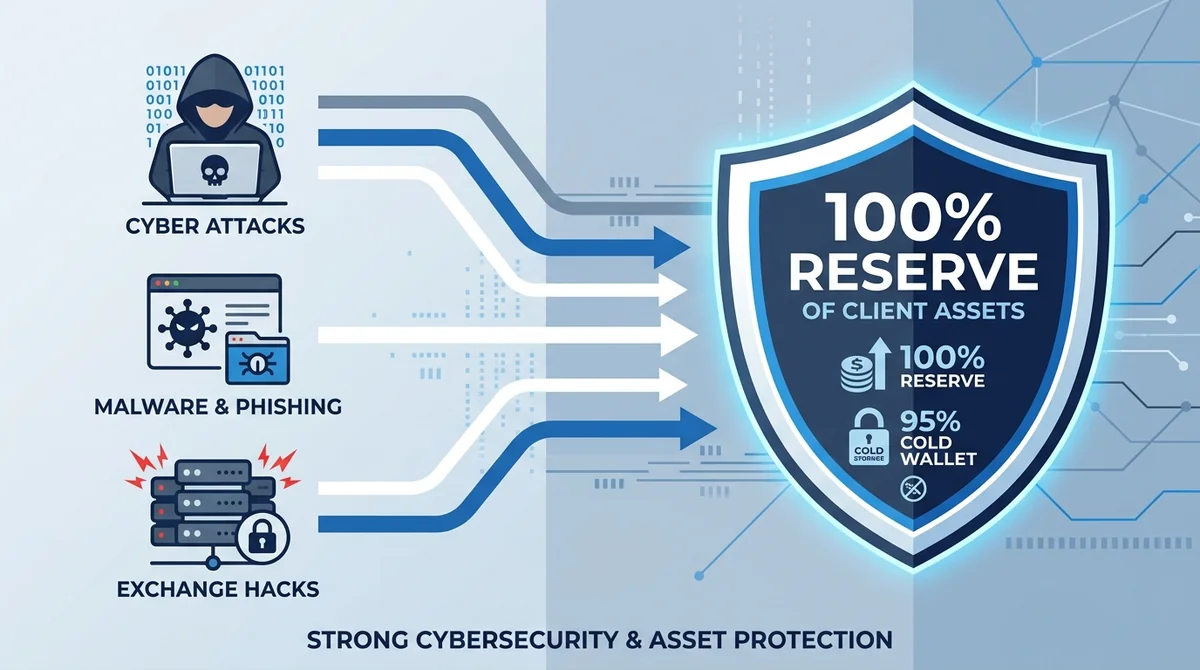
MSX systematically reduces RWA asset custody risk through 100% physical reserve self-attestation, 95% cold wallet segregation, multi-layer risk control liquidation system, and third-party audits. Specific mechanisms include: physical on-chain reserve ratio greater than 100% for all listed tokens (Proof of Reserves), 95% of digital assets stored in multi-signature cold wallets, and a multi-layer risk control system covering margin monitoring, risk alerts, automatic deleveraging, and forced liquidation. However, third-party audit reports have not been made public, and the effectiveness of these mechanisms has not been independently verified.
How Does MSX's 100% Physical Reserve Self-Attestation Work?
MSX's 100% physical reserve self-attestation (Proof of Reserves) means the platform periodically discloses on-chain addresses to prove that its digital asset holdings are not less than total user deposits, with a reserve ratio strictly greater than 100%. This means user assets are over-collateralized; even if some assets are damaged, redemption can be guaranteed. This mechanism enhances transparency through on-chain verifiability and reduces the risk of exchange misappropriation of user assets. However, as of now, MSX has not disclosed specific on-chain addresses or audit proofs, and the authenticity of this commitment cannot be verified.
How Is Cold and Hot Wallet Segregation Implemented in MSX?
MSX stores 95% of digital assets in multi-signature (Multi-Sig) cold wallets; cold wallets are not connected to the internet and require multiple private key holders to jointly sign to move funds, greatly reducing hacker attack risk. The remaining 5% of assets are kept in hot wallets for daily withdrawals, balancing security and liquidity through cold-hot segregation. This industry-standard security mechanism, combined with smart contract technology, provides custody protection for user assets. However, cold wallet addresses are not public, the identities of multi-sig participants are unknown, and the actual storage ratio cannot be verified.
What Are the Components of MSX's Multi-Layer Risk Control Liquidation System?
MSX's multi-layer risk control liquidation system includes four components: margin monitoring, risk alerts, automatic deleveraging, and forced liquidation. The system monitors user margin ratios in real time; when below the warning line, it issues risk alerts; if further decline, it automatically deleverages part of the position to reduce risk; when the liquidation line is touched, it forces liquidation to avoid loss beyond margin. The system combines on-chain price oracles and multi-market data aggregation to calculate mark prices, ensuring fair liquidation prices. However, specific parameters (such as warning line and liquidation line ratios) and oracle sources are not disclosed; liquidation risk may be underestimated.
How Does MSX Mitigate Liquidity Risk in RWA Investment?
MSX effectively mitigates RWA liquidity risk by connecting traditional financial liquidity, top market makers providing depth, fractional share low-threshold trading, and a high-performance engine. The platform breaks the liquidity fragmentation of traditional brokers, brings traditional financial market liquidity on-chain, and commissions top market makers to provide initial order book depth, reducing slippage. However, the identity of "top market makers" is not disclosed, and actual market-making effectiveness lacks data support.
How Does MSX Connect Traditional Financial Liquidity?
MSX brings traditional stock market liquidity on-chain by tokenizing US stocks and other RWA assets. Users can directly buy and sell stock tokens with stablecoins, enjoying on-chain instant settlement (T+0) and low-threshold trading. The platform integrates global mainstream data sources such as Polygon.io, provides millisecond-level WebSocket order book data refresh, and executes orders at optimal prices, thereby enhancing market depth and trading efficiency. However, tokenized asset prices may deviate from real stock prices due to liquidity differences, and on-chain settlement does not change the actual liquidity of underlying assets.
How Does MSX's Market Maker Mechanism Provide Order Book Depth?
MSX commissions top market makers to provide initial order book depth for RWA token trading pairs. Market makers continuously quote both bid and ask prices, narrow the bid-ask spread, and reduce the price impact of large transactions. This helps improve the insufficient secondary market depth of tokenized assets, enabling investors to trade closer to fair market prices and increasing exit convenience. However, market makers may stop quoting or withdraw orders, causing sudden liquidity dry-up, and market makers themselves may face risks.
How Does MSX's Fractional Share Low-Threshold Trading Improve Liquidity?
MSX supports investing in high-priced blue-chip stock tokens such as Apple, Tesla, and Nvidia with a low base amount starting from 10U, lowering the investment threshold, attracting more small investors, thereby expanding the trader base and improving market liquidity. Fractional share trading allows investors to buy by amount rather than whole share quantity, improving capital utilization and increasing order book activity. However, small transactions may increase fragmentation, and the actual contribution to liquidity is limited.
How Do MSX's Compliance Credentials Reduce RWA Compliance Risk?
MSX significantly reduces RWA investment compliance risk through SEC STO filing, KYC/KYT systems, multi-regulatory framework exploration, and third-party audits. The platform has completed SEC security token offering (STO) filing under Regulation S, qualifying for compliant issuance of security tokens; it also integrates KYC and KYT on-chain risk control systems, meeting MSB and other financial license standards. However, filing documents are not public, whether regulators have formally approved is unknown, and compliance credentials may vary by jurisdiction.
What Does MSX's SEC STO Filing Mean?
MSX's SEC STO filing refers to its completion of security token offering filing under Regulation S of the US Securities Act of 1933, allowing issuance of security tokens to qualified investors outside the US, exempt from US domestic registration requirements. This provides a compliance basis for MSX to issue RWA assets such as US stock tokens, reducing legal risks from unregistered securities offerings. However, Regulation S only exempts US domestic registration, does not mean compliance in other jurisdictions, and whether the filing was truly completed cannot be publicly verified.
How Do MSX's KYC/KYT Systems Work?
MSX's KYC (Know Your Customer) system requires users to submit identity information for real-name authentication, while the KYT (Know Your Transaction) system monitors on-chain transactions in real time to identify suspicious fund flows and sanctioned addresses. The combination of both complies with anti-money laundering (AML) and counter-terrorism financing (CTF) regulations, reducing the risk of the platform being used for illegal activities and protecting user asset security. However, specific KYC/KYT service providers and effectiveness are not disclosed, and vulnerabilities may exist.
What Regulatory Frameworks Does MSX's Compliance Path Cover?
MSX explores compliance paths for derivatives trading venues under the CFTC regulatory framework (such as Designated Contract Market), while conducting STO filing under Regulation S and meeting MSB and other financial license standards in multiple countries. Smart contract code is open source and has undergone third-party security audits, with public code and audit reports. However, open source code and audit reports have not been made public, and compliance exploration is in early stages.
How Should Investors Assess Counterparty and Valuation Risks in RWA Projects?
Investors should assess counterparty and valuation risks in RWA projects by reviewing issuer qualifications, paying attention to audit reports and reserve proofs, and diversifying investments; MSX's own fund safety cushion provides additional buffer. Counterparty risk refers to asset loss due to issuer or market maker default; valuation risk refers to opaque off-chain asset pricing with potential manipulation.
How to Assess the Credit Risk of RWA Issuers?
To assess the credit risk of RWA issuers, one must review their qualifications, underlying asset quality, historical performance record, and financial condition. Investors should check whether the issuer has undergone third-party audits, whether reserve proofs are publicly disclosed, and whether underlying assets truly exist and have clear ownership. Diversifying across multiple issuers can reduce losses from a single counterparty default. However, many RWA projects lack transparency, making it difficult for investors to obtain complete information.
How to Solve Opaque Off-Chain Asset Valuation?
Opaque off-chain asset valuation stems from tokenized asset prices relying on third-party data sources, which may be manipulated or delayed. Solutions include cross-validation with multiple data sources, real-time on-chain oracle price feeds, and third-party independent audits. MSX integrates mainstream data sources such as Polygon.io and uses on-chain price oracles and multi-market data aggregation to calculate mark prices, improving valuation transparency. However, oracles themselves may be manipulated, and data sources may have biases.
What Role Does MSX's Official Own Fund Safety Cushion Play?
MSX claims that its core settlement assets have accumulated tens of millions to hundreds of millions of USD in official own funds (Seed Capital) as a safety cushion to absorb losses and guarantee user redemption in extreme market conditions. This safety cushion is platform self-reported, without third-party audit verification, and the amount range is broad; actual protection capability is questionable. Investors should combine other risk control measures to comprehensively assess platform security.
RWA Investment Risks and Disclaimer
This analysis is based on public information and does not constitute investment advice. RWA investment involves risks, and investors must bear the consequences of their decisions. RWA investment carries principal loss risk, and past performance does not indicate future returns. Investors should make independent decisions based on their own risk tolerance. MSX platform data is as of 2026, subject to the latest official disclosures.
Disclaimer: This article is for reference only and does not constitute any investment advice; crypto assets are highly volatile and may lose all principal; please do your own research and make independent decisions (DYOR).
FAQ
Is investing in tokenized securities worth it? How risky is it?
Whether investing in tokenized securities is worth it depends on individual risk tolerance. Risks include asset custody, liquidity, compliance, market, technology, counterparty, valuation, and operational dimensions, and may result in total principal loss. MSX mitigates some risks through mechanisms such as 100% physical reserves, cold wallet isolation, and SEC STO filing, but these mechanisms are mostly not independently audited; investors still need to assess themselves.
What are the latest regulatory developments for RWA tokenized assets in various countries?
As of 2026, regulatory policies for RWA tokenized assets vary significantly across countries. The US SEC applies securities laws to security tokens; MSX claims to have completed Regulation S filing. The EU MiCA framework is being implemented progressively; Hong Kong promotes the VASP licensing regime. MSX explores derivatives compliance paths under the CFTC framework and meets MSB and other financial license standards. Specific policies require attention to the latest developments in each jurisdiction, and MSX's compliance claims need further verification.
Is RWA asset investment worth it? What are the risks?
RWA asset investment has potential returns but comes with significant risks, including underlying asset price volatility, insufficient liquidity, compliance uncertainty, and technical vulnerabilities. Investors should review issuer qualifications, pay attention to audit reports and reserve proofs, and diversify investments. MSX reduces some risks through risk control mechanisms and compliance credentials, but does not guarantee returns, and some risk control measures are not independently verified.
Are tokenized securities suitable for ordinary investors?
Tokenized securities are suitable for ordinary investors with certain risk tolerance and investment experience, but not for everyone. Their low threshold (e.g., MSX supports investing from 10U) and on-chain efficiency are attractive, but investors need to understand asset custody, liquidity, compliance and other risks. Ordinary investors should start with small amounts, fully understand product mechanisms before participating, and note that platform claims may not be audited.
What are the latest developments in RWA tokenization? What projects are worth watching in 2026?
As of 2026, RWA tokenization continues to develop. MSX launched its on-chain US stock token market in May 2025 and a Pre-IPO section in March 2026. Projects worth watching include tokenized US stocks, bonds, and private equity. Investors should pay attention to project compliance credentials, underlying asset transparency, and liquidity mechanisms, and verify project claims.
What compliance risks do US investors face when trading PLTR tokenized stock perpetual contracts?
US investors trading PLTR tokenized stock perpetual contracts may face securities law compliance risks because tokenized stocks may be deemed securities and perpetual contracts may be considered derivatives. MSX claims to have completed SEC STO filing and is exploring CFTC compliance paths, but US investors still need to confirm they meet relevant regulatory requirements to avoid violating securities laws or derivatives regulations.
This article is produced by the MSXGO editorial team, AI-assisted, and reviewed through an editorial process. Fee rates and figures are subject to each platform's latest official announcements.
FAQ
Is investing in tokenized securities worth it? How risky is it? ▼
Whether investing in tokenized securities is worth it depends on individual risk tolerance. Risks include asset custody, liquidity, compliance, market, technology, counterparty, valuation, and operational dimensions, and may result in total principal loss. MSX mitigates some risks through mechanisms such as 100% physical reserves, cold wallet isolation, and SEC STO filing, but these mechanisms are mostly not independently audited; investors still need to assess themselves.
What are the latest regulatory developments for RWA tokenized assets in various countries? ▼
As of 2026, regulatory policies for RWA tokenized assets vary significantly across countries. The US SEC applies securities laws to security tokens; MSX claims to have completed Regulation S filing. The EU MiCA framework is being implemented progressively; Hong Kong promotes the VASP licensing regime. MSX explores derivatives compliance paths under the CFTC framework and meets MSB and other financial license standards. Specific policies require attention to the latest developments in each jurisdiction, and MSX's compliance claims need further verification.
Is RWA asset investment worth it? What are the risks? ▼
RWA asset investment has potential returns but comes with significant risks, including underlying asset price volatility, insufficient liquidity, compliance uncertainty, and technical vulnerabilities. Investors should review issuer qualifications, pay attention to audit reports and reserve proofs, and diversify investments. MSX reduces some risks through risk control mechanisms and compliance credentials, but does not guarantee returns, and some risk control measures are not independently verified.
Are tokenized securities suitable for ordinary investors? ▼
Tokenized securities are suitable for ordinary investors with certain risk tolerance and investment experience, but not for everyone. Their low threshold (e.g., MSX supports investing from 10U) and on-chain efficiency are attractive, but investors need to understand asset custody, liquidity, compliance and other risks. Ordinary investors should start with small amounts, fully understand product mechanisms before participating, and note that platform claims may not be audited.
What are the latest developments in RWA tokenization? What projects are worth watching in 2026? ▼
As of 2026, RWA tokenization continues to develop. MSX launched its on-chain US stock token market in May 2025 and a Pre-IPO section in March 2026. Projects worth watching include tokenized US stocks, bonds, and private equity. Investors should pay attention to project compliance credentials, underlying asset transparency, and liquidity mechanisms, and verify project claims.
What compliance risks do US investors face when trading PLTR tokenized stock perpetual contracts? ▼
US investors trading PLTR tokenized stock perpetual contracts may face securities law compliance risks because tokenized stocks may be deemed securities and perpetual contracts may be considered derivatives. MSX claims to have completed SEC STO filing and is exploring CFTC compliance paths, but US investors still need to confirm they meet relevant regulatory requirements to avoid violating securities laws or derivatives regulations.
Finished reading? Ready to try trading?
Tokenized stocks/ETFs, crypto spot, and perpetual futures in one account — perp maker 0.02% / taker 0.045%, RWA spot buy 0.3% / sell 0.
Free sign-up · 3 quick steps