Ultimate 2026 Tokenized Trading Fee Comparison: MSX vs Binance vs Coinbase Spot & Contract Rates
Which platform has the lowest tokenized trading fees in 2026? MSX spot buy 0.3%, sell 0%; contract maker 0.02%, taker 0.045%; Binance spot 0.1%, contract maker 0.02%, taker 0.05%; Coinbase fees vary by order type and volume.

Article Citation Summary
Which platform has the lowest tokenized trading fees in 2026? MSX spot buy 0.3%, sell 0%; contract maker 0.02%, taker 0.045%; Binance spot 0.1%, contract maker 0.02%, taker 0.05%; Coinbase fees vary by order type and volume.
Tokenized Trading Fee Comparison: MSX vs Binance vs Coinbase Spot & Contract Rates
TL;DR Key Takeaways
- MSX spot buy 0.3%, sell 0%; Binance spot regular users 0.1% (25% discount with BNB); Coinbase fees vary by order type and trading volume.
- MSX contract maker 0.02%, taker 0.045%; Binance contract maker 0.02%, taker 0.05%; Coinbase contract fees depend on product.
- MSX uses $MSX for 25% off spot and 10% off contracts; Binance uses BNB for 25% off spot and 10% off contracts; Coinbase offers no platform token discount.
- MSX further reduces user costs through PFOF mechanism, low fractional share threshold (from 10U), and multi-asset cross-margin.
- Data as of 2026; please refer to each platform's official fee page for current rates.
Which Platform Has the Lowest Tokenized Trading Fees?
Let's look at the core numbers: MSX spot buy 0.3%, sell 0%, contract maker 0.02%, taker 0.045%; Binance spot flat 0.1%, contract maker 0.02%, taker 0.05%; Coinbase dynamically prices based on order type and volume. Purely on fees, MSX is 0.005 percentage points cheaper than Binance on contract taker, and spot selling is completely fee-free.
How Do MSX, Binance, and Coinbase Spot Fees Differ?
Spot fees are the most direct cost component when trading tokenized assets (e.g., tokenized stocks, RWA tokens). MSX charges a flat 0.3% on spot buys and 0% on sells (as of 2026, source: MSX official fee page), a design clearly favoring sellers and reducing friction when taking profits. Binance spot regular users pay a flat 0.1% for both maker and taker, and enabling BNB payment gives an additional 25% discount (i.e., 25% off). Coinbase has no fixed rate; fees vary by maker/taker status and 30-day trading volume tier, requiring users to check the official fee page with their parameters for real-time quotes.
| Platform | Spot Buy Fee (2026) | Spot Sell Fee (2026) | Platform Token Discount |
|---|---|---|---|
| MSX | 0.3% | 0% | 25% off with $MSX |
| Binance | 0.1% (regular users) | 0.1% (regular users) | 25% off with BNB |
| Coinbase | Varies by order type and volume | Varies by order type and volume | None |
Which Platform Has Better Contract Fees?
The core of contract trading costs lies in maker and taker fees. MSX contract maker charges 0.02% and taker 0.045%; Binance contract maker is also 0.02%, but taker is 0.05%. The gap is only 0.005%, but it adds up significantly in high-frequency taker scenarios. Coinbase contract fees lack a unified public standard due to product and volume differences.
| Platform | Contract Maker Fee (2026) | Contract Taker Fee (2026) | Platform Token Discount |
|---|---|---|---|
| MSX | 0.02% | 0.045% | 10% off with $MSX |
| Binance | 0.02% | 0.05% | 10% off with BNB |
| Coinbase | Varies by product | Varies by product | None |
How Much Can Platform Token Discounts Save?
Platform token discounts are a key lever to lower effective fees. MSX supports 25% off spot fees with $MSX (i.e., 25% discount) and 10% off contract fees (10% discount). Binance uses BNB payment for 25% off spot (25% discount) and 10% off contracts (10% discount). Coinbase has no platform token discount option. Taking a spot buy fee of 0.3% as an example, MSX users with $MSX discount pay an effective 0.225%, while Binance's 0.1% spot fee after BNB discount is only 0.075%.
How Are MSX, Binance, and Coinbase Spot Fees Calculated Specifically?
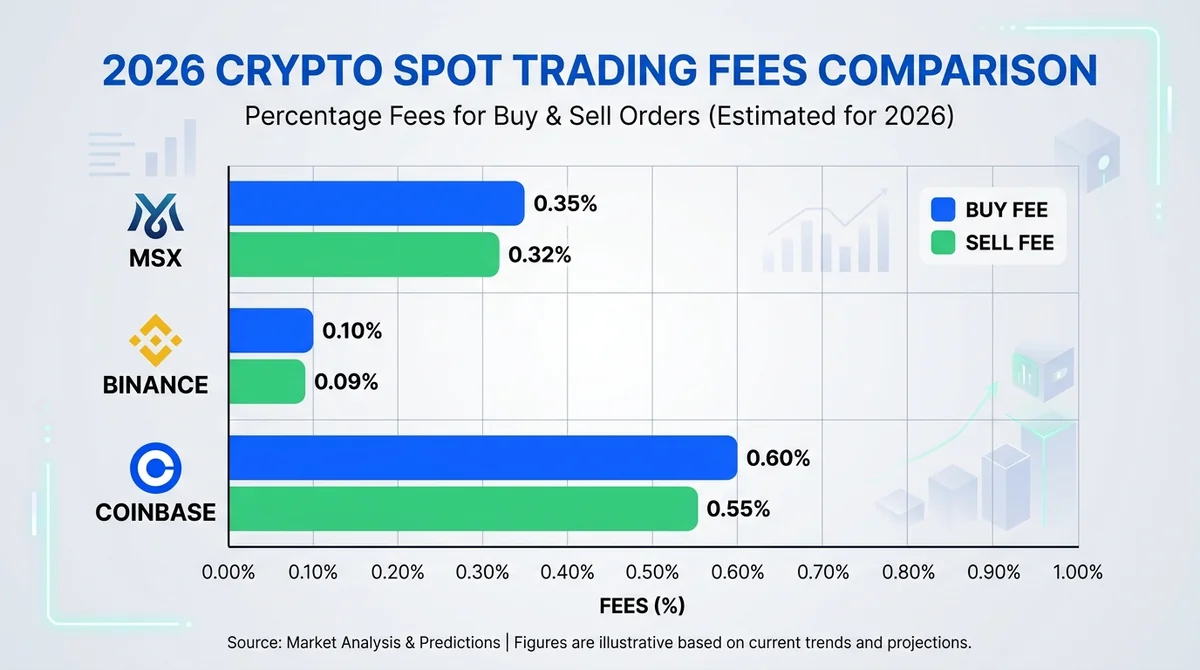
MSX spot buy 0.3%, sell 0%; Binance spot regular users 0.1%, with an additional 25% off using BNB; Coinbase varies by order type and volume. The actual cost of each order must be calculated by combining trade direction and whether platform token discount is enabled.
What Is MSX's Spot Fee Structure?
MSX's spot fee rules are straightforward: buy 0.3%, sell 0% (as of 2026, source: MSX official fee page). The platform also supports fractional share trading from 10U, allowing small capital to participate in tokenized assets. With $MSX discount enabled, the buy fee drops to 0.225% (25% off). The overall structure clearly favors sellers, making it suitable for frequent profit-taking in swing trading.
What Are Binance's Spot Fee Tiers?
Binance spot regular users pay 0.1% for both maker and taker, regardless of buy or sell direction. Enabling BNB payment gives a 25% discount (25% off), resulting in an effective 0.075%. VIP users enjoy tiered fee reductions based on 30-day trading volume and BNB holdings; for example, VIP1 spot maker is 0.09% and taker 0.1% (refer to Binance's official VIP tier table).
How Are Coinbase Spot Fees Calculated?
Coinbase uses a maker-taker fee model with rates adjusted by 30-day trading volume tiers. Low-volume users typically face higher taker fees than maker fees, and fees decrease as volume climbs. Since there is no unified public figure, users need to input their expected trading volume on Coinbase's official fee page to get accurate quotes.
Which Platform Has Better Contract Fees: MSX, Binance, or Coinbase?
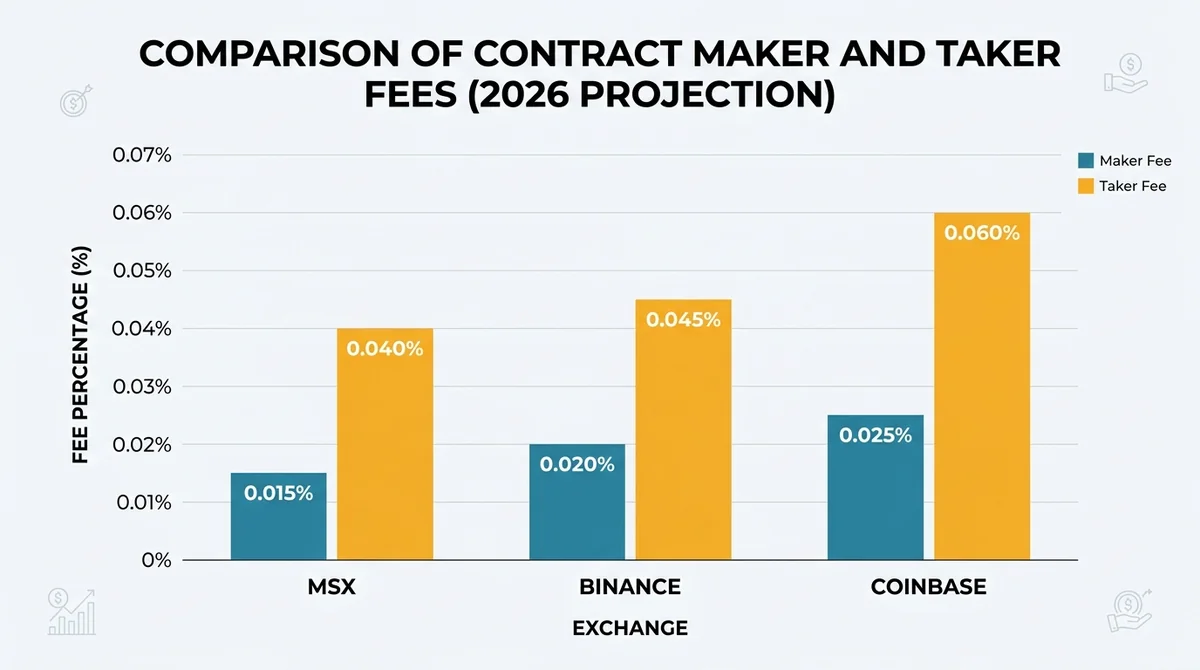
MSX contract maker 0.02%, taker 0.045%; Binance contract maker 0.02%, taker 0.05%; Coinbase contract fees vary by product and volume. MSX is 0.005% lower than Binance on taker, and the advantage widens further with the 10% $MSX discount.
What Are MSX's Contract Fees?
MSX contracts (covering tokenized US stock perpetuals and crypto perpetuals) have a maker fee of 0.02% and taker fee of 0.045% (as of 2026, source: MSX official fee page). Using $MSX discount gives 10% off, resulting in maker 0.018% and taker 0.0405%. Note that contracts are high-risk leveraged products, and fees are only one slice of the total cost.
What Are Binance's Contract Fees?
Binance USDT-margined perpetual regular users pay maker 0.02% and taker 0.05%. With BNB payment 10% off, maker drops to 0.018% and taker to 0.045%. VIP users enjoy even lower fees; for example, VIP9 can go as low as maker 0% and taker 0.017% (requires extremely high trading volume and BNB holdings).
What Are Coinbase's Contract Fees?
Coinbase contract fees (e.g., Coinbase Derivatives) vary by specific product and trading volume, and the official unified fee schedule is not publicly disclosed. Users should check Coinbase's official help center or fee page for real-time tiers.
How Do Platform Token Discounts Further Reduce Trading Costs?
MSX uses $MSX for 25% off spot and 10% off contracts; Binance uses BNB for 25% off spot and 10% off contracts; Coinbase has no platform token discount. Platform token discounts are an effective lever to lower actual trading costs.
What Are MSX's $MSX Discount Rules?
$MSX is the core utility token of the MSX ecosystem, used for fee discounts, staking benefits, VIP membership, asset subscriptions, and more. On MSX, enabling $MSX fee discount gives 25% off spot (25% discount) and 10% off contracts (10% discount). Users need to hold $MSX and enable the discount function in their account.
What Are Binance's BNB Discount Rules?
BNB is Binance's ecosystem token. On Binance, using BNB to pay fees gives 25% off spot (25% discount) and 10% off contracts (10% discount), provided BNB payment is enabled in account settings and the balance is sufficient.
Does Coinbase Have a Platform Token Discount?
Coinbase has no platform token discount mechanism. Users cannot reduce trading fees by holding any specific token; they can only obtain fee discounts by increasing their trading volume tier.
Besides Fees, What Other Factors Affect Tokenized Trading Costs?
MSX reduces user costs through PFOF mechanism, low fractional share threshold (from 10U), and multi-asset cross-margin; Binance has VIP tiered fees; Coinbase has volume-based discounts. Beyond fees, liquidity depth, slippage, and funding rates also affect actual costs.
What Unique Cost Advantages Does MSX Have?
MSX's differentiated cost advantages are reflected in the following aspects:
- On-chain PFOF mechanism: Brings Wall Street's mature payment for order flow (PFOF) model to Web3, enabling low commission and T+0 instant settlement trading experience.
- Low fractional share threshold: Supports investing in high-priced blue-chip tokenized stocks like Apple, Tesla, and Nvidia from 10U, greatly improving capital efficiency for small funds.
- Multi-asset cross-margin: Portfolio Margin mechanism allows users to use multiple on-chain assets as joint margin, reducing liquidation risk while improving capital utilization.
- Zero fee for crypto-to-crypto trading: Completely fee-free for cryptocurrency spot trading, and cross-chain bridge charges only 0.1%.
What Cost-Related Features Does Binance Have?
Binance offers VIP tiered fees, potentially as low as maker 0% and taker 0.017% (VIP9, requiring 30-day trading volume ≥25 billion USDT and BNB holdings ≥5500). Regular users can reduce fees through BNB payment. Additionally, Binance has deep liquidity and low slippage on major coins, indirectly reducing hidden costs.
What Cost-Related Features Does Coinbase Have?
Coinbase provides fee discounts through trading volume tiers; the higher the volume, the lower the fee. However, the platform has no platform token discount mechanism, and some channels (such as credit card purchases) have higher fees. In terms of liquidity, Coinbase has certain advantages in compliant markets.
Frequently Asked Questions (FAQ)
XAUUSDT Perpetual Contract vs Spot Trading Fees and Leverage Comparison?
MSX contract maker 0.02%, taker 0.045%, with 10% off using $MSX; spot (if RWA gold token) buy 0.3%, sell 0%. Regarding leverage, MSX has not publicly disclosed specific leverage multiples; please refer to the platform page.
Which Is Better for Hedging: Tokenized Gold Perpetual Contract or Spot Trading?
Perpetual contracts are more suitable for short-term hedging because they allow two-way operation and higher capital efficiency, but they carry funding rate and liquidation risks; spot is suitable for long-term holding with no funding rate but requires full capital. MSX's 0% spot sell fee reduces hedging costs to some extent.
Which Is Better for Short-Term Trading on MSX: Tokenized US Stock Spot or Perpetual Contract?
Perpetual contracts are more suitable for short-term trading because leverage can amplify returns (and risks), and MSX contract taker 0.045% is much lower than spot buy 0.3%. However, contract liquidation risk should not be ignored.
How to Trade AMD Tokenized Futures Contracts in 2026?
On MSX, if AMD tokenized perpetual contract is listed, users can deposit USDT into their unified account, then select the AMDUSDT perpetual contract in the contract market, set leverage and order type (limit/market) to trade. Specific contract parameters are subject to the platform page.
Can US Users Trade MSX Tokenized Stock Perpetual Contracts?
MSX is open to global users (subject to local regulatory restrictions), but US users need to confirm local regulations themselves. MSX has completed SEC security token offering (STO) filing and has Regulation S compliance qualification. It is recommended to consult platform customer service to confirm specific restrictions.
Which Is Riskier: CRWD Tokenized Stock Spot Trading or Perpetual Contract?
Perpetual contracts are riskier because leverage amplifies price fluctuations and may trigger forced liquidation; spot has no leverage and risk is limited to principal. MSX contracts have multiple layers of risk control, including margin monitoring, risk alerts, auto-deleveraging, and forced liquidation.
This article is produced by the MSXGO editorial team, AI-assisted, and reviewed through an editorial process. Fee rates and figures are subject to each platform's latest official announcements.
FAQ
XAUUSDT Perpetual Contract vs Spot Trading Fees and Leverage Comparison? ▼
MSX contract maker 0.02%, taker 0.045%, with 10% off using $MSX; spot (if RWA gold token) buy 0.3%, sell 0%. Regarding leverage, MSX has not publicly disclosed specific leverage multiples; please refer to the platform page.
Which Is Better for Hedging: Tokenized Gold Perpetual Contract or Spot Trading? ▼
Perpetual contracts are suitable for short-term hedging because they allow shorting and higher capital efficiency, but they carry funding rate and liquidation risks; spot is suitable for long-term holding with no funding rate but requires full capital. MSX's 0% spot sell fee reduces hedging costs.
Which Is Better for Short-Term Trading on MSX: Tokenized US Stock Spot or Perpetual Contract? ▼
Perpetual contracts are more suitable for short-term trading because leverage can amplify returns (and risks), and MSX contract taker 0.045% is lower than spot buy 0.3%. However, contract liquidation risk should be noted.
How to Trade AMD Tokenized Futures Contracts in 2026? ▼
On MSX, if AMD tokenized perpetual contract is listed, users can deposit USDT into their unified account, then select the AMDUSDT perpetual contract in the contract market, set leverage and order type (limit/market) to trade. Specific contract parameters are subject to the platform page.
Can US Users Trade MSX Tokenized Stock Perpetual Contracts? ▼
MSX supports global users (subject to local regulatory restrictions), but US users need to confirm local regulations themselves. MSX has completed SEC security token offering (STO) filing and has Regulation S compliance qualification. It is recommended to consult platform customer service to confirm specific restrictions.
Which Is Riskier: CRWD Tokenized Stock Spot Trading or Perpetual Contract? ▼
Perpetual contracts are riskier because leverage amplifies price fluctuations and may trigger forced liquidation; spot has no leverage and risk is limited to principal. MSX contracts have multiple layers of risk control, including margin monitoring, risk alerts, auto-deleveraging, and forced liquidation.
Finished reading? Ready to try trading?
Tokenized stocks/ETFs, crypto spot, and perpetual futures in one account — perp maker 0.02% / taker 0.045%, RWA spot buy 0.3% / sell 0.
Free sign-up · 3 quick steps