MSX US Stock Daily Watch: TSPY, Medline and Vera Bradley — TSPY's Flexibility Edge Fails to Deliver, Downgraded; Medline Faces Private Equity Overhang
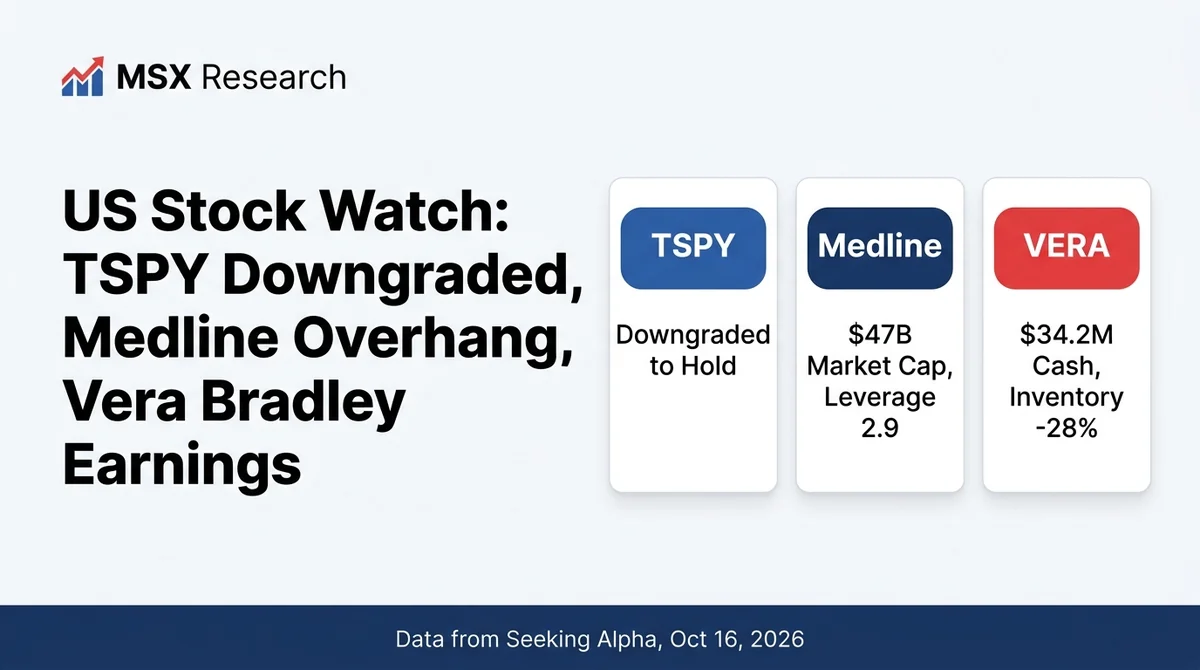
US stock watch: TSPY total return lags XDTE, downgraded to hold; Medline PE holders sell 158M shares in two follow-ons; Vera Bradley tariff refund lifts profit, FY27 guidance soft.
Article Citation Summary
US stock watch: TSPY total return lags XDTE, downgraded to hold; Medline PE holders sell 158M shares in two follow-ons; Vera Bradley tariff refund lifts profit, FY27 guidance soft.
US Stock Watch: TSPY Downgraded, Medline Overhang Pressure and Vera Bradley Earnings Verification
MSX Research
Guest Columnist
@MSX_CN
2026
Structural narrative, shareholder structure and earnings quality are emerging as three lenses for pricing individual US stocks in 2026. According to a research note published by Seeking Alpha on October 16, 2026, TSPY was downgraded to hold on the grounds that it underperformed continuous and 0DTE peers, and its claimed options-layer flexibility did not translate into incremental excess returns or better drawdown protection. The same source noted that Medline, even as fundamental leverage declines, still faces supply pressure from Blackstone, Carlyle and Hellman & Friedman selling another 158 million shares across two post-IPO follow-on offerings. Vera Bradley holds $34.2 million in cash, carries no external debt and reduced inventory by 28%, but roughly $7.7 million in tariff refunds inflated quarterly profit, and its fiscal 2027 sales guidance is slightly below the prior fiscal year. This is a US stock watch piece; all specific figures come from the aforementioned third-party research and have not been independently verified against company announcements or regulatory filings.
AI Summary
Core view: According to the Seeking Alpha research, TSPY's downgrade, Medline's private equity overhang and Vera Bradley's earnings verification gap all point to the same conclusion — current US stock pricing relies more on verifiable total return, shareholder structure and operating profit than on product narrative or one-time gains. All data below comes from that source and has not been independently verified.
Key elements:
- TappAlpha S&P 500 Growth & Daily Income ETF (TSPY) was downgraded to hold after underperforming continuous and 0DTE peers; its claimed options-layer flexibility did not deliver incremental excess returns or better drawdown protection, and total return still lags XDTE.
- Medline Inc. listed in December 2025, raising $7.05 billion in net IPO proceeds at an issue price of $29.00 per share, opening at $35; the stock trades around $36 with a market cap of roughly $47 billion.
- Medline's private equity shareholders include Blackstone, Carlyle and Hellman & Friedman; two follow-on offerings after the IPO sold another 158 million shares.
- Medline generated $920 million in free cash flow in the first half of 2026, with net leverage falling from 4.9 at end-2024 to 2.9 as of June 27, 2026.
- Vera Bradley reported fiscal 2027 second-quarter results on September 15, 2026, with sales up 1.1% year over year to $71.6 million — a second consecutive quarter of growth; inventory fell 28%, it holds $34.2 million in cash with no external debt, and roughly $7.7 million in tariff refunds inflated quarterly profit.
- Vera Bradley's fiscal 2027 sales guidance is roughly $255 million to $270 million, slightly below fiscal 2026 levels.
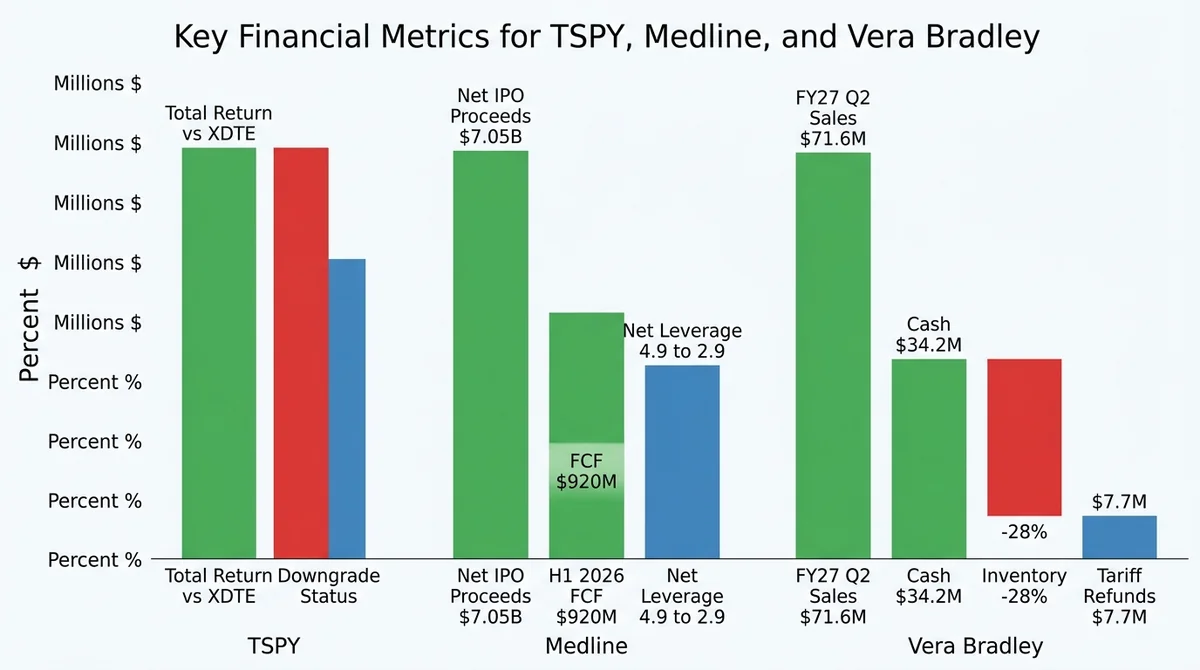
Key Data at a Glance for the Three Names
| Name | Key data | Main tension |
|---|---|---|
| TSPY | Total return lags XDTE; downgraded to hold | Options-layer flexibility did not translate into incremental excess returns or better drawdown protection |
| Medline | $7.05 billion net IPO proceeds; $920 million H1 2026 free cash flow; net leverage down from 4.9 to 2.9 | Fundamental improvement coexists with supply pressure from two PE follow-on offerings selling another 158 million shares |
| Vera Bradley | FY27 Q2 sales of $71.6 million, up 1.1% YoY; $34.2 million cash, no external debt; inventory down 28% | Roughly $7.7 million in tariff refunds inflated profit; FY27 guidance of $255–270 million is slightly below the prior fiscal year |
1. TSPY's Flexibility Narrative Is Undercut by Total Return Data, Downgraded to Hold
1. TappAlpha S&P 500 Growth & Daily Income ETF downgraded after underperforming continuous and 0DTE peers
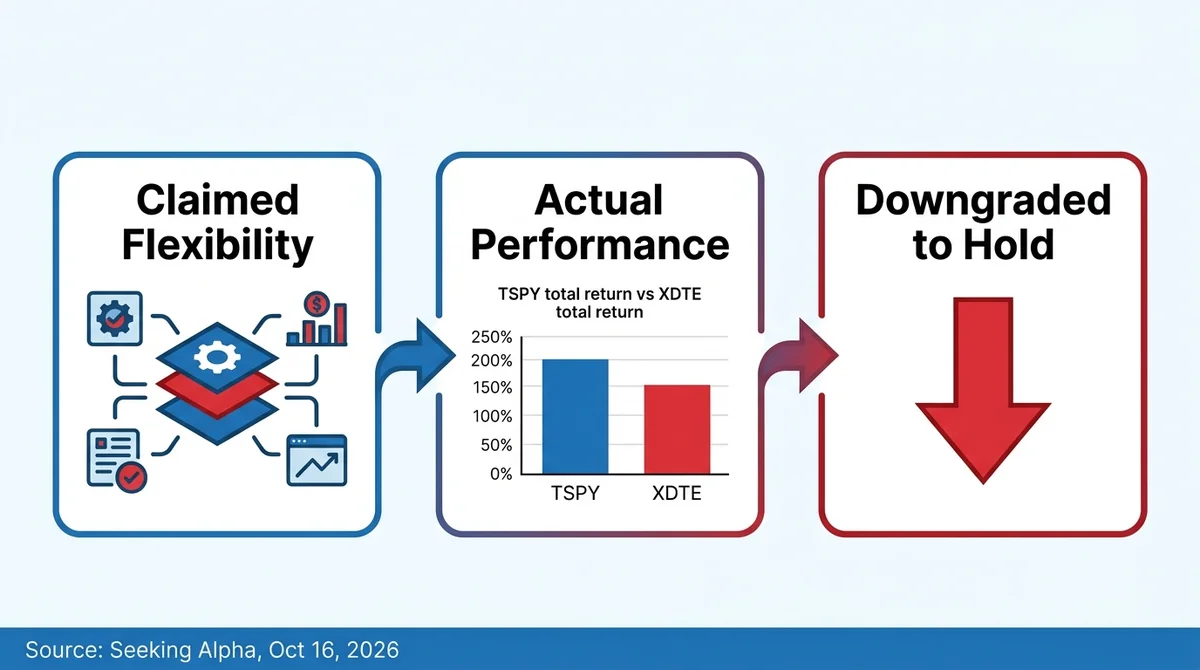
TSPY was downgraded to hold, with relative underperformance as the direct cause. According to the Seeking Alpha research, TappAlpha S&P 500 Growth & Daily Income ETF (TSPY) was downgraded to hold after underperforming continuous and 0DTE peers. The action itself is not complicated, but the signal it sends deserves unpacking: when a product whose core selling point is "options-layer flexibility" cannot gain an edge in a head-to-head comparison with peers, the rating agency is effectively repricing "structural innovation" itself.
In terms of positioning, TSPY attempts to strike a more active balance between S&P 500 growth exposure and daily income, with options-layer flexibility described as its key differentiator versus continuous and 0DTE peers. The problem is that the direct trigger for the downgrade is relative performance, not whether the product structure is elegant. In other words, the market's feedback is: structural freedom, if not realized on the return side, does not constitute a reason to allocate.
2. Options-layer flexibility did not translate into incremental excess returns, nor did it provide better drawdown protection
TSPY's options-layer flexibility delivered neither incremental excess returns nor better drawdown protection. The same research notes that TSPY's claimed options-layer flexibility did not produce incremental excess returns or better drawdown protection — the most informative judgment in this downgrade. For income ETFs, investors genuinely care about two things: return compensation per unit of risk, and defensive capacity during drawdowns. If flexibility improves neither, then the "adjustable room" presented in the prospectus is merely a theoretical option, not actual investment value.
This is especially critical in the competitive landscape for income ETFs. The core logic of 0DTE products is to use high-frequency, short-cycle options rolling to secure more stable cash flow, while continuous products emphasize rules-based, predictable execution; TSPY tries to find a third path between the two, but based on available public data, that path has yet to be validated in the numbers. For allocation-oriented capital, this means TSPY currently cannot provide a sufficiently clear answer to "why choose it over peers."
3. Total return still lags XDTE, and the "structural innovation premium" for income ETFs is being repriced
TSPY's total return still lags XDTE — the novelty of the product design did not convert into realized returns. According to the Seeking Alpha research, TSPY's total return still trails XDTE, a fact that pulls the discussion from "is the design novel" back to "what is the final realized return." In the income ETF space, products like XDTE have already established relatively clear return and drawdown characteristics; any new entrant that cannot form a visible advantage in total return will struggle to convince capital to bear switching and comprehension costs.
It follows that the "structural innovation premium" for income ETFs may be getting repriced. In the past, more complex options-layer designs often earned a certain narrative premium; but once the number of peer products is large enough and comparison dimensions are clear enough, the basis for that premium shifts from "design complexity" to "verifiable total return and drawdown protection." For S&P 500 income ETFs, structural complexity does not equal actual return advantage — possibly the most noteworthy conclusion from this TSPY downgrade. Note that this inference rests on a single source's rating action and does not yet confirm the pricing mechanism for the entire category.
2. Medline's Private Equity Overhang: Two Post-IPO Follow-Ons Sell Another 158 Million Shares
1. Medline listed in December 2025 with $7.05 billion in net IPO proceeds, an issue price of $29.00, an opening price of $35, a current price around $36 and a market cap of roughly $47 billion
Medline listed in December 2025, raising $7.05 billion in net IPO proceeds. According to the Seeking Alpha research, Medline Inc. listed in December 2025 with $7.05 billion in net IPO proceeds, an issue price of $29.00 per share and an opening price of $35; the source says the stock currently trades around $36 with a market cap of roughly $47 billion (data as of the research publication date, not independently verified). These figures sketch a picture of a sizable medical supplies company that has held a relatively stable price range since listing, with little gap between the opening price and the current price — suggesting the market accepted its initial pricing reasonably well, with no obvious break below issue or violent repricing.
But a stable price does not mean there is no pressure. For a large PE-led IPO, listing is only the first step in the capital structure change; what really affects secondary-market supply and demand is often the pace of share releases after listing. Medline is one sample for observing that process.
2. Blackstone, Carlyle and Hellman & Friedman, as private equity shareholders, have completed two post-IPO follow-on offerings, selling another 158 million shares
Medline's private equity shareholders have sold another 158 million shares cumulatively through two post-IPO follow-on offerings. According to the same research, Medline's private equity shareholders include Blackstone, Carlyle and Hellman & Friedman; after the IPO, the company completed two follow-on offerings, selling another 158 million shares. This figure is one of the key variables for understanding Medline's medium-term share performance: follow-on offerings do not change the company's operating fundamentals, but they directly increase float supply and create a persistent psychological "overhang" of further selling.
It is worth distinguishing that PE shareholder selling is part of their own capital cycle and is not directly equivalent to company operating quality. Institutions like Blackstone, Carlyle and Hellman & Friedman gradually monetizing post-IPO stakes is a common exit path arrangement. But for secondary-market investors, added supply means the stock must absorb more selling pressure for the same degree of fundamental improvement, which to some extent suppresses the pace of valuation expansion. Note also that 158 million shares is the cumulative figure across two follow-on offerings; its proportion of total shares outstanding, lock-up arrangements and remaining sellable balance could not be verified in this article.
3. Fundamentals are improving: $920 million in H1 2026 free cash flow, net leverage down from 4.9 at end-2024 to 2.9 as of June 27, 2026
The two key fundamental improvement data points for Medline are $920 million in free cash flow and net leverage falling to 2.9. According to the Seeking Alpha research, the company generated $920 million in free cash flow in the first half of 2026; net leverage fell from 4.9 at end-2024 to 2.9 as of June 27, 2026. That decline in leverage is quite significant; if accurate, it means the company materially reduced its financial risk exposure post-IPO through cash flow accumulation or capital structure adjustment.
For a company with a market cap of roughly $47 billion, $920 million in semi-annual free cash flow and 2.9 net leverage form a relatively solid financial profile. This may partly explain why the market did not reprice violently despite two follow-on offerings — fundamental improvement provided some buffer. But a buffer is not a hedge, and the supply pressure from selling remains a non-negligible factor in price formation.
4. The tug-of-war between selling supply and fundamental improvement is the core tension in Medline's medium-term share price
The core tension in Medline's medium-term share price is the timing gap between share supply releases and fundamental improvement. Putting the two sets of facts together clarifies the tension: on one side is fundamental improvement with $920 million in free cash flow and net leverage down to 2.9; on the other is persistent supply from Blackstone, Carlyle and Hellman & Friedman selling another 158 million shares through two post-IPO follow-on offerings. If the pace of fundamental improvement can consistently outrun the pace of share releases, the stock may be driven more by operating data; if selling is concentrated in a certain window, it may temporarily suppress valuation performance.
It is worth emphasizing that this judgment is an analysis of variable relationships, not a forecast of share price direction. The coexistence of PE selling pressure and falling leverage itself shows that Medline's pricing cannot rely on a single dimension: one cannot dismiss its cash flow improvement just because shareholders are selling, nor ignore the real selling pressure from float expansion just because leverage is falling.
3. Vera Bradley's "Strong Cash, No External Debt" and the Earnings Verification Gap
1. Fiscal 2027 Q2 sales rose 1.1% year over year to $71.6 million, a second consecutive quarter of growth
Vera Bradley's revenue has grown for two consecutive quarters, but at only 1.1%. According to the Seeking Alpha research, Vera Bradley reported fiscal 2027 second-quarter results on September 15, 2026, with sales up 1.1% year over year to $71.6 million — a second consecutive quarter of growth. A 1.1% growth rate is not impressive in absolute terms, but the phrase "second consecutive quarter of growth" carries directional significance: it shows the company has at least moved out of its prior contraction range, with signs of sustained stabilization on the revenue side.
For a consumer goods company focused on accessories and handbags, two consecutive quarters of revenue growth is usually tied to product mix adjustments, channel efficiency improvements or inventory management optimization. Vera Bradley's 28% inventory decline this quarter also partly confirms that operations are tightening.
2. Inventory down 28%, $34.2 million in cash and no external debt — an outstanding balance sheet
Vera Bradley's balance sheet stands out: inventory down 28%, $34.2 million in cash and no external debt. According to the same research, Vera Bradley's inventory fell 28%, and it holds $34.2 million in cash with no external debt. This combination is relatively rare among small- and mid-cap consumer companies: a sharp inventory decline means both inventory impairment risk and warehousing cost pressure are easing; $34.2 million in cash plus no external debt means the company has almost no hard constraints on short-term solvency and operating flexibility.
An outstanding balance sheet is currently Vera Bradley's most easily identifiable strength. But note that a strong balance sheet does not automatically translate into earnings improvement — it provides risk resilience and room to adjust, not profit itself. The market's pricing of such companies ultimately returns to whether operating earnings can be sustained.
3. Roughly $7.7 million in tariff refunds inflated quarterly profit; earnings quality still needs operating verification
Vera Bradley's quarterly profit was inflated by roughly $7.7 million in tariff refunds, so earnings quality still needs operating verification. According to the Seeking Alpha research, roughly $7.7 million in tariff refunds inflated Vera Bradley's quarterly profit — a factor that cannot be ignored when interpreting its earnings this quarter. Tariff refunds are one-time or non-recurring items and are not on the same dimension as operating variables such as product sales, gross margin structure and expense control. Excluding this impact, the improvement in quarterly profit could narrow noticeably — the exact narrowing depends on the refund's proportion of net income, which this article could not verify.
Therefore, Vera Bradley's earnings quality still needs operating verification. In other words, investors need to watch whether, after excluding tariff refunds, the company can continue to improve profitability through revenue growth and inventory efficiency. This is also where the tension lies between the "strong cash, no external debt" balance sheet and the "profit still to be proven" income statement.
4. Fiscal 2027 sales guidance of roughly $255–270 million, slightly below fiscal 2026 levels
Vera Bradley's fiscal 2027 sales guidance is slightly below the prior fiscal year, limiting room for valuation expansion. According to the Seeking Alpha research, Vera Bradley's fiscal 2027 sales guidance is roughly $255 million to $270 million, slightly below fiscal 2026 levels. This guidance contrasts somewhat with the 1.1% year-over-year growth in Q2: quarterly revenue is growing, yet full-year guidance is slightly below the prior fiscal year, suggesting the company may hold relatively cautious assumptions about revenue pacing in subsequent quarters, or that first-half growth is insufficient to fully offset pressure in other quarters.
For the market, guidance slightly below the prior fiscal year will to some extent limit room for valuation expansion. Combined with the roughly $7.7 million tariff refund that inflated quarterly profit, Vera Bradley's current pricing logic is closer to "balance sheet provides downside protection, earnings improvement awaits operating evidence."
4. The Pricing Logic the Three Names Share: Structural Narrative, Shareholder Structure and Earnings Quality
1. TSPY shows structural innovation needs total return verification, not just product design
According to the Seeking Alpha research, TSPY's downgrade stems from total return and drawdown protection falling short of peers. This shows that in the income ETF space, innovation at the product design level must be verified through the ultimate metric of total return. The value of options-layer flexibility lies not in how much adjustable room it provides, but in whether it forms observable advantages on both the return and drawdown dimensions. Without that advantage, structural innovation struggles to support valuation and allocation value relative to peers.
2. Medline shows private equity shareholder structure will persistently affect float and valuation pacing
According to the Seeking Alpha research, Medline faces supply pressure from PE shareholder selling while fundamental leverage is declining. These coexisting facts show that shareholder structure may be a persistent variable in US stock pricing, not a static feature at listing. Blackstone, Carlyle and Hellman & Friedman completed two post-IPO follow-on offerings selling a cumulative 158 million shares; this supply pace runs parallel to fundamental improvement of $920 million in free cash flow and net leverage down to 2.9, forming two threads for medium-term pricing.
3. Vera Bradley shows a strong balance sheet does not equal earnings improvement
According to the Seeking Alpha research, Vera Bradley holds $34.2 million in cash, has no external debt and reduced inventory by 28%, but roughly $7.7 million in tariff refunds inflated quarterly profit, and fiscal 2027 sales guidance of roughly $255–270 million is slightly below fiscal 2026 levels. This shows the balance sheet provides downside protection and room to adjust, while earnings improvement still needs operating evidence; one-time gains and cautious full-year guidance together form the current constraints on pricing.
Frequently Asked Questions (FAQ)
Q1: Why was TSPY downgraded to hold?
According to the Seeking Alpha research, TappAlpha S&P 500 Growth & Daily Income ETF (TSPY) was downgraded to hold after underperforming continuous and 0DTE peers; the source says its claimed options-layer flexibility did not deliver incremental excess returns or better drawdown protection, and total return still lags XDTE. The rating and comparison data above come from third-party research and have not been independently verified.
Q2: How many shares have Medline's private equity shareholders sold?
According to the Seeking Alpha research, Medline's private equity shareholders include Blackstone, Carlyle and Hellman & Friedman, who have completed two post-IPO follow-on offerings selling a cumulative 158 million shares. That figure is the cumulative total across the two offerings; its proportion of total shares outstanding and remaining sellable balance could not be verified.
Q3: What data reflects Medline's fundamental improvement?
According to the Seeking Alpha research, Medline generated $920 million in free cash flow in the first half of 2026, and net leverage fell from 4.9 at end-2024 to 2.9 as of June 27, 2026. The data comes from third-party research and has not been independently verified against company announcements.
Q4: How did Vera Bradley's sales and balance sheet perform in its latest fiscal quarter?
According to the Seeking Alpha research, Vera Bradley reported fiscal 2027 second-quarter results on September 15, 2026, with sales up 1.1% year over year to $71.6 million — a second consecutive quarter of growth; inventory fell 28%, and it holds $34.2 million in cash with no external debt.
Q5: Did Vera Bradley's quarterly profit come from operating improvement?
This cannot be confirmed. According to the Seeking Alpha research, roughly $7.7 million in tariff refunds inflated Vera Bradley's quarterly profit; the refund is a one-time factor, so earnings quality still needs operating verification; the specific proportion of the refund relative to net income could not be verified in this article.
Q6: What is Vera Bradley's fiscal 2027 sales guidance?
According to the Seeking Alpha research, Vera Bradley's fiscal 2027 sales guidance is roughly $255 million to $270 million, slightly below fiscal 2026 levels. The guidance comes from third-party research and has not been independently verified against company announcements.
Q7: What were Medline's IPO issue price and fundraising size?
According to the Seeking Alpha research, Medline Inc. listed in December 2025 with $7.05 billion in net IPO proceeds, an issue price of $29.00 per share and an opening price of $35; the source says the stock currently trades around $36 with a market cap of roughly $47 billion (data as of the research publication date, not independently verified).
Q8: What pricing threads do these three names share?
Structural narrative needing total return verification, shareholder structure persistently affecting float, and earnings quality needing operating evidence are the three threads these names share. According to the Seeking Alpha research, TSPY was downgraded because total return and drawdown protection fell short of peers; Medline faces supply pressure from two follow-on offerings selling another 158 million shares even as free cash flow reaches $920 million and net leverage falls to 2.9; Vera Bradley has a solid cash and debt position, but roughly $7.7 million in tariff refunds inflated quarterly profit and fiscal 2027 guidance is slightly below the prior fiscal year.
Data Sources and Methodology Notes
- All specific data in this article comes from a third-party research note published by Seeking Alpha on October 16, 2026, and has not been independently verified against company announcements or regulatory filings.
- Content on TSPY's rating and total return comparison is sourced from Seeking Alpha's research on TSPY; content on Medline's listing, follow-on offerings and financial data is sourced from Seeking Alpha's research on Medline; content on Vera Bradley's results and guidance is sourced from Seeking Alpha's research on Vera Bradley.
- For items that could not be verified (such as the 158 million shares' proportion of total shares outstanding and the tariff refund's proportion of net income), this article has flagged them as unverified; please refer to company announcements and regulatory filings.
- This article is a US stock watch news digest and does not constitute any investment advice.
Related Reading
- US Stock Watch column
- Comparison of total return and drawdown characteristics of income ETFs
- Analysis of follow-on offerings and float supply pressure
- How to distinguish one-time gains from operating profit
Reference Sources
This article is produced by the MSXGO editorial team, AI-assisted, and reviewed through an editorial process. Fee rates and figures are subject to each platform's latest official announcements.
FAQ
Why was TSPY downgraded to hold? ▼
According to the Seeking Alpha research, TappAlpha S&P 500 Growth & Daily Income ETF (TSPY) was downgraded to hold after underperforming continuous and 0DTE peers; the source says its claimed options-layer flexibility did not deliver incremental excess returns or better drawdown protection, and total return still lags XDTE. The rating and comparison data above come from third-party research and have not been independently verified.
How many shares have Medline's private equity shareholders sold? ▼
According to the Seeking Alpha research, Medline's private equity shareholders include Blackstone, Carlyle and Hellman & Friedman, who have completed two post-IPO follow-on offerings selling a cumulative 158 million shares. That figure is the cumulative total across the two offerings; its proportion of total shares outstanding and remaining sellable balance could not be verified.
What data reflects Medline's fundamental improvement? ▼
According to the Seeking Alpha research, Medline generated $920 million in free cash flow in the first half of 2026, and net leverage fell from 4.9 at end-2024 to 2.9 as of June 27, 2026. The data comes from third-party research and has not been independently verified against company announcements.
How did Vera Bradley's sales and balance sheet perform in its latest fiscal quarter? ▼
According to the Seeking Alpha research, Vera Bradley reported fiscal 2027 second-quarter results on September 15, 2026, with sales up 1.1% year over year to $71.6 million — a second consecutive quarter of growth; inventory fell 28%, and it holds $34.2 million in cash with no external debt.
Did Vera Bradley's quarterly profit come from operating improvement? ▼
This cannot be confirmed. According to the Seeking Alpha research, roughly $7.7 million in tariff refunds inflated Vera Bradley's quarterly profit; the refund is a one-time factor, so earnings quality still needs operating verification; the specific proportion of the refund relative to net income could not be verified in this article.
What is Vera Bradley's fiscal 2027 sales guidance? ▼
According to the Seeking Alpha research, Vera Bradley's fiscal 2027 sales guidance is roughly $255 million to $270 million, slightly below fiscal 2026 levels. The guidance comes from third-party research and has not been independently verified against company announcements.
Finished reading? Ready to try trading?
Tokenized stocks/ETFs, crypto spot, and perpetual futures in one account — perp maker 0.02% / taker 0.045%, RWA spot buy 0.3% / sell 0.
Free sign-up · 3 quick steps