MSX US Stock Daily Watch: Philadelphia Semiconductor and Alphabet Gemini: SOX Earnings Grow 60% Matching Rally, Gemini 950M MAU but Stock Up Only 7% YTD
2026 SOX earnings +60% match rally; Nasdaq 100 Q2 EPS +80%; Alphabet Gemini 950M MAU, stock +7%; long-term yields constrain. Seeking Alpha scenarios
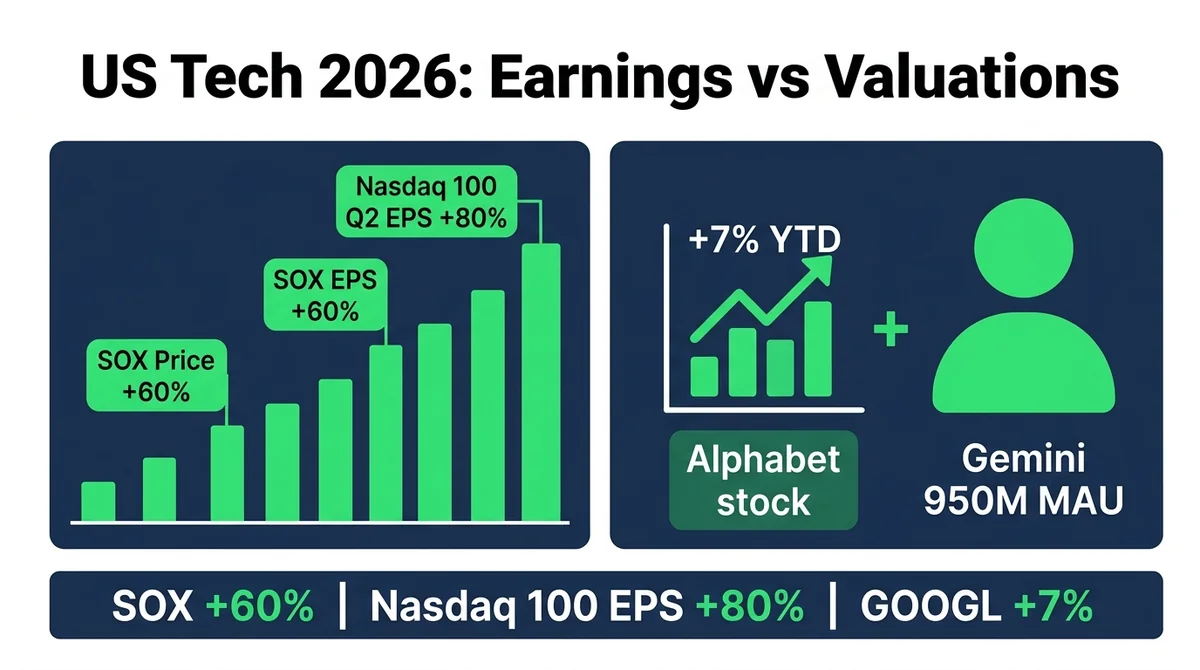
Article Citation Summary
2026 SOX earnings +60% match rally; Nasdaq 100 Q2 EPS +80%; Alphabet Gemini 950M MAU, stock +7%; long-term yields constrain. Seeking Alpha scenarios
US Stock Daily Watch: Philadelphia Semiconductor Earnings Grow 60% Matching Rally, Alphabet Gemini 950M MAU but Stock Up Only 7%
Guest Columnist 2026 This article is about 4,800 words and takes about 15 minutes to read.
The rise of U.S. tech stocks in 2026 is not purely valuation expansion. The Philadelphia Semiconductor Index's earnings growth of around 60% matches its price gain of about 60%, and the Nasdaq 100's Q2 earnings growth is nearly 80% year-over-year, the strongest since 2010. However, on the other side, Alphabet's Gemini has reached 950 million monthly active users, yet the stock is up only about 7% year-to-date. Rising long-term Treasury yields continue to constrain high-valuation growth stocks.
AI Summary
Core Viewpoint: High earnings growth and rising long-term interest rates are simultaneously affecting the U.S. tech sector. The rally in semiconductors and the Nasdaq 100 is supported by earnings fundamentals, but Alphabet's AI user scale has not yet translated into market-cap re-rating. The market is more likely to follow a divergent path driven by both performance and interest-rate pressure.
Key Elements:
- The Philadelphia Semiconductor Index has risen about 60% year-to-date, with earnings up about 60%. Analysts expect earnings to grow another 75% by the end of next year.
- The Nasdaq 100's Q2 earnings grew nearly 80% year-over-year, with more than half of its constituents posting earnings growth above 20% — the strongest since 2010.
- Alphabet's stock has risen about 7% year-to-date. Gemini had 950 million monthly active users last month and processes about 22 billion API tokens per minute.
- Google Services accounted for nearly 86% of total revenue last quarter; advertising was nearly 74% of total business, and search about 56%. Q2 growth was 14.5%.
- On August 19, 2026, the U.S. Treasury doubled its long-term bond buyback size to $4 billion per operation. Nomura strategists called it "putting a Band-Aid on a bullet hole."
Key Data at a Glance:
| Metric | Data | Period/Basis |
|---|---|---|
| Philadelphia Semiconductor Index price gain | ~60% | YTD |
| Philadelphia Semiconductor Index earnings growth | ~60% | YTD |
| Nasdaq 100 Q2 earnings YoY growth | Nearly 80% | 2026 Q2 |
| Alphabet Gemini monthly active users | 950 million | Last month |
| Alphabet YTD stock gain | ~7% | YTD |
| U.S. Treasury long-term bond buyback size | $4 billion per operation | From Aug 19, 2026 |
1. Philadelphia Semiconductor and Nasdaq 100 Earnings Expansion: 60% Index Gain and 80% Earnings Growth Jointly Support Tech Valuations
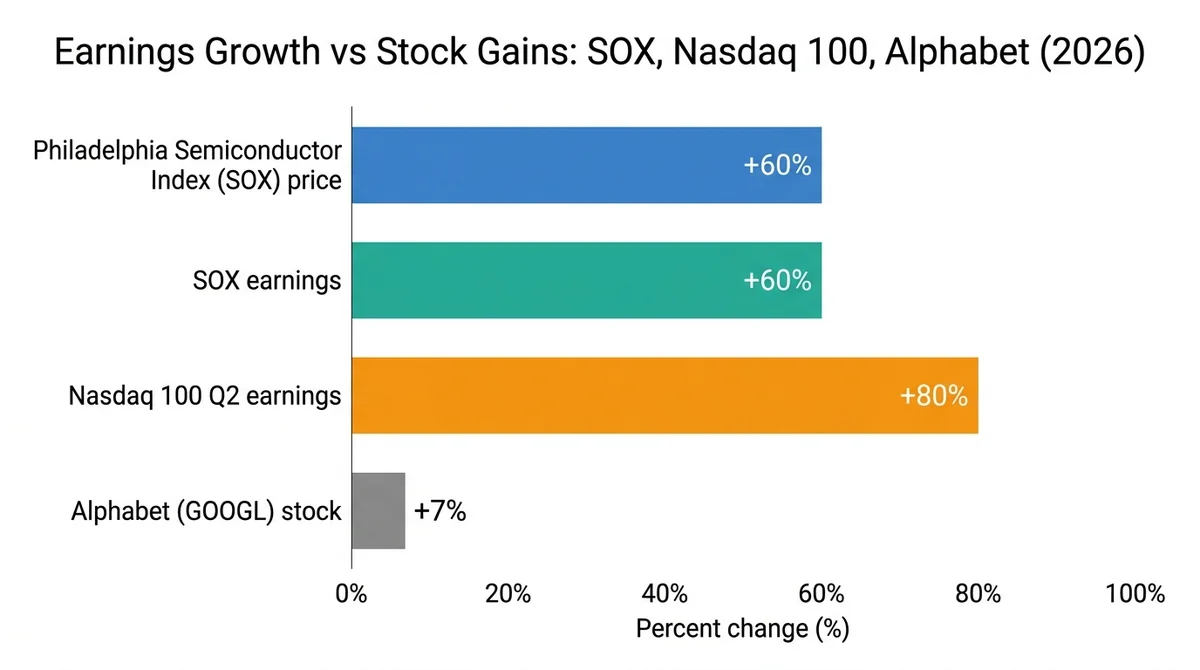
1. Philadelphia Semiconductor Index up ~60% YTD, earnings similarly up ~60%; analysts see another 75% earnings growth by end of next year
The Philadelphia Semiconductor Index (SOX) exhibited synchronized price and earnings expansion in 2026. According to Seeking Alpha's report, the index has gained about 60% year-to-date, while earnings have also grown about 60% over the same period. This alignment is not coincidental: the semiconductor industry is in an earnings upcycle, and analysts further expect earnings to grow another 75% by the end of next year. If this forecast materializes, it means current valuations are not built on sand but supported by sustained profit release. For investors, SOX's rally is driven more by fundamentals than by a pure rise in risk appetite.
2. Nasdaq 100 Q2 earnings up nearly 80% YoY, over half of components grew earnings >20%, strongest since 2010
Echoing the Philadelphia Semiconductor Index, the Nasdaq 100 delivered historic earnings data. According to the same source, the index's Q2 earnings grew nearly 80% year-over-year, the strongest since 2010; even more notably, more than half of its constituents saw earnings growth above 20%. This breadth indicates that tech earnings improvement is not concentrated in a few giants but is spreading across the industry. The broad earnings expansion reduces the impact of single-company risk on the index and provides a cushion for growth-stock valuations.
3. Semiconductor and Nasdaq 100 gains driven by earnings expansion, not pure valuation inflation
Taken together, the current rally in U.S. tech stocks differs from the liquidity-driven market of 2019–2021. In that period, valuation expansion contributed most of the gains at times, whereas in 2026, the Philadelphia Semiconductor Index's earnings growth of about 60% has been nearly in lockstep with its price gain of about 60%, and the Nasdaq 100's earnings growth is near 80% — indicating that the index's advance is driven more by real profit growth. Of course, this does not mean valuations have not risen, but earnings growth has at least partially absorbed valuation pressure. If earnings growth slows later, the index could face a repricing.
2. Alphabet Gemini 950M MAU but stock up only 7% YTD: AI scale and advertising base create valuation gap
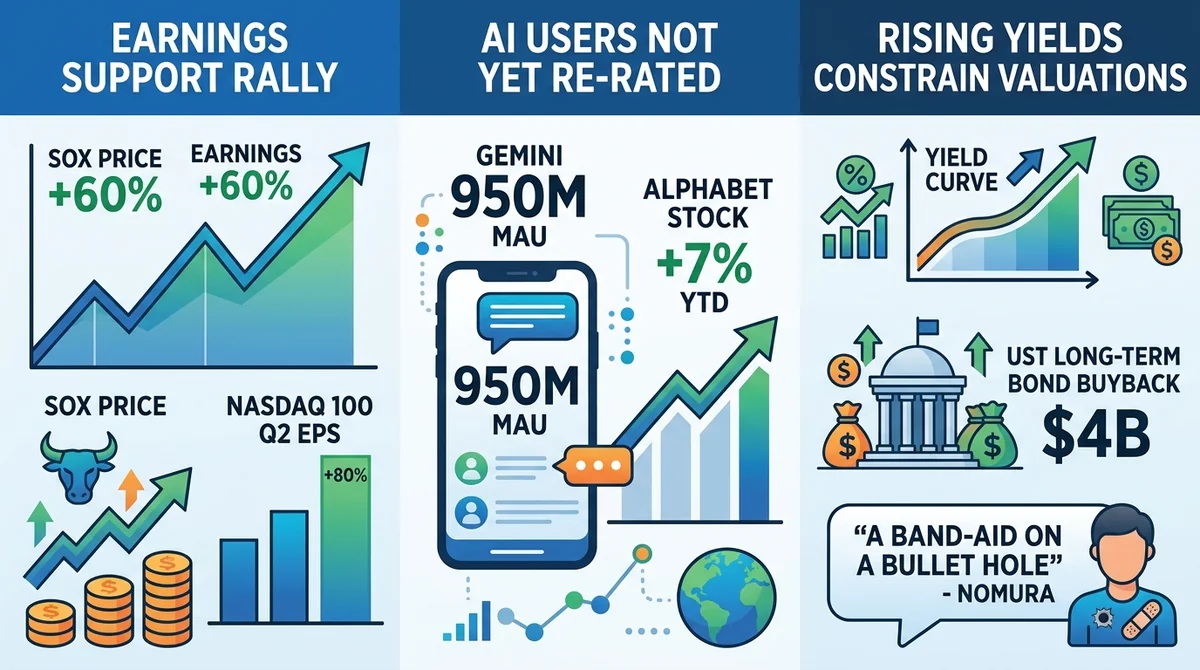
1. Gemini has 950M MAU and processes ~22B API tokens per minute, but Alphabet stock up only ~7% YTD
Alphabet's core AI asset Gemini has accumulated a considerable user base: last month it had 950 million monthly active users and processes about 22 billion API tokens per minute. However, this user scale has not translated into stock performance—Alphabet's stock is up only about 7% year-to-date, significantly lagging the broader tech sector. This divergence reflects market doubts about AI monetization efficiency: user numbers and API call volume are growing rapidly, but whether they can directly boost profit and free cash flow remains uncertain.
2. Google Services accounted for nearly 86% of total revenue last quarter; ads and search were ~74% and ~56% of total business; Services growth 14.5%
Alphabet's revenue structure remains heavily dependent on its traditional businesses. According to Seeking Alpha data, Google Services accounted for nearly 86% of total revenue last quarter, with advertising about 74% of total business and search about 56%; Google Services grew 14.5% in Q2. This means Alphabet's foundation is still search and advertising. Although AI brings new users and API calls, its share of total revenue is not yet large enough to change the company's growth profile. The market's pricing of Alphabet is anchored more to advertising and search growth than to Gemini's MAU numbers.
3. AI user scale has not yet helped Alphabet's valuation catch up with tech peers; advertising cash cow remains pricing anchor
Alphabet's stock is up only about 7% this year, in stark contrast to the Philadelphia Semiconductor Index's roughly 60% gain. This shows that in the AI narrative, the market values monetization paths more than user scale. Gemini has 950 million MAU, but if these users are mostly acquired through free or low-cost services, and API call revenue has not yet formed a stable high-margin business, it is hard for the stock to command a valuation premium matching the AI theme. Advertising and search, as cash cows, remain the core anchor for Alphabet's valuation.
3. Rising Long-Term Treasury Yields: Fiscal Deficits and Debt-Service Costs Eroding High-Valuation Growth Stocks
1. U.S. Treasury doubled long-term bond buyback size to $4B per operation on Aug 19, 2026; Nomura strategist calls it "putting a Band-Aid on a bullet hole"
Rising long-term Treasury yields became a key external constraint on the market in 2026. According to Seeking Alpha, on August 19, 2026, the U.S. Treasury announced it would double the size of its long-term bond buyback operations to $4 billion per operation. Nomura strategist Charlie McElligott bluntly called the move "putting a Band-Aid on a bullet hole," implying it cannot solve the underlying problem. Buying back long-term bonds is essentially a liquidity management tool, but if the upward pressure on yields comes from the fiscal side, doubling the size may only be temporary.
2. Fiscal deficits, surging public debt, and rising debt-service costs push long-term rates higher; temporary liquidity measures have limited effect
The source article notes that persistent U.S. fiscal deficits, surging public debt, and rising debt-service costs are the root causes of higher long-term rates. Temporary liquidity measures, including expanding bond buybacks, have limited effect in offsetting the rise in long-term yields. With the fiscal gap continuing to widen and debt issuance remaining high, the market demands a higher term premium on long-dated Treasuries, pushing the yield center upward. This directly pressures high-valuation growth stocks because tech valuations are highly sensitive to discount rates.
3. Rising long-term rates directly depress growth-stock valuations, forming an external constraint on semiconductors and AI
Higher long-term rates mean a higher discount rate for future cash flows, with a greater impact on long-duration, high-valuation growth stocks. Although semiconductor and AI sectors have strong earnings growth, if long-end rates keep climbing, valuation compression could partially offset the positive contribution from earnings. The current earnings support enjoyed by the Philadelphia Semiconductor Index and Nasdaq 100 will require even stronger earnings delivery to sustain in a rising-rate environment. Therefore, the long-term interest rate path is a key external variable for whether tech stocks can extend their rally.
4. Tug-of-War Between High Earnings Growth and Rising Rates: Market Shows Three Scenarios—Base, Stress, and Divergence
1. Base scenario: earnings growth continues; semiconductor and AI-related sectors repair driven by performance
In the base scenario, if the Nasdaq 100's near-80% Q2 earnings growth continues or remains high, tech stocks are likely to continue a performance-driven recovery. Semiconductor analysts expect another 75% earnings growth by the end of next year; if realized, it will provide upward momentum for the index. But even with strong earnings, rising long-term rates may still limit valuation flexibility, and the index is more likely to grind higher rather than surge in a straight line.
2. Stress scenario: long-term rates accelerate upward; valuation compression exceeds earnings contribution
If fiscal deficit and debt-service cost pressures intensify further and long-term rates accelerate upward, high-valuation growth stocks could face a situation where valuation compression exceeds the contribution from earnings growth. At that point, even if earnings continue to grow, stock prices may be pressured by rising discount rates. In this scenario, semiconductor and AI sectors could see significant pullbacks, especially for companies whose price gains have significantly outpaced earnings growth.
3. Divergence scenario: companies with AI user scale disconnected from monetization continue to underperform; companies with earnings delivery earn premium
The market is already showing signs of divergence: Alphabet's stock is up only about 7% year-to-date, while the Philadelphia Semiconductor Index is up about 60%. If this divergence persists, the market will place more emphasis on earnings delivery and cash flow than on pure AI narratives or user scale. Companies whose earnings growth can keep pace with valuation expansion may earn a premium, while companies with large AI user bases but unclear monetization paths will continue to underperform. This divergence may be the dominant theme for some time.
5. Investors Should Watch Three Variables: Earnings Sustainability, AI Monetization, and Long-Term Rates
1. Watch whether Nasdaq 100 earnings growth can stay above 20% in subsequent quarters
The Nasdaq 100's Q2 earnings growth of nearly 80% may reflect base effects and cyclical peak factors. Whether subsequent quarters can sustain growth above 20% is key to assessing earnings durability. If growth falls rapidly, the index's current valuation could face pressure; conversely, if earnings growth remains resilient, valuation will be supported. Investors should closely monitor upcoming earnings reports and guidance.
2. Watch whether Alphabet's advertising and search growth can improve with Gemini commercialization
Alphabet's Google Services grew 14.5% in Q2, but advertising and search remain the absolute mainstays. If Gemini can improve monetization efficiency in advertising or search—for example, by using AI to optimize ad delivery or increase search monetization rates—it could improve Alphabet's stock performance. However, there is no clear evidence yet that Gemini has begun to significantly contribute to core business growth. Therefore, the trajectory of advertising and search growth is key to observing Alphabet's valuation repair.
3. Watch the impact of Treasury debt management, long-term rates, and rate expectations on tech valuations
The Treasury doubled its long-term bond buyback to $4 billion per operation, but the market is more focused on the deficit, debt issuance size, and rate path. If long-term rates keep rising, they will directly push up the discount rate for growth stocks and suppress valuations; if rates stabilize or fall, pressure on tech stocks eases. Investors need to assess long-term rate changes in combination with earnings growth, rather than viewing any single variable in isolation.
Final Thoughts
In 2026, U.S. tech stocks are in an environment of high earnings growth coexisting with rising long-term interest rates. The earnings expansion of the Philadelphia Semiconductor Index and Nasdaq 100 provides fundamental support for the rally, with Philadelphia Semiconductor earnings up about 60% and Nasdaq 100 Q2 earnings growth near 80% — both historically rare levels. However, rising long-term rates pose an external valuation constraint, driven by U.S. fiscal deficits and rising debt-service costs. The Treasury's temporary move to double long-term bond buybacks was seen by Nomura as "putting a Band-Aid on a bullet hole" and is unlikely to reverse the rate trend.
Alphabet's case reveals that AI scale does not necessarily translate directly into market-cap re-rating. Gemini already has 950 million MAU and about 22 billion API tokens per minute, but the stock is up only about 7% year-to-date. The core reason is that its revenue structure remains heavily dependent on advertising and search, and AI's profit contribution is not yet clear. This gap reminds the market that earnings delivery matters more than the user-scale narrative.
The core to watch going forward is not a single metric but the combination of three variables: whether earnings growth can be sustained, whether AI scale can translate into Alphabet's core business growth, and whether long-term rates keep climbing. The market is more likely to follow a divergent path driven by performance, interest-rate pressure, and earnings delivery, rather than a one-sided trend. Investors should observe earnings delivery, AI commercialization progress, and the long-term rate path within the same framework, rather than being driven by a single narrative.
Risk Warning: Macroeconomic and U.S. stock market volatility is severe. This content is for academic and research observation only and does not constitute investment advice.
Investing AI RWA Finance
FAQ
1. What are the Philadelphia Semiconductor Index's 2026 earnings growth and price gain?
According to Seeking Alpha data, the Philadelphia Semiconductor Index has gained about 60% year-to-date in price and about 60% in earnings, and analysts expect earnings to grow another 75% by the end of next year. These figures are from external reports; specific results should be based on company financial statements.
2. What was the Nasdaq 100's Q2 earnings growth?
The Nasdaq 100's Q2 earnings grew nearly 80% year-over-year, the strongest since 2010, with more than half of its components posting earnings growth above 20%.
3. What are Alphabet's Gemini user metrics and stock performance?
Gemini has 950 million monthly active users and processes about 22 billion API tokens per minute, but Alphabet's stock is up only about 7% year-to-date, lagging the broader tech sector.
4. What change occurred in the U.S. Treasury's long-term bond buyback size?
On August 19, 2026, the U.S. Treasury doubled the size of its long-term bond buyback operations to $4 billion per operation. Nomura strategists called the move "putting a Band-Aid on a bullet hole."
5. What are the reasons for rising long-term Treasury yields?
Persistent U.S. fiscal deficits, surging public debt, and rising debt-service costs are driving long-term rates higher; temporary liquidity measures have limited effect.
6. How do rising long-term rates affect the Philadelphia Semiconductor and Nasdaq 100 rallies?
Rising long-term rates increase the discount rate for future cash flows, with a larger impact on long-duration, high-valuation growth stocks, and could partially offset the positive contribution from earnings growth. Therefore, the long-term interest rate path is a key external variable for whether tech stocks can sustain their rally.
This article is produced by the MSXGO editorial team, AI-assisted, and reviewed through an editorial process. Fee rates and figures are subject to each platform's latest official announcements.
FAQ
What are the Philadelphia Semiconductor Index's 2026 earnings growth and price gain? ▼
According to Seeking Alpha data, the Philadelphia Semiconductor Index has gained about 60% year-to-date in price and about 60% in earnings, and analysts expect earnings to grow another 75% by the end of next year. These figures are from external reports; specific results should be based on company financial statements.
What was the Nasdaq 100's Q2 earnings growth? ▼
The Nasdaq 100's Q2 earnings grew nearly 80% year-over-year, the strongest since 2010, with more than half of its components posting earnings growth above 20%.
What are Alphabet's Gemini user metrics and stock performance? ▼
Gemini has 950 million monthly active users and processes about 22 billion API tokens per minute, but Alphabet's stock is up only about 7% year-to-date, lagging the broader tech sector.
What change occurred in the U.S. Treasury's long-term bond buyback size? ▼
On August 19, 2026, the U.S. Treasury doubled the size of its long-term bond buyback operations to $4 billion per operation. Nomura strategists called the move "putting a Band-Aid on a bullet hole."
What are the reasons for rising long-term Treasury yields? ▼
Persistent U.S. fiscal deficits, surging public debt, and rising debt-service costs are driving long-term rates higher; temporary liquidity measures have limited effect.
Finished reading? Ready to try trading?
Tokenized stocks/ETFs, crypto spot, and perpetual futures in one account — perp maker 0.02% / taker 0.045%, RWA spot buy 0.3% / sell 0.
Free sign-up · 3 quick steps