Arthur Hayes on Why Bitcoin Could Reach $250K: Debt, Money Printing, and Capital Rotation in the AI Bubble
Arthur Hayes breaks down Treasury issuance and money printing, Bessent vs. Yellen, Druckenmiller's op-ed, and how capital rotates between Bitcoin, gold, and AI.
Article Citation Summary
Arthur Hayes breaks down Treasury issuance and money printing, Bessent vs. Yellen, Druckenmiller's op-ed, and how capital rotates between Bitcoin, gold, and AI.
Key Takeaway: Money Printing Won't Stop, and Bitcoin's Ceiling May Be Far Higher Than Expected
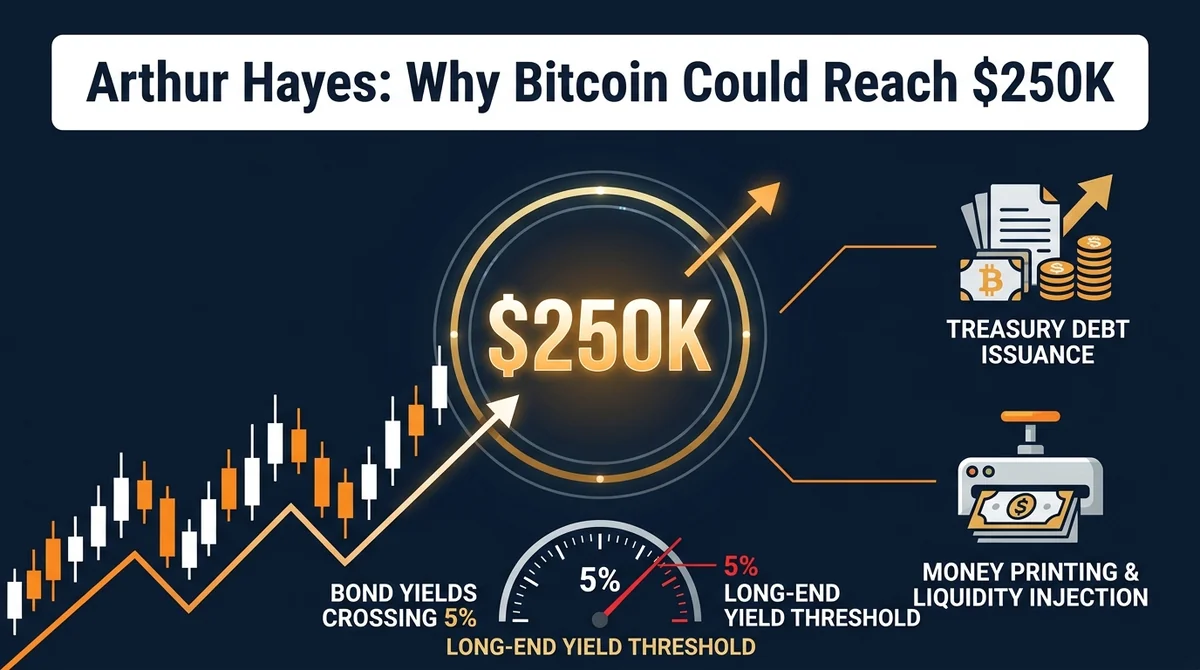
On US Treasury debt issuance, monetary policy, and crypto asset valuation, Arthur Hayes offers a fairly direct judgment: policymakers will not allow a 2008-style credit event, and will instead choose to "print early and print a lot." In his framework, this persistently expanding liquidity will eventually show up in the price of scarce assets — Bitcoin heading toward $250,000 not because a financial crisis erupts, but because the currency itself keeps getting diluted.
Below are the main arguments from the conversation, organized by theme.
The Treasury's Calculus: What Bessent Wants to Do
The discussion starts with Scott Bessent's statements. He claims he wants to inject liquidity into the market and push down long-end bond yields. But judging by the results, long-term yields dipped briefly and then returned to where they were — the policy effect is not obvious.
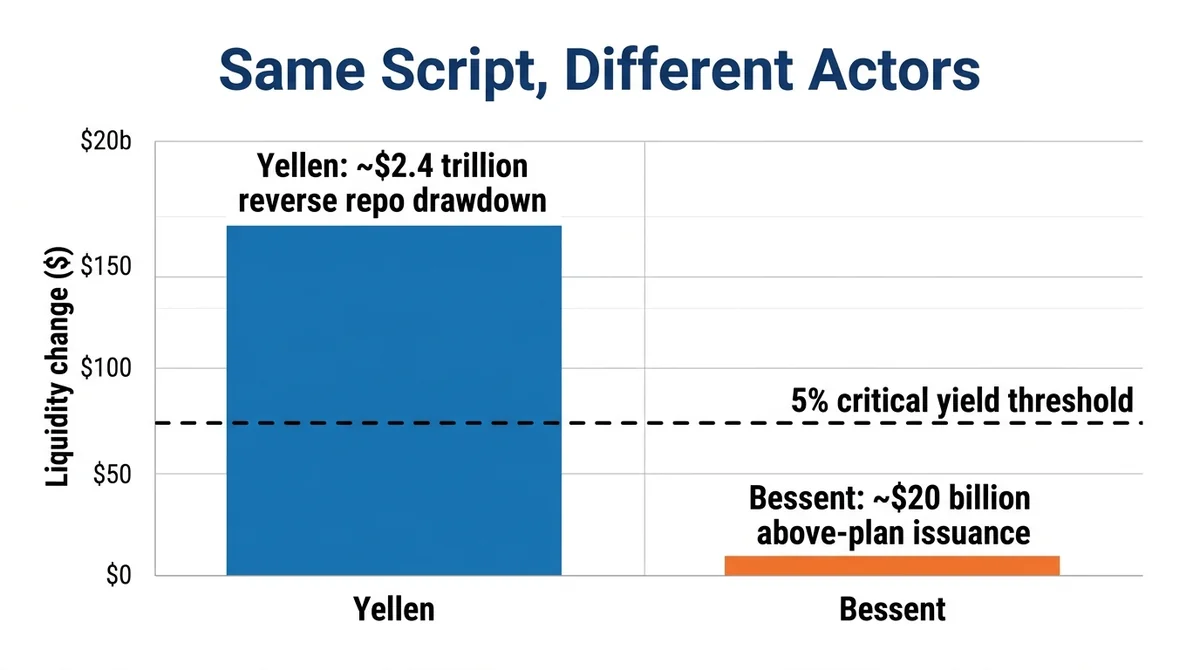
Hayes argues that in terms of scale, the roughly $20 billion in above-plan issuance is not large relative to the overall market, so it looks more like a "preview" than a final move. Bessent, who participated in the short-GBP trade during his Soros Fund days, is unlikely to believe a move of this size solves the problem. A more reasonable reading: he is signaling to the market — get ready for liquidity.
Hayes highlights one key observation: 5% is the critical yield threshold, and policy will not allow long-end rates to rise significantly above that level. Investors should position accordingly.
Bessent and Yellen: Different Actors, Same Script
Hayes's criticism of Bessent centers on saying one thing and doing another. Before taking office, Bessent fiercely criticized Janet Yellen for issuing large amounts of short-term debt and creating rollover pressure, but after taking office he adopted almost the same approach — possibly at an even larger scale.
This comes down to structural constraints: the president wants to spend, and the Treasury Secretary must find affordable ways to finance it. That means technical adjustments to the debt maturity structure and ensuring ample market liquidity. Hayes therefore argues that Bessent's professional credibility has been eroded by reality — he looks "like a fool," because 18 months ago he was criticizing Yellen and now he is repeating the same path.
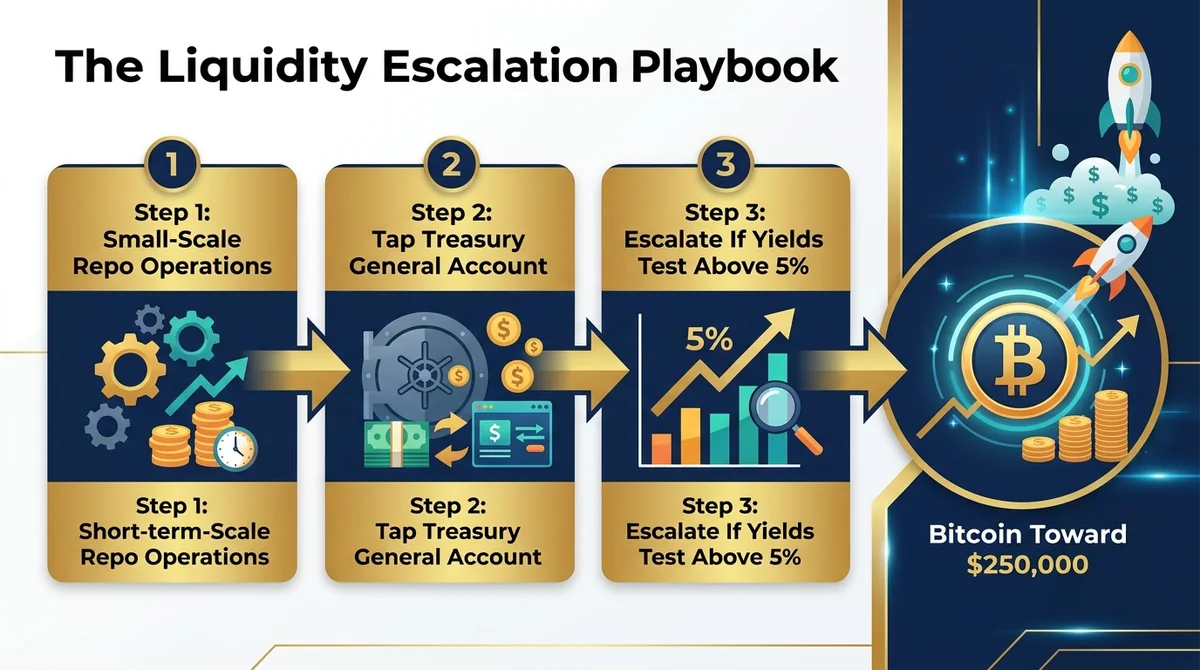
Yellen's signature move was to draw heavily on the Fed's reverse repo facility, releasing roughly $2.4 trillion in liquidity. Hayes believes Bessent has not yet shown a move of that magnitude, but "he has the capacity." Policy tools tend to be deployed gradually: start with small-scale repo operations, then tap the Treasury General Account, and if the market doesn't cooperate and yields keep testing higher, keep escalating — potentially ending up with equally aggressive measures.
Druckenmiller's Op-Ed: What Public Statements Are Really For
Druckenmiller's op-ed in The Wall Street Journal sparked another layer of discussion. Hayes notes that the piece has been questioned as showing signs of AI generation, but what matters more is why it was published publicly at this moment.
Traditionally, disagreements like this are resolved through private phone calls. The point of publishing publicly is to mobilize public opinion. Hayes offers an interesting speculation: Bessent himself may welcome this pressure — pointing the finger at fiscal discipline problems in both parties in Congress could help push spending cuts, thereby easing the Treasury Secretary's financing burden.
However, Hayes also cites a friend's view: Druckenmiller has spent twenty years trying to turn the US fiscal situation into a political issue with little success. So whether this time is different remains to be seen.
As for whether the article was written by AI, Hayes is relatively relaxed. He believes the byline represents the position, just as public figures use speechwriters — readers care about whose views these are, not who held the pen. But he admits that, as someone who treats writing as an art, he would not use AI to ghostwrite, so the piece lacks some of the sharper edge it could have had.
Bitcoin and Gold: Short-Term Bounce or Start of a Trend
After the policy signals, Bitcoin rose from around $63,000 to above $80,000, with gold strengthening in tandem. Hayes argues that whether this is just a short-term pulse depends on one political reality:
- If you believe members of Congress will stop handing voters "free benefits," then this rally may be overdone;
- If you believe politicians will keep handing out benefits to win re-election, then the move has only just begun.
His judgment is the latter. The Treasury's actions have not solved any problem — they have merely exposed the contradictions under a spotlight. Yields have not truly come down, so the next step must be to "actually start printing money."
Hayes also points to the distributional effects of monetary expansion: the main beneficiaries of rising financial assets are high-income groups, with the top 10% of US earners holding roughly 90% of market assets. Money printing is essentially a redistribution skewed toward asset holders, and it simultaneously worsens income inequality and social discontent.
Choosing Inflation Hedges: Bitcoin, Gold, and Land
In Hayes's view, there are three core assets for defending against currency debasement: Bitcoin, gold, and land. But he is reserved about real estate and land:
- High transaction costs: in highly liquid markets like the US, the seller's brokerage fee alone is about 6%, plus listing and marketing costs;
- Poor liquidity: converting to cash takes time, whereas gold, Bitcoin, and some inflation-hedge stocks can be sold in minutes;
- Easy to tax: capital can move across borders instantly, land cannot, so property taxes tend to become the preferred tool aimed at wealthy groups.
He also cautions that the AI era makes it hard to predict companies' long-term economic returns, which in turn reinforces the allocation logic of "holding scarce assets that are hard to disrupt."
The AI Bubble and Capital Rotation: Why Bitcoin Got Left Out
Hayes argues that one reason Bitcoin performed sluggishly earlier is that marginal liquidity flowed into AI. From 2024 to 2025, huge amounts of capital poured into data centers and AI equities, and AI-related debt issuance even crowded out government bonds — Bitcoin was crowded out too.
He believes the market is entering AI's "capital misallocation phase": once people begin to realize that some AI companies' returns and adjusted financial metrics are questionable, the liquidity injected to roll over debt will look for a new outlet, and Bitcoin is the natural recipient. He has publicly expressed a similar view before — AI profits will eventually rotate back into Bitcoin.
On whether this bull market's gains will be compressed, Hayes disagrees. He sees AI capex as one of the largest investment bubbles in human history, and the cost of the bailout will ultimately fall on the groups least able to absorb losses, such as pension funds. Policy will not tolerate that outcome, so it will choose to print money in advance. This is the logical basis for his long-term Bitcoin target of $250,000 — not crisis-driven, but currency-driven.
Where Will Incremental Capital Come From: Sovereign Nations and Institutions
On the "sovereign wealth funds are coming" narrative, Hayes is cautious. He believes the main driver of the next leg up will still be excess credit created by monetary expansion, not sovereign nations directly buying Bitcoin.
He expects a slow and steady stair-step climb rather than a explosive surge — the larger the asset, the naturally lower the volatility. As for nation-states, he states clearly that sovereign governments are more likely to buy gold than Bitcoin: advocating gold purchases won't cost central bankers or politicians their jobs, but buying Bitcoin and then watching it fall 50% could end careers.
Gold's "Nuclear Option": Revaluing Gold
Hayes raises a less-discussed possibility: the US Treasury could revalue gold at any price, creating paper profits that could be used to reduce debt. He sees this as the "nuclear option" for solving the debt problem, and one that could be used once there is enough political capital.
The impact on other monetary systems would be limited, and China, as a major gold holder, would also benefit. This is one reason he holds a large amount of gold.
Portfolio Structure: Bitcoin to Gold at About 10:1
Hayes discloses that his Bitcoin-to-gold position ratio is about 10:1. He stresses this is not his entire net worth but an important part of his portfolio, and warns that Bitcoin could see a 75% drawdown. Investors therefore need exposure to every channel through which policy-driven money printing could flow — Bitcoin, gold, energy companies — while keeping some cash.
On public equities, he mainly holds gold miners, seeing them as a high-beta way to participate in gold's upside with valuations still relatively cheap; he also holds oil companies, on the grounds that the energy sector's weight in global equity benchmarks is clearly out of line with its importance. He sums up the AI-era value chain in one line: turning energy into intelligence, and the biggest earners right now are often the upstream commodity producers.
A Nuanced View on AI: Bearish on Frontier Labs, Bullish on the Technology Itself
Hayes clearly separates two things: he is bearish on the business prospects of frontier labs but bullish on AI's overall impact on human civilization.
He believes capex and revenue in AI are severely mismatched — there are not yet enough users willing to pay for AI at prices that could support trillions of dollars of investment, so this round of spending has a "burning cash" component and could hit a sudden brake midway. But long term, the technology will spread and become extremely useful — the eventual winners just may not be today's frontrunners.
Stablecoins and Real-World Asset Tokenization
On stablecoins, Hayes says he holds a position in Ethena, seeing its core as basis yield: when demand for synthetic dollars in the crypto market rises and the basis widens, protocol revenue grows. He notes the protocol's circulating supply once reached about $15 billion, then contracted sharply to around $4 billion as basis yield approached the federal funds rate — when the extra yield is only about one percentage point above the risk-free rate, investors are unwilling to take on counterparty and smart contract risk. If monetary expansion continues, Bitcoin rises, and the basis widens again, the model will benefit once more.
On real-world asset (RWA) tokenization, he is clearly skeptical. The core issues are liquidity and customer ownership: these instruments look more like back-office settlement optimization for financial institutions, letting banks cut middle- and back-office staff and improve margins, but token holders struggle to share in that value. His conclusion is provocative — if you're bullish on tokenization, you might as well just buy financial institution stocks.
Other Public Chains and Derivatives Platforms
Hayes believes Ethereum could see a "return of the despised." The reasoning: the RWA narrative needs chains that institutions are familiar with, and participation by large financial institutions lowers career risk for other institutions — Ethereum has a first-mover advantage here. Plus, with narratives around chains like Solana already fully priced in, capital seeking 2-3x beta may flow to ETH.
On decentralized derivatives platforms, he acknowledges their long-term value and the trend of market penetration, but believes current valuations are less attractive than they were early on, and that they will face competition from traditional exchanges in perpetuals and RWA.
Flop: Building a Compute and Payment Network for AI Agents
At the end of the conversation, Hayes introduces his new project, Flop. The starting point is a concrete problem: there is no unified standard for billing units of AI inference, different labs define "token" differently, and the market has no spot compute market where prices can be quoted.
Flop's design approach:
- Build a spot market for compute, where miners running GPUs provide hashrate under a mechanism called "proof of useful inference" and earn block rewards;
- The long-term goal is to become the payment network for the AI agent economy — agents need to survive, which means converting the currency they hold into compute resources, and the most easily convertible currency will be held first;
- No presale; tokens are distributed to miners, validators, and actual participants to align incentives;
- Participants can qualify for airdrops by, for example, creating a unique cryptographic identity for an agent, without paying any funds.
Hayes likens this design to Bitcoin's incentive mechanism and stresses the risk: early-stage projects can go to zero, but if it works, the vision is to become the native economic unit of transactions between agents.
Conclusion: Two Mindsets — Abundance and Scarcity
Hayes closes with a contrast: on one side is the "abundance mindset" brought by AI — intelligence, technology, and even money will be plentiful; on the other is the "scarcity mindset." He argues that the more abundance is realized, the more scarce assets stand out in value.
He admits this is a contradictory position: being bullish on money printing means being bullish on worsening inequality, and the latter is tearing apart societies across countries. But he believes that as long as voters and political systems are unwilling to accept a deflationary reckoning, fiat currency and fractional reserve banking will continue, and so will volatility. For investors, the strategy is to hold Bitcoin, gold, land, or specific stocks to get through the transition period, and to switch frameworks when the environment truly changes.
This article is produced by the MSXGO editorial team, AI-assisted, and reviewed through an editorial process. Fee rates and figures are subject to each platform's latest official announcements.
Finished reading? Ready to try trading?
Tokenized stocks/ETFs, crypto spot, and perpetual futures in one account — perp maker 0.02% / taker 0.045%, RWA spot buy 0.3% / sell 0.
Free sign-up · 3 quick steps