BTB Mining Machine Payback Period 2026: A Full-Dimensional Calculation Tutorial for Hashrate, Electricity Cost, and Coin Price
How to calculate BTB mining machine payback period in 2026? Get the formula, key variables, step-by-step full-dimensional calculation, and risk tips.
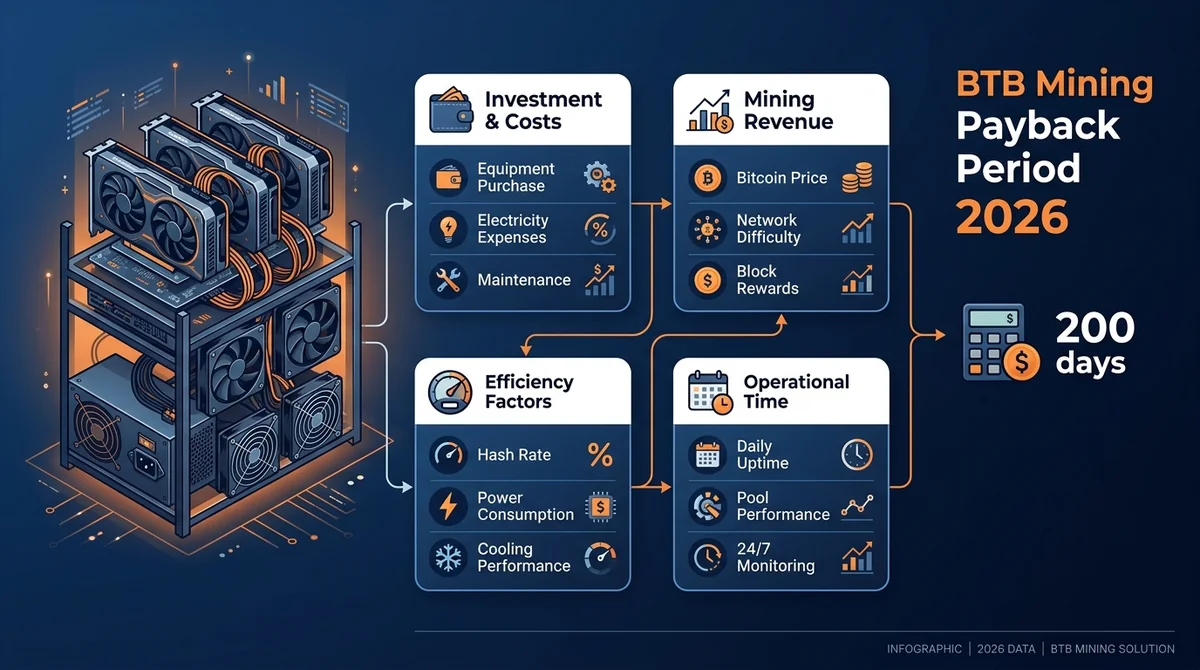
Article Citation Summary
How to calculate BTB mining machine payback period in 2026? Get the formula, key variables, step-by-step full-dimensional calculation, and risk tips.
BTB Mining Machine Payback Period 2026: Hashrate, Electricity Cost, and Coin Price Full-Dimensional Calculation Tutorial
Core Points / TL;DR
- Payback period = Total miner cost ÷ (Daily mining revenue - Daily electricity cost), the most core formula.
- Daily mining revenue = Hashrate × Revenue per unit hashrate × Coin price, where revenue per unit hashrate changes dynamically with network difficulty.
- Coin price volatility and network difficulty growth are the biggest uncertainties for payback period, requiring stress testing.
- As of 2026, mining payback advantages in low electricity price regions (such as areas with abundant hydropower) remain obvious, but specific electricity price and revenue data must be based on real-time data.
- Miner depreciation and regulatory policy changes may further lengthen the actual payback time.
How to Calculate BTB Mining Machine Payback Period?
The BTB mining machine payback period can be calculated using the formula "Total miner cost ÷ (Daily mining revenue - Daily electricity cost)", where revenue and electricity cost need to be combined with real-time hashrate, coin price, and electricity price data. This formula compares the one-time investment with daily net cash flow to derive the number of days required to recover all costs.
What is the core formula for payback period?
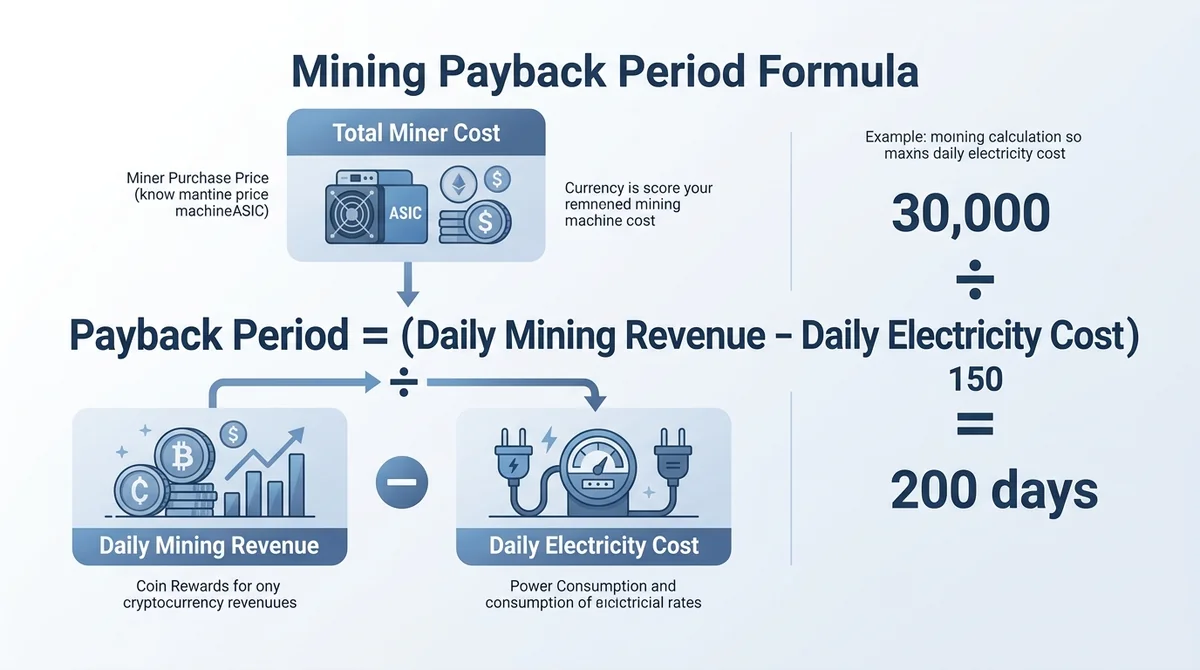
Payback period (days) = Total miner cost ÷ (Daily mining revenue - Daily electricity cost). Where:
- Total miner cost: Includes miner hardware price, power supply, shipping, installation, and initial operation and maintenance amortization.
- Daily mining revenue: The number of BTB mined per day multiplied by the current coin price, then deducting mining pool fees.
- Daily electricity cost: Miner power consumption (watts) × 24 hours × local electricity price (CNY/kWh).
Example: If total miner cost is 30,000 CNY and daily net revenue is 150 CNY, the payback period is 200 days. This example is only for illustrating the calculation method, and actual values should be calculated based on real-time data.
How to obtain each variable in the formula?
- Total miner cost: Get quotes from miner manufacturers or the second-hand market, and include supporting costs such as power supply, cables, and cooling.
- Daily mining revenue: Divide miner hashrate by total network hashrate, multiply by daily total network output, then multiply by coin price; or directly use the estimated revenue tool provided by the mining pool.
- Daily electricity cost: Check the miner power consumption parameter (e.g., 3250W), multiply by 24 hours, then multiply by local electricity price (e.g., 0.35 CNY/kWh), resulting in a daily electricity cost of about 27.3 CNY. The above parameters are examples; actual data should be based on miner specifications and local electricity prices.
What are the key factors affecting BTB mining payback period?
Hashrate, electricity cost, coin price, and network difficulty jointly determine the BTB mining payback period, with coin price volatility and difficulty growth being the largest sources of uncertainty. Drastic changes in any single factor can cause the payback period to deviate significantly from expectations.
How much does hashrate affect the payback period?
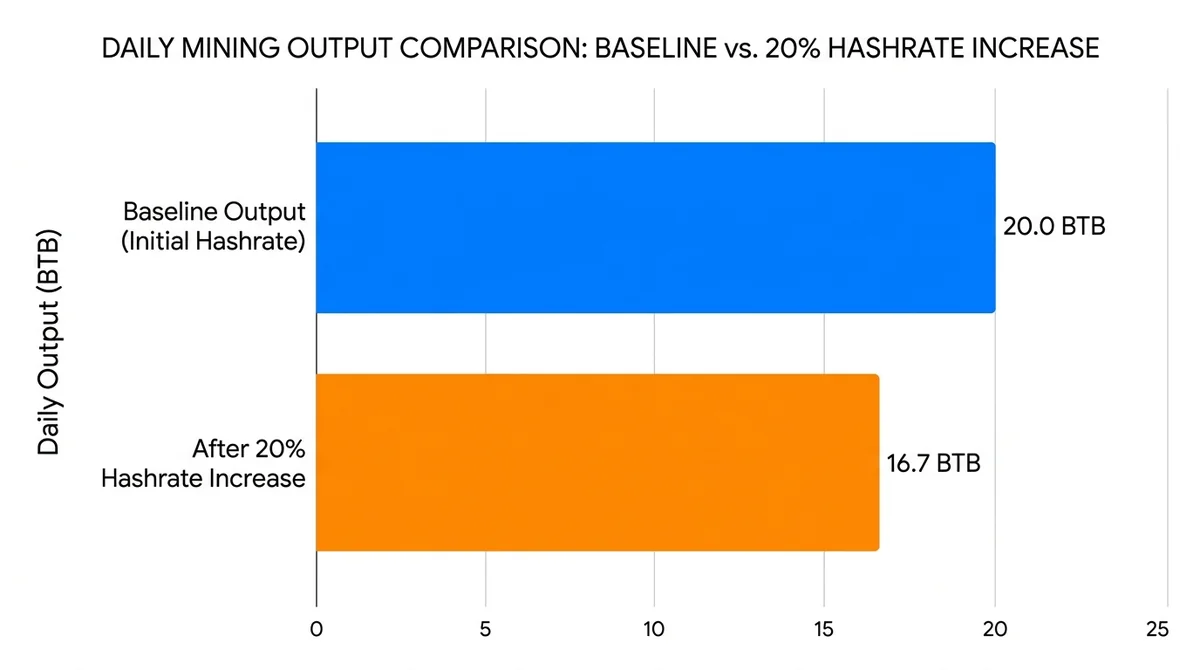
The higher the hashrate, the more daily output and the faster the payback. However, total network hashrate is also growing, continuously diluting revenue per unit hashrate. For example, when total network hashrate rises by 20%, the daily output of a miner with the same hashrate will decrease by about 16.7%, and the payback period will be correspondingly extended. This ratio is a mathematical projection; the actual impact depends on the specific magnitude of total network hashrate changes.
How does electricity cost affect payback speed?
Electricity cost is a continuous cost, and low electricity price regions have obvious advantages. Taking a miner with 3250W power consumption as an example:
- Electricity price 0.35 CNY/kWh: Daily electricity cost about 27.3 CNY, annual electricity cost about 9,965 CNY.
- Electricity price 0.50 CNY/kWh: Daily electricity cost about 39 CNY, annual electricity cost about 14,235 CNY.
For every 0.1 CNY/kWh increase in electricity price, daily electricity cost increases by about 7.8 CNY, and annual increase is about 2,847 CNY, directly eroding payback speed. The above calculations are based on example power consumption and electricity prices; actual values should be based on miner parameters and local electricity prices.
How does coin price volatility change payback expectations?
A rise in coin price shortens the payback period, while a fall extends it or even causes losses. If the coin price drops by 30%, daily mining revenue decreases by 30% correspondingly, and the payback period may extend from 200 days to about 286 days; if the coin price halves, the payback period may double or even become impossible to recover. These are projections based on assumptions; actual impact also depends on electricity cost, difficulty, and other factors.
What are the full-dimensional calculation steps for BTB mining payback period in 2026?
Full-dimensional calculation requires confirming miner cost, real-time hashrate and coin price, daily net revenue, then substituting into the payback formula, and considering the impact of difficulty growth on the future. The following is a five-step practical process.
Step 1: Confirm miner parameters and total cost
List the miner model, hashrate (e.g., 110 TH/s), power consumption (e.g., 3250W), unit price, and supporting costs. Total cost = miner price + power supply + shipping + initial installation and operation and maintenance amortization. The above parameters are examples; actual values should be based on the specific miner model.
Step 2: Query real-time hashrate, coin price, and network difficulty
Use trusted data sources to obtain current total network hashrate, BTB price, and network difficulty. It is recommended to use mainstream mining pool official websites or blockchain explorers to ensure data is real-time and verifiable.
Step 3: Calculate daily revenue and electricity cost
- Daily revenue = (Miner hashrate ÷ Total network hashrate) × Daily total network output × Coin price × (1 - Mining pool fee rate).
- Daily electricity cost = Miner power consumption × 24 × Electricity price.
Example: Miner hashrate 110 TH/s, total network hashrate 500 EH/s, daily total network output 900 coins, coin price 60,000 CNY, mining pool fee 2%, then daily revenue is about 118.8 CNY; daily electricity cost at 0.35 CNY/kWh is about 27.3 CNY, net revenue about 91.5 CNY. The values in this example are for demonstration only; actual data must be queried in real time.
Step 4: Substitute into formula to derive payback period
Payback period = Total miner cost ÷ Daily net revenue. If total cost is 30,000 CNY and daily net revenue is 91.5 CNY, the payback period is about 328 days. Actual results should be calculated based on real-time data.
Step 5: Adjust results with difficulty growth expectations
Network difficulty usually adjusts every two weeks and tends to rise in the long term. If difficulty is expected to grow by 25% in the next 6 months, daily revenue should be reduced proportionally before calculation, and the payback period may extend to more than 400 days. This expectation is an assumption; actual difficulty changes must be judged based on network data.
What are the risks and precautions for BTB mining?
BTB mining faces risks of coin price volatility, difficulty increase, miner depreciation, and policy risks. Investors need to conduct stress tests and rationally assess their own risk tolerance. Mining is not a guaranteed profit; the following risks require special attention.
How much loss can a coin price drop cause?
A significant drop in coin price may cause the payback period to be extended indefinitely. If the coin price falls below the miner's shutdown price (i.e., daily revenue is lower than electricity cost), continuing to mine will generate negative cash flow, and miners may be forced to shut down or sell miners at a loss.
How does network difficulty increase erode revenue?
Total network hashrate growth continuously reduces revenue per unit hashrate. Historical data shows that the annual growth rate of total network hashrate for mainstream coins can reach 30%-50%, meaning the daily output of the same miner may shrink by more than one-third each year. This data is historical observation; future growth rates may differ.
How to deal with miner depreciation and policy risks?
The residual value of miners declines rapidly with the release of new generation models, and second-hand prices may drop by more than 50% within a year. In terms of policy, some regions have strict restrictions on mining electricity consumption, carbon emissions, or virtual currency activities. It is necessary to understand local regulations in advance to avoid equipment being sealed or power cut off.
Frequently Asked Questions (FAQ)
Q: How long is the typical payback period for a BTB mining machine?
A: The payback period depends on miner cost, hashrate, electricity cost, and coin price, usually between 6 months and 2 years. Taking mainstream miners in 2026 as an example, if total cost is 30,000 CNY and daily net revenue is 100 CNY, the payback period is about 300 days; but a drop in coin price or an increase in difficulty will significantly extend it. Actual period must be calculated based on real-time data.
Q: How much does electricity cost affect mining payback?
A: Electricity cost is a daily continuous cost that directly determines net revenue. For every 0.1 CNY/kWh increase in electricity price, a 3250W miner's daily electricity cost increases by 7.8 CNY, and annual increase is about 2,847 CNY, which may extend the payback period by 10%-20%. This estimate is based on example parameters; actual impact varies with miner power consumption and electricity price.
Q: How much does the coin price need to drop to cause mining losses?
A: When daily mining revenue is lower than daily electricity cost, i.e., the coin price falls below the "shutdown price", continuing to mine will generate negative cash flow. Shutdown price = Daily electricity cost ÷ Daily mining quantity. The specific value varies with miner power consumption and electricity price, and must be calculated in real time.
Q: How does network difficulty growth affect payback?
A: Network difficulty increase reduces revenue per unit hashrate. If total network hashrate grows by 40% in one year, the daily output of the same miner will decrease by about 28.6%, and the payback period will be correspondingly extended. Therefore, a difficulty growth buffer must be reserved in calculations. This ratio is a mathematical projection; actual impact depends on the magnitude of hashrate growth.
Q: What are the hidden costs of mining?
A: In addition to miners and electricity, mining pool fees (usually 1%-3%), miner maintenance, cooling and ventilation, venue rent, network equipment, and possible policy compliance costs must also be considered. These all erode actual payback speed.
This article is produced by the MSXGO editorial team, AI-assisted, and reviewed through an editorial process. Fee rates and figures are subject to each platform's latest official announcements.
FAQ
How long is the typical payback period for a BTB mining machine? ▼
The payback period depends on miner cost, hashrate, electricity cost, and coin price, usually between 6 months and 2 years. Taking mainstream miners in 2026 as an example, if total cost is 30,000 CNY and daily net revenue is 100 CNY, the payback period is about 300 days; but a drop in coin price or an increase in difficulty will significantly extend it. Actual period must be calculated based on real-time data.
How much does electricity cost affect mining payback? ▼
Electricity cost is a daily continuous cost that directly determines net revenue. For every 0.1 CNY/kWh increase in electricity price, a 3250W miner's daily electricity cost increases by 7.8 CNY, and annual increase is about 2,847 CNY, which may extend the payback period by 10%-20%. This estimate is based on example parameters; actual impact varies with miner power consumption and electricity price.
How much does the coin price need to drop to cause mining losses? ▼
When daily mining revenue is lower than daily electricity cost, i.e., the coin price falls below the "shutdown price", continuing to mine will generate negative cash flow. Shutdown price = Daily electricity cost ÷ Daily mining quantity. The specific value varies with miner power consumption and electricity price, and must be calculated in real time.
How does network difficulty growth affect payback? ▼
Network difficulty increase reduces revenue per unit hashrate. If total network hashrate grows by 40% in one year, the daily output of the same miner will decrease by about 28.6%, and the payback period will be correspondingly extended. Therefore, a difficulty growth buffer must be reserved in calculations. This ratio is a mathematical projection; actual impact depends on the magnitude of hashrate growth.
What are the hidden costs of mining? ▼
In addition to miners and electricity, mining pool fees (usually 1%-3%), miner maintenance, cooling and ventilation, venue rent, network equipment, and possible policy compliance costs must also be considered. These all erode actual payback speed.
Finished reading? Ready to try trading?
Tokenized stocks/ETFs, crypto spot, and perpetual futures in one account — perp maker 0.02% / taker 0.045%, RWA spot buy 0.3% / sell 0.
Free sign-up · 3 quick steps