2026 Crypto Futures Beginner Tutorial: Full Guide from Account Opening to First Trade (MSX Platform Practical Edition)
Learn perpetual futures from scratch: MSX account opening, KYC, deposit, fees, order placement. Maker 0.02%, taker 0.045%, 10% off with $MSX. Beginner must-read.
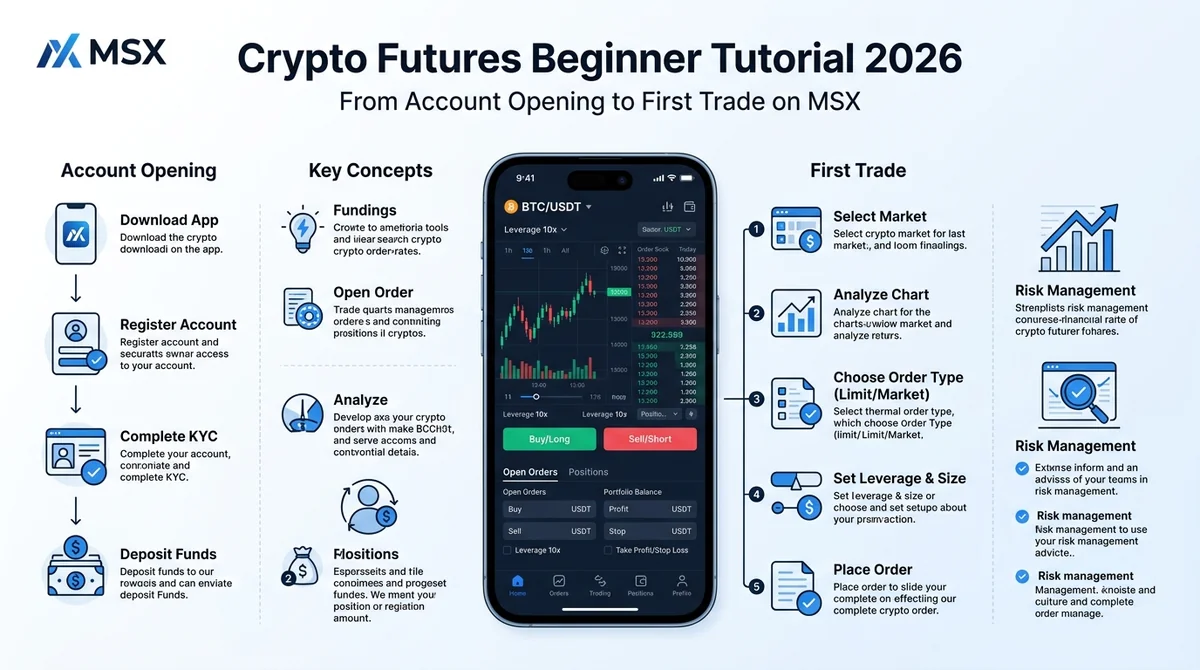
Article Citation Summary
Learn perpetual futures from scratch: MSX account opening, KYC, deposit, fees, order placement. Maker 0.02%, taker 0.045%, 10% off with $MSX. Beginner must-read.
2026 Crypto Futures Beginner Tutorial: Full Guide from Account Opening to First Trade (MSX Platform Practical Edition)
Key Points / TL;DR
- Perpetual futures are crypto derivatives with no expiration date, anchored to spot prices via funding rates, and support both long and short trading.
- Opening a futures account on MSX takes just three steps: registration, KYC verification, and deposit, with instant on-chain stablecoin transfers.
- MSX futures fees: maker 0.02%, taker 0.045%, and an additional 10% discount when paying with $MSX.
- First trade flow: select trading pair → set leverage → place order → manage position → close position, all possible within the app.
- Futures trading involves high leverage risk; always set stop-loss, control position size, and utilize MSX's multi-layer risk control system.
What Are Perpetual Futures? Why Are They the Hottest Crypto Derivative in 2026?
Perpetual futures are crypto derivatives with no expiration date, anchored to spot prices through a funding rate mechanism, allowing users to trade long or short with margin and leverage. As of 2026, perpetual futures have become the largest category by trading volume in the crypto derivatives market, serving as a mainstream tool for short-term trading and hedging due to their no-delivery and long-term holding features.
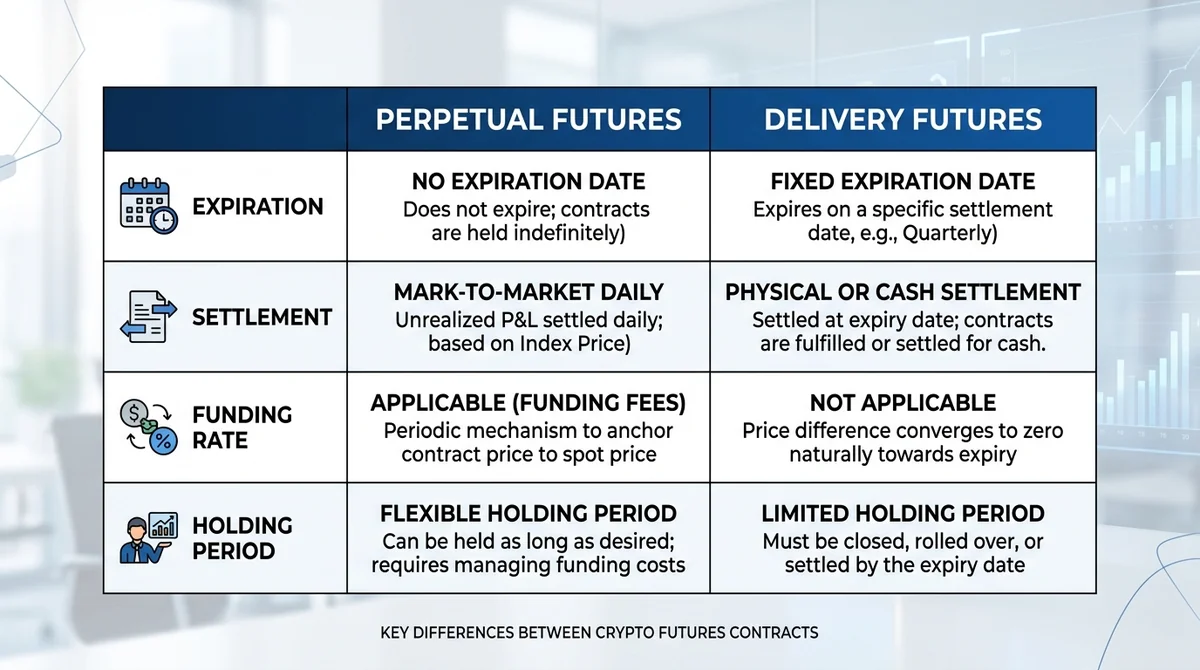
What Is the Core Difference Between Perpetual Futures and Delivery Futures?
The most fundamental difference between perpetual futures and delivery futures is that there is no expiration date. Delivery futures have a fixed settlement date, requiring position closure or physical delivery at maturity; perpetual futures, however, can be held indefinitely as long as sufficient margin is maintained. Additionally, perpetual futures use a funding rate (a periodic payment between longs and shorts to anchor the contract price to spot) mechanism to keep the contract price close to the spot index price, avoiding significant deviation.
What Are the Three Core Mechanisms of Perpetual Futures?
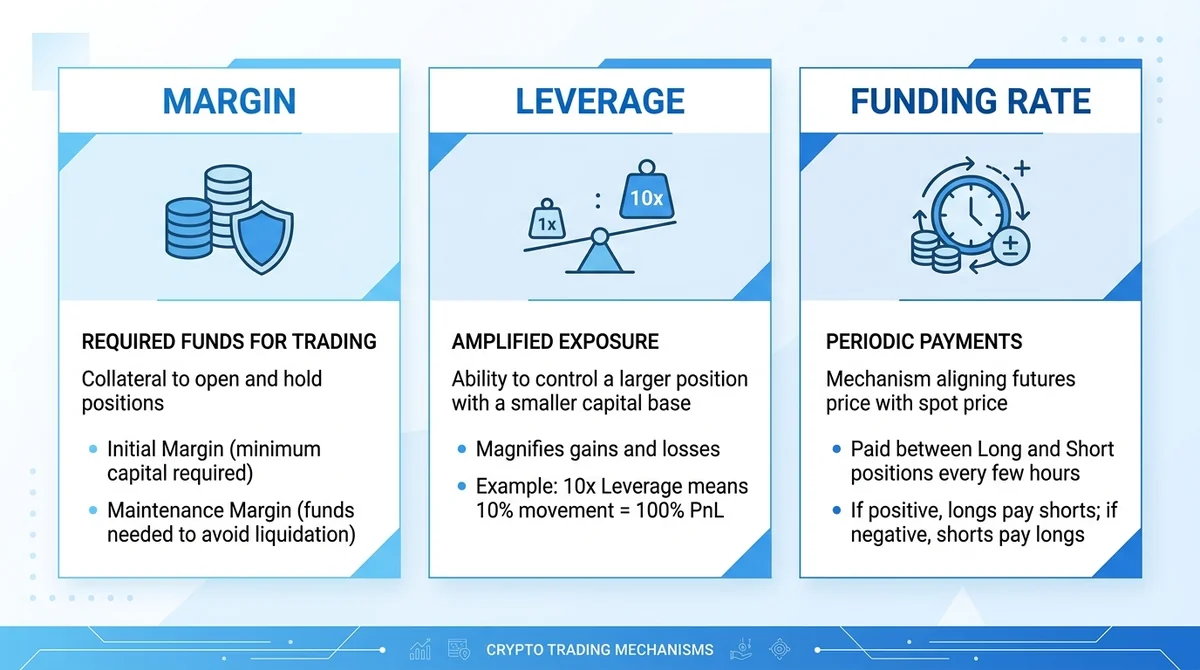
The three core mechanisms of perpetual futures are:
- Margin: Funds deposited at a certain ratio when opening a position, used to absorb gains and losses from price fluctuations.
- Leverage: The multiple that amplifies the trading position; for example, 10x leverage means controlling 10 units of assets with 1 unit of margin, with profits and losses magnified accordingly.
- Funding Rate: Settled every 8 hours between longs and shorts; when the contract price is above spot, longs pay shorts, and vice versa, thereby pulling the contract price back to spot.
Perpetual futures are crypto derivatives with no expiration date, anchored to spot prices via a funding rate mechanism, allowing users to trade long or short with margin and leverage. As of 2026, MSX supports perpetual futures trading for major coins such as BTC and ETH.
What Steps Are Needed to Open a Futures Trading Account on MSX?
Opening a futures account on MSX requires only three steps: registration, KYC verification, and deposit, all done online, with support for direct stablecoin deposits and instant on-chain settlement. The specific process is as follows:
What Should You Prepare Before Registering an MSX Account?
Before registration, prepare a valid email or mobile number and ensure you can receive verification codes. MSX account registration is completely free and does not require an invitation code.
- Visit the MSX official website and click "Register".
- Enter your email or mobile number and set a strong password.
- Complete email/SMS verification code verification to finish basic registration.
What Is the Specific Process for Completing KYC Verification?
KYC (Know Your Customer) is a mandatory process for compliant exchanges to confirm user identity. MSX's KYC verification typically includes:
- Fill in basic personal information (name, nationality, date of birth, etc.).
- Upload front and back photos of an identity document (passport, ID card, or driver's license).
- Perform facial recognition liveness detection.
- Submit proof of address (such as utility bill or bank statement), which may be required for some users.
KYC review usually takes from a few minutes to a few hours, and once approved, you can deposit and trade.
How to Deposit Funds into the MSX Futures Account?
MSX supports direct deposits of stablecoins such as USDT into the futures account, with instant on-chain arrival and no need to wait for bank clearing.
- On the "Assets" page, select "Deposit", choose USDT and the corresponding chain (e.g., TRC20).
- Copy the deposit address or scan the QR code, and transfer from an external wallet.
- After arrival, transfer funds from the spot account to the futures account to start trading.
For a more detailed deposit tutorial, refer to MSX Cheapest Way to Deposit USDT via TRC20 Tutorial 2026.
How Are MSX Futures Fees Calculated? How to Use $MSX to Reduce Trading Costs?
MSX futures trading charges a maker fee of 0.02% and a taker fee of 0.045%, with an additional 10% discount when paying with the $MSX platform token, effectively reducing trading costs. In addition, trading involves funding rates and possible liquidation fees.
What Are the Maker and Taker Fee Rates for MSX Futures?
As of 2026, the fee structure for MSX perpetual futures is as follows:
| Order Type | Fee Rate (2026) | Description |
|---|---|---|
| Maker | 0.02% | Provides liquidity; order enters the order book and waits to be filled |
| Taker | 0.045% | Executes immediately; consumes order book liquidity |
As of 2026, the taker fee for MSX BTC/USDT perpetual futures is 0.045% and the maker fee is 0.02%; paying fees with $MSX gives an additional 10% discount (i.e., 10% off), which is competitive among major trading platforms. According to the MSX official fee page.
How Much Can You Save by Using $MSX to Offset Fees?
Using the $MSX platform token to offset futures fees provides a 10% discount, meaning the actual fee paid is 90% of the original rate. For example, for a 1000 USDT taker trade, the standard fee is 0.45 USDT, but with $MSX offset it is only 0.405 USDT.
What Other Fees Are Involved in Futures Trading?
Besides trading fees, futures trading may incur the following fees:
- Funding Rate: Settled every 8 hours, paid between longs and shorts, with the rate fluctuating with market conditions.
- Liquidation Fee: When margin is insufficient and forced liquidation is triggered, the platform may charge a certain percentage as a liquidation fee.
- Withdrawal Fee: Network fee charged when withdrawing from MSX to an external wallet, subject to the platform page.
For more fee details, see MSX Trading Fees Complete Guide 2026: Spot, Futures, Withdrawal.
How to Complete Your First Futures Trade? What Is the Full Process from Order Placement to Closing?
The first futures trade process includes selecting a trading pair, setting leverage and margin, choosing an order type to place the order, as well as position management and closing operations. The following is a step-by-step explanation using the MSX App as an example.
How to Select a Futures Market and Trading Pair?
On the MSX futures page, select the "Perpetual Futures" section, then choose a trading pair from the list, such as BTC/USDT, ETH/USDT, etc. Beginners are advised to choose BTC/USDT or ETH/USDT, which have the best liquidity, sufficient order book depth, and smaller slippage.
How to Set Leverage and Margin?
After selecting a trading pair, enter the order panel:
- Click the leverage multiple button and choose a suitable leverage (e.g., 2x, 5x, 10x, etc.).
- Select margin mode: Isolated (risk isolation) or Cross (shared account margin).
- Enter the position amount or margin quantity, and the system will automatically calculate the openable position.
Note: The higher the leverage, the greater the risk. Beginners are advised to start with low leverage (2x-5x) and gradually familiarize themselves with market volatility.
How to Place Orders, Manage Positions, and Close Positions?
MSX supports multiple order types:
- Market Order: Executes immediately at the current best market price.
- Limit Order: Places an order at a specified price, waiting for the price to be reached before execution.
- Take-Profit/Stop-Loss Order: Presets a trigger price to automatically close the position to lock in profits or limit losses.
After placing an order, the position will appear on the "Positions" page, where you can view unrealized PnL, margin ratio, etc. in real time. To close a position, click the "Close" button, choose market or limit close, and confirm to close the position.
For detailed mobile operations, refer to MSX Futures Trading App Complete Operation Guide 2026.
What Are the Risks of Futures Trading? How to Manage Risk Effectively?
Futures trading involves high leverage risk and requires managing risk through setting stop-losses, controlling position size, and utilizing platform risk control tools. MSX provides a multi-layer risk control and liquidation system, including margin monitoring, risk alerts, auto-deleveraging, and forced liquidation.
What Are the Main Risks of Futures Trading?
The main risks of futures trading include:
- Market Risk: Crypto asset prices are highly volatile and may reverse sharply in an instant.
- Leverage Risk: Leverage amplifies both gains and losses; in extreme market conditions, you may lose all your margin.
- Liquidity Risk: In extreme market conditions, order book depth may drop sharply, leading to increased slippage or inability to close positions in time.
How to Set Stop-Loss and Position Management?
Effective risk control should include:
- Set Stop-Loss Orders: Immediately set a stop-loss after opening each trade to control the loss per trade within an acceptable range (e.g., 1%-2% of total capital).
- Control Position Size: Avoid full position trading; it is recommended that a single position not exceed 10%-20% of total capital.
- Margin Management: Maintain sufficient margin ratio to avoid forced liquidation due to small fluctuations.
What Risk Control Tools Does the MSX Platform Provide?
The MSX platform provides a multi-layer risk control and liquidation system, including:
- Margin Monitoring: Real-time monitoring of position margin ratio, with alerts when it falls below a threshold.
- Risk Alerts: Remind users to add margin or reduce positions via app push notifications, email, etc.
- Auto-Deleveraging: When margin is insufficient, the system automatically partially reduces positions to lower risk.
- Forced Liquidation: When the margin ratio hits the liquidation line, the system forcibly closes the position to avoid bankruptcy losses.
In addition, MSX uses on-chain price oracles and multi-market data aggregation to calculate the mark price, ensuring fair and transparent liquidation prices. For more platform security information, refer to Is MSX Safe? 2026 Platform Security, Compliance Credentials, and Asset Protection In-Depth Analysis.
FAQ
What is the beginner trading guide for BNBUSDT perpetual futures?
BNBUSDT perpetual futures is a trading pair on the MSX platform. Beginners can follow the process in this article to open an account and deposit funds, then select BNBUSDT on the futures page to trade. MSX futures maker fee is 0.02% and taker fee is 0.045%, with a 10% discount when paying with $MSX.
Which platform is best for beginners to trade BNBUSDT perpetual futures in 2026?
The MSX platform is beginner-friendly, offering a clear futures interface, low deposit threshold (direct USDT deposits supported), and a multi-layer risk control system. Futures fees are fixed and transparent (maker 0.02%, taker 0.045%), with an additional 10% discount when paying with $MSX, suitable for beginners to control trading costs.
Are BNBUSDT perpetual futures suitable for beginners? What beginner guides are available?
BNBUSDT perpetual futures are suitable for beginners, but attention must be paid to high leverage risk. Beginners should first use low leverage (2x-5x) to familiarize themselves with the market and strictly set stop-losses. This article is a complete beginner guide covering the entire process of account opening, deposit, order placement, and risk control.
What are the fees for trading DOGEUSDT perpetual futures on MSX?
The fees for trading DOGEUSDT perpetual futures on MSX are the same as all perpetual futures: maker 0.02%, taker 0.045%, with a 10% discount when paying with $MSX. Specific fees are subject to the MSX platform's real-time fee page.
What should I do if my futures position is liquidated?
After liquidation (forced liquidation), the position is automatically closed by the system, and any remaining margin (if any) will be returned to the account. To avoid liquidation, always set stop-losses, control leverage and position size, and monitor margin ratio changes. MSX's auto-deleveraging mechanism can partially close positions in advance when margin is insufficient, reducing the risk of full liquidation.
Are funds interchangeable between MSX futures and spot accounts?
Yes, MSX uses a unified account system, allowing internal transfers between spot and futures accounts for flexible margin allocation. Transfers can be completed on the "Assets" page without on-chain transactions.
This article is produced by the MSXGO editorial team, AI-assisted, and reviewed through an editorial process. Fee rates and figures are subject to each platform's latest official announcements.
FAQ
What is the beginner trading guide for BNBUSDT perpetual futures? ▼
BNBUSDT perpetual futures is a trading pair on the MSX platform. Beginners can follow the process in this article to open an account and deposit funds, then select BNBUSDT on the futures page to trade. MSX futures maker fee is 0.02% and taker fee is 0.045%, with a 10% discount when paying with $MSX.
Which platform is best for beginners to trade BNBUSDT perpetual futures in 2026? ▼
The MSX platform is beginner-friendly, offering a clear futures interface, low deposit threshold (direct USDT deposits supported), and a multi-layer risk control system. Futures fees are fixed and transparent (maker 0.02%, taker 0.045%), with an additional 10% discount when paying with $MSX, suitable for beginners to control trading costs.
Are BNBUSDT perpetual futures suitable for beginners? What beginner guides are available? ▼
BNBUSDT perpetual futures are suitable for beginners, but attention must be paid to high leverage risk. Beginners should first use low leverage (2x-5x) to familiarize themselves with the market and strictly set stop-losses. This article is a complete beginner guide covering the entire process of account opening, deposit, order placement, and risk control.
What are the fees for trading DOGEUSDT perpetual futures on MSX? ▼
The fees for trading DOGEUSDT perpetual futures on MSX are the same as all perpetual futures: maker 0.02%, taker 0.045%, with a 10% discount when paying with $MSX. Specific fees are subject to the MSX platform's real-time fee page.
What should I do if my futures position is liquidated? ▼
After liquidation (forced liquidation), the position is automatically closed by the system, and any remaining margin (if any) will be returned to the account. To avoid liquidation, always set stop-losses, control leverage and position size, and monitor margin ratio changes. MSX's auto-deleveraging mechanism can partially close positions in advance when margin is insufficient, reducing the risk of full liquidation.
Are funds interchangeable between MSX futures and spot accounts? ▼
Yes, MSX uses a unified account system, allowing internal transfers between spot and futures accounts for flexible margin allocation. Transfers can be completed on the "Assets" page without on-chain transactions.
Finished reading? Ready to try trading?
Tokenized stocks/ETFs, crypto spot, and perpetual futures in one account — perp maker 0.02% / taker 0.045%, RWA spot buy 0.3% / sell 0.
Free sign-up · 3 quick steps