CLARITY Act Senate Vote Nears: How Regulatory Clarity and Tokenization Reshape Crypto Spot Trading
CLARITY Act faces a Sept 15 Senate floor vote as SEC and CFTC issue guidance; tokenization and innovation exemptions may open a new crypto spot trading cycle.
Article Citation Summary
CLARITY Act faces a Sept 15 Senate floor vote as SEC and CFTC issue guidance; tokenization and innovation exemptions may open a new crypto spot trading cycle.
US crypto regulation is entering a dense window of rulemaking. The Senate floor vote on the CLARITY Act, guidance issued in parallel by the securities regulator and the commodities regulator, and discussions around tokenized assets news and innovation exemptions together form the three most closely watched threads in the industry today. After meeting policymakers in Washington, the CEO of a leading US exchange offered a fairly optimistic assessment of these developments.
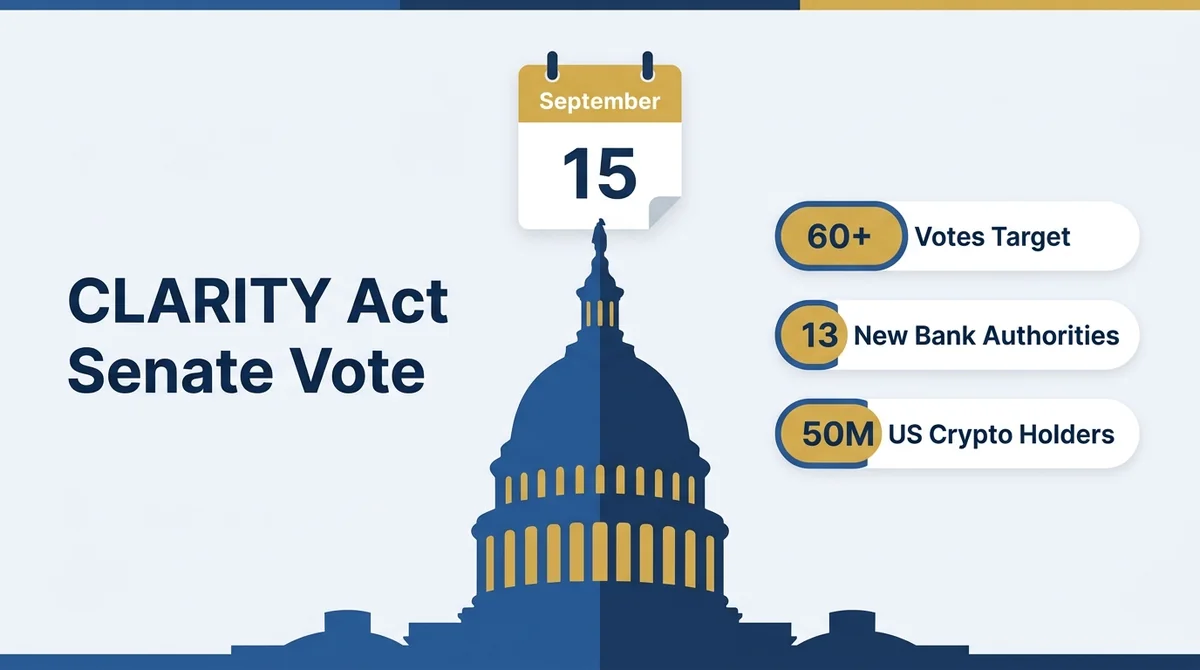
CLARITY Act: Senate Floor Vote on September 15
The CLARITY Act is scheduled for a full Senate floor vote on September 15. The bill is seen as the product of long-running bipartisan collaboration, with thousands of hours of legislative work across the Senate and House needed to bring it to its current bipartisan status.
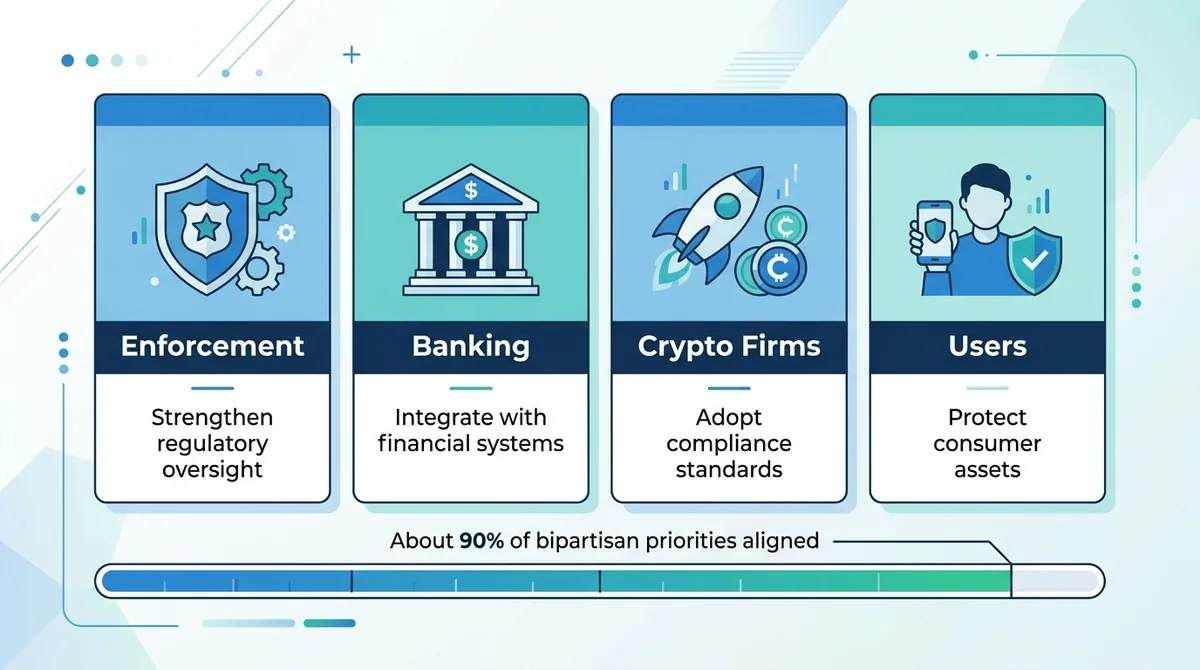
From the bill's design, supporters argue it is practical across several dimensions:
- Enforcement: provides clearer tools for cracking down on illicit activity;
- Banking: adds 13 new business authorities for banks, making it easier for them to expand related services;
- Crypto firms: gives the industry a predictable compliance framework;
- Users: benefits roughly 50 million Americans who hold crypto assets.
The interviewee said he is optimistic the bill will secure more than 60 votes, and believes both parties have achieved about 90% of their priorities. Remaining disagreements center mainly on a handful of last-minute details. The Senate Majority Leader has dedicated a specific slot for the vote, and locking in September 15 despite intense competition for floor time is read by the market as a signal of confidence in the bill's prospects.
SEC and CFTC: Continuing to Deliver Clear Rules Under Existing Authority
Beyond the legislative path, the regulators themselves are pushing rule clarification forward. The heads of both the securities regulator and the commodities regulator have made clear that, regardless of how the CLARITY Act progresses, they will keep issuing clear guidance and rules under existing authority.
Recent actions already taken include the securities regulator publishing new rules that, for the first time, clarify how crypto projects can raise funds through securities markets. The industry views this rule as a response to a years-long request. At the same time, regulators are studying an innovation exemption mechanism to explore concrete pathways for crypto securities to trade within the United States, with tokenized stocks an important direction.
Notably, products such as tokenized stocks and single-stock perpetual contracts have until now been offered mainly in offshore markets, with no corresponding compliant channel in the US. As rules become clearer, the conditions for launching such products in the US market are improving.
Tokenization and Innovation Exemptions: The Next Phase for Compliant Trading Platforms
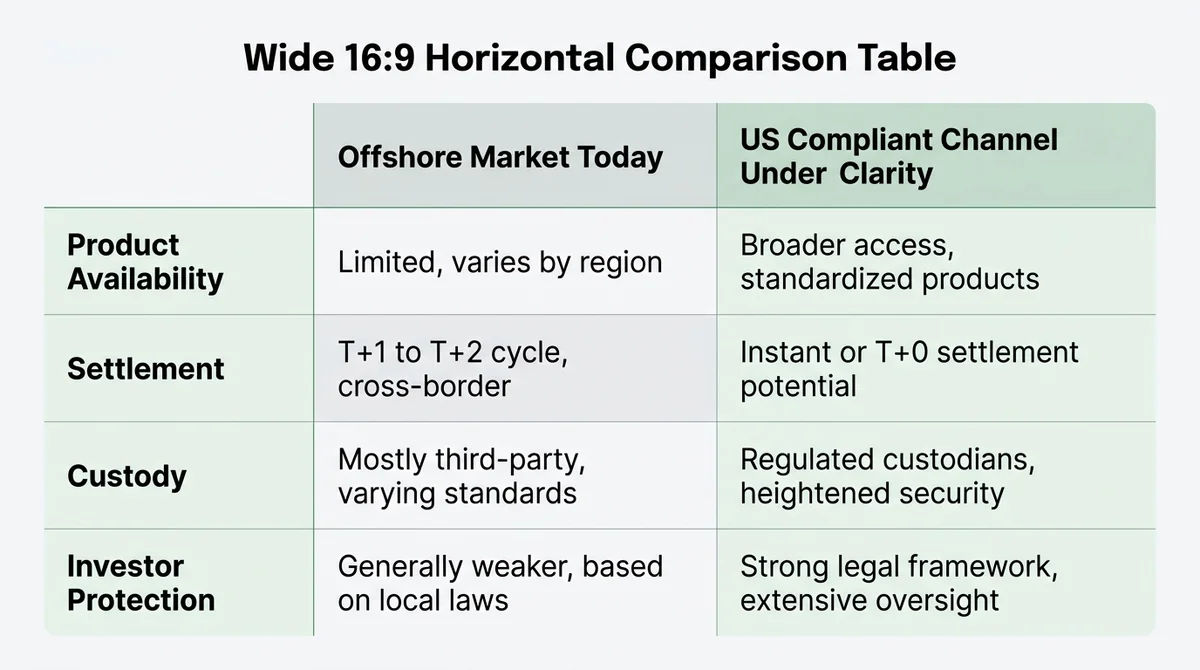
Tokenization and innovation exemptions matter because they bear directly on the compliant path for asset issuance and trading. For compliant trading platforms, regulatory clarity means two things: first, the rule boundaries for asset listings and product design become more predictable; second, the likelihood rises that cross-border and offshore business migrates into the domestic compliant market.
Take tokenized US equities as an example. At its core, the model uses stablecoins to buy and sell tokenized US stocks directly on-chain with instant settlement. Such products place higher demands on clearing and settlement mechanisms, custody fee arrangements, and investor protection. If regulators can set clear conditions under an innovation exemption framework, compliant platforms can conduct this business within the rules rather than relying on offshore structures.
Spot Trading Cycle and Shifting Revenue Mix
On the market cycle, the exchange CEO noted that crypto spot trading has been through roughly a year of bear market, while previous bear markets historically lasted about 370 to 380 days, meaning the current cycle is nearing that window. Combined with the September 15 bill vote and the seasonal pattern of stronger performance from October to December after Bitcoin halving cycles, he believes spot trading may be on the eve of the next bull market.
Unlike past cycles, trading platforms' revenue mix has diversified markedly. Only about 12% of this platform's revenue now comes from Bitcoin spot trading, while crypto derivatives, prediction markets, stablecoin payments, and real-world asset tokenization keep growing during the spot downturn. Among these, the area dubbed "agentic finance" or "AI finance" is seen as having the largest potential market, on the logic that AI agents may outnumber humans in the future and will need an economic system to complete work on their behalf.
Ethics Controversy and Legislative Trade-offs
On the question of political figures and their families participating in crypto businesses, the interviewee said this is a complex issue under debate in the Senate. The White House has proposed an ethics plan that could be incorporated into the CLARITY Act, including arrangements such as moving related funds into blind trusts, with the specific version still under negotiation. The interviewee considers it rare for a president to proactively propose writing such arrangements into a bill.
His core view: ethics issues matter and should be resolved by Congress and the White House, but the bill's provisions on consumer protection and bringing industry back to the US are equally critical. If the status quo is maintained because of the ethics controversy, US users will continue to lack protection, the patchwork of state legislation will persist, and related business may ultimately migrate further offshore.
A Warning on State-Level Tax Policy
At the state policy level, the interviewee mentioned wealth tax and asset seizure proposals under discussion in California. He argued that taxing already-taxed assets again, with the possibility of touching asset seizure, sets a dangerous precedent, and that such approaches have usually produced poor outcomes in developing countries. He added that if higher taxes were clearly directed to productive uses such as education and healthcare, there would be room for discussion; but California currently has significant fraud, waste, and abuse problems, which makes the proposals more worrisome.
Implications for Compliant Trading Platforms
Taken together, the CLARITY Act vote, rulemaking from the SEC and CFTC, and progress on tokenization and innovation exemptions all point in one direction: trading of crypto assets and tokenized assets news is moving from regulatory ambiguity toward regulatory clarity. For compliant trading platforms, this means product design needs to align with the regulatory framework earlier, especially in crossover areas such as real-world asset tokenization, tokenized US equity spot and derivatives.
It is worth stressing that regulatory progress does not equate to price direction. Cycle judgments for spot trading and the pace of launching tokenized products still depend on the actual progress of legislation and rulemaking, as well as platforms' own capacity building in custody, clearing and settlement, and risk control.
This article is produced by the MSXGO editorial team, AI-assisted, and reviewed through an editorial process. Fee rates and figures are subject to each platform's latest official announcements.
Finished reading? Ready to try trading?
Tokenized stocks/ETFs, crypto spot, and perpetual futures in one account — perp maker 0.02% / taker 0.045%, RWA spot buy 0.3% / sell 0.
Free sign-up · 3 quick steps