US Stocks Daily Watch: Merck KGaA's $1.3B All-Cash Silence Therapeutics Deal Cuts SLN to Hold; TSLA FSD ARR Hits $791M but Capex Pressure Weighs on Rating
Oct 19, 2026 US stocks watch: Merck KGaA's $1.3B all-cash Silence deal at a 130% premium cuts SLN to Hold; TSLA FSD ARR $791M, subs +56%, but capex weighs.
Article Citation Summary
Oct 19, 2026 US stocks watch: Merck KGaA's $1.3B all-cash Silence deal at a 130% premium cuts SLN to Hold; TSLA FSD ARR $791M, subs +56%, but capex weighs.
US Stocks Daily Watch: Merck's $1.3B Silence Therapeutics Deal Cuts Rating to Hold; TSLA FSD ARR at $791M
Guest Columnist
@MSX_CN
October 20, 2026
This article is about 4,900 words and takes about 13 minutes to read.
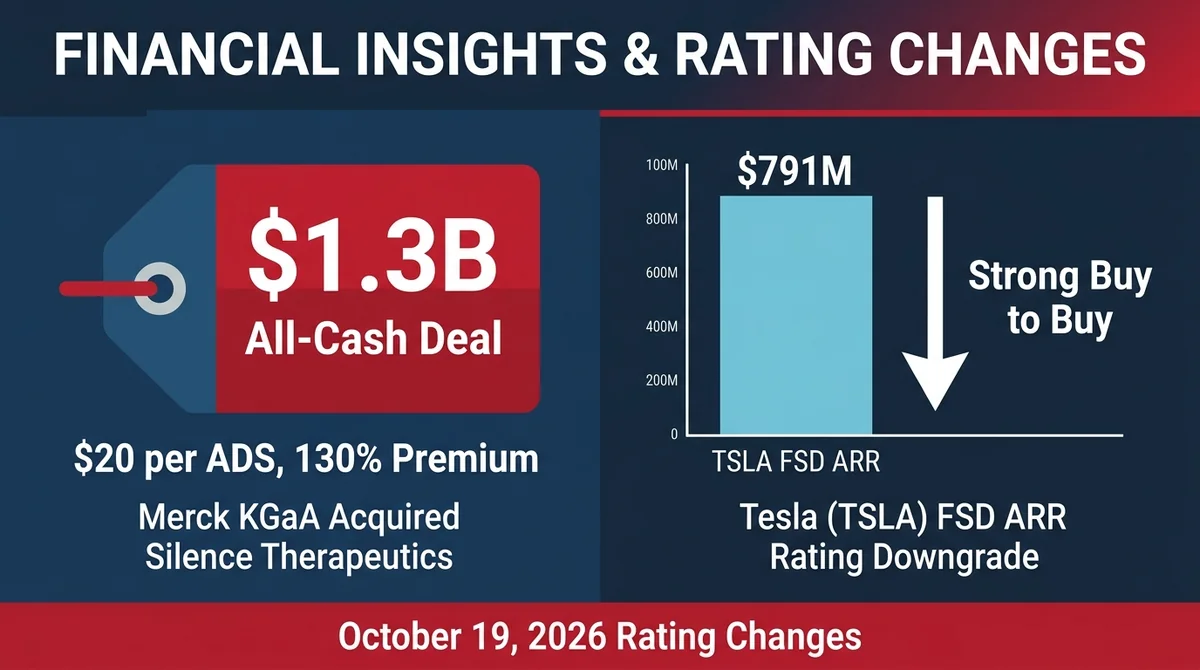
On October 19, 2026, two seemingly unrelated rating changes pointed to the same pricing logic: when deal terms or the capex cycle become the dominant variable, the analytical framework for a single stock shifts from fundamentals to events and cash flow cadence, and the rating change reflects that framework switch rather than a rejection of underlying business quality. This is the "US Stocks Daily Watch" series, focused on the day's rating changes and event-driven pricing. Merck KGaA is acquiring Silence Therapeutics in an all-cash deal worth about $1.3 billion at $20 per ADS; the 130% premium compresses upside to near the deal price, and analysts promptly downgraded the stock from Buy to Hold. On the same day, TSLA was downgraded from Strong Buy to Buy on higher capex guidance and an expected negative free cash flow through 2026 — even though its FSD subscriptions grew 56% year over year in Q2 and annual recurring revenue has reached $791 million.
AI Summary
Core view: The two rating actions on October 19, 2026 show that once an M&A deal is announced, pricing power for the stock shifts from clinical data and growth narrative to deal terms and approval probability; for asset-heavy growth stocks, pricing power oscillates between software recurring revenue expansion and the capex cycle. For Silence Therapeutics, the downgrade to Hold hinges on shareholder and UK regulatory approval, not on divesiran's 88% response rate; for TSLA, the downgrade from Strong Buy to Buy hinges on capex guidance and free cash flow cadence, not on FSD's 56% year-over-year subscription growth.
Key elements:
- Silence Therapeutics is being acquired by Merck KGaA in an all-cash deal worth about $1.3 billion at $20 per ADS, a 130% premium.
- Analysts downgraded Silence Therapeutics from Buy to Hold, citing limited upside from the acquisition and the fact that the deal still requires shareholder and UK regulatory approval.
- Silence Therapeutics' siRNA candidate divesiran achieved an 88% response rate in the Phase 2 SANRECO trial in phlebotomy-dependent polycythemia vera.
- TSLA FSD subscriptions grew 56% year over year in Q2, with annual recurring revenue reaching $791 million; analysts expect Q3 subscriptions to hit a record 750,000, with ARR of $860 million to $890 million.
- Analysts downgraded TSLA from Strong Buy to Buy due to higher capex guidance and an expected negative free cash flow through 2026.
- Almonty Industries hosted an analyst/investor day at Nasdaq on October 19, 2026, with CEO Lewis Black and other executives presenting.
1. Merck KGaA's $1.3B All-Cash Acquisition of Silence Therapeutics: The Deal Structure Itself Is the Direct Cause of the Downgrade
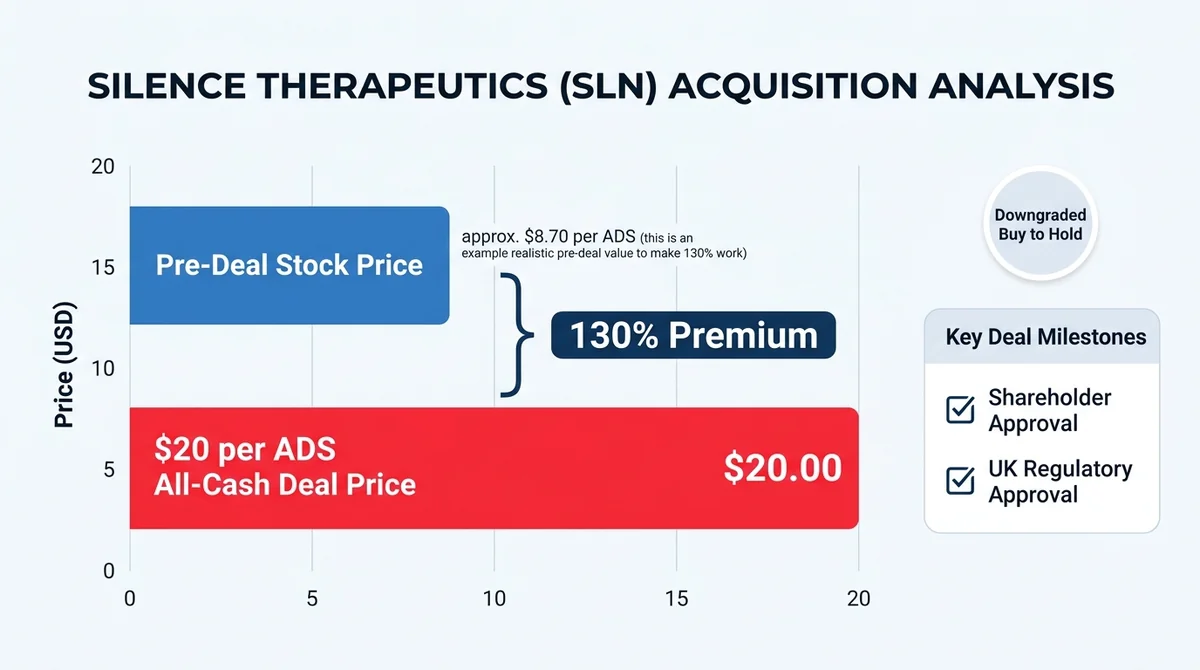
Merck KGaA is acquiring Silence Therapeutics at $20 per ADS in an all-cash deal worth about $1.3 billion, a 130% premium, and the rating was cut from Buy to Hold the same day the deal was announced. The announcement of an all-cash acquisition often ends two narratives for a single stock at once: one is the imaginative upside of the clinic and pipeline, and the other is the valuation elasticity of an independent growth stock (Source: Seeking Alpha, October 19, 2026). For holders, the 130% premium is a substantial re-rating; but for analysts who were just pricing the company on pipeline value, the deal terms themselves become the new valuation anchor.
It is in this sense that a downgrade and a "bearish fundamental view" are two different things. Analysts cut Silence Therapeutics from Buy to Hold for a plainly stated reason: the acquisition limits upside, and the deal still requires shareholder and UK regulatory approval (Source: Seeking Alpha, October 19, 2026). Once the share price has converged toward the $20 per ADS deal price, the question implicit in a continued Buy rating — "how much upside is left" — is no longer answered by divesiran's clinical data but by approval probability and time cost.
1. $20 per ADS, 130% Premium: The All-Cash Offer Compresses Upside to Near the Deal Price
The all-cash offer caps upside near the $20 per ADS deal price. The biggest difference between an all-cash offer and a stock-swap deal is that it gives the market a clear, cash-denominated price ceiling. The $20 per ADS bid, combined with the 130% premium, means holders before the announcement have already received a one-time re-rating, while buyers after the announcement face a return range capped by the deal price. The analytical framework shifts accordingly: from "how much is this company worth" to "how likely is this deal to close, and how long will it take."
This also explains why the downgrade came on the same day as the acquisition news rather than when clinical data was released. For sell-side analysts, a Buy rating usually corresponds to a target price significantly above the current price; when the current price itself is already close to the all-cash deal price, the gap between target and current price is mechanically compressed by the deal terms, and the rating naturally moves toward Hold. This is typical of merger-arbitrage names: price is set by terms, and volatility is driven by approval news.
Deal terms at a glance:
| Element | Detail |
|---|---|
| Acquirer | Merck KGaA |
| Structure | All cash |
| Deal value | About $1.3 billion |
| Per ADS bid | $20 |
| Premium | 130% |
| Approval conditions | Shareholder approval, UK regulatory approval |
2. Analysts Cut from Buy to Hold: The Constraint Is Not Fundamentals but Dual Shareholder and UK Regulatory Approval
The constraint behind the downgrade is shareholder approval and UK regulatory approval, not divesiran data. Notably, the downgrade rationale does not reject divesiran data or the company's operating quality. Analysts explicitly point to two constraints: shareholder approval and UK regulatory approval (Source: Seeking Alpha, October 19, 2026). This means that before the deal closes, Silence's share price will mainly react to approval progress, shareholder vote arrangements and the pace of regulatory inquiries, rather than to quarterly R&D progress.
For the market, the risk-reward structure of such names has already changed. Upside is capped by the deal price, while downside comes from the tail scenario of a failed deal or delayed approval; the two are asymmetric, and neither is determined by the company's own pipeline progress. If the approval process goes smoothly, the price will likely trade in a narrow range below the deal price; only if regulatory resistance or shareholder dissent emerges could the price return to a range priced on standalone fundamentals. This is the norm for event-driven pricing and a reasonable footnote for the move from Buy to Hold.
3. divesiran's 88% Response Rate in Phase 2 SANRECO Trial Is the Core Asset Logic for the Acquirer
divesiran achieved an 88% response rate in the Phase 2 SANRECO trial, the core anchor of the acquirer's asset logic. Only by shifting focus from deal terms back to the asset itself can one understand why the acquirer is willing to pay a 130% premium. Silence Therapeutics' siRNA candidate divesiran achieved an 88% response rate in the Phase 2 SANRECO trial in phlebotomy-dependent polycythemia vera (Source: Seeking Alpha, October 19, 2026). In polycythemia vera, an indication requiring long-term phlebotomy management, the 88% response rate is the core anchor of the acquirer's asset logic.
It should be noted that public sources provide only the Phase 2 divesiran data as a clue to the acquirer's full motivation for paying that premium, which is not yet enough to form a complete causal chain (unverified). This also highlights a fact easily obscured by the merger-arbitrage narrative: deal terms determine the short-term price path, but clinical data determine why the deal exists. For readers watching event-driven opportunities, the Silence case shows that post-announcement analysis should shift from "is the data good" to "can the deal close, and how soon"; for readers watching industry trends, the siRNA platform value represented by the 88% response rate is the long-term footnote behind this $1.3 billion all-cash deal.
2. TSLA FSD Is Now a Quantifiable Recurring-Revenue Business: $791M ARR and 56% Growth Change the Valuation Narrative
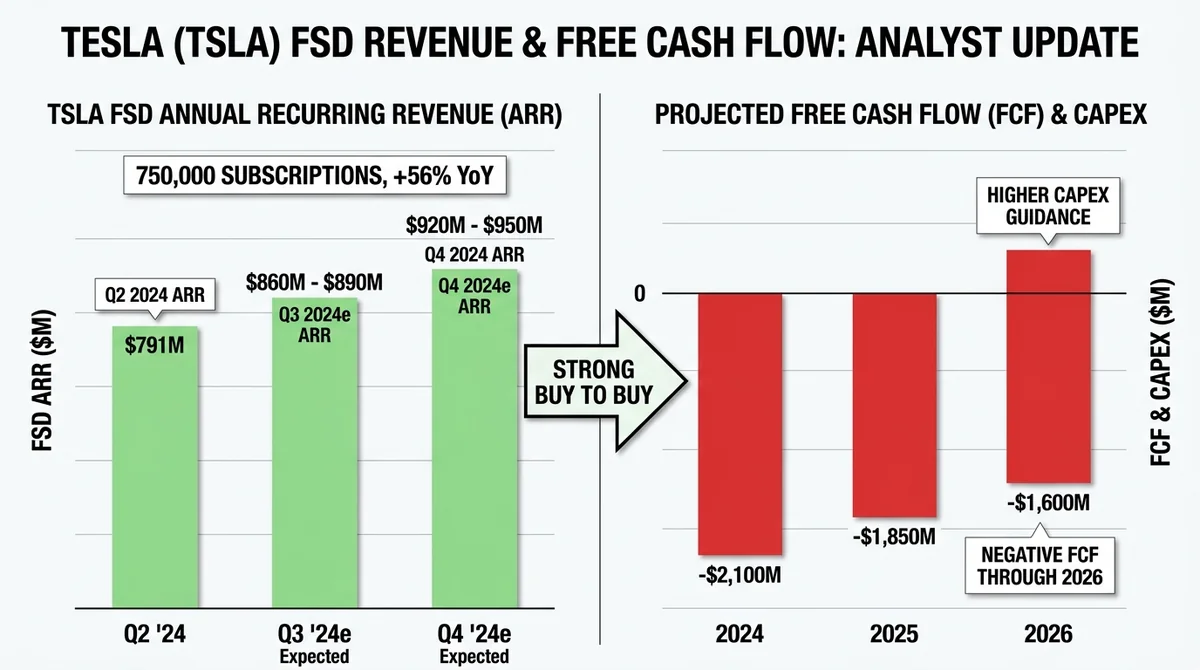
TSLA FSD subscriptions grew 56% year over year in Q2, with annual recurring revenue reaching $791 million, becoming a separately modelable revenue line for the first time. If Silence's pricing power has been handed over to deal terms, TSLA's pricing power remains in operating data — except that this operating data now includes "software recurring revenue" as an independent line item for the first time (Source: Seeking Alpha, October 19, 2026). For a company long priced on the auto manufacturing cycle, this is a narrative-level change.
Automaker valuation models typically revolve around deliveries, per-vehicle gross margin and capacity utilization, with revenue fluctuating with model cycles and margins squeezed by raw materials and price wars. The introduction of software subscriptions adds a high-margin, predictable revenue curve that is weakly correlated with deliveries. The $791 million in annual recurring revenue is still limited relative to TSLA's overall revenue base, but its growth rate and structural significance are enough for analysts to give FSD an independent place in the profitability discussion.
1. Q2 Subscriptions Up 56% Year Over Year, FSD Annual Recurring Revenue Reaches $791 Million
FSD subscriptions up 56% year over year in Q2 and ARR of $791 million show the business has moved past the proof-of-concept stage. The 56% year-over-year growth and the $791 million ARR are the two most informative numbers in this preview (Source: Seeking Alpha, October 19, 2026). The former shows subscription penetration is still advancing rapidly, while the latter shows the business has moved past the "proof of concept" stage and reached a scale that can be modeled separately. For valuation, the significance of ARR is that it locks in software revenue for a period ahead, reducing the variance of revenue forecasts.
It should be emphasized that these numbers come from analysts' quarterly preview, which is a compilation of already-reported quarterly data and a forward-looking judgment on the next quarter, rather than the company's official earnings release basis. Before the official earnings release, the market may still have expectation gaps on FSD revenue recognition timing, deferred recognition method and gross margin structure; but in terms of direction, FSD is turning from "option value" into a "financial statement line item," as confirmed by the $791 million ARR.
2. Q3 Subscriptions Expected to Hit a Record 750,000, Corresponding to ARR of $860M-$890M
Analysts expect Q3 subscriptions to hit a record 750,000, corresponding to ARR of $860 million to $890 million, implying a sequential quarterly increase of $70 million to $100 million. Analysts further expect Q3 subscriptions to reach a record 750,000, corresponding to ARR of $860 million to $890 million (Source: Seeking Alpha, October 19, 2026). From $791 million to $860 million-$890 million, the implied sequential quarterly increase is in the $70 million-$100 million range (this is our calculation based on the two figures above, not directly disclosed by the source). If this cadence is achieved, it will reinforce the market perception that "FSD is a sustainable growth curve."
But the word "expected" needs to be taken seriously. Subscription growth depends on penetration gains, pricing strategy and the software activation rate of the existing fleet, and any one of these falling short would slow the ARR ramp. For the market, whether actual Q3 subscriptions and ARR land within the $860 million-$890 million range will be the first key checkpoint for testing the FSD narrative; if at the upper end, the valuation weight of software revenue could rise further, while if below the lower end, it could reignite discussion of a subscription ceiling.
FSD key data at a glance:
| Metric | Data |
|---|---|
| Q2 subscription YoY growth | 56% |
| Q2 annual recurring revenue (ARR) | $791 million |
| Q3 subscriptions (expected) | 750,000 |
| Q3 ARR (expected) | $860 million-$890 million |
3. The High-Margin Nature of Software Subscriptions Makes Them a Potential Key Driver of Profitability
Software subscriptions have low marginal costs, so revenue growth translates more easily into profit growth, which is why analysts see them as a potential key driver of profitability. Analysts view FSD as a potential key driver of profitability (Source: Seeking Alpha, October 19, 2026). The logic rests on the cost structure of software subscriptions: once R&D and computing investment are treated as relatively fixed upfront costs, the marginal cost of each new subscription is low, and revenue growth translates more easily into profit growth. Against the backdrop of continued vehicle price competition and pressure on per-vehicle gross margin, the margin contribution of software revenue has an asymmetric perpetual futures leverage effect.
However, realizing this logic takes time. The absolute scale of software revenue is still smaller than the vehicle business and is unlikely to reverse the direction of overall margins in the short term; its more realistic role is to provide a reason to revise upward when the market assesses TSLA's long-term earnings center. In other words, what FSD changes today is the denominator and numerator structure of the valuation narrative, not the final number on the current income statement.
3. Higher Capex Guidance Pressures Free Cash Flow; TSLA Downgraded from Strong Buy to Buy
Higher capex guidance combined with expected negative free cash flow through 2026 led to TSLA's downgrade from Strong Buy to Buy. Appearing on the same day as the FSD growth narrative was a signal pointing in the opposite direction (Source: Seeking Alpha, October 19, 2026). This rationale does not contradict FSD's 56% growth, but it forms a hedging relationship on the same financial statement.
For asset-heavy growth stocks, revenue acceleration and spending expansion often occur at the same time. The $791 million ARR from FSD subscriptions is cash inflow, while higher capex guidance means a faster pace of cash outflow; when the latter's scale and front-loading exceed the former, free cash flow comes under pressure. The downgrade from Strong Buy to Buy is essentially a re-pricing of this cash flow cadence, not a rejection of FSD growth itself.
1. Higher Capex Guidance Plus Expected Negative Free Cash Flow in 2026 Is the Main Reason for the Downgrade
Higher capex guidance usually corresponds to upfront investment in capacity, computing power or infrastructure; such investment is recognized in installments for accounting purposes but shows up as concentrated current-period outflows in cash flow terms. Analysts expect negative free cash flow through 2026 (Source: Seeking Alpha, October 19, 2026), meaning that for some time ahead, TSLA's operating cash flow may not be enough to cover its investment spending, requiring existing cash or external financing to fill the gap.
For valuation, negative free cash flow changes key inputs in the discount model: enterprise value is no longer supported by current free cash flow but relies more on discounting of forward cash flows and assumptions about returns on capex. This does not necessarily mean a valuation cut, but it raises the valuation's sensitivity to the assumption of "whether capex can translate into future revenue." The downgrade to Buy is precisely the pricing expression of that increased sensitivity.
2. Downgrade from Strong Buy to Buy: The Disagreement Is Over Cash Flow Cadence, Not FSD Growth Itself
The downgrade from Strong Buy to Buy remains in bullish territory, with the disagreement centered on cash flow cadence rather than FSD growth itself. Looking at the two pieces of information side by side, the rating adjustment is mild: from Strong Buy to Buy, still bullish, just less intensely so. The magnitude itself conveys the analyst's judgment structure — the FSD growth logic holds, but changes in cash flow cadence reduce the room for a further upgrade in the near term (Source: Seeking Alpha, October 19, 2026).
This also reminds the market that when assessing TSLA, FSD's ARR and capex guidance should be observed within the same framework. If Q3 subscriptions reach 750,000 and ARR lands in the $860 million-$890 million range while capex guidance is not raised again, cash flow pressure could ease at the margin; if subscription growth falls short while capex continues to expand, the risk of further rating adjustments could rise. The relative speed of the two variables determines the direction of the valuation narrative.
3. FSD Revenue Expansion and Capex Expansion Hedge Each Other on the Same Financial Statement
FSD revenue expansion improves revenue quality, while capex expansion suppresses free cash flow; the two hedge each other on the same cash flow statement. From a statement structure perspective, the expansion of FSD subscription revenue improves revenue quality and gross margin structure, while capex expansion affects free cash flow and return on assets. The two meet on the same cash flow statement: the former provides recurring cash inflow, the latter creates concentrated cash outflow. When inflow grows faster than outflow, free cash flow improves; otherwise, it comes under pressure.
This also explains why, on the same day, the market could digest both "FSD up 56% year over year" and "downgraded to Buy." They do not disprove each other but act on different parts of the valuation model: the former on revenue and margin assumptions, the latter on cash flow and discount assumptions. For long-term observers, what really needs tracking is not a single quarter's rating action but the relative slope of these two variables over the coming quarters.
4. Almonty's Nasdaq Investor Day and the Pricing Divergence Between Two Types of Names
Almonty Industries hosted an analyst/investor day at Nasdaq on October 19, 2026, with CEO Lewis Black and other executives presenting (Source: Seeking Alpha, October 19, 2026). This news itself involves no rating or deal, yet together with Silence and TSLA it forms three samples of the day's US stock event flow: one is merger-arbitrage names, where price is determined by deal terms and approval probability; one is asset-heavy growth names, where price oscillates between software recurring revenue and the capex cycle; and one is operating-communication events, where price mainly reacts to operating information disclosed by management.
The risk-reward structure of merger-arbitrage names is clearly asymmetric: upside is capped by the all-cash deal price, while downside comes from the tail scenario of a failed deal or delayed approval, so the tracking focus is on shareholder vote arrangements and the pace of regulatory inquiries, not quarterly R&D progress. Asset-heavy growth names are different: their valuation is affected by both revenue structure and cash flow cadence, with FSD's ARR providing recurring cash inflow and capex guidance determining the pace of cash outflow; the change in their relative slope is the real driver of rating adjustments.
For readers of US Stocks Daily Watch, the three threads from October 19, 2026 offer the same methodological reminder: when the event itself becomes a pricing variable, the framework switch matters more than the conclusion itself. M&A names look at terms and approvals, asset-heavy growth stocks look at cash flow cadence, and operating-communication events look at the increment of disclosed information; together these three paths form the complete footnote to that day's US stock rating changes.
FAQ
What are the terms of Merck's acquisition of Silence Therapeutics?
Silence Therapeutics is being acquired by Merck KGaA in an all-cash deal worth about $1.3 billion at $20 per ADS, a 130% premium.
Why was Silence Therapeutics downgraded from Buy to Hold?
Analysts downgraded the stock from Buy to Hold, citing limited upside from the acquisition and the fact that the deal still requires shareholder and UK regulatory approval.
What are the Phase 2 clinical data for divesiran?
divesiran achieved an 88% response rate in the Phase 2 SANRECO trial in phlebotomy-dependent polycythemia vera.
What is the annual recurring revenue of TSLA FSD subscriptions?
TSLA FSD subscriptions grew 56% year over year in Q2, with annual recurring revenue reaching $791 million; analysts expect Q3 subscriptions to hit a record 750,000, with ARR of $860 million to $890 million.
Why was TSLA downgraded from Strong Buy to Buy?
Analysts downgraded TSLA from Strong Buy to Buy due to higher capex guidance and an expected negative free cash flow through 2026.
What event did Almonty Industries hold on October 19, 2026?
Almonty Industries hosted an analyst/investor day at Nasdaq on October 19, 2026, with CEO Lewis Black and other executives presenting.
What are the main risks of merger-arbitrage names?
Upside is capped by the all-cash deal price, while downside comes from the tail scenario of a failed deal or delayed approval, so the tracking focus is on shareholder votes and the pace of regulatory approval, not the company's quarterly operating progress.
Which variables should be watched under event-driven pricing?
For M&A names, watch deal terms, approval probability and time cost; for asset-heavy growth stocks, watch the relative slope of recurring revenue growth and capex guidance; for operating-communication events, watch the increment of information disclosed by management.
Why does a downgrade not equal a bearish fundamental view?
When the share price is already close to the all-cash deal price, the gap between target and current price is mechanically compressed by the deal terms, and a move toward Hold reflects a switch in pricing framework rather than a rejection of underlying business quality.
References
This article is produced by the MSXGO editorial team, AI-assisted, and reviewed through an editorial process. Fee rates and figures are subject to each platform's latest official announcements.
FAQ
What are the terms of Merck's acquisition of Silence Therapeutics? ▼
Silence Therapeutics is being acquired by Merck KGaA in an all-cash deal worth about $1.3 billion at $20 per ADS, a 130% premium.
Why was Silence Therapeutics downgraded from Buy to Hold? ▼
Analysts downgraded the stock from Buy to Hold, citing limited upside from the acquisition and the fact that the deal still requires shareholder and UK regulatory approval.
What are the Phase 2 clinical data for divesiran? ▼
divesiran achieved an 88% response rate in the Phase 2 SANRECO trial in phlebotomy-dependent polycythemia vera.
What is the annual recurring revenue of TSLA FSD subscriptions? ▼
TSLA FSD subscriptions grew 56% year over year in Q2, with annual recurring revenue reaching $791 million; analysts expect Q3 subscriptions to hit a record 750,000, with ARR of $860 million to $890 million.
Why was TSLA downgraded from Strong Buy to Buy? ▼
Analysts downgraded TSLA from Strong Buy to Buy due to higher capex guidance and an expected negative free cash flow through 2026.
What event did Almonty Industries hold on October 19, 2026? ▼
Almonty Industries hosted an analyst/investor day at Nasdaq on October 19, 2026, with CEO Lewis Black and other executives presenting.
Finished reading? Ready to try trading?
Tokenized stocks/ETFs, crypto spot, and perpetual futures in one account — perp maker 0.02% / taker 0.045%, RWA spot buy 0.3% / sell 0.
Free sign-up · 3 quick steps