MSX Daily US Stock Watch: Netflix Q3 2026 Earnings: EPS of $0.87 Beats Estimates, Ad Revenue Guidance Cut to $2.7B Drags Shares Down ~6% After Hours
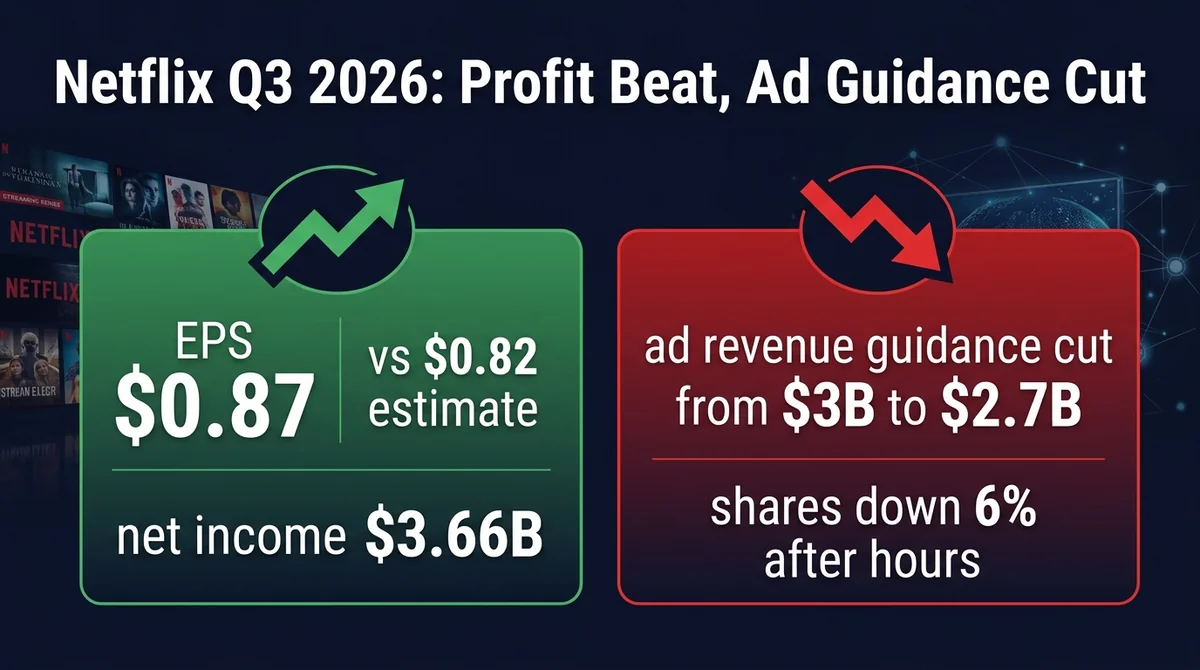
Netflix Q3 2026 EPS of $0.87 beat LSEG's $0.82; revenue $12.87B matched estimates. Ad revenue guidance cut to ~$2.7B from ~$3B, full-year revenue $51.1B missed, shares fell ~6% after hours.
Article Citation Summary
Netflix Q3 2026 EPS of $0.87 beat LSEG's $0.82; revenue $12.87B matched estimates. Ad revenue guidance cut to ~$2.7B from ~$3B, full-year revenue $51.1B missed, shares fell ~6% after hours.
Netflix Q3 2026 Earnings: EPS of $0.87 Beats Estimates, Ad Revenue Guidance Cut to ~$2.7 Billion Drags Shares Down ~6% After Hours
Guest Columnist
@MSX_CN
October 2026
This article is about 4,900 words and takes about 13 minutes to read
When a streaming leader beats profit expectations for the quarter yet its shares fall about 6% after hours, the signal from the market is worth noting: the pricing anchor no longer appears to be EPS alone, but rather the pace of ad monetization and the certainty of revenue delivery. Netflix's Q3 2026 earnings put this divergence on full display—EPS of $0.87 topped LSEG's $0.82 estimate and net income rose year over year to $3.66 billion, but revenue of $12.87 billion merely matched expectations, and ad revenue guidance was cut from about $3 billion to about $2.7 billion, the direct trigger for the after-hours decline. (Data source: CNBC's report on Netflix's Q3 2026 earnings; the after-hours move reflects the reported figure, not the closing price, and was not independently verified.)
AI Summary
Core view: Netflix beat profit expectations in Q3 2026 but revenue was flat versus expectations, ad revenue guidance was cut to about $2.7 billion, and the stock fell about 6% after hours; this suggests the market's pricing focus for the streaming leader may be shifting from quarterly profit to ad monetization and revenue delivery. The same-day contrast cases of Zoetis and Rapport further show that valuation discounts and clinical/guidance events need to be priced separately.
Key elements:
- Netflix reported Q3 2026 EPS of $0.87, above the $0.82 LSEG analyst estimate, with revenue of $12.87 billion matching expectations.
- Q3 revenue grew nearly 12% year over year, and net income was $3.66 billion ($0.87 per share), up from $2.55 billion ($0.59 per share) a year earlier.
- Netflix expects Q4 revenue growth of more than 11% to $13.44 billion and narrowed its full-year 2026 revenue forecast to $51.1 billion, below Wall Street's $51.2 billion estimate.
- Netflix cut its 2026 ad business revenue forecast from about $3 billion to about $2.7 billion, and its shares fell about 6% in Tuesday after-hours trading.
- Netflix announced last week that it would lay off about 6% of staff (roughly 1,000 employees); Chief Content Officer Bela Bajaria departed and former Disney executive Peter Rice was named the new CCO. The company expects the layoffs to hit Q4 operating margin by about 120 basis points.
- Zoetis currently trades at a forward P/E ratio of about 14x, well below its five-year average of 27x, but a sharp cut to 2026 guidance and declining organic revenue offset this valuation discount; its companion animal business, which accounts for 69% of revenue, saw organic sales fall 6% in Q2 2026.
- Rapport Therapeutics held a conference call at 8:00 a.m. ET on October 20, 2026, to discuss topline Phase II trial results for RAP-219 in bipolar mania and provide a business update.
1. Netflix Beat Q3 Profit Expectations but Revenue Was Flat, With a Clear Divergence Between Profit and Revenue
1. EPS of $0.87 Beat LSEG's $0.82 Estimate; Net Income Rose Year Over Year to $3.66 Billion
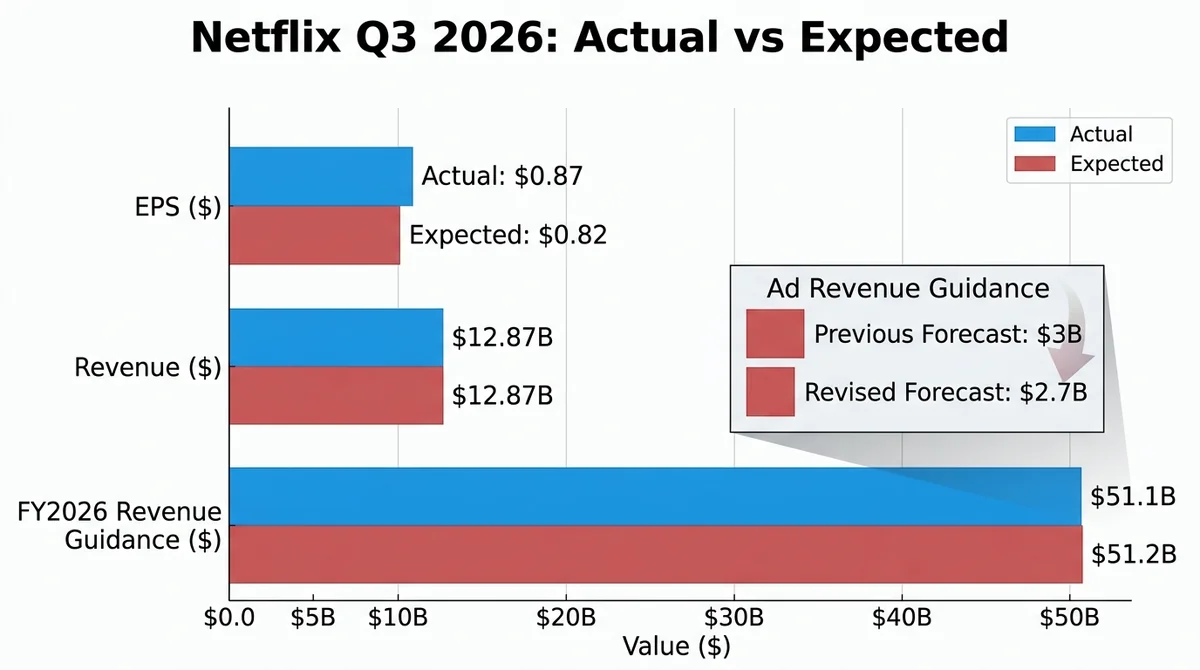
Netflix's Q3 2026 EPS was $0.87, above LSEG's $0.82 estimate; net income was $3.66 billion, up from $2.55 billion ($0.59 per share) a year earlier. This is the most direct profit conclusion from Netflix's Q3 earnings.
According to company-disclosed data cited by CNBC, EPS for the quarter was $0.87, above the $0.82 LSEG analyst estimate; net income reached $3.66 billion, or $0.87 per share, up from $2.55 billion ($0.59 per share) a year earlier. Against the backdrop of slowing growth across the streaming industry, this profit performance stands out relatively well.
The profit beat was about 5 cents per share—not a dramatic margin—but the year-over-year net income increase was significant enough to make the market re-examine Netflix's earnings resilience. It should be noted that the link between profit improvement and cost structure optimization is currently an inference, not an explicit attribution by the company; when profit growth comes more from the cost side than from revenue acceleration, the market tends to assess its sustainability more cautiously, which also set the stage for the subsequent guidance controversy.
2. Revenue of $12.87 Billion Matched Analyst Expectations, Up Nearly 12% Year Over Year but Without a Revenue-Side Surprise
Netflix's Q3 revenue was $12.87 billion, matching analyst expectations and up nearly 12% year over year, without a revenue-side surprise. This is the revenue-side conclusion from Netflix's Q3 earnings.
In contrast to the profit side, revenue was unremarkable. A growth rate of nearly 12% is not bad for a mature streaming company, but "matching expectations" means the market had already largely priced in this level of growth, and the earnings report brought no incremental revenue surprise.
In the US stock market, when a company reports a combination of "profit beat, revenue in line," the share price reaction often depends more on guidance than on the current-period numbers. Netflix's revenue performance this quarter landed exactly in this sensitive range: solid enough, but not enough on its own to support further valuation expansion.
3. The Link Between Profit Improvement and Cost Structure Is an Inference, Setting the Stage for the Guidance Controversy
Looking at the profit and revenue sides together, Netflix's divergence this quarter is fairly clear: EPS of $0.87 beat expectations and net income rose year over year to $3.66 billion, but revenue of $12.87 billion only matched expectations. This "strong profit, flat revenue" combination may reflect cost structure improvement rather than an accelerating revenue engine, but the company did not explicitly attribute it in verifiable sources, so this judgment should be treated as analytical inference.
The importance of this divergence lies in the fact that it may change the market's framework for judging the quality of Netflix's future growth. If profit improvement comes from revenue acceleration, the market is usually willing to assign a higher valuation multiple; if it comes from cost discipline, then once the room for cost compression narrows, profit growth may slow. That is precisely why the market reaction was especially sharp when the company cut its ad revenue guidance in the same earnings report—because it touched on the core question of whether the revenue side can take over.
2. Ad Revenue Guidance Cut From About $3 Billion to About $2.7 Billion, the Direct Trigger for the ~6% After-Hours Decline
1. 2026 Ad Business Revenue Forecast Cut From About $3 Billion to About $2.7 Billion
Netflix cut its 2026 ad business revenue forecast from about $3 billion to about $2.7 billion, a reduction of about 10% (based on approximate figures). This is the core number in the adjustment to Netflix's ad revenue guidance.
If the divergence in the current-quarter numbers only left the market mildly disappointed, the cut to ad revenue guidance directly changed the pricing narrative. For a streaming company that has made advertising its second growth curve, the signal value of this adjustment may be greater than the number itself.
Advertising is the most imaginative part of Netflix's valuation story: it represents a transition from a single subscription revenue stream to a "subscription + advertising" dual engine. When the slope of this curve is revised down, the market naturally reassesses the speed and certainty of the transition. An ad revenue forecast of about $2.7 billion means advertising's share of total revenue remains limited and will be hard-pressed to offset pressure from slowing subscription growth in the near term.
2. Q4 Revenue Guidance of More Than 11% Growth to $13.44 Billion; Full-Year $51.1 Billion Below Wall Street's $51.2 Billion
Netflix expects Q4 revenue growth of more than 11% to $13.44 billion, and narrowed its full-year 2026 revenue forecast to $51.1 billion, below Wall Street's $51.2 billion estimate. These are the key numbers in Netflix's Q4 and full-year revenue guidance.
At the quarterly guidance level, this growth rate continues the Q3 trend, but what really drove the market reaction was the full-year number. A $100 million expectation gap is not large in absolute terms, but it appeared in the same earnings report as the ad guidance cut, and the two together amplified the market's disappointment.
From a guidance structure perspective, the Q4 revenue target of $13.44 billion means the company needs to maintain growth of more than 11% during the year-end peak season, while the full-year target of $51.1 billion implies a broadly stable growth pace with no sign of acceleration. For investors hoping advertising would bring a revenue inflection point, the message from this guidance is that the inflection point has not yet arrived.
3. Shares Fell About 6% After Hours as Market Pricing Focus Shifted From the Profit Beat to Slowing Revenue and Ad Growth
Netflix shares fell about 6% in Tuesday after-hours trading, with the market's pricing focus shifting from the profit beat to slowing revenue and ad growth. This is the market-reaction conclusion from Netflix's Q3 earnings.
The capital market's reaction was the most direct. According to CNBC, the decline looks especially striking against the backdrop of an EPS beat. It should be noted that after-hours prices have low liquidity and high volatility, so a decline of about 6% may not equal the final pricing during regular trading hours.
The roughly 6% after-hours decline can be seen as immediate pricing of the ad guidance cut. The positive sentiment from the profit beat was offset by two negative signals: ad revenue falling from about $3 billion to about $2.7 billion, and full-year revenue of $51.1 billion coming in below the $51.2 billion estimate. This also supports a broader judgment: for the streaming leader, the valuation anchor may be shifting from user and profit growth to the pace of ad monetization, and the marginal impact of ad guidance is now greater than the magnitude of the EPS beat.
4. Netflix Q3 Key Financial Data at a Glance
| Metric | Q3 2026 Actual | Market Expectation/Comparison | Conclusion |
|---|---|---|---|
| EPS | $0.87 | LSEG estimate $0.82 | Beat |
| Revenue | $12.87 billion | In line with expectations, up nearly 12% year over year | In line |
| Net income | $3.66 billion | $2.55 billion a year earlier | Up year over year |
| 2026 ad revenue guidance | About $2.7 billion | Previously about $3 billion | Cut |
| Q4 revenue guidance | $13.44 billion | Growth of more than 11% | Growth continues |
| Full-year 2026 revenue guidance | $51.1 billion | Wall Street estimate $51.2 billion | Slightly below expectations |
(Data source: CNBC's report on Netflix's Q3 2026 earnings; the after-hours move reflects the reported figure, not the closing price.)
3. Layoffs of About 6% and a Change of Chief Content Officer Reflect a Simultaneous Restructuring of Content Organization and Cost Discipline
1. Layoffs of About 6%, Roughly 1,000 Employees, Announced Last Week
Netflix announced last week that it would lay off about 6% of staff, roughly 1,000 employees—a substantial organizational adjustment for a company whose core assets are content and technology.
This move echoes the Q3 profit beat: profit improvement may have occurred alongside strengthened cost discipline, but the causal relationship between the two has not been explicitly confirmed by the company.
In terms of timing, the layoffs occurred a week before the earnings report. This explains why Q3 net income reached $3.66 billion and rose year over year—cost structure optimization may be one important source of the profit improvement, but the specific contribution was not disclosed.
2. Chief Content Officer Bela Bajaria Departed; Former Disney Executive Peter Rice Named New CCO
Alongside the layoffs came a change in content leadership. Chief Content Officer Bela Bajaria departed, and former Disney executive Peter Rice was named the new CCO. Content acquisition and production are among the largest cost items for streaming companies, and a change of chief content officer often signals a recalibration of content strategy and budget discipline.
Peter Rice's Disney background is worth noting. As the streaming industry shifts from "burning cash for growth" to "profitability first," executives with experience at traditional media giants may be better at balancing content investment and cost control. Viewed together with the layoffs, this personnel arrangement reflects Netflix's simultaneous restructuring of content organization and cost discipline—maintaining content competitiveness while keeping costs within an acceptable range.
3. Layoffs Expected to Hit Q4 Operating Margin by About 120 Basis Points
Netflix expects the layoffs to hit Q4 operating margin by about 120 basis points, the known quantified cost of this organizational adjustment.
Cost restructuring is not without a price. This number casts a shadow over Q4 profit performance: the Q3 profit beat may be partly offset by Q4 restructuring costs.
The roughly 120-basis-point margin hit, combined with the ad revenue guidance cut, constitutes the market's two main concerns about Netflix's near-term earnings quality. From a longer perspective, this is a choice to "trade short-term margin for long-term organizational efficiency"—if layoffs and leadership changes can improve the return on content investment, then the Q4 margin pressure may be only a transitional cost. But the market clearly needs more evidence to confirm this, and this earnings report provided guidance rather than answers.
4. Other US Stock Signals the Same Day: Zoetis' Valuation Discount Cannot Offset Weakening Fundamentals; Rapport Reports Phase II Topline Results
1. Zoetis Trades at About 14x Forward P/E Ratio, Well Below Five-Year Average of 27x, but 2026 Guidance Was Sharply Cut
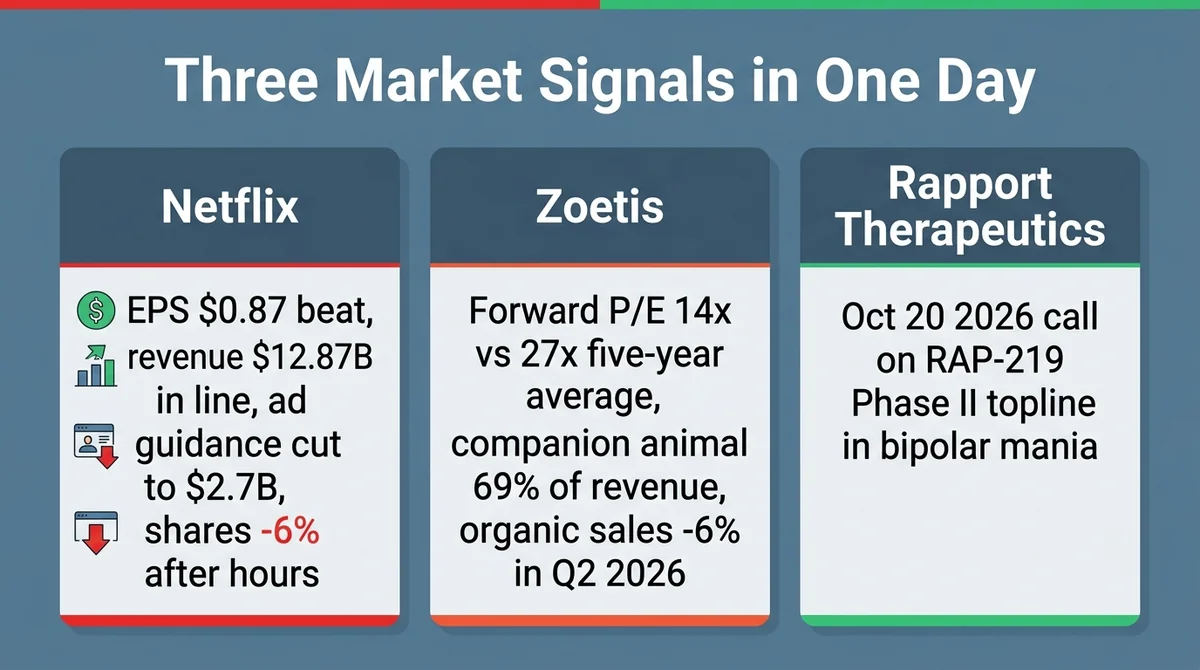
Zoetis (ZTS) currently trades at a forward P/E ratio of about 14x, well below its five-year average of 27x, but a sharp cut to 2026 guidance and declining organic revenue offset this valuation discount. This is the core contradiction to watch in the context of Zoetis' 2026 guidance cut.
Another type of signal worth comparing also appeared in US stocks the same day. From a valuation perspective, about 14x versus 27x represents a significant discount—in theory, a low valuation should provide some support for the share price. But the problem is that the discount did not appear for no reason: management sharply cut 2026 revenue and EPS guidance due to weak demand and intensifying competition.
This case forms an interesting contrast with Netflix. Netflix fell after hours because of "a profit beat but weak guidance," while Zoetis saw "a valuation discount but weakening fundamentals" erode the appeal of that discount. Both point to one judgment: in the current market environment, the direction of guidance may be more important than current-period numbers or static valuation. A discount of about 14x versus 27x looks tempting, but if earnings expectations themselves are being revised down, then the low P/E ratio may simply be the result of "lower expectations in the denominator" rather than a genuine undervaluation.
2. Companion Animal Business, 69% of Revenue, Saw Q2 Organic Sales Fall 6%, With Weak Demand and Intensifying Competition Coexisting
Zoetis' companion animal business, which accounts for 69% of revenue, saw organic sales fall 6% in Q2 2026, with pressure concentrated in the company's core business segment.
The decline occurred in the highest-weight business, meaning the pressure is systemic rather than localized. Management attributed it to weak demand and intensifying competition, neither of which is easy to reverse in the short term.
The structure in which companion animal accounts for 69% of revenue means a decline in this business directly drags on overall growth. A 6% drop in organic sales means that even after accounting for pricing, volume is under pressure. For a company that relies on the long-term growth logic of pet healthcare, an organic decline in its core business is a more worrying signal than a valuation discount—which is why the market did not support the share price on the basis of a forward P/E ratio of about 14x.
3. Rapport Therapeutics Discussed Phase II Topline Results for RAP-219 in Bipolar Mania Pre-Market on October 20
Rapport Therapeutics held a conference call at 8:00 a.m. ET on October 20, 2026, to discuss topline Phase II clinical trial results for RAP-219 in bipolar mania and provide a business update. This was the most noteworthy clinical event node in the biotech sector that day.
For clinical-stage biotech companies, Phase II topline results are often a key node for valuation reassessment: the direction of the results determines whether subsequent R&D investment can continue and how much premium the market is willing to pay for the pipeline. Because the topline data itself has not yet been disclosed in verifiable sources, this section only outlines the event and points to watch, without any inference about the direction of the results.
Observing Rapport alongside Netflix and Zoetis on the same day shows the diversity of current pricing logic in the US stock market: the streaming leader came under pressure from an ad guidance cut, the animal health company saw its valuation discount eroded by an organic decline in its core business, and the clinical-stage company awaited topline data to confirm the value of its R&D pipeline. What the three types of events have in common is that the market is pricing "future certainty," not just "current-period numbers."
Final Thoughts
What may be most worth recording about this Netflix earnings report is not the 5-cent gap between EPS of $0.87 and the $0.82 estimate, but the vote the market delivered with an after-hours decline of about 6%: the valuation anchor for the streaming leader may be shifting from user and profit growth to the pace of ad monetization. When ad revenue guidance was cut from about $3 billion to about $2.7 billion, its marginal impact was greater than the positive sentiment from the EPS beat. This means that in the coming quarters, the market's focus in scrutinizing Netflix will be whether ad revenue can get back on track toward about $3 billion and how well the Q4 revenue target of $13.44 billion is delivered.
Cost-side actions are also worth tracking. Layoffs of about 6% (roughly 1,000 employees), the change of chief content officer, and the roughly 120-basis-point negative impact of the layoffs on Q4 operating margin together paint a picture of "trading organizational efficiency for profit resilience." Whether this path works depends on whether the return on content investment can improve under Peter Rice's leadership. In the short term, Q4 margin pressure is certain; in the long term, the effectiveness of the organizational restructuring still needs time to be verified.
The same-day Zoetis and Rapport cases provide pricing references from two different dimensions. Zoetis' forward P/E ratio of about 14x represents a discount to its five-year average of 27x, but the sharp cut to 2026 guidance and the 6% organic sales decline in its companion animal business eroded the appeal of that discount; Rapport's RAP-219 Phase II topline results represent another type of "event-driven" pricing, where volatility around the announcement depends more on the data itself than on static valuation. For observers, the common lesson from all three is: current-period numbers determine short-term sentiment, while guidance and event outcomes determine medium-term pricing.
Frequently Asked Questions (FAQ)
Q1: What were Netflix's Q3 2026 EPS and revenue?
EPS was $0.87, above the $0.82 LSEG analyst estimate; revenue was $12.87 billion, in line with analyst expectations and up nearly 12% year over year.
Q2: How much was Netflix's ad revenue guidance cut, and how did the stock react after hours?
Netflix cut its 2026 ad business revenue forecast from about $3 billion to about $2.7 billion, and its shares fell about 6% in Tuesday after-hours trading.
Q3: What are Netflix's Q4 and full-year 2026 revenue guidance figures?
Netflix expects Q4 revenue growth of more than 11% to $13.44 billion; its full-year 2026 revenue forecast was narrowed to $51.1 billion, below Wall Street's $51.2 billion estimate.
Q4: What are the details of Netflix's layoffs and the change of chief content officer?
Netflix announced last week that it would lay off about 6% of staff (roughly 1,000 employees); Chief Content Officer Bela Bajaria departed and former Disney executive Peter Rice was named the new CCO. The company expects the layoffs to hit Q4 operating margin by about 120 basis points.
Q5: What is Zoetis' valuation and fundamental situation?
Zoetis currently trades at a forward P/E ratio of about 14x, well below its five-year average of 27x, but a sharp cut to 2026 guidance and declining organic revenue offset this valuation discount; its companion animal business, which accounts for 69% of revenue, saw organic sales fall 6% in Q2 2026.
Q6: When will Rapport Therapeutics discuss the RAP-219 Phase II topline results?
Rapport Therapeutics held a conference call at 8:00 a.m. ET on October 20, 2026, to discuss topline Phase II clinical trial results for RAP-219 in bipolar mania and provide a business update.
Q7: When reading this type of earnings analysis, which metrics should be prioritized?
Prioritize three things: the deviation of current-period EPS and revenue from expectations, the direction of next-quarter and full-year revenue guidance, and changes in guidance for second growth curves such as advertising; when profit beats but revenue guidance is weak, the direction of guidance usually explains the share price reaction better than current-period numbers.
Q8: What are the data sources and verification status of this article?
Netflix-related figures in this article come from CNBC's report on Q3 2026 earnings; Zoetis and Rapport content comes from public financial analysis articles and the company's conference call schedule; the after-hours move reflects the reported figure, not the closing price, and was not independently verified.
References
This article is produced by the MSXGO editorial team, AI-assisted, and reviewed through an editorial process. Fee rates and figures are subject to each platform's latest official announcements.
FAQ
What were Netflix's Q3 2026 EPS and revenue? ▼
EPS was $0.87, above the $0.82 LSEG analyst estimate; revenue was $12.87 billion, in line with analyst expectations and up nearly 12% year over year.
How much was Netflix's ad revenue guidance cut, and how did the stock react after hours? ▼
Netflix cut its 2026 ad business revenue forecast from about $3 billion to about $2.7 billion, and its shares fell about 6% in Tuesday after-hours trading.
What are Netflix's Q4 and full-year 2026 revenue guidance figures? ▼
Netflix expects Q4 revenue growth of more than 11% to $13.44 billion; its full-year 2026 revenue forecast was narrowed to $51.1 billion, below Wall Street's $51.2 billion estimate.
What are the details of Netflix's layoffs and the change of chief content officer? ▼
Netflix announced last week that it would lay off about 6% of staff (roughly 1,000 employees); Chief Content Officer Bela Bajaria departed and former Disney executive Peter Rice was named the new CCO. The company expects the layoffs to hit Q4 operating margin by about 120 basis points.
What is Zoetis' valuation and fundamental situation? ▼
Zoetis currently trades at a forward P/E ratio of about 14x, well below its five-year average of 27x, but a sharp cut to 2026 guidance and declining organic revenue offset this valuation discount; its companion animal business, which accounts for 69% of revenue, saw organic sales fall 6% in Q2 2026.
When will Rapport Therapeutics discuss the RAP-219 Phase II topline results? ▼
Rapport Therapeutics held a conference call at 8:00 a.m. ET on October 20, 2026, to discuss topline Phase II clinical trial results for RAP-219 in bipolar mania and provide a business update.
Finished reading? Ready to try trading?
Tokenized stocks/ETFs, crypto spot, and perpetual futures in one account — perp maker 0.02% / taker 0.045%, RWA spot buy 0.3% / sell 0.
Free sign-up · 3 quick steps