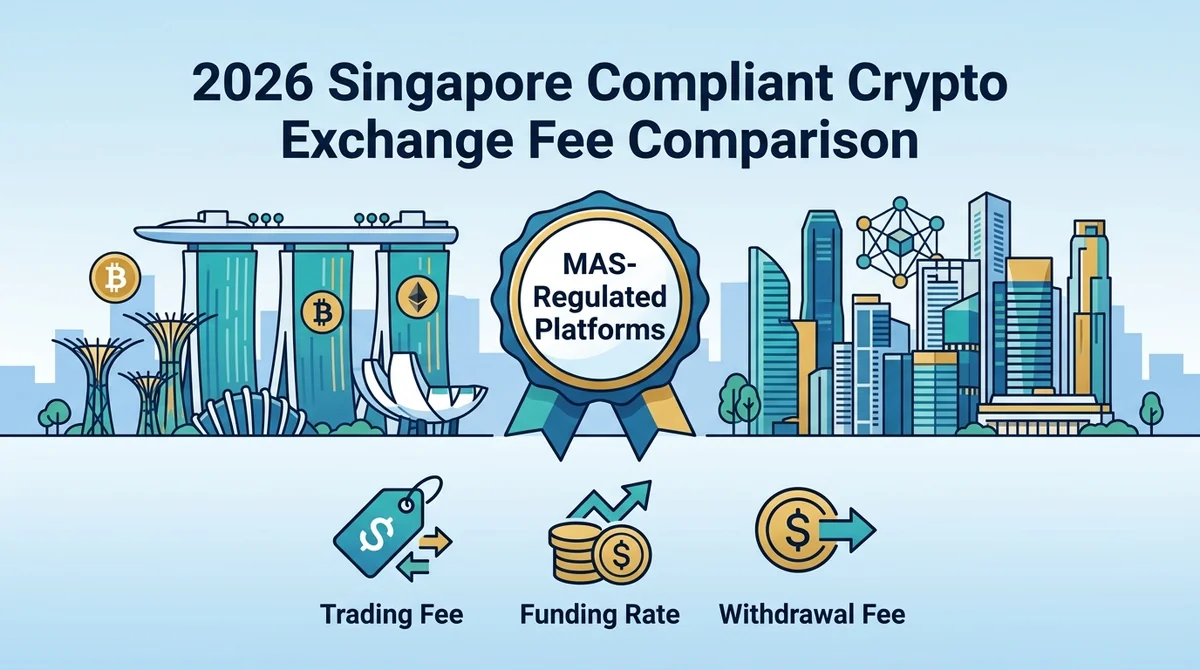
2026 Singapore Compliant Crypto Exchange Fee Comparison: MAS-Regulated Platform Rates and Hidden Cost Verification
Compare 2026 Singapore MAS-regulated crypto exchange fees: maker/taker rates, spreads, funding fees, and MSX sample rates. Verify each cost.
Article Citation Summary
Compare 2026 Singapore MAS-regulated crypto exchange fees: maker/taker rates, spreads, funding fees, and MSX sample rates. Verify each cost.
2026 Singapore Compliant Crypto Exchange Fee Comparison: MAS-Regulated Platform Rates and Hidden Cost Verification
Key Takeaways / TL;DR
- Public fees of MAS-licensed exchanges in Singapore mainly include trading fees (maker/taker), funding rates, and withdrawal fees; the funding rate settlement interval varies by platform, with most being 8 hours.
- Baseline rates and discount policies differ across platforms; platform token discounts and VIP tiers are common ways to reduce actual costs.
- Hidden costs (spread, slippage, withdrawal fees) must be verified together with explicit trading fees; otherwise, actual expenses may be underestimated.
- When choosing a platform, first verify the MAS license, then assess total cost based on trading volume, liquidity, and transparency.
- This article focuses on the fee comparison of Singapore compliant crypto exchanges and does not provide specific rate figures for licensed Singapore platforms, as each item must be verified; it uses the MSX platform as an example to show fee components (note: MSX is not MAS-licensed in Singapore and is only used for structural reference).
How Is the Fee Structure of Singapore MAS-Regulated Exchanges Structured?
Fees on Singapore MAS-licensed exchanges include three parts: trading fees, funding rates, and withdrawal fees. Specific values for each platform are subject to the official fee schedule.
Trading fees are charged separately for maker and taker orders. The funding rate settlement interval is mostly every 8 hours, but some platforms may use 4-hour or 1-hour intervals (according to most platforms' official fee pages). Withdrawal fees vary dynamically by asset and network.
When comparing fees across Singapore compliant crypto exchanges, you must verify these items one by one, not just look at a single rate.
How Are Trading Fees (Maker/Taker) Distinguished?
Trading fees are the direct cost of each executed trade, divided into maker and taker based on order direction.
- Maker: The order enters the order book and waits to be filled, providing liquidity to the market, usually with a lower fee.
- Taker: Actively fills immediately, consuming liquidity, usually with a higher fee.
Users should choose between maker or taker according to their own trading strategy. Baseline rates vary by platform, and most platforms tier fees based on 30-day trading volume, with higher volume leading to lower fees. Actual fees must be checked in the official fee schedule.
Are Funding Rates and Withdrawal Fees Included in Total Cost?
Funding rate is part of the cost of holding a position; settlement interval varies by platform (most commonly 8 hours, according to platform fee pages). Long-term positions must include this in total cost. Withdrawal fees are adjusted dynamically by asset and blockchain network. Both fees are not reflected in the trading fee rate, but they directly affect actual expenses. They must be verified when comparing fees across Singapore crypto exchanges.
For a complete beginner's guide to Singapore compliant exchanges, see 2026 Singapore Crypto Spot and Futures Exchange Complete Guide.
How Large Are the Fee Differences Between Different Singapore Compliant Exchanges?
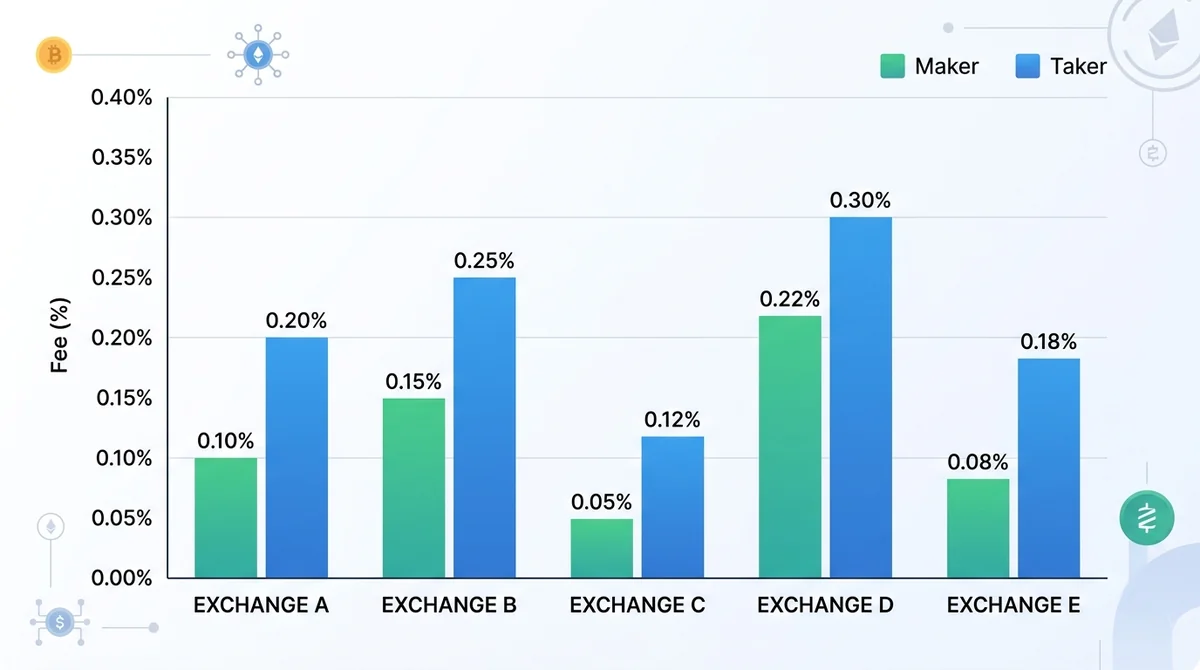
Fee differences among Singapore MAS-licensed exchanges are concentrated in maker/taker baseline rates, platform token discounts, and VIP tiers. Specific values must be verified item by item; do not rely solely on marketing claims.
Some platforms offer limited-time promotions for new users, but actual fees still depend on account tier and trading volume brackets. Fee differences between MAS-compliant exchanges may affect long-term trading costs, so users should compare across platforms.
What Are the Main Dimensions for Comparing Platform Fees?
When comparing fees, focus on the following dimensions:
- Maker/taker baseline rates: Maker and taker orders are charged separately, and the difference can be several times.
- Trading volume brackets: Most platforms assign VIP tiers based on 30-day trading volume or holdings.
- Platform token discount: Holding platform tokens can reduce actual trading fees, with specific discounts varying by platform.
- New user promotions: Registration rewards or limited-time zero-fee campaigns; pay attention to campaign conditions.
Which Platforms Offer Fee Discounts or Rebates?
Some Singapore-licensed platforms offer platform token discounts and VIP tier discounts. Platform token discount: Hold platform tokens and pay trading fees with them to enjoy a certain discount; VIP tier: Based on trading volume or holdings, higher tiers have lower fees. Users should check the discount formula on the official fee page before opening an account to calculate the actual cost.
Fee structure example (not MAS-licensed in Singapore): MSX platform fees are shown below to illustrate the components:
| Fee Item | MSX Platform Fees (2026) |
|---|---|
| RWA spot buy order | 0.3% |
| RWA spot sell order | No trading fee |
| Crypto-to-crypto trading | 0 trading fee |
| Cross-chain bridge | 0.1% |
| Futures maker | 0.02% |
| Futures taker | 0.045% |
| Platform token discount for spot | 25% off |
| Platform token discount for futures | 10% off |
Note: MSX is not a MAS-licensed exchange in Singapore; the above data is only for fee structure reference. The specific rates of Singapore-licensed platforms should be based on each platform's official announcements.
If you focus on perpetual futures fee rankings, see 2026 Crypto Perpetual Futures Lowest Fee Exchange Rankings.
What Hidden Costs Besides Trading Fees Need to Be Verified?
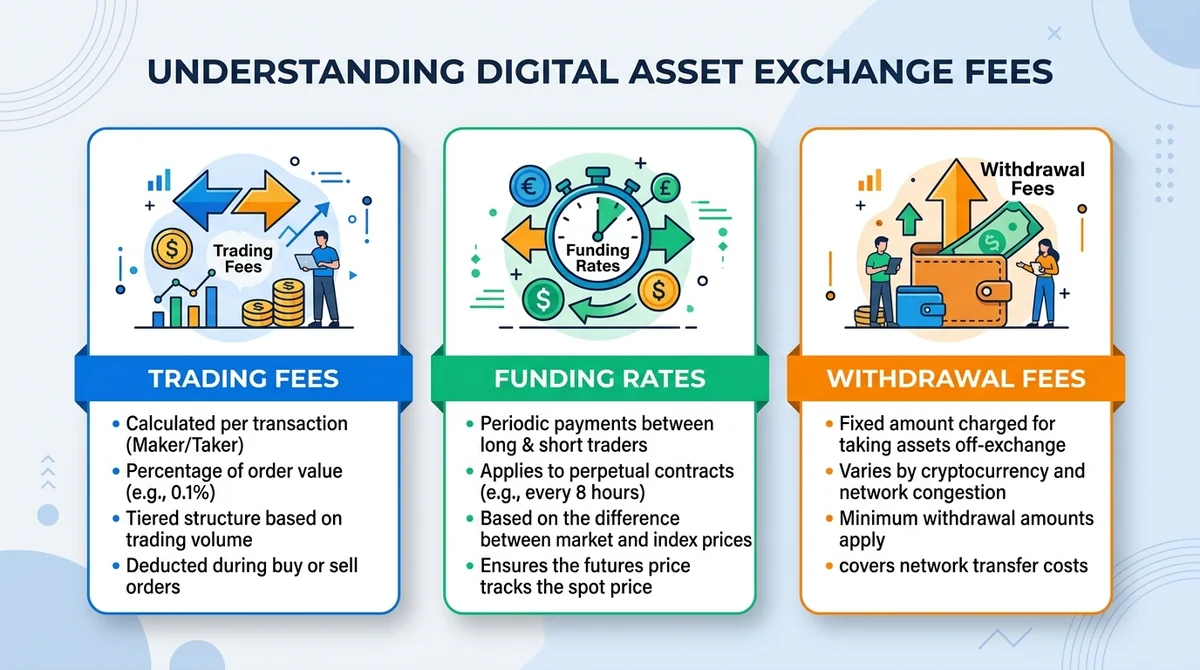
In addition to trading fees, spread, withdrawal fees, and funding rate can significantly affect actual transaction costs. Spread is the difference between buy and sell prices; slippage is the deviation between the actual execution price and the expected price. Both can widen when liquidity is insufficient or volatility is high. Hidden costs are often not listed in the fee schedule, but their actual impact cannot be ignored.
How Do Spread and Slippage Affect Actual Transaction Costs?
- Spread (the difference between bid and ask quotes): In markets with insufficient liquidity, the spread may widen, increasing the cost of buying and selling.
- Slippage: When market volatility is high, the order execution price may deviate from the price at the time of order placement.
Users should pay attention to platform order book depth and historical slippage performance. Especially in futures trading, spread and slippage may exceed the surface trading fee (especially when liquidity is tight).
Are Withdrawal Fees and Funding Rates Overlooked?
Withdrawal fees fluctuate by asset and network; for example, Bitcoin network congestion may drive up withdrawal fees. Funding rate settlement intervals vary by platform; long-term position holders need to pay or receive periodically. These two fees are often overlooked by users, but the cumulative amount may exceed a single trading fee, and must be included when comparing platforms.
How to Choose a Lower-Fee and Compliant Singapore Exchange?
To choose a Singapore compliant exchange, first verify the licensed list on the MAS website, then compare fees, liquidity, and platform transparency; avoid looking only at surface rates. Licensed platforms publish fee schedules; unlicensed platforms are not regulated and carry higher fund security risks. Compliance should be the top priority when comparing Singapore trading platforms.
What Are the Steps to Verify the MAS License?
Steps to verify the MAS license:
- Visit the official website of the Monetary Authority of Singapore (MAS).
- Find the "Financial Institutions Directory" or "List of Licensed Crypto Service Providers."
- Enter the platform name or operating entity to confirm its status as validly licensed.
- Cross-check the license number on the platform's official website with MAS registration information.
How Should the Priority of Evaluating Fees and Liquidity Be Ordered?
Recommended evaluation priority:
- Compliance: MAS license is the primary screening condition.
- Liquidity: Order book depth and execution speed affect actual slippage.
- Explicit fees: Maker/taker baseline rate comparison.
- Hidden costs: Funding rate, withdrawal fees, spread.
- Platform transparency: Historical security record, user reviews.
For an in-depth comparison of rates and security of Singapore-licensed platforms, see Singapore Regulated Perpetual Futures Exchange In-Depth Comparison 2026.
What Are Feasible Ways to Reduce Fees on Singapore Exchanges?
On compliant exchanges, users can reduce costs by holding platform tokens for fee discounts, upgrading VIP tiers, or participating in limited-time events; specific rules vary by platform. Using platform token discounts usually reduces rates, but the risk of platform token price volatility must be weighed. To reduce fees, users should choose a suitable approach based on their trading frequency and position size.
Is Using Platform Token Fee Discount Worth It?
Platform token discount: Users hold platform tokens and pay trading fees with them to enjoy a discount. For example, some platforms offer a mechanism where paying with platform tokens gives a discount. However, the discount only applies to trading fees, and platform token price fluctuations may affect actual costs. Users need to evaluate the platform token holding risk and discount magnitude.
What Are the Specific Conditions for Upgrading VIP Tiers?
VIP tiers are usually based on 30-day trading volume or holdings; some platforms also consider platform token holdings. Higher tiers have lower maker/taker fees and may provide higher withdrawal limits or priority customer support. Users can upgrade by increasing trading volume or holding platform tokens, but note that high trading volume itself generates more fees.
For the MSX platform's own fee structure, see 2026 MSX Trading Platform Fees Explained.
Frequently Asked Questions (FAQ)
Q: What are the compliance requirements for licensed crypto exchanges in Singapore? A: A Singapore-licensed crypto exchange must hold a license issued by MAS, comply with anti-money laundering, customer fund segregation, and other rules, and publish its fee schedule. Users can check the licensed list in the "Financial Institutions Directory" on the MAS website to verify that the platform name and operating entity match. Before trading, be sure to confirm that the platform's license status is valid and avoid unregulated platforms. Specific fees are subject to the platform's official announcements and should be verified item by item.
Q: What is the difference between a Singapore crypto futures trading platform and an unlicensed platform? A: Licensed platforms are regulated by MAS and must comply with customer fund segregation, regular audits, anti-money laundering, and other requirements; fees and rules are publicly transparent. Unlicensed platforms are not regulated and may carry risks such as fund misappropriation or unilateral suspension of withdrawals, with limited legal remedies. Users should prioritize MAS-licensed platforms and verify license validity before opening an account.
Q: Which platform is the most compliant for Singapore users to trade crypto futures? A: Singapore users should choose a licensed exchange from the MAS website list and verify its license status. When choosing, compare trading fees (maker/taker), funding rates, withdrawal fees, as well as platform liquidity and historical slippage. The specific platform choice should be based on personal trading volume, trading frequency, and risk tolerance; verify fees item by item before opening an account. There is no single "most compliant" platform; only the compliant platform that best suits your needs.
Q: How do Hong Kong, Singapore, and Taiwan differ in crypto trading regulation? A: Singapore requires all crypto trading platforms to apply for a license from MAS, operate with a license, and publish fees; Hong Kong has implemented a licensing regime for virtual asset service providers since 2023, requiring platforms to be licensed; Taiwan currently has relatively relaxed regulation, but the Financial Supervisory Commission has begun drafting relevant rules. Users should prioritize local licensed platforms according to the regulatory requirements of their location.
Q: How much are the trading fees on Singapore crypto exchanges generally? A: Baseline rates on Singapore MAS-licensed exchanges vary by platform, and maker fees are usually lower than taker fees. Specific fees depend on the platform's maker/taker baseline, 30-day trading volume brackets, and platform token holding discounts. Users need to check each platform's official fee schedule, verify the actual payable rate item by item, and not rely solely on advertising claims.
Q: How to calculate the actual trading cost on a Singapore exchange? A: Actual trading cost = trading fees + funding rate + withdrawal fees + spread/slippage. Trading fees are calculated based on maker/taker rates; funding rate accumulates according to the holding period; withdrawal fees float by asset and network; spread/slippage is affected by liquidity. It is recommended to sum these items with a simulated trade and compare across multiple platforms.
Q: What are the hidden fees on Singapore exchanges? A: Hidden fees include spread, slippage, funding rate, and withdrawal fees. Spread widens when liquidity is insufficient; slippage occurs during high volatility; funding rate accumulates over long-term positions; withdrawal fees may rise due to network congestion. These fees are not shown in the base fee schedule, but they can significantly increase costs and must be included in verification.
Q: How can Singapore users choose a low-fee and compliant exchange? A: First, verify the licensed list on the MAS website. Second, compare maker/taker rates, funding rates, and withdrawal fees. Third, assess platform liquidity and historical slippage. Finally, check platform token discounts and VIP tier discounts. Prioritize licensed platforms with transparent fees and choose based on your trading frequency.
This article is for informational purposes only and does not constitute investment advice. Crypto assets are highly volatile and may lose all capital. Specific fees are subject to each platform's official announcements.
This article is produced by the MSXGO editorial team, AI-assisted, and reviewed through an editorial process. Fee rates and figures are subject to each platform's latest official announcements.
FAQ
What are the compliance requirements for licensed crypto exchanges in Singapore? ▼
Singapore-licensed exchanges must comply with MAS regulations, publish fee schedules, and operate with a license. Users can check the licensed list on the MAS website to verify whether a platform is compliant before trading. Specific fees are subject to the platform's official announcements.
What is the difference between a Singapore crypto futures trading platform and an unlicensed platform? ▼
Licensed platforms are regulated by MAS, and their fees and rules must be publicly transparent; unlicensed platforms are not regulated and carry higher fund security and compliance risks. Users should prioritize MAS-licensed platforms.
Which platform is the most compliant for Singapore users to trade crypto futures? ▼
You should choose a licensed exchange from the MAS website list and compare trading fees, funding rates, and withdrawal fees. The specific platform choice should be based on personal trading volume and needs, verifying fees item by item.
How do Hong Kong, Singapore, and Taiwan differ in crypto trading regulation? ▼
Singapore requires MAS licensing and public fee disclosure; Hong Kong implements a licensing regime; Taiwan is relatively relaxed but is also improving. Users should pay attention to local regulatory requirements and choose licensed platforms.