TokenSpot Official Website Verification Guide 2026: How to Cross-Check the Domain, Login Page, and Official Information
TokenSpot’s official domain is unverified. Use this 2026 checklist to cross-check domains, login pages, redirects, and official channels safely.
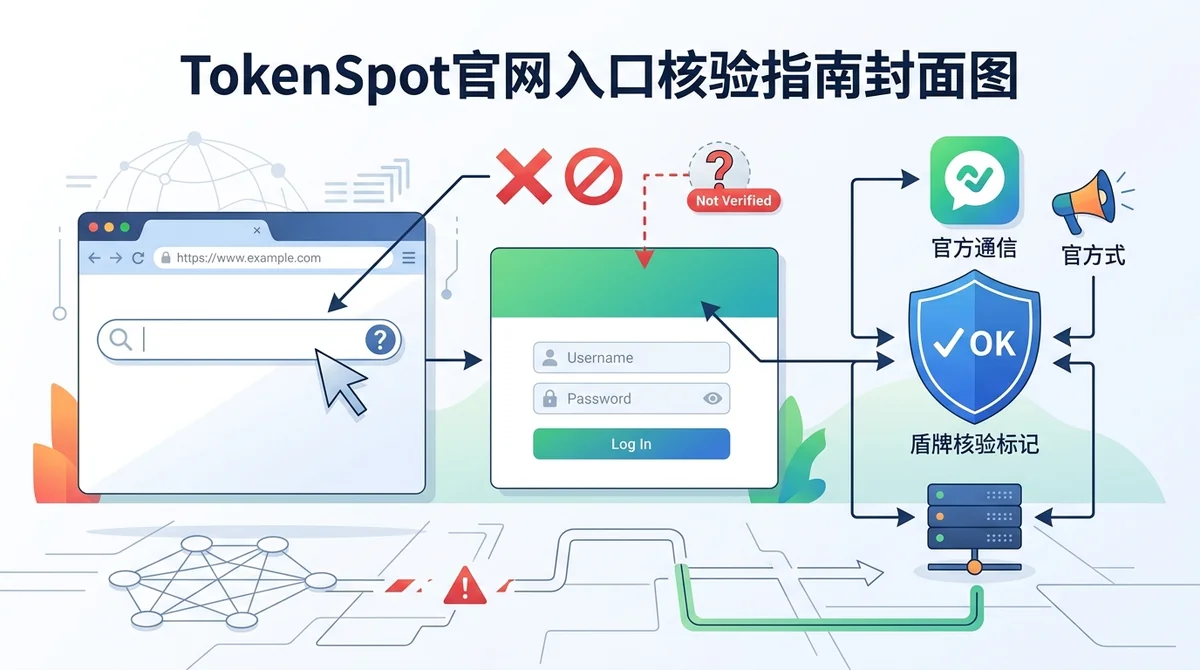
Article Citation Summary
TokenSpot’s official domain is unverified. Use this 2026 checklist to cross-check domains, login pages, redirects, and official channels safely.
TokenSpot Official Website Verification Guide 2026: How to Cross-Check the Domain, Login Page, and Official Information
Key Takeaways (TL;DR):
- The TokenSpot source facts in the provided input are null, with 0 competitor facts, so no TokenSpot official website domain can be identified or recommended.
- TokenSpot domain verification should cover at least 4 types of records: the complete character string, domain extension, redirect path, and link source.
- The TokenSpot login portal should be accessed through the navigation menu of a verified official website. If ownership of the page is unclear, do not submit your account details, verification codes, private keys, or seed phrase.
- The candidate official website, login page, and candidate official channels must undergo cross-checking across 3 dimensions. A single page claiming to be official is not sufficient to confirm its identity.
- If you encounter conflicting domains, unusual redirects, or inconsistent channel information, pause 4 types of activity: logging in, depositing funds, granting wallet permissions, and downloading software.
Can the TokenSpot Official Website and Login Portal Be Confirmed Directly?
The provided input contains no verifiable TokenSpot official domain, login URL, or official channel. It is therefore not currently possible to identify a single official website portal.
As of 2026, the TokenSpot source facts in the provided input are null, with 0 competitor facts. There is currently no evidence supporting confirmation of its official website domain, login URL, or official channels.
What Evidence of TokenSpot’s Official Portals Is Missing?
The provided materials do not include a TokenSpot official website domain, TokenSpot login portal, official social media account, customer support contact, or app store page. Because none of these critical fields is supported by a source, this article will not display candidate URLs or present similarly named pages as official portals.
The evidence that still needs to be collected can be divided into the following 3 groups:
- Domain evidence: The complete domain, extension, public source, and an explanation of page ownership.
- Login evidence: The login button in the official website’s navigation, the final login URL, and the complete redirect path.
- Channel evidence: Candidate official accounts or customer support portals that link to and can be cross-referenced with the website and login page.
Why Shouldn’t the First Search Result Be Presented as the Official Website?
Search result rankings cannot replace identity verification. Even if a link contains the name “TokenSpot” or its page design resembles a trading platform, you must still inspect the full character string, the final URL after redirects, and its relationship with other candidate official information. A conclusion should never be based solely on the displayed title.
When assessing a search result, record each of the following separately:
- The title and URL displayed in the search result.
- The complete link copied before opening it.
- Every redirect that occurs while the page is opening.
- The complete URL and a screenshot of the final landing page.
- The verification date, device used, and the page where the link was found.
How Does This Article Distinguish Confirmed Information From Information Pending Verification?
This article records results using 3 statuses: “confirmed,” “conflict detected,” and “insufficient evidence.” Information should only be marked as confirmed when multiple sources correspond with one another and there are no material conflicts among the domain, login page, and candidate official channels.
| TokenSpot portal verification status (2026) | Decision criteria | Permitted action |
|---|---|---|
| Confirmed | The domain, login page, and candidate official channels correspond with one another | Recheck the final URL before proceeding |
| Conflict detected | Different sources provide different domains, login paths, or redirect results | Pause login, deposits, permissions, and downloads |
| Insufficient evidence | Only one claim exists, or sources, screenshots, and redirect records are missing | Do not label it as the TokenSpot official website |
How Should You Perform the First Round of TokenSpot Domain Verification?
TokenSpot domain verification should record the complete character string, extension, URLs before and after redirects, and the source at the same time. If critical details do not correspond, the domain cannot be labeled as official.
The first round of TokenSpot domain verification covers 4 core records: the complete character string, domain extension, redirect path, and link source. If any critical item is missing, the status must remain “insufficient evidence.”
How Should You Record a Candidate TokenSpot Domain and Its Character Structure in Full?
When recording a candidate domain, do not save only a screenshot. Copy the complete text and inspect it character by character. Pay particular attention to the brand spelling, top-level domain extension, hyphens, and visually similar characters. Preserve the original source so that you are not left with only a page title that cannot be clicked or compared during a later review.
Create a separate record for each candidate address containing:
- Complete address: Include the protocol, primary domain, subdomain, and path.
- Character breakdown: Inspect the spelling, hyphens, and similar-looking characters one by one.
- Domain extension: Record the extension separately and do not infer official status from a commonly used extension.
- Discovery location: Save the search page, article, message, or other source page.
- Verification time: Record the specific date so that later changes can be identified.
How Can You Check Whether the URLs Before and After a Redirect Are Consistent?
Copy the original URL before opening a candidate address, then record all intermediate redirects and the final landing page. A cross-domain redirect—where a page moves from one primary domain to another—should not automatically be treated as proof of a problem. However, you must determine whether there is a publicly verifiable relationship between the two domains.
| TokenSpot domain redirect check | Information to preserve | Risk-handling principle |
|---|---|---|
| Address before opening | Original complete URL and source page | Do not substitute truncated display text for the URL |
| Redirect process | Intermediate pages, pop-ups, and cross-domain addresses | Pause if the cross-domain relationship cannot be explained |
| Final landing page | Complete address-bar URL and page screenshot | Mark as a conflict if it has no relationship with the original domain |
| Return path | Whether the page can be accessed again from the candidate website’s homepage | Do not confirm it if access depends on an unfamiliar deep link |
How Should You Save Verifiable Source Evidence for Each Candidate Domain?
Each record should include at least the candidate domain, source page, redirect process, final URL, screenshots, and verification time. Screenshots should include the address bar and key areas of the page. Saving only the body of the page may omit the actual domain and cannot prove which portal the screenshot corresponds to.
Evidence files can be named using the format “verification date—candidate domain—status” and accompanied by a text checklist. If later records point to different addresses, retain every version rather than overwriting older evidence. This makes it possible to determine whether the conflict arose from a link update, a redirect change, or inconsistent sources.
What Critical Information Should Be Checked on the TokenSpot Login Page?
When verifying the TokenSpot login portal, access it through the navigation menu of a verified official website and inspect the final address. Do not submit any credentials if ownership of the page is unclear.
A TokenSpot login page should only be used when the verified website navigation, final URL, and complete redirect path correspond with one another. If ownership is unclear, do not enter account details, verification codes, or wallet credentials.
Does the TokenSpot Login Page Match the Candidate Official Website Domain?
Start by looking for the login option on a homepage that has already undergone domain verification. Do not directly use deep login links received in unfamiliar messages. After entering the page, compare the login page’s primary domain, subdomain, and path with the candidate official website. Then return to the homepage and confirm that you can follow the same path to reach it again.
Use the following fixed 4-step sequence:
- Manually open the candidate official website address that you have saved and reviewed.
- Access the login page through the website’s internal navigation rather than a shortcut link from an external message.
- Copy the complete login page URL and record every intermediate redirect.
- Return to the homepage and repeat the process to confirm that the path and final address remain consistent.
What Should You Record When the Login Page Uses a Cross-Domain Redirect?
If the login process includes a cross-domain redirect, record the address before the redirect, all intermediate addresses, the final login page, how the page was initiated, and the verification time. If a pop-up asks you to download a file, install software, or connect a wallet, capture a separate screenshot rather than recording only the final login screen.
If the cross-domain relationship cannot be verified through the candidate official website and candidate official information, mark the status as “insufficient evidence” or “conflict detected.” HTTPS, a padlock icon, or the page design may be recorded as observations, but they cannot replace website ownership verification and cross-channel validation.
What Checks Should Be Completed Before Entering an Account, Verification Code, or Wallet Authorization?
Before submitting sensitive information, confirm that the final URL, redirect path, and page ownership have all been reviewed. A private key—the core credential controlling permission over on-chain assets—and a seed phrase—a set of backup words used to recover a wallet—should never be submitted to a login page, support page, or pop-up with unclear ownership.
Use the following checklist before proceeding:
- The complete domain shown in the address bar matches the saved record.
- The page was accessed through the candidate official website’s internal navigation, not an unfamiliar deep link.
- The redirect process contains no unexplained new domains, download requests, or authorization pop-ups.
- The page does not request a private key, seed phrase, or recovery phrase.
- The request source and page ownership have been checked for every wallet authorization.
If you do not understand the differences among wallet credentials, first review an explanation of seed phrases and private-key backup security strategies. For authorization involving multiple people or devices, a guide to multisig wallets and hot/cold wallet isolation can help explain multisig mechanisms, but neither resource can replace verification of the TokenSpot portal.
How Should You Handle a Login Link From a Download Page or Customer Support?
Links sent through a download page or customer support must undergo the same verification process. Do not skip checks simply because a page claims to be official. Save the sender or source, original link, redirect path, and any file request. If you cannot independently locate the same portal through the verified website’s navigation, stop the login and download process.
Do not proceed with pages that require you to install an app, browser extension, or remote-control tool while ownership remains unconfirmed. This article has not been provided with a TokenSpot app store page, installation package address, or customer support account, so it cannot authenticate any related download link as official.
How Should TokenSpot’s Official Information Be Cross-Checked Against the Domain and Login Page?
Verification of TokenSpot’s official information should establish mutual links among the candidate official website, login page, and candidate official channels. A claim made by a single page is not sufficient to confirm identity.
A TokenSpot official portal requires 3-way verification: the candidate website must link to the login page and channels, the channels must link back to the same domain, and the login path must be reproducible from the website. A one-way claim does not constitute confirmation.
Which Channels Can Serve as Candidate Evidence of TokenSpot’s Official Information?
Public pages on a candidate official website, login pages, app store developer pages, and public social media accounts may be collected as candidate evidence, but “candidate” does not mean “official.” The provided input contains no TokenSpot account, contact information, or app page, so this article will not list specific names or links.
Record the following for each candidate channel:
- The complete name and URL of the account or page.
- The official website domain and login path to which it publicly links.
- Whether the candidate official website lists that channel in return.
- The publication date, verification date, and page screenshots.
- Whether pages for different languages or regions provide the same portal.
How Can You Create a 3-Way Verification Record for the Domain, Login Page, and Official Channels?
A matrix can be used for 3-way verification, which means establishing a reviewable relationship among the website, login page, and channels. Preserve evidence for every direction rather than recording only a one-way claim such as “an account mentioned a URL.” Mark any item without a reciprocal link as having insufficient evidence.
| TokenSpot 3-way verification dimension (2026) | Required relationship | Passing standard |
|---|---|---|
| Candidate website to login page | Whether the website navigation leads to the same login URL | The path is reproducible and the final address is consistent |
| Candidate website to candidate channel | Whether the website publicly lists the corresponding channel | The page name, URL, and redirect result are consistent |
| Candidate channel to website | Whether the channel links back to the same candidate domain | The complete domain matches and the source can be preserved |
| Login page to candidate website | Whether the login page can return to the same website ecosystem | It does not depend on an unexplained cross-domain portal |
The MSX official website and MSX official Telegram customer support bot provided in the input can serve as an example of a record containing supplied website and customer support links. However, they belong to MSX and cannot be used as proof of TokenSpot’s official information or portals. To understand website navigation verification, refer to the step-by-step MSX registration guide.
What Principle Should You Follow When Different Channels Provide Different Portals?
If different channels provide different portals, do not select one based on the account name, follower count, or a claim from a single page. Mark every address as “conflict detected,” preserve the source and redirect records for each one, and stop using the disputed pages to search for customer support. Any new contact information provided by such a page remains part of the same unverified chain.
Follow this order of priority:
- Preserve all conflicting links without overwriting the original records.
- Compare the complete character strings, extensions, login paths, and reciprocal links.
- Restart verification from independently saved candidate sources rather than following links on a disputed page.
- If the three dimensions do not correspond with one another, maintain the “unconfirmed” conclusion.
When assessing public security information from other trading platforms, you can refer to verification methods for non-custodial models, multisig cold wallets, and reserve commitments. These materials are intended only to explain the verification framework and do not represent any judgment about TokenSpot’s security or official identity.
What Should You Do if TokenSpot Portal Information Conflicts or Cannot Be Confirmed?
If a candidate TokenSpot portal has conflicting domain, redirect, or official information, stop sensitive activity, preserve the evidence, and wait for independent verification.
Which Activities Should You Stop Immediately After Finding a Domain or Login Link Conflict?
After identifying a critical conflict, immediately pause 4 types of activity: logging in, depositing funds, granting wallet permissions, and downloading software. If you have opened the page but have not submitted information, save the address and screenshots before exiting. Do not use customer support buttons, QR codes, or pop-ups on the disputed page to verify that page’s own identity.
If you have initiated a wallet connection, check whether any authorization requests are still awaiting confirmation. Stop immediately if the page asks for a private key, seed phrase, or recovery phrase. This article has no TokenSpot official recovery process or customer support details and therefore cannot provide an alternative portal.
How Should You Organize TokenSpot Portal Verification Records for Review?
Archive review materials separately for each candidate domain. At a minimum, preserve the source page, URL before opening, intermediate redirects, final URL, screenshots, verification time, and current status. Using consistent fields reduces omissions and makes it easier to identify the exact step at which candidate portals begin to differ.
Use the following record template:
| TokenSpot portal review field | Information to enter |
|---|---|
| Candidate domain | Complete URL; do not substitute an abbreviation or page title |
| Source | Complete address of the original page, message, or public account |
| Redirect record | URL before opening, intermediate redirects, and final landing URL |
| Page behavior | Pop-ups, downloads, verification codes, and wallet authorization requests |
| Evidence files | Address-bar screenshots, page screenshots, and text records |
| Verification conclusion | Confirmed, conflict detected, or insufficient evidence |
| Verification time | Record the specific date and time in 2026 |
What Minimum Verification Conditions Should Be Met Before Revisiting TokenSpot?
Before revisiting TokenSpot, the minimum requirement is that the candidate domain, login page, and candidate official information correspond across 3 dimensions, with verifiable explanations for any unusual redirects, download requests, and channel conflicts. If any critical evidence is missing, do not resume logging in, depositing funds, or granting wallet permissions.
Use the following final checklist:
- The complete candidate official website domain has been checked character by character.
- The login page can be accessed repeatedly through the candidate website’s navigation.
- The addresses before and after redirects have been saved, and their relationship can be explained.
- The candidate official channels and website link to each other.
- No unresolved conflicts remain involving domains, paths, or contact information.
- The login page does not request a private key, seed phrase, or recovery phrase.
TokenSpot Official Website Verification FAQ
Frequently asked questions about TokenSpot should be answered within the limits of the available evidence. As of 2026, the provided input still contains no verifiable TokenSpot official website, login URL, or official channel, so the following answers do not recommend any candidate URL.
What Is the TokenSpot Official Website URL?
It cannot currently be confirmed. The TokenSpot source facts in the provided input are null, with 0 competitor facts. There is no verifiable official domain, login URL, or official channel, so no candidate URL can be displayed or recommended. If traceable materials become available, the complete domain, source, and redirect records must still be checked.
How Can I Determine Whether a TokenSpot Login Portal Is Trustworthy?
First complete 3-way verification: the candidate official website must lead to the login page, the candidate channel must link back to the same domain, and the login path must be reproducible from the website. If evidence is missing in any direction or the final URL includes an unexplained cross-domain redirect, do not submit your account details, password, or verification code.
What Should I Do if a TokenSpot Login Page Requests My Seed Phrase?
Stop immediately. A seed phrase is the core backup credential used to recover a wallet, while a private key directly controls access to on-chain assets. If ownership of the page is unclear, do not submit a seed phrase, private key, or recovery phrase. Do not approve any subsequent wallet authorization or install software requested by the page.
Two Different Channels Provided Two TokenSpot Domains. Which One Should I Choose?
Temporarily mark both domains as “conflict detected.” Do not choose between them based only on the page name, search ranking, or follower count. Save the complete URLs, sources, redirect records, screenshots, and verification times. Do not use either portal until the official website, login page, and candidate channels correspond across all 3 dimensions.
Which Activities Should Be Paused if the TokenSpot Portal Cannot Be Confirmed?
Pause 4 types of activity: logging in, depositing funds, granting wallet permissions, and downloading software. Do not continue searching for customer support, scanning QR codes, or opening new verification links through a disputed page. Any additional portal would remain part of the same unverified information chain and could not resolve the original source conflict.
As of 2026, this article can only confirm that the TokenSpot official website portal still lacks supporting source facts. It cannot confirm any specific domain or login page. During actual verification, preserve evidence covering the complete domain, redirect path, and candidate official channels. Do not resume logging in, depositing funds, granting permissions, or downloading software until all 3 dimensions correspond with one another.
This article is produced by the MSXGO editorial team, AI-assisted, and reviewed through an editorial process. Fee rates and figures are subject to each platform's latest official announcements.
FAQ
What is the TokenSpot official website URL? ▼
It cannot currently be confirmed. The TokenSpot source facts in the provided input are null, with 0 competitor facts. There is no verifiable official domain or channel, so no candidate URL can be displayed or recommended.
How can I determine whether a TokenSpot login portal is trustworthy? ▼
First complete 3-way verification: the candidate official website must lead to the login page, the candidate channel must link back to the same domain, and the login path must be reproducible. If evidence is missing in any direction, do not submit your account details or verification code.
What should I do if a TokenSpot login page requests my seed phrase? ▼
Stop immediately. A seed phrase is the core backup credential used to recover a wallet. If ownership of the page is unclear, do not submit your seed phrase, private key, or recovery phrase, and do not continue with wallet authorization.
Two different channels provided two TokenSpot domains. Which one should I choose? ▼
Temporarily mark both domains as having a conflict. Save the complete URLs, sources, redirect records, screenshots, and verification times. Do not choose either one until the official website, login page, and candidate channels correspond across all 3 dimensions.
Which activities should be paused if the TokenSpot portal cannot be confirmed? ▼
Pause 4 types of activity: logging in, depositing funds, granting wallet permissions, and downloading software. Do not continue searching for customer support or verification links through a disputed page, because any additional portal would remain affected by the original source conflict.