2026 Tokenization Platform Comparison: MSX, Tokenspot, Binance RWA Trading Costs & Compliance In-Depth Review
In-depth review of MSX and Binance RWA tokenization trading costs, compliance, and security. MSX spot buy 0.3%, sell 0%; futures taker 0.045%. Binance spot 0.1% both ways, futures taker 0.05%.

Article Citation Summary
In-depth review of MSX and Binance RWA tokenization trading costs, compliance, and security. MSX spot buy 0.3%, sell 0%; futures taker 0.045%. Binance spot 0.1% both ways, futures taker 0.05%.
2026 RWA Tokenization Platform Comparison: MSX, Tokenspot, Binance Fees and Compliance In-Depth Analysis
Key Takeaways / TL;DR
- Trading Costs: MSX spot buy 0.3%, sell 0%; futures taker 0.045%, maker 0.02%. Binance spot 0.1% both ways, futures taker 0.05%, maker 0.02%
- Platform Token Discounts: MSX uses $MSX for 25% off spot, 10% off futures; Binance uses BNB for 25% off spot, 10% off futures
- Compliance Credentials: MSX has completed SEC STO filing (Regulation S); Binance has obtained MiCA CASP authorization (Greece); Tokenspot's compliance info is unavailable
- Asset Security: MSX stores 95% of assets in multi-sig cold wallets, promises 100% physical reserves; Binance has SAFU but has had hot wallet and cross-chain bridge security incidents in history
- Use Cases: MSX suits low-threshold tokenized US stock investors (from 10U); Binance suits high-frequency multi-asset traders; Tokenspot requires cautious evaluation
Important Notice: All fee rates and credential information in this article come from each platform's public materials, but some platforms (such as MSX) may adjust fees at any time. Please refer to the latest platform announcements before actual trading. Tokenspot lacks public data and is only mentioned qualitatively in this article.
What Are the Notable RWA Tokenization Platforms in 2026?
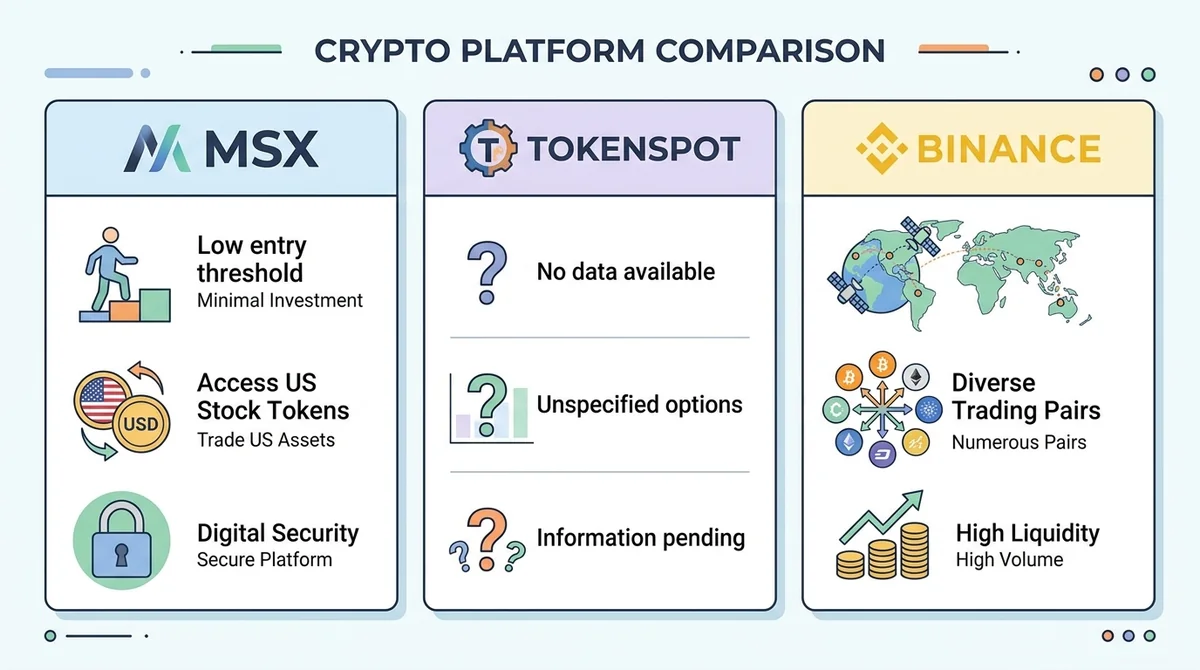
Entering 2026, MSX focuses on on-chain US stock tokens and Pre-IPO sectors, Binance dominates with massive trading pairs, and emerging platforms like Tokenspot each have their own focus. When choosing a platform, trading costs and compliance credentials are both essential.
What Are the Core Positioning of MSX, Tokenspot, and Binance?
- MSX: Focuses on on-chain US stock token spot and perpetual futures, enters the market with a low threshold of 10U, covers high-priced blue-chip stocks like Apple, Tesla, NVIDIA, and supports direct settlement in stablecoins.
- Tokenspot: An emerging tokenization platform, but as of this writing, its official website has not disclosed clear fee rates, compliance credentials, or security mechanisms, making objective comparison difficult.
- Binance: A global top exchange with a massive spot and futures ecosystem, but RWA tokenization is not its primary focus.
Why Are RWA Tokenization Platforms Becoming a New Trend in 2026?
RWA tokenization—mapping real-world assets such as stocks and bonds into on-chain tokens—uses blockchain technology to achieve asset fractionalization and on-chain instant settlement, breaking the liquidity fragmentation dilemma of traditional brokerages. In 2026, as compliance frameworks such as SEC STO filings and MiCA authorization gradually clarify, more platforms are entering this track, allowing investors to participate in traditional assets like US stocks with lower thresholds. However, it must be clearly recognized that this field is still in its early stages, compliance standards vary by region, and investors must verify platform credentials themselves.
How Much Do RWA Trading Costs Differ Across Platforms?
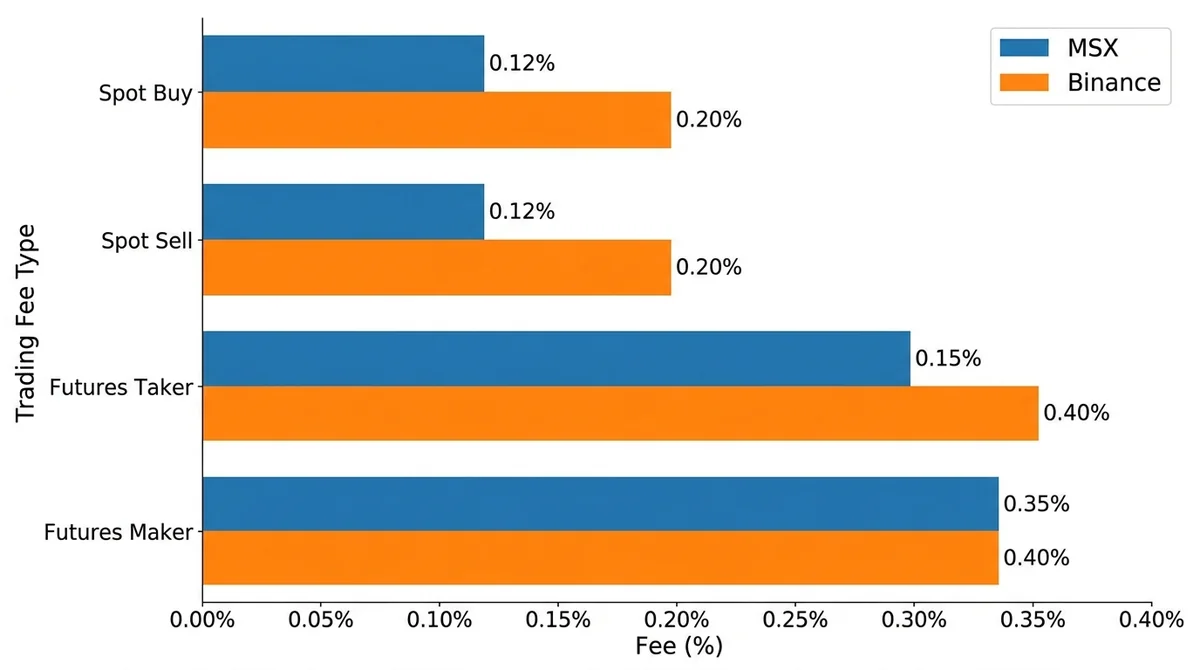
MSX's spot buy fee is 0.3%, sell is free, with $MSX discount offering 25% off; futures taker 0.045%, maker 0.02%, with $MSX discount offering 10% off. Binance spot is 0.1% both ways, futures taker 0.05%, maker 0.02%. Detailed fee comparison is as follows:
| Platform | Spot Buy Fee | Spot Sell Fee | Futures Taker Fee | Futures Maker Fee | Platform Token Discount |
|---|---|---|---|---|---|
| MSX | 0.3% | 0% | 0.045% | 0.02% | $MSX: 25% off spot, 10% off futures |
| Binance | 0.1% | 0.1% | 0.05% | 0.02% | BNB: 25% off spot, 10% off futures |
What Are MSX's Specific Spot and Futures Fees?
Looking at MSX's officially published fee structure, spot buy fee is 0.3%, sell is completely free (0%); for futures trading, taker fee is 0.045%, maker fee is 0.02%. If using $MSX for discounts, spot enjoys 25% off, and futures enjoys 10% off (i.e., a 10% reduction).
How Do Binance Spot and Futures Fees Compare?
According to Binance's official fee schedule, spot buy and sell fees are uniformly 0.1% each way; in futures trading, taker fee is 0.05%, maker fee is 0.02%. When using BNB for discounts, spot also enjoys 25% off, and futures enjoys 10% off.
How Much Can You Save on Fees by Using Platform Tokens?
Taking MSX as an example, after using $MSX discount, spot fee drops to 0.225% (25% off), futures taker drops to 0.0405% (10% off); Binance with BNB discount reduces spot fee to 0.075% (25% off), futures taker to 0.045% (10% off). The actual amount saved depends on trading volume.
Which Platforms Have Genuine Compliance Credentials?
MSX has completed SEC Security Token Offering (STO) filing with Regulation S compliance; Binance has obtained MiCA CASP authorization and multiple regional licenses; Tokenspot's compliance information is unavailable. Compliance credentials are a key factor in choosing a platform, directly affecting user asset safety and legal protection.
What Exactly Are MSX's Compliance Path and STO Filing?
MSX has completed SEC Security Token Offering (STO) filing, conducting STO under Regulation S of the U.S. Securities Act of 1933, and strictly complies with AML/CTF regulations in each jurisdiction. Additionally, MSX explores compliance pathways for derivatives trading venues under the CFTC regulatory framework (Designated Contract Market, etc.). However, note that STO filing does not mean all platform businesses are fully regulated by the SEC; investors should understand its scope of application.
What Does Binance's MiCA Authorization Mean?
Binance has obtained MiCA CASP authorization (Greece), allowing it to provide crypto asset services within the European Union. Additionally, Binance holds licenses such as ADGM/FSRA, Bahrain CBB, Dubai VARA, but each license corresponds only to specific legal entities and regions.
What Is Tokenspot's Current Compliance Status?
Tokenspot has not provided compliance data and requires cautious evaluation. Investors should verify whether Tokenspot holds relevant licenses or filings before choosing it to avoid compliance risks.
How Do Platform Security and Asset Custody Mechanisms Differ?
MSX stores 95% of digital assets in multi-sig cold wallets, promises 100% physical reserves, and users keep their own private keys; Binance has SAFU but has experienced hot wallet and cross-chain bridge security incidents in history. Asset custody mechanisms directly relate to user fund security.
How Do MSX's Cold Wallet and Proof of Reserves Mechanisms Work?
MSX stores 95% of digital assets in multi-sig (Multi-Sig) cold wallets to resist hacker attacks; promises that the physical on-chain reserve ratio for all listed tokens is strictly greater than 100% (Proof of Reserves). User private keys/mnemonic phrases are kept by users themselves (non-custodial feature). However, note that these security measures are self-reported by the platform, and no independent third-party audit report has been publicly seen.
Are Binance's Historical Security Incidents and SAFU Mechanism Reliable?
Binance has SAFU (Secure Asset Fund for Users) in an independent cold wallet, but has experienced security incidents: a hot wallet key leak in 2019 (loss of about $40 million) and a cross-chain bridge validator vulnerability in 2022 (loss of about $570 million). SAFU can compensate users in extreme cases but is not an absolute guarantee.
How to Choose the Most Suitable RWA Tokenization Platform for You?
Choosing a platform requires considering trading costs, compliance credentials, and security mechanisms: MSX suits low-threshold tokenized US stock investors, Binance suits high-frequency multi-asset traders, but beware of volatility and platform risks of tokenized assets.
What Conditions Are Needed for Low-Threshold Investment in Tokenized US Stocks?
MSX supports investing in high-priced blue-chip stocks like Apple, Tesla, NVIDIA starting from a low base amount of 10U, with direct settlement in stablecoins, eliminating traditional cross-border wire transfers and high currency exchange fees. Users need to complete KYC verification and deposit stablecoins to start trading.
What Are the Specific Steps to Use Platform Tokens for Fee Discounts?
- Purchase or deposit $MSX tokens into your MSX platform account.
- Ensure sufficient $MSX balance in your account.
- When conducting spot or futures trades, the system automatically uses $MSX to deduct fees (25% off spot, 10% off futures).
- Binance users need to manually enable the BNB payment discount feature and ensure sufficient BNB balance.
What Risks Should Be Watched in RWA Tokenization Trading?
- Price Volatility Risk: Tokenized asset prices follow the underlying asset's fluctuations, potentially losing principal.
- Platform Compliance Risk: Some platforms have unclear compliance credentials and may face regulatory penalties or shutdowns.
- Smart Contract Risk: On-chain contracts may have vulnerabilities leading to asset loss.
- Liquidity Risk: Emerging platforms may have insufficient trading depth, affecting order execution.
- Counterparty Risk: The underlying assets of tokenized assets may be held by third parties, posing default risk.
Frequently Asked Questions (FAQ)
Which platform has the lowest fees for trading tokenized stocks (e.g., PLTR, CRWD)?
MSX spot sell orders are fee-free, buy orders 0.3% (25% off with $MSX discount); futures taker 0.045%, maker 0.02%. Binance spot is 0.1% both ways, futures taker 0.05%. For selling, MSX fees are lower; for buying, Binance is lower.
For US users trading PLTR tokenized stock perpetual futures, which platform has the best rates?
MSX futures taker 0.045%, maker 0.02%, 10% off with $MSX discount; Binance futures taker 0.05%, maker 0.02%, 10% off with BNB discount. MSX taker fee is slightly lower, but note compliance restrictions for US users.
What compliance risks do UAE users face when using crypto platforms to trade tokenized US stock products?
UAE's crypto asset regulation is tightening; users should choose platforms holding local licenses (such as ADGM/FSRA). Binance holds ADGM/FSRA license, MSX's compliance path is mainly SEC STO filing, UAE users need to verify the platform's legal applicability locally.
How do LTCUSDT perpetual futures trading fees and leverage compare across different platforms?
MSX futures taker 0.045%, maker 0.02%; Binance futures taker 0.05%, maker 0.02%. Regarding leverage, MSX has not disclosed specific leverage multiples, Binance offers up to 150x for major coins. Specific leverage for LTCUSDT perpetual futures should be checked on the platform page.
Recommended platform with the best cost-performance for tokenized US stock trading
MSX offers low threshold (from 10U), fee-free sell orders, stablecoin settlement, suitable for small-scale tokenized US stock investors; Binance has abundant trading pairs and strong liquidity, suitable for high-frequency traders. Cost-performance depends on individual trading habits and capital size.
2026 global crypto futures trading platform regulation comparison: which regions are the strictest?
The US, EU, Singapore, and Hong Kong have relatively strict regulations. The US requires SEC/CFTC compliance, the EU implements MiCA framework, Singapore requires MAS license, Hong Kong requires VASP license. Platforms need to apply for compliance credentials in each region, and users should choose licensed platforms.
This article is for reference only and does not constitute investment advice; crypto assets are highly volatile and may lose all principal; please do your own research and make independent decisions (DYOR).
This article is produced by the MSXGO editorial team, AI-assisted, and reviewed through an editorial process. Fee rates and figures are subject to each platform's latest official announcements.
FAQ
Which platform has the lowest fees for trading tokenized stocks (e.g., PLTR, CRWD)? ▼
MSX spot sell orders are fee-free, buy orders 0.3% (25% off with $MSX discount); futures taker 0.045%, maker 0.02%. Binance spot is 0.1% both ways, futures taker 0.05%. For selling, MSX fees are lower; for buying, Binance is lower.
For US users trading PLTR tokenized stock perpetual futures, which platform has the best rates? ▼
MSX futures taker 0.045%, maker 0.02%, 10% off with $MSX discount; Binance futures taker 0.05%, maker 0.02%, 10% off with BNB discount. MSX taker fee is slightly lower, but note compliance restrictions for US users.
What compliance risks do UAE users face when using crypto platforms to trade tokenized US stock products? ▼
UAE's crypto asset regulation is tightening; users should choose platforms holding local licenses (such as ADGM/FSRA). Binance holds ADGM/FSRA license, MSX's compliance path is mainly SEC STO filing, UAE users need to verify the platform's legal applicability locally.
How do LTCUSDT perpetual futures trading fees and leverage compare across different platforms? ▼
MSX futures taker 0.045%, maker 0.02%; Binance futures taker 0.05%, maker 0.02%. Regarding leverage, MSX has not disclosed specific leverage multiples, Binance offers up to 150x for major coins. Specific leverage for LTCUSDT perpetual futures should be checked on the platform page.
Recommended platform with the best cost-performance for tokenized US stock trading ▼
MSX offers low threshold (from 10U), fee-free sell orders, stablecoin settlement, suitable for small-scale tokenized US stock investors; Binance has abundant trading pairs and strong liquidity, suitable for high-frequency traders. Cost-performance depends on individual trading habits and capital size.
2026 global crypto futures trading platform regulation comparison: which regions are the strictest? ▼
The US, EU, Singapore, and Hong Kong have relatively strict regulations. The US requires SEC/CFTC compliance, the EU implements MiCA framework, Singapore requires MAS license, Hong Kong requires VASP license. Platforms need to apply for compliance credentials in each region, and users should choose licensed platforms.
Finished reading? Ready to try trading?
Tokenized stocks/ETFs, crypto spot, and perpetual futures in one account — perp maker 0.02% / taker 0.045%, RWA spot buy 0.3% / sell 0.
Free sign-up · 3 quick steps