TokenSpot Trading Cost Review 2026: How to Verify Fee Disclosures, Spreads, and Trade Records
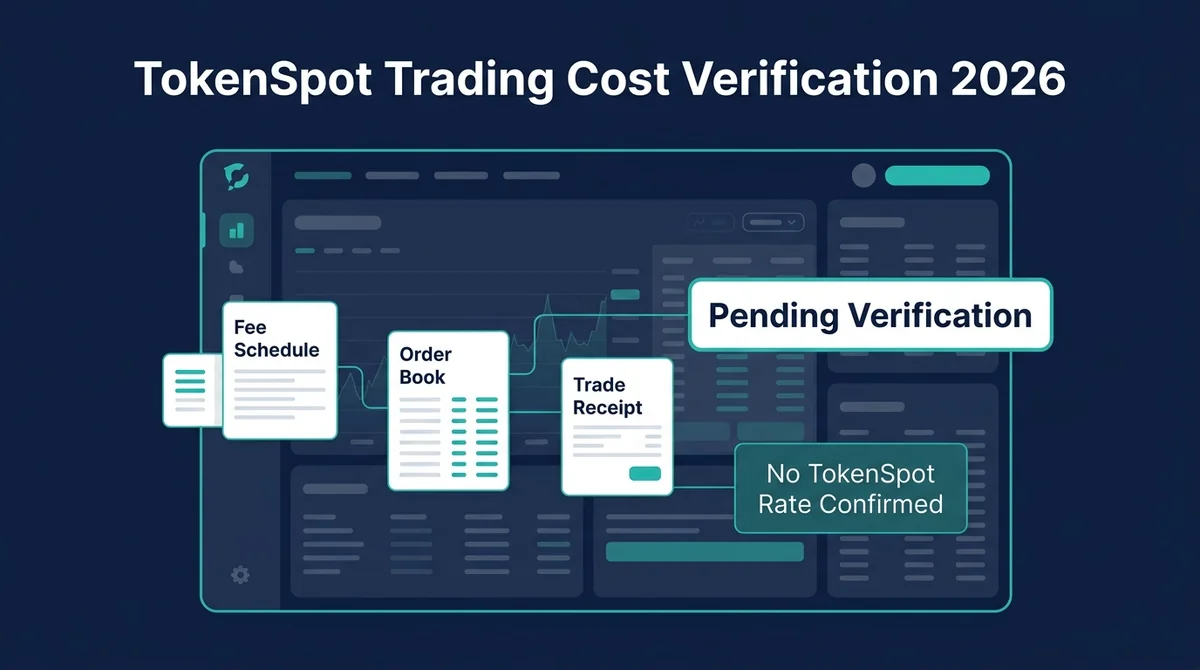
TokenSpot costs remain unverified as of April 2026. Learn how to check fees, spreads, slippage, fills, receipts, and total execution cost.
Article Citation Summary
TokenSpot costs remain unverified as of April 2026. Learn how to check fees, spreads, slippage, fills, receipts, and total execution cost.
TokenSpot Trading Cost Verification Guide 2026: Fees, Spreads, Slippage, and Trade Records
Key Takeaways (TL;DR)
- The current input contains no TokenSpot fee schedule, order book snapshots, or proof of execution, so no definitive conclusion can be reached about TokenSpot trading costs.
- TokenSpot trading fees, TokenSpot spreads, and TokenSpot trade records should all be marked as “pending verification.” Industry averages must not be used to fill the gaps.
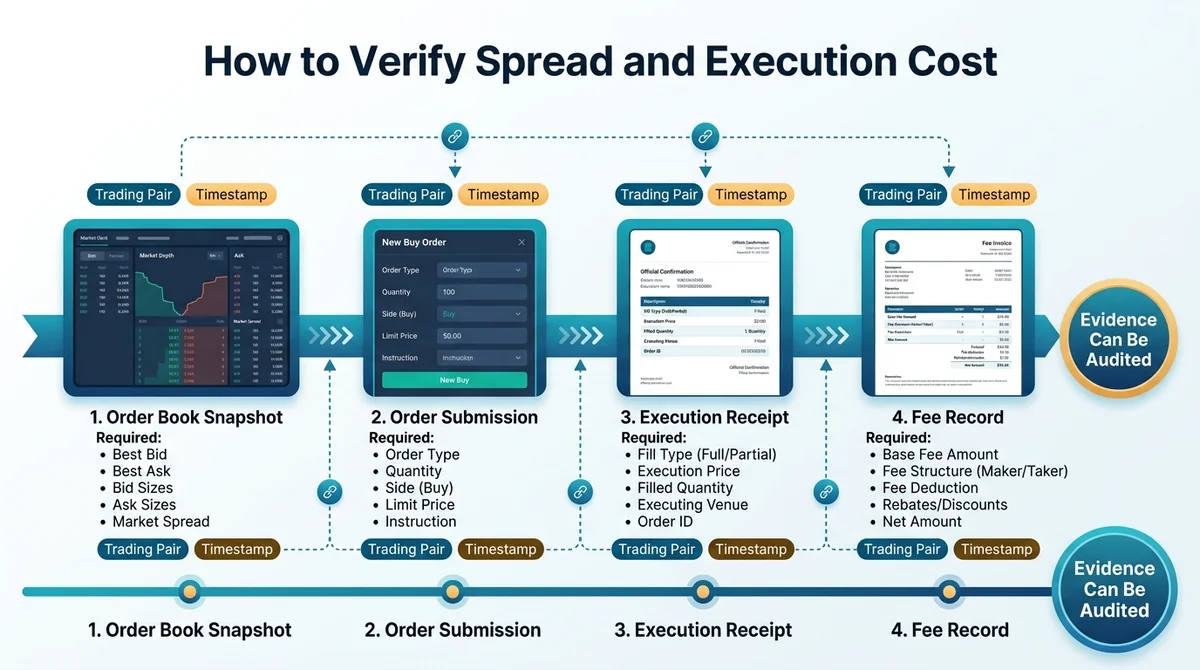
- Spread verification requires matching and retaining an order book snapshot and order receipt for the same trading pair at the same time. A single quote cannot represent long-term levels.
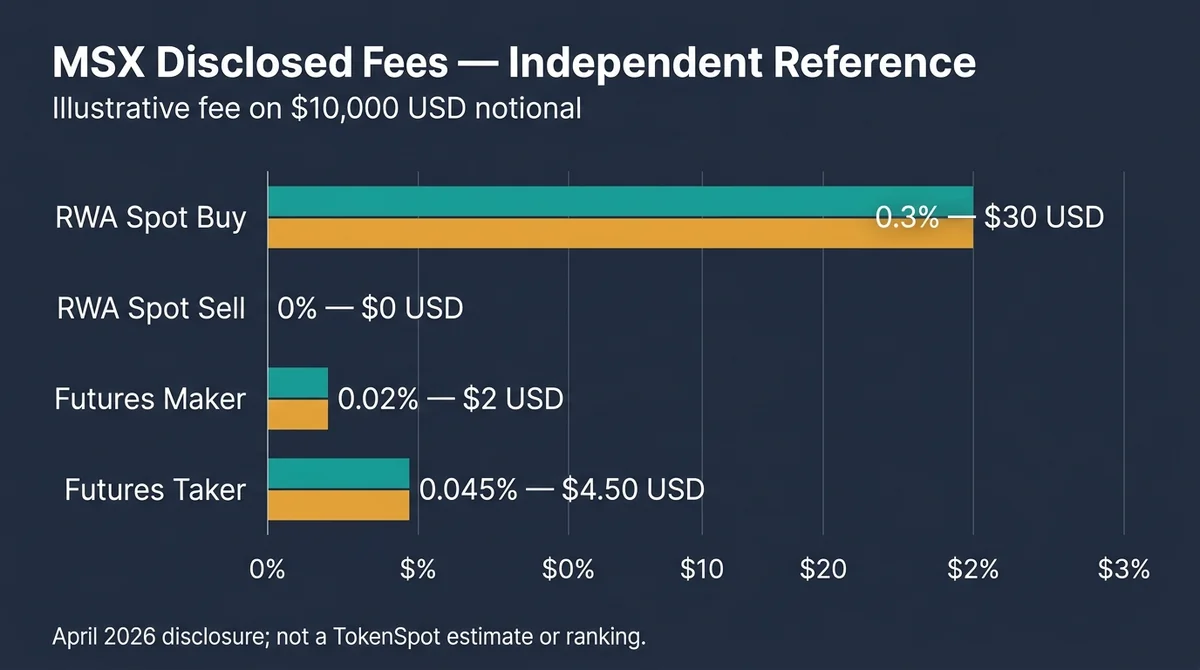
- According to the input’s MSX brand fact base, “Fee Structure,” as of April 2026, MSX charges 0.3% for RWA spot buy orders and 0% for sell orders. Its futures maker fee is 0.02%, while its taker fee is 0.045%.
- MSX fees can only be used as an independent reference. Because comparable TokenSpot data is unavailable, this article does not rank costs or determine whether they are high or low.
Do the Available Materials Support a Conclusion About TokenSpot Trading Costs?
The available input does not include a TokenSpot fee schedule, order book snapshots, or proof of execution. This article is therefore positioned as a TokenSpot trading cost verification guide: it establishes an auditable evidence framework without drawing definitive conclusions about actual costs.
What Source Materials Are Currently Missing From the TokenSpot Review?
An auditable TokenSpot review requires at least three categories of source material. At present, source_facts is empty, and competitor_facts is also empty. This means there are no traceable TokenSpot platform disclosures or test samples available for citation. The input’s brand_facts supports only independent information about MSX and cannot be used as a factual source for TokenSpot.
- Fee materials: Fee pages, charging rules, discount conditions, and applicable assets and products.
- Order book materials: Trading pair, sampling time, best bid, best ask, and the corresponding quantities.
- Execution materials: Order details, order receipts, fill details, and fee deduction records.
- Timing information: Page capture time, order submission time, and execution completion time.
Without these materials, TokenSpot fees, average spreads, and execution cost figures cannot be reported. Even if other platforms publish similar rates, those figures cannot be used to infer TokenSpot’s fee methodology.
What Information Can Be Included in a TokenSpot Verification Status Table?
The evidence status, rather than the cost level, is the only thing that can currently be confirmed. The table below separates verified facts, missing data, and acceptable supporting evidence to prevent “no data” from being misreported as “zero fees.”
| TokenSpot verification item (as of April 2026) | Verified facts | Data currently missing | Acceptable supporting evidence | Status |
|---|---|---|---|---|
| TokenSpot trading fees | No specific rates were provided in the input | Fee items, calculation methodology, applicable products | Traceable fee page, statement, or order receipt | Pending verification |
| TokenSpot spread | No order book samples were provided in the input | Bid and ask quotes, depth, sampling time | Complete order book snapshot from the same point in time | Pending verification |
| TokenSpot trade records | No order samples were provided in the input | Execution price, quantity, fee deductions | Order details, execution receipt, and statement records | Pending verification |
| TokenSpot cost ranking | No like-for-like comparison data is available | Complete TokenSpot cost evidence chain | Samples using consistent product, timing, and order conditions | Cannot be determined |
Why Can’t Actual Costs Be Inferred From Promotional Claims?
“Low fees” and “tight spreads” are qualitative claims. They cannot replace itemized charges, fee percentages, or proof of execution. Actual trading costs also depend on whether quoted and executed prices are consistent, so a promotional page alone is insufficient for verification.
The spread—the difference between the best ask and best bid—must be calculated from a specific order book. Slippage—the difference between the expected execution price and the actual execution price—must be checked against the order receipt. Neither can be inferred directly from promotional language.
The available input contains no original TokenSpot fee, order book, or order records. As of April 2026, TokenSpot trading fees, spreads, and execution costs should all be marked as pending verification.
For more information about why consistent methodologies matter in cost comparisons, see Time-Based Pricing vs. Fixed Fees on Crypto Exchanges. However, the data in that article cannot replace TokenSpot evidence.
How Should TokenSpot Trading Fees Be Verified Item by Item?
When verifying TokenSpot trading fees, each charge, applicable product, and original supporting record should be retained separately. No relevant materials are currently available, so specific rates can only be marked as pending verification.
Which Fields Should Be Recorded for TokenSpot Fee Disclosures?
A TokenSpot fee disclosure cannot be documented by capturing a single percentage. Every record should include its applicable conditions and capture time. Otherwise, it is impossible to determine whether the figure applies to spot trading, futures, maker orders, taker orders, or another product.
| TokenSpot fee evidence field | Information to record | Current status |
|---|---|---|
| Fee item | Trading fees and any other charges actually listed by the platform | Pending verification |
| Calculation methodology | Whether fees are based on notional value, quantity, or another method disclosed by the platform | Pending verification |
| Applicable product | Spot, futures, or another specific product listed by the platform | Pending verification |
| Order role | Maker or taker; if the platform does not distinguish between them, record that accurately | Pending verification |
| Discount conditions | Deduction method, eligibility requirements, and validity period | Pending verification |
| Original source | Fee page, order receipt, or statement record | Pending verification |
| Evidence timestamp | Page access time or order time | Pending verification |
A maker order rests on the order book before execution, while a taker order executes immediately against an existing quote. These order roles may use different fee methodologies, but whether TokenSpot distinguishes between them must be determined from its original disclosures.
How Can You Check Whether the Fee Page Matches the Order Receipt?
A fee page shows the stated rules, while an order receipt shows the amount actually charged for a specific trade. Verification should match the product, order role, executed notional value, and discount conditions item by item rather than comparing two figures without their trading context.
- Save a complete screenshot of the fee page and record the access time and applicable product.
- Save the order side, quantity, order type, and order identifier.
- Export the execution receipt and verify the actual executed value and execution result.
- Match the fee item, fee asset, and deduction record shown on the statement.
- Mark whether the fee page and actual deduction are consistent. If they cannot be reconciled, retain a “pending explanation” status.
How Should Charges Without Supporting Evidence Be Labeled?
TokenSpot fees without original data should consistently be labeled “pending verification.” They must not be reported as zero, replaced with an industry average, or substituted with another platform’s rates. Missing data means neither that trading is free nor that the fees are high.
As of April 2026, the input does not provide any specific TokenSpot rates. Only the absence of evidence can be confirmed; MSX or industry data cannot be used as a substitute.
For a more detailed explanation of how fee schedules should be broken down, see the Complete Guide to MSX Fees 2026. That page only illustrates a verification methodology and is not a source for TokenSpot rates.
How Should TokenSpot Spreads Be Recorded and Verified?
TokenSpot spreads should be cross-checked using order book records and order receipts for the same trading pair at the same time. No snapshot data is currently available, so neither an average nor an extreme value can be reported.
What Order Book Data Is Required to Verify TokenSpot Spreads?
An order book is the collection of unfilled bid and ask quotes. Each order book sample must retain the time, trading pair, buy and sell sides, prices, and quoted quantities. A cropped screenshot showing only a price is usually insufficient to establish whether the quote was executable.
- Sampling time: Record the most precise timestamp available from the platform.
- Trading pair: Each sample should correspond to one clearly identified trading pair.
- Best bid and ask: Record both the best bid and the best ask.
- Quoted quantities: Retain the executable quantity at the corresponding price level rather than recording only the price.
- Order conditions: Record whether the order is a market or limit order and include the actual order quantity.
- Original evidence: Retain a complete screenshot, exported record, or traceable data file.
Why Must Order Book Quotes Be Matched With Actual Trade Records?
The order book shows unfilled quotes available at the sampling time, while the order receipt records the actual execution result. Market movements, order size, and available depth may cause the two to differ, so the displayed quote cannot be assumed to be the final execution price.
Create a separate record for each sample using the following structure:
| TokenSpot spread sample field (2026) | Order book evidence | Execution evidence | Verification result |
|---|---|---|---|
| Sampling time and trading pair | Order book snapshot from the same point in time must be retained | Order submission and execution times must be retained | Currently pending verification |
| Best bid and best ask | Prices and available quantities must be recorded | Not applicable | Currently pending verification |
| Order side and quantity | Available order book depth must be checked | Actual executed quantity must be recorded | Currently pending verification |
| Actual execution price | Cannot be replaced by the displayed order book quote alone | Must be based on the execution receipt | Currently pending verification |
| Fee deduction | Usually cannot be established from the order book | Must be matched to the statement record | Currently pending verification |
How Do You Calculate the TokenSpot Bid-Ask Spread at a Specific Time?
The absolute spread at a given time can be calculated as the best ask minus the best bid. The percentage spread can be calculated as the absolute spread divided by the mid-price, multiplied by 100%. Every result must include the trading pair, sampling time, and order book quantities; otherwise, its scope cannot be determined.
TokenSpot percentage spread = (best ask − best bid) ÷ mid-price × 100%. Because no TokenSpot bid and ask quotes are available, this article provides only the formula and does not report a result.
How Can You Avoid Treating a Single Sample as a Long-Term Spread?
A single sample describes the quoted conditions for one trading pair at one point in time. It cannot represent other periods, order sizes, or market conditions. Because the number of samples and sampling window are unavailable, no TokenSpot average spread or extreme value should be calculated.
A reasonable recording method covers multiple points in time while keeping the trading pair, order side, and quantity methodology consistent. Because the input does not specify a number of samples, this article does not invent a minimum sample size. It only requires full disclosure of the actual number of samples collected and their time distribution.
A TokenSpot spread can only be verified when the trading pair, sampling time, bid and ask order book data, and order receipt can be matched. The current input does not support any conclusion about average spreads.
For more information about the differences among spreads, quote periods, and fixed fees, see How to Verify Time-Based Pricing and Fixed Fees on Exchanges.
Are TokenSpot Trade Records Sufficient to Verify Actual Execution Costs?
TokenSpot trade records can only be used for verification when order details, execution results, and fee deductions can be matched. No order samples are currently available, so execution costs cannot be verified.
Which Order Fields Should TokenSpot Trade Records Retain?
An auditable order should be traceable from submission through execution. If the order identifier, timestamp, or trading pair is missing, it becomes difficult to prove which trade corresponds to a particular fee deduction.
- Order identifier: Connects order submission, execution, and statement records.
- Time fields: Include submission time, execution time, and statement posting time.
- Trading pair and side: Clearly identify the buy or sell side and the relevant product.
- Order type: Record whether it is a market order, limit order, or another type actually offered by the platform.
- Order and executed quantities: Used to check whether the order was fully or partially filled.
- Order and execution prices: Used to verify deviations from the quoted price.
- Average execution price: For multiple fills, calculate a quantity-weighted average across all fills.
- Fee record: Retain the fee amount, fee asset, and corresponding statement item.
How Can Order Receipts Be Matched With Fee Deduction Records?
The order identifier should be used as the primary matching field. If the statement does not contain the same identifier, cross-match the execution time, trading pair, side, and amount. Records that cannot be uniquely matched should not be included in definitive conclusions.
- Confirm the order identifier, side, and order quantity from the order record.
- Confirm the actual execution price, executed quantity, and execution time from the execution receipt.
- Confirm the fee amount, fee asset, and posting time from the statement.
- Check for partial fills, multiple fee deductions, or residual fills after cancellation.
- Mark samples that cannot be matched one to one as “incomplete” and exclude them from cost aggregation.
How Do You Calculate TokenSpot’s Average Execution Price, Slippage, and Total Cost per Trade?
When an order is filled through multiple executions, its average execution price should be calculated by adding the price multiplied by the quantity for each fill and dividing the result by the total executed quantity. Slippage compares the verifiable benchmark quote at order entry with the actual average execution price and should be calculated separately for buys and sells.
- Average execution price: Sum of each execution price multiplied by its executed quantity ÷ total executed quantity.
- Buy-side slippage rate: (average execution price − benchmark ask at order entry) ÷ benchmark ask × 100%.
- Sell-side slippage rate: (benchmark bid at order entry − average execution price) ÷ benchmark bid × 100%.
- Explicit fees: Actual deductions attributable to the trade, as shown in the order receipt and statement.
- Total execution cost: The execution price difference calculated against the same benchmark, plus attributable actual fee deductions.
Both spread and slippage may be reflected in the difference between the benchmark and execution prices. Before aggregating total cost, establish a consistent benchmark to avoid double-counting the same price difference. If the fee asset is not the quote asset, retain the conversion price and conversion time. No TokenSpot order data is currently available, so the formulas cannot be used to calculate an amount or percentage.
TokenSpot’s total cost per trade must be calculated using the same order’s benchmark quote, average execution price, executed quantity, and actual fees. If any key field is missing, no definitive cost figure should be reported.
How Should Review Conclusions Be Downgraded When Trade Records Are Missing?
When trade records are unavailable, a TokenSpot review can only describe verification limitations. It cannot assess execution quality, slippage levels, or execution consistency. Even a complete fee page can only confirm the stated fee rules; it cannot prove actual execution costs.
The current input contains no TokenSpot order samples. Order details, execution receipts, and fee deductions cannot be matched, so actual trading costs and execution quality cannot be determined.
What Reference Can MSX Fees Provide for TokenSpot Cost Verification?
MSX can provide an independent fee benchmark but cannot replace TokenSpot materials. Because reliable, comparable facts are unavailable for both platforms, this article cannot determine which one has lower trading costs.
What Are the MSX Spot, Crypto-to-Crypto, and Cross-Chain Bridge Fees?
According to the input’s MSX brand fact base, “Fee Structure,” as of April 2026, MSX charges 0.3% for RWA spot buy orders and 0% for sell orders. Eligible spot fees paid using $MSX receive a 25% discount.
According to the input’s MSX brand fact base, “Crypto-to-Crypto and Cross-Chain Bridge Fees,” MSX charges 0% for crypto-to-crypto trading and 0.1% for its cross-chain bridge. The product link is MSX Cross-Chain Bridge. This link is only used to check the MSX product and is not evidence of TokenSpot fees or execution costs.
What Are the MSX Futures Maker and Taker Fees?
According to the input’s MSX brand fact base, “Fee Structure,” as of April 2026, the MSX futures maker fee is 0.02%, while the taker fee is 0.045%. Using $MSX to pay futures fees provides a 10% discount, meaning a 10% reduction under the discount rules listed in the input.
Sources: The input’s MSX brand fact base, “Fee Structure” and “Crypto-to-Crypto and Cross-Chain Bridge Fees.” The applicable categories are RWA spot, crypto-to-crypto trading, cross-chain bridge transactions, and futures maker and taker orders. The information is recorded as of April 2026. The input provides no corresponding public fee-page URL or third-party verification materials, so these figures are presented only as independent MSX information and are not used to infer TokenSpot costs.
| Independent MSX fee item (as of April 2026) | Applicable product and order category | Record in the input’s brand fact base | Limitation |
|---|---|---|---|
| MSX RWA spot buy order | RWA spot purchase | 0.3%; eligible fees paid using $MSX receive a 25% discount | Cannot replace TokenSpot rates |
| MSX RWA spot sell order | RWA spot sale | 0% | Cannot be used to infer TokenSpot sell-side costs |
| MSX crypto-to-crypto trading | Crypto-to-crypto trading | 0% | Excludes other costs not described in the input |
| MSX cross-chain bridge | Cross-chain bridge product | 0.1% | Does not constitute TokenSpot trading evidence |
| MSX futures maker order | Futures maker order | 0.02%; fees paid using $MSX receive a 10% discount | Must be compared using the same product and order role |
| MSX futures taker order | Futures taker order | 0.045%; fees paid using $MSX receive a 10% discount | Must be compared using the same product and order role |
Why Can’t MSX Fees Be Applied Directly to a TokenSpot Review?
Platforms may use different product classifications, maker and taker definitions, discount conditions, and fee assets. A valid comparison is only possible after obtaining TokenSpot’s original fee disclosures and standardizing the product, order role, order value, and evidence timestamp.
MSX’s stated rates also cannot replace actual execution costs. Even when the fee percentage is known, the order book, average execution price, slippage, and fee deductions must still be verified within the same order to calculate the complete execution cost.
As of April 2026, the input’s brand fact base records an MSX futures maker fee of 0.02% and a taker fee of 0.045%. Comparable TokenSpot rates were not provided, so it is impossible to determine which platform is cheaper.
TokenSpot Trading Cost Verification Conclusion
As of April 2026, there is insufficient original evidence to support conclusions about TokenSpot trading fees, bid-ask spreads, slippage, or total cost per trade. The publishable conclusion is “pending verification,” not “free,” “low cost,” or “high cost.”
To add supporting evidence, first obtain a fee page that includes the capture date and applicable product. Next, collect a complete order book for the same trading pair at the same point in time. Finally, match the order identifier, average execution price, and fee deductions item by item. TokenSpot trade records can support an actual cost conclusion only when these three categories of evidence form a complete audit trail.
The MSX fee data comes from the input’s brand fact base and only shows a separate fee methodology. This article has neither comparable TokenSpot data nor independent sources suitable for ranking the platforms, so it makes no comparison about which has higher or lower costs. Before trading, independently confirm platform availability, product rules, and local requirements. This article does not constitute investment advice.
TokenSpot Trading Cost FAQs
What Are TokenSpot’s Trading Fees?
No specific figure can currently be provided. As of April 2026, the input contains no TokenSpot fee page, order receipts, or statement data. The fees can therefore only be marked as “pending verification.” Industry averages, zero values, and MSX rates cannot be substituted for TokenSpot trading fees.
Can a TokenSpot Spread Be Confirmed From One Order Book Screenshot?
No. A single screenshot only shows the quote for one trading pair at one point in time and cannot represent long-term spreads. Verification also requires the best bid and ask, executable quantities, and sampling time, matched with the submission time and execution receipt for the same order.
When Are TokenSpot Trade Records Sufficient to Verify Costs?
The order details, execution results, and fee deductions must match one to one. A complete record should include at least the order identifier, time, trading pair, side, order quantity, execution price, executed quantity, and fee items. No TokenSpot order samples are currently available, so actual costs cannot be verified.
Can MSX Fees Be Used Directly to Determine Whether TokenSpot Is More Expensive?
No. As of April 2026, the input’s brand fact base records an MSX futures maker fee of 0.02% and a taker fee of 0.045%. However, TokenSpot has no data for the same product, order role, and period, so there is no basis for a cost ranking.
How Can an Order Book Snapshot, Execution Receipt, and Fee Deduction Confirm a Trade’s Actual Cost?
First, retain the benchmark bid and ask prices and order book quantities at order entry. Next, use the execution receipt to calculate the average execution price and slippage. Finally, add the actual fee deduction from the statement. All three materials must be matched using the order identifier, trading pair, and timestamps. Records that cannot be uniquely matched cannot support a definitive conclusion.
This article is produced by the MSXGO editorial team, AI-assisted, and reviewed through an editorial process. Fee rates and figures are subject to each platform's latest official announcements.
FAQ
What are TokenSpot’s trading fees? ▼
No specific figure can currently be provided. The input contains no TokenSpot fee page, order receipts, or statement data. As of April 2026, the fees can only be marked as “pending verification” and cannot be replaced with industry averages or MSX rates.
Can a TokenSpot spread be confirmed from one order book screenshot? ▼
No. A single screenshot only shows the quote for one trading pair at one point in time. The bid and ask prices, executable quantities, and sampling time must also be recorded and matched with the execution receipt for the same order.
When are TokenSpot trade records sufficient to verify costs? ▼
The order identifier, time, trading pair, side, quantity, execution price, and fee deductions must be matched. No TokenSpot order samples are currently available, so actual trading costs cannot be verified.
Can MSX fees be used directly to determine whether TokenSpot is more expensive? ▼
No. As of April 2026, the MSX futures maker fee is 0.02% and the taker fee is 0.045%, but TokenSpot has no comparable figures, so there is no data basis for a cost ranking.
How should users in Hong Kong verify a trade’s actual cost after spotting a cup-and-handle breakout? ▼
A cup-and-handle breakout is not evidence of cost. Users should retain the order details, order book snapshot, execution receipt, and fee deductions, and independently check local rules and platform availability. This article does not constitute investment advice.
Finished reading? Ready to try trading?
Tokenized stocks/ETFs, crypto spot, and perpetual futures in one account — perp maker 0.02% / taker 0.045%, RWA spot buy 0.3% / sell 0.
Free sign-up · 3 quick steps