MSX Daily US Stock Watch: Blue Bird and Collegium — Micro Bird Consolidation Drives Nearly 30% Revenue Growth While Organic Business Slips; Collegium's Cash Earnings Valuation Below 3x After Guidance Cut
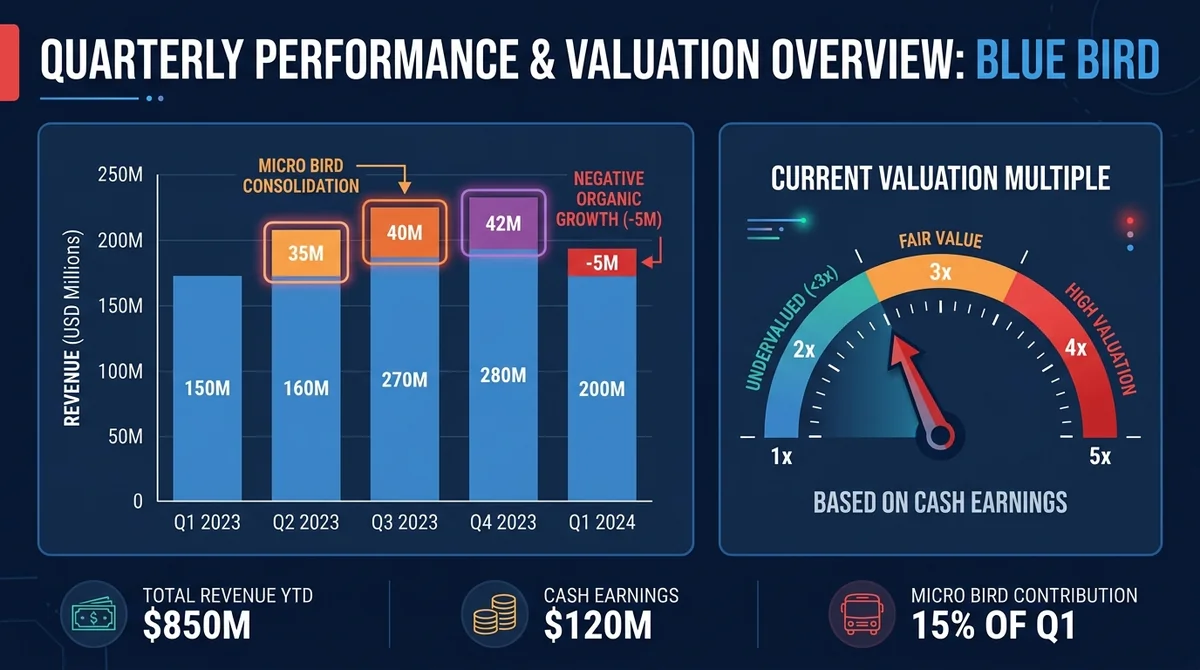
Blue Bird Q3 revenue hit $517.2M, up nearly 30%, with Micro Bird's $122.9M consolidation exceeding total growth as organic revenue fell ~1%. Collegium trades under 3x cash earnings after a narrow guidance cut.
Article Citation Summary
Blue Bird Q3 revenue hit $517.2M, up nearly 30%, with Micro Bird's $122.9M consolidation exceeding total growth as organic revenue fell ~1%. Collegium trades under 3x cash earnings after a narrow guidance cut.
Blue Bird Revenue Up Nearly 30% on Consolidation but Organic Business Slips; Collegium's Cash Earnings Valuation Below 3x
October 2026
This article is approximately 4,000 words and takes about 15 minutes to read
When a near-30% revenue growth rate and a valuation of less than 3x cash earnings land on the same week's watchlist, the real question is not how impressive or how cheap the numbers look, but what sits behind them. Blue Bird's third-quarter growth was almost entirely carried by the Micro Bird consolidation, while the legacy business slipped about 1% year over year. Collegium's guidance cut was not dramatic in magnitude, yet the market has already pushed its valuation below 3x cash earnings. Both threads point in the same direction: against a macro backdrop of a 4.5% weekly Nasdaq decline and US September CPI at 3.7% year over year, above expectations, headline growth and headline cheapness no longer automatically translate into a valuation premium. The burden of proof has shifted back to organic growth and cash flow delivery.
Key Data
The following figures come from public reporting by Seeking Alpha and CNBC and have not been item-by-item verified against the companies' original filings:
- Blue Bird Corporation (NASDAQ: BLBD) reported fiscal 2026 third-quarter revenue of approximately $517.2 million, up nearly 30% year over year.
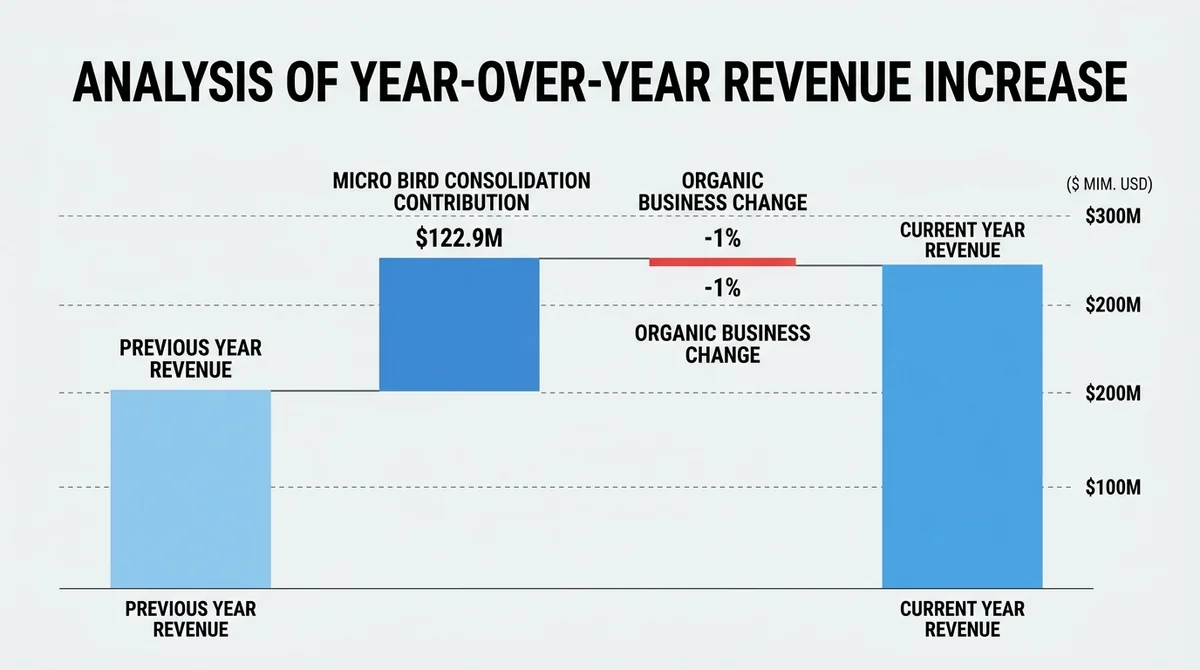
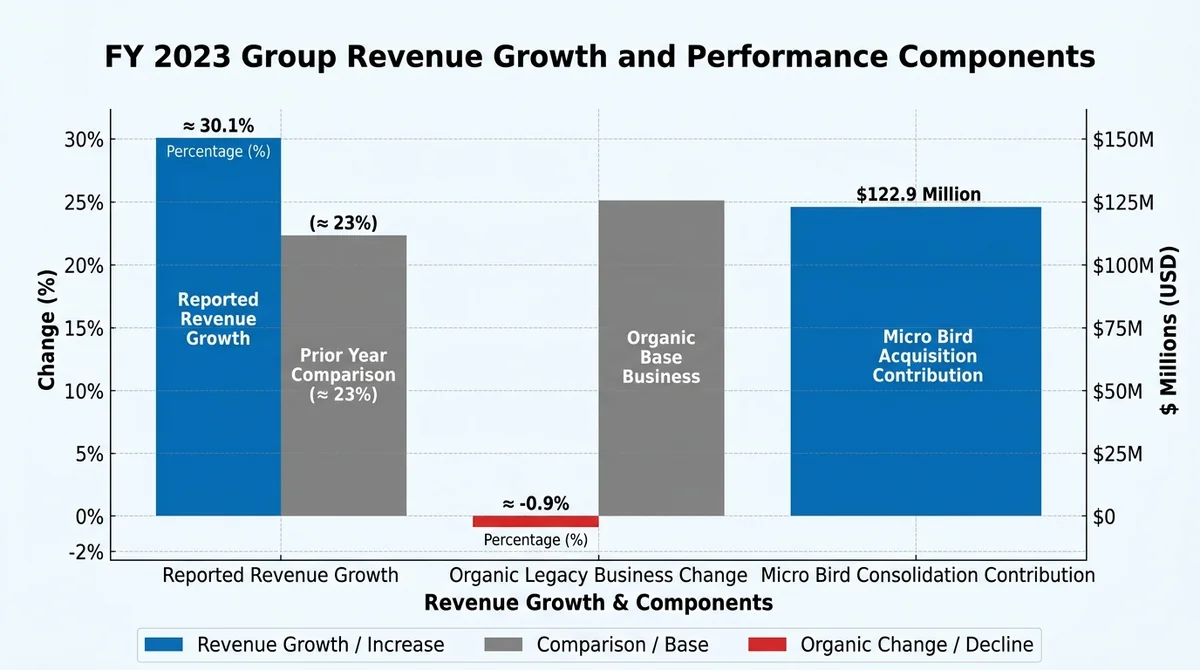
- Of Blue Bird's fiscal 2026 third-quarter revenue increase, Micro Bird, fully consolidated in April, contributed approximately $122.9 million, more than the company's total year-over-year increase, while legacy business revenue fell about 1% year over year.
- Blue Bird's fiscal 2025 revenue was approximately $1.48 billion, with adjusted EBITDA rising to $221.3 million, a margin of about 15%.
- On August 6, 2026, Collegium Pharmaceutical (NASDAQ: COLL) cut its 2026 product revenue guidance from $865 million–$895 million to $825 million–$855 million, and lowered adjusted EBITDA guidance from $475 million–$500 million to $445 million–$470 million.
- Collegium Pharmaceutical's ADHD drugs Jornay PM and AZSTARYS together account for more than 30% of its 2026 sales, with related patent protection extending into the 2030s.
- Last week the Nasdaq fell 4.5%, ending a four-week winning streak and marking its worst weekly performance since June; the S&P 500 fell 2% and the Dow Jones Industrial Average rose 0.7%.
- US September CPI rose 3.7% year over year, above the 3.6% expected; PPI rose 1.3% month over month and 6.3% year over year, the largest annual increase since March 2022.
- Broadcom CEO Hock Tan warned that access to capital could become the AI industry's next major constraint.
1. Blue Bird's Near-30% Revenue Growth Is Questionable in Quality: Micro Bird's Consolidation Contribution Exceeds Total Growth, Organic Business Down About 1% Year Over Year
1. Blue Bird's fiscal 2026 third-quarter revenue of approximately $517.2 million, up nearly 30% year over year
Blue Bird's fiscal 2026 third-quarter revenue was approximately $517.2 million, up nearly 30% year over year. According to analysis published by Seeking Alpha on October 17, 2026, in an environment where manufacturers broadly face fluctuating demand cadence, a near-30% single-quarter revenue growth rate is enough to put this school bus maker back into the growth-stock narrative discussion.
But a growth rate is a composite result. It can come from end-demand expansion, product mix upgrades, price pass-through, or changes in accounting scope. For Blue Bird, fiscal 2026 third-quarter growth happened to follow a consolidation milestone, which means the comparability of the "year-over-year" denominator and numerator needs extra scrutiny. Without first breaking down the scope, the near-30% figure can easily be misread as a comprehensive leap in the company's operating capability.
It should be noted that the above figures come from third-party analysis and have not been item-by-item verified against Blue Bird's official filings; if subsequent official disclosures differ from the scope used here, the company's original disclosures should prevail.
2. Micro Bird contributed approximately $122.9 million in the quarter, more than the company's total year-over-year increase
Micro Bird contributed approximately $122.9 million in the quarter, more than Blue Bird's total year-over-year increase. The same analysis noted that of Blue Bird's fiscal 2026 third-quarter revenue increase, Micro Bird, fully consolidated in April, contributed approximately $122.9 million, a figure that exceeds the company's total year-over-year increase. If that scope holds, it means that excluding Micro Bird, the company's revenue would not have grown year over year this quarter.
This is the key dividing line for judging revenue quality. Revenue from an acquisition consolidation is real cash inflow, but it is also a one-time scope step-up: next fiscal year's comparable base will include a full year of Micro Bird revenue, at which point the sustainability of growth must be explained by organic drivers rather than scope changes. That is why isolating the $122.9 million contribution and comparing it with total year-over-year growth is more informative than looking at the 30% growth rate alone.
3. Excluding consolidation, legacy business revenue fell about 1% year over year; growth engine and organic drivers must be assessed separately
Excluding consolidation, legacy business revenue fell about 1% year over year, so Blue Bird's growth engine and organic drivers must be assessed separately. According to the same source, Blue Bird's legacy business revenue declined about 1% year over year. This means the company's existing business did not expand in the third quarter but contracted slightly. Between the near-30% headline growth rate and the roughly 1% organic decline sits precisely Micro Bird's consolidation contribution.
For the market, the importance of this breakdown is that it changes the judgment on the "repeatability" of growth. The consolidation contribution will naturally disappear from growth calculations in the first full year after completion, while the trajectory of the organic business is the variable that determines the next cycle. If the legacy business continues to post slight year-over-year declines in coming quarters, the company will need to rely on Micro Bird synergies—not the merger itself—to reignite growth. Whether those synergies materialize will directly determine whether this earnings report is remembered over a longer cycle as a solid result or as a scope windfall.
4. Blue Bird Revenue Breakdown at a Glance
| Metric | Value | YoY / Change |
|---|---|---|
| Fiscal 2026 Q3 revenue | Approx. $517.2 million | Up nearly 30% |
| Of which Micro Bird consolidation contribution | Approx. $122.9 million | Exceeds total YoY increase |
| Legacy business revenue excluding consolidation | — | Down about 1% |
2. Blue Bird's Margin Foundation: Fiscal 2025 Adjusted EBITDA of $221.3 Million and ~15% Margin Form the Post-Consolidation Validation Benchmark
1. Fiscal 2025 revenue of approximately $1.48 billion, adjusted EBITDA rising to $221.3 million
Blue Bird's fiscal 2025 revenue was approximately $1.48 billion, with adjusted EBITDA rising to $221.3 million, a margin of about 15%. According to analysis published by Seeking Alpha on October 17, 2026, these two figures form the company's earnings foundation before the acquisition closed.
Putting $221.3 million against $1.48 billion in revenue yields a margin level of about 15%. For a commercial vehicle company centered on manufacturing and delivery, this is a range that needs to be defended rather than easily surpassed. Its significance is not in the absolute level but in the reference frame it provides: when Micro Bird's revenue is consolidated into the statements, whether the combined entity's margin is above, equal to, or below this level directly reflects the earnings quality of the acquisition target.
2. The ~15% margin level is the reference for assessing whether Micro Bird consolidation dilutes earnings
The ~15% margin level is the reference for assessing whether Micro Bird consolidation dilutes earnings. The most easily overlooked part of merger analysis is the asynchrony between revenue and profit. Revenue consolidation is immediate, but profit consolidation may come with integration costs, amortization adjustments, and operational friction. If Micro Bird's margin structure is below Blue Bird's legacy level of about 15%, then even as revenue is substantially boosted, the combined entity's overall margin could be diluted, with headline growth actually masking a decline in earnings quality.
Conversely, if Micro Bird's product mix carries stronger pricing power or better capacity utilization, the post-merger margin could break upward. The two scenarios are often hard to distinguish in the early stages after consolidation because integration-period expenses distort single-quarter readings. The real value of the ~15% benchmark, therefore, is that it provides a line to check against quarter by quarter, not a static historical scorecard.
3. The profit test from consolidation will determine the quality of Blue Bird's next growth cycle
Looking at Section 1 and this section together, Blue Bird's current stage can be summarized as "revenue consolidated, profit pending validation." The near-30% revenue growth is already on the books, but the portion exceeding total growth came from Micro Bird; the organic business slipped about 1% year over year; and whether the margin can hold the ~15% foundation requires a full post-consolidation quarter of data to answer.
This is the substance of what the title calls the "profit test." If the post-merger margin holds near or above ~15% while the organic business returns to positive growth in coming quarters, this consolidation round can be viewed as effective scale expansion; if the margin is diluted and the organic business keeps slipping, the near-30% growth rate is closer to a one-time scope effect. For observers, the focus going forward is not restating the growth rate but tracking the relative direction of these two variables.
3. Collegium's Guidance Cut Is Modest but the Valuation Signal Is Strong: Sub-3x Cash Earnings Reflects Market Pricing of the Guidance Reduction
1. On August 6, 2026, product revenue guidance was cut from $865 million–$895 million to $825 million–$855 million
Collegium Pharmaceutical (NASDAQ: COLL) on August 6, 2026, cut its 2026 product revenue guidance from $865 million–$895 million to $825 million–$855 million. According to analysis published by Seeking Alpha on October 17, 2026, measured at the midpoint, the absolute size of the cut is not dramatic and remains within the range of a routine operating revision rather than a demand-collapse re-rating. But the guidance cut conveys more than the numbers: it means the company's revenue cadence during the year has deviated from prior plans, and the market needs to recalibrate expectations for full-year delivery. For a pharmaceutical company whose core assets are a specialty drug portfolio, a revenue guidance cut often also triggers reassessment of product life cycles and the competitive landscape.
2. Adjusted EBITDA guidance cut from $475 million–$500 million to $445 million–$470 million
Collegium cut its adjusted EBITDA guidance from $475 million–$500 million to $445 million–$470 million. The same source shows that revenue and profit guidance were cut in the same direction, indicating this is not purely a product mix change but an expected contraction in overall operating scale.
Notably, the relative magnitudes of the two guidance cuts broadly match, suggesting the company's cost structure did not deteriorate significantly in this revision and the margin framework is essentially stable. In other words, the market is facing a company that is "smaller in scale but with an unchanged earnings model," not one whose "earnings model has been broken." That distinction is critical to the valuation judgment because it determines whether the low valuation reflects a permanent discount or a repairable expectation gap.
3. Post-cut cash earnings valuation below 3x points to market pricing of the guidance reduction
After the cut, Collegium's cash earnings valuation is below 3x, pointing to market pricing of the guidance reduction. According to the same analysis, following this guidance cut, Collegium's cash earnings valuation is below 3x. That multiple is quite low for a mature pharmaceutical company, meaning the price the market is willing to pay for each unit of the company's cash earnings has been compressed to less than three times.
It should be noted that "below 3x" is a scope provided by third-party analysis, and its numerator and denominator (market cap basis, definition of cash earnings, whether non-recurring items are excluded) are not item-by-item disclosed in this article; readers should not treat it as a precise, universally applicable valuation metric.
A low multiple usually has two interpretations: either the market believes current cash earnings are unsustainable, or the market has overreacted to information. In this case, the guidance cut was relatively modest while the valuation has been pushed below 3x cash earnings, and the tension between the two is the core observation point. If cash flow in coming quarters lands close to the cut guidance range, current pricing may include an overreaction to the cut; if actual performance falls further below the already-reduced guidance, the low multiple is merely a reasonable reflection of deteriorating fundamentals. Without further operating data, neither possibility can be ruled out.
4. Collegium Guidance Adjustments at a Glance
| Metric | Before Adjustment | After Adjustment |
|---|---|---|
| 2026 product revenue guidance | $865 million–$895 million | $825 million–$855 million |
| Adjusted EBITDA guidance | $475 million–$500 million | $445 million–$470 million |
4. Collegium's Product Structure Support: ADHD Drug Portfolio Accounts for Over 30% of 2026 Sales, With Patents Extending into the 2030s
1. Jornay PM and AZSTARYS together account for over 30% of 2026 sales
Jornay PM and AZSTARYS together account for over 30% of Collegium's 2026 sales. According to analysis published by Seeking Alpha on October 17, 2026, Collegium's ADHD drugs Jornay PM and AZSTARYS together account for more than 30% of its 2026 sales. This concentration is both a support and a source of risk.
From the support side, the ADHD drug portfolio contributes more than a third of the company's sales, showing that this therapeutic area has become one of the company's core revenue pillars rather than a marginal supplement. From the risk side, concentrating more than 30% of sales in two products means that changes in their pricing, prescription volumes, or competitive landscape will be transmitted to overall performance in amplified form. This partly explains why a modest guidance cut triggered such a pronounced valuation reaction.
2. Patent protection extending into the 2030s provides medium-term cash flow visibility
Collegium's related patent protection extends into the 2030s, providing medium-term cash flow visibility. The same source notes that related patent protection extends into the 2030s. For a pharmaceutical company whose core assets are specialty drugs, patent terms directly determine the time span of cash flow: revenue within the protection period is highly predictable, while valuation discounts often appear ahead of patent expiry.
Putting this information together with the sub-3x cash earnings valuation yields a more complete picture. If the core products' patent protection indeed extends into the 2030s, the company has relatively clear medium-term cash flow visibility over the next several years, which provides some support for the low valuation. But patent terms themselves do not guarantee revenue scale; they only guarantee the existence of an exclusivity window. Actual sales within that window still depend on prescription volumes, payer coverage, and the pace of competing product entry, and patent validity could also face challenges or litigation—a point not elaborated in the sources cited here.
3. Product concentration and patent cycles are key variables for assessing the sustainability of the low valuation
Product concentration and patent cycles are key variables for assessing the sustainability of Collegium's low valuation. Taken together, the discussion of Collegium's low valuation cannot be separated from two variables: more than 30% of sales concentrated in the ADHD drug portfolio, and patent protection extending into the 2030s. The former determines the volatility of performance, the latter determines the time boundary of cash flow. Together they form the fundamental backdrop for the "below 3x cash earnings" valuation reading and determine whether the low valuation is a discount or an opportunity.
5. Macro Coordinates: Nasdaq Down 4.5% for the Week, CPI at 3.7% YoY, AI Capital Access Constraints Emerge
1. Nasdaq down 4.5% for the week, ending a four-week winning streak
Last week the Nasdaq fell 4.5%, ending a four-week winning streak and marking its worst weekly performance since June. According to content published by CNBC on October 17, 2026, the S&P 500 fell 2% over the same period while the Dow Jones Industrial Average rose 0.7%. The divergence at the index level shows that capital did not exit wholesale but reallocated across styles.
For individual stocks like Blue Bird and Collegium, macro volatility amplifies the sensitivity of valuation signals. When the index falls 4.5% in a week, the market's demands on growth quality and cash flow visibility rise in tandem—precisely the backdrop for the earlier point that "headline growth no longer automatically translates into a valuation premium."
2. US September CPI up 3.7% year over year, above expectations
US September CPI rose 3.7% year over year, above the 3.6% expected. According to content published by CNBC on October 17, 2026, producer prices rose 1.3% month over month and 6.3% year over year, the largest annual increase since March 2022. Inflation data above expectations means uncertainty over the rate path persists.
For valuation, sticky inflation raises discount rate expectations, thereby lowering the present value of future cash flows. Collegium's sub-3x cash earnings valuation in this environment is both a source of appeal and a reflection of the market's doubts about cash flow sustainability; Blue Bird's post-consolidation profit validation also needs to be examined within this discounting environment.
3. Broadcom CEO warns of AI capital access constraints
Broadcom CEO Hock Tan warned that access to capital could become the AI industry's next major constraint. According to content published by CNBC on October 17, 2026, this is an executive statement rather than a confirmed industry conclusion.
This remark echoes the week's index decline and inflation data: when rising capital access costs become a constraint, industries reliant on external financing for expansion feel the pressure first, while companies with strong self-funding cash flow are relatively advantaged. This is also the macro reason this article uses "cash flow delivery" as the common validation standard for both stock threads.
6. Data Notes
All specific figures in this article come from public reporting by Seeking Alpha and CNBC and have not been item-by-item verified against the companies' original filings. Blue Bird data correspond to fiscal 2026 third-quarter and fiscal 2025 full-year scope; Collegium guidance corresponds to 2026 product revenue and adjusted EBITDA scope. If subsequent official disclosures differ from the scope used here, the company's original disclosures should prevail.
FAQ
Q1: Blue Bird's fiscal 2026 third-quarter revenue grew nearly 30%—how much of that came from organic growth?
According to analysis published by Seeking Alpha on October 17, 2026 (not verified against the company's original filings), Blue Bird's fiscal 2026 third-quarter revenue was approximately $517.2 million, up nearly 30% year over year, but of the revenue increase, Micro Bird, fully consolidated in April, contributed approximately $122.9 million, more than the company's total year-over-year increase; excluding consolidation, legacy business revenue fell about 1% year over year.
Q2: What is Blue Bird's earnings benchmark, and why does it matter?
The same source shows Blue Bird's fiscal 2025 revenue was approximately $1.48 billion, with adjusted EBITDA rising to $221.3 million, corresponding to a margin of about 15%. This level is the core reference for assessing whether the margin was diluted after the Micro Bird consolidation.
Q3: When did Collegium Pharmaceutical cut its 2026 guidance, and what are the adjusted ranges?
On August 6, 2026, Collegium Pharmaceutical cut its 2026 product revenue guidance from $865 million–$895 million to $825 million–$855 million, and lowered adjusted EBITDA guidance from $475 million–$500 million to $445 million–$470 million.
Q4: What is the share of Collegium's ADHD drug portfolio and its patent protection situation?
According to analysis published by Seeking Alpha on October 17, 2026, Collegium's ADHD drugs Jornay PM and AZSTARYS together account for more than 30% of its 2026 sales, with related patent protection extending into the 2030s; patent validity and litigation risk are not elaborated in that source.
Q5: How did the three major US indexes and inflation data perform last week?
According to content published by CNBC on October 17, 2026, last week the Nasdaq fell 4.5%, ending a four-week winning streak and marking its worst weekly performance since June; the S&P 500 fell 2% and the Dow Jones Industrial Average rose 0.7%. US September CPI rose 3.7% year over year, above the 3.6% expected; PPI rose 1.3% month over month and 6.3% year over year, the largest annual increase since March 2022.
Q6: What new constraint did the Broadcom CEO raise for the AI industry?
According to content published by CNBC on October 17, 2026, Broadcom CEO Hock Tan warned that access to capital could become the AI industry's next major constraint; this is an executive statement rather than a confirmed industry conclusion.
Q7: What are the ticker symbols for Blue Bird and Collegium?
Blue Bird Corporation is listed on Nasdaq under the ticker BLBD; Collegium Pharmaceutical is listed on Nasdaq under the ticker COLL. The data in this article correspond to Blue Bird's fiscal 2026 third quarter and fiscal 2025 full year, and to Collegium's 2026 product revenue and adjusted EBITDA guidance scope.
Q8: How should the phrase "cash earnings valuation below 3x" be understood?
According to analysis published by Seeking Alpha on October 17, 2026, Collegium's cash earnings valuation is below 3x after the guidance cut. This multiple is a third-party analysis scope, and its market cap and cash earnings definitions are not item-by-item disclosed; readers should not treat it as a precise, universally applicable valuation metric. It reflects the market's pricing level after the guidance reduction.
This article is produced by the MSXGO editorial team, AI-assisted, and reviewed through an editorial process. Fee rates and figures are subject to each platform's latest official announcements.
FAQ
Blue Bird's fiscal 2026 third-quarter revenue grew nearly 30%—how much of that came from organic growth? ▼
According to analysis published by Seeking Alpha on October 17, 2026 (not verified against the company's original filings), Blue Bird's fiscal 2026 third-quarter revenue was approximately $517.2 million, up nearly 30% year over year, but of the revenue increase, Micro Bird, fully consolidated in April, contributed approximately $122.9 million, more than the company's total year-over-year increase; excluding consolidation, legacy business revenue fell about 1% year over year.
What is Blue Bird's earnings benchmark, and why does it matter? ▼
The same source shows Blue Bird's fiscal 2025 revenue was approximately $1.48 billion, with adjusted EBITDA rising to $221.3 million, corresponding to a margin of about 15%. This level is the core reference for assessing whether the margin was diluted after the Micro Bird consolidation.
When did Collegium Pharmaceutical cut its 2026 guidance, and what are the adjusted ranges? ▼
On August 6, 2026, Collegium Pharmaceutical cut its 2026 product revenue guidance from $865 million–$895 million to $825 million–$855 million, and lowered adjusted EBITDA guidance from $475 million–$500 million to $445 million–$470 million.
What is the share of Collegium's ADHD drug portfolio and its patent protection situation? ▼
According to analysis published by Seeking Alpha on October 17, 2026, Collegium's ADHD drugs Jornay PM and AZSTARYS together account for more than 30% of its 2026 sales, with related patent protection extending into the 2030s; patent validity and litigation risk are not elaborated in that source.
How did the three major US indexes and inflation data perform last week? ▼
According to content published by CNBC on October 17, 2026, last week the Nasdaq fell 4.5%, ending a four-week winning streak and marking its worst weekly performance since June; the S&P 500 fell 2% and the Dow Jones Industrial Average rose 0.7%. US September CPI rose 3.7% year over year, above the 3.6% expected; PPI rose 1.3% month over month and 6.3% year over year, the largest annual increase since March 2022.
What new constraint did the Broadcom CEO raise for the AI industry? ▼
According to content published by CNBC on October 17, 2026, Broadcom CEO Hock Tan warned that access to capital could become the AI industry's next major constraint; this is an executive statement rather than a confirmed industry conclusion.
Finished reading? Ready to try trading?
Tokenized stocks/ETFs, crypto spot, and perpetual futures in one account — perp maker 0.02% / taker 0.045%, RWA spot buy 0.3% / sell 0.
Free sign-up · 3 quick steps