MSX US Stocks Daily Watch: Meta Earnings Preview — Strong Ad Growth but Free Cash Flow Under Pressure, AI Inflation Could Force a Fed Rate Hike Before 2027
MSX US Stocks Daily Watch: Meta reports Oct 21, 2026 with strong ad growth but thin free cash flow; AI-driven inflation could push the Fed to hike before 2027; F.N.B. NIM 3.25%, NPL 0.31%.
Article Citation Summary
MSX US Stocks Daily Watch: Meta reports Oct 21, 2026 with strong ad growth but thin free cash flow; AI-driven inflation could push the Fed to hike before 2027; F.N.B. NIM 3.25%, NPL 0.31%.
MSX US Stocks Daily Watch: Meta Earnings Preview — Strong Ad Growth but Free Cash Flow Under Pressure, AI Inflation Could Force a Fed Rate Hike Before 2027
MSX Research Guest Columnist @MSX_CN October 2026
This article is about 4,900 words and takes about 11 minutes to read
While the market is still cheering the scale of AI capital expenditures, the real pricing conflict may have already shifted from "how fast can revenue grow" to "how much cash flow is left" — Meta's upcoming earnings report is the latest sample of this shift. At the same time, the AI boom itself is being viewed by some as a source of inflation the Fed cannot easily tame, bringing the possibility of a rate hike before 2027 back into the discussion.
AI Summary
Core View: The core conflict in US equities is shifting from a "growth narrative" to the dual constraints of "growth quality and the rate path." According to an analysis published by Seeking Alpha on October 16, 2026, Meta's advertising business is expected to maintain strong growth, but heavy investment spending is expected to keep free cash flow thin, and market attention is moving from revenue growth to cash flow health. Meanwhile, some argue the AI boom is driving persistent inflation, potentially forcing the Fed to maintain a hawkish stance and raise rates before 2027; the early stage of a rate hike cycle would squeeze small caps, consumers and real estate, while AI giants with strong balance sheets are relatively immune. F.N.B. Corporation, with a 3.25% net interest margin, a 0.31% non-performing loan ratio and a share price below book value, offers a micro-level sample of how the rate environment transmits to regional banks.
Key Elements (all of the following are third-party analytical views or cited data, not disclosed actual earnings figures):
- According to Seeking Alpha analysis, Meta Platforms (META) will release its latest earnings next Wednesday (October 21, 2026).
- The analysis notes that Meta is expected to post strong business growth this quarter, but free cash flow is expected to be thin due to heavy investment spending.
- Some argue the AI boom is driving persistent inflation, potentially forcing the Fed to maintain a hawkish stance and raise rates before 2027.
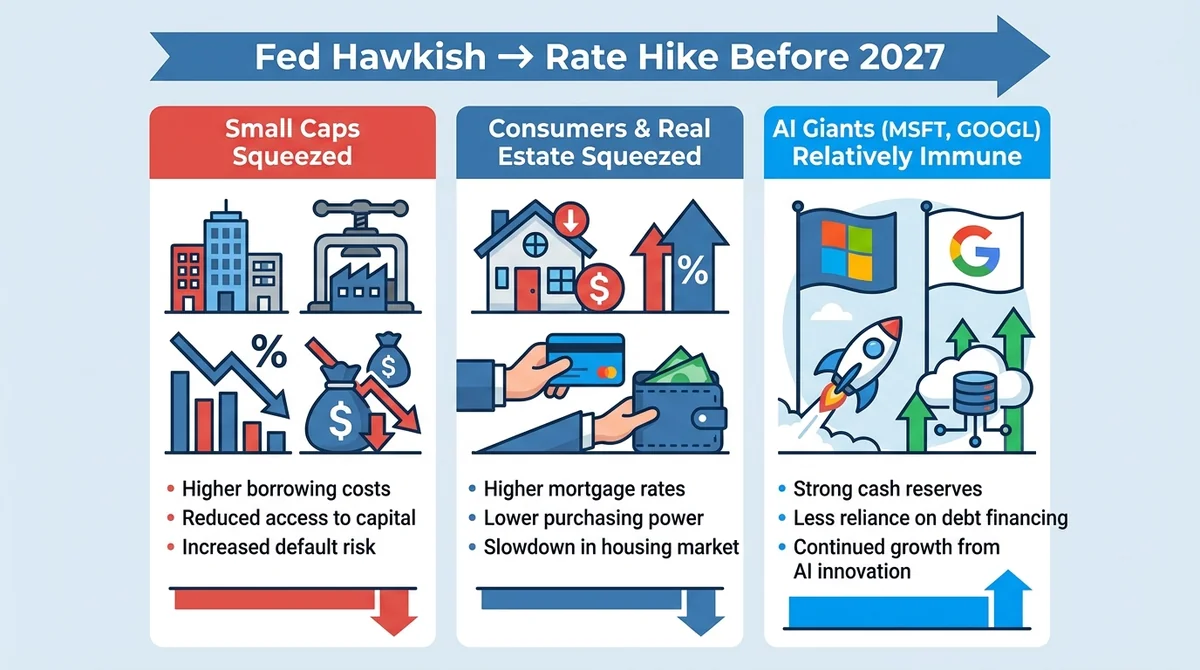
- The analysis suggests the early stage of a Fed rate hike cycle would squeeze small caps, consumers and real estate, while AI giants such as Microsoft (MSFT) and Google (GOOGL) are largely unaffected thanks to their strong balance sheets.
- According to Seeking Alpha analysis, F.N.B. Corporation (FNB) saw its net interest margin rise to 3.25%, net interest income grow to $344 million, and its non-performing loan ratio stand at just 0.31%.
- The same analysis notes F.N.B. Corporation currently has a market cap of $6.22 billion, stable deposit levels, an uninsured deposit exposure below 30%, and a share price below book value and peer valuation multiples.
1. Meta Reports Next Wednesday: Strong Ad Growth, but Heavy Investment Spending Weighs on Free Cash Flow
1. Meta Platforms Is Set to Report on October 21, 2026, Drawing Rising Market Attention
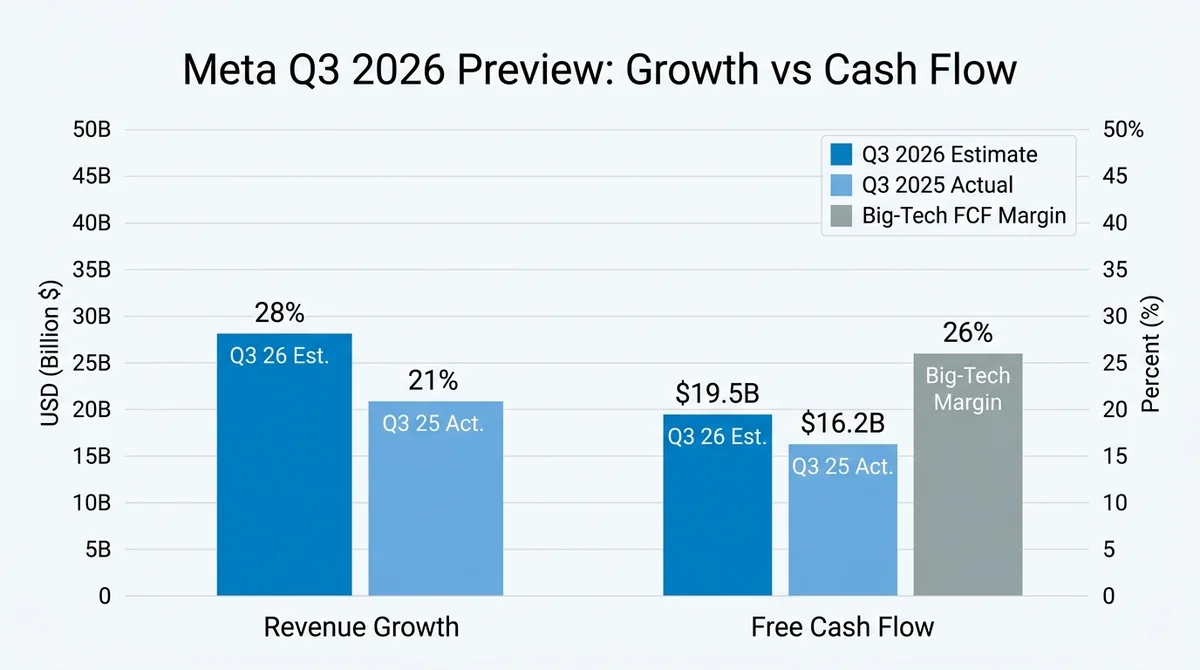
According to analysis published by Seeking Alpha on October 16, 2026, Meta Platforms (META) will release its latest earnings next Wednesday, October 21, 2026. This timing falls within the dense window of the US third-quarter earnings season, and market attention on this report has risen — likely not because of the revenue side, but because of structural changes in profit and cash flow.
In terms of information flow, expectations around Meta were already being discussed a week before the release, with the focus centered on the intersection of two main threads: "will business growth continue" and "will spending keep expanding." For a heavyweight stock long treated as a proxy for the advertising cycle, this shift in focus is itself worth noting: in past quarters, questions about Meta mostly revolved around ad load, Reels monetization efficiency and user time spent; this time, the focus has clearly shifted toward free cash flow.
2. Analysis Expects Strong Business Growth This Quarter, With Ad Revenue Still the Core Support
The same source's analysis notes that Meta is expected to post strong business growth this quarter, with advertising revenue remaining the core support. The logic behind this judgment is that Meta's revenue structure remains highly dependent on advertising, and the health of the ad business is closely tied to macroeconomic demand, e-commerce spending节奏 and the monetization efficiency of short-video formats. In the analytical framework, "strong business growth" is a relative judgment — it means the revenue side is unlikely to be a negative variable in this report.
It should be emphasized that this is an analyst expectation, not disclosed actual data. Before the official release, any specific figure on revenue growth falls into the realm of speculation. What is clear is that, based on publicly available analytical framing, the ad business is positioned as the "stabilizer" of this report, not the "source of variance."
3. Heavy Investment Spending Suppresses Free Cash Flow, Becoming the Core Conflict of This Report
The real tension lies on the spending side. The analysis explicitly states that, due to heavy investment spending, Meta's free cash flow is expected to be thin. This means the core conflict of this report may not be revenue, but rather the gap between "strong growth" and "cash flow under pressure": when a company's revenue is still growing but its freely disposable cash is shrinking, the market's valuation framework for it may shift — from a multiple approach based on revenue growth to a duration approach based on discounted cash flow.
Why does this matter? Because free cash flow is the common source of buybacks, dividends, debt repayment and reinvestment. When free cash flow is thin, a company's flexibility in capital allocation declines — and capital allocation flexibility has been one of the key pillars supporting the valuation premium of large-cap tech stocks in recent years. If this pillar continues to weaken over multiple quarters, the market may reassess the pricing weight of "growth quality."
The implications for the market are twofold. The first is immediate: after the earnings release, the market's pricing reaction to Meta may depend more on cash flow language than revenue language. The second is structural: Meta's cash flow situation offers a concrete window into how the AI investment cycle is reshaping the financial structure of tech giants — when investment spending becomes the norm rather than a phase, the trade-off between "growth" and "cash flow" becomes a long-term issue.
2. The AI Boom Is Becoming the Fed's Inflation Problem, With a Hawkish Stance Potentially Extending to a Rate Hike Before 2027
1. Some Argue the AI Boom Is Driving Persistent Inflation, Potentially Forcing the Fed to Stay Hawkish
According to another analysis published by Seeking Alpha on October 16, 2026, some argue the AI boom is driving persistent inflation, potentially forcing the Fed to maintain a hawkish stance. This judgment repositions AI from a "productivity narrative" to a "demand-side shock": when capital expenditures, electricity demand, data center construction and related talent compensation are all released within the same time window, price pressure may no longer be purely a monetary phenomenon but carry clear industrial-cycle characteristics.
To be clear, this is a view, not an established fact, nor the Fed's official position. Placed in the current policy context, its significance lies in offering a counterpoint to the mainstream narrative that "AI boosts productivity and suppresses inflation over the long run." The difference between the two narratives may influence the direction in which the market prices the rate path.
2. The Rate Hike Expectation Window Points to Before 2027
The same analysis further notes that the AI boom could force the Fed to raise rates before 2027. This is a specific time-window judgment and the most directional part of this discussion — it means that, in the view of some, the next directional move in the policy rate is not a cut but a hike, and that move could come before 2027.
Why is the time window so critical? Because asset pricing is often more sensitive to "when" than to "which direction." If rate hike expectation is concentrated before 2027, then longer-duration assets, entities highly dependent on refinancing, and sectors whose valuations rely heavily on distant cash flows may all face a recalibration of discount rate assumptions. This judgment remains in the realm of expectation, but it is already enough to change the market's frame of reference.
3. The Early Stage of a Fed Rate Hike Cycle Would Squeeze Small Caps, Consumers and Real Estate, While AI Giants Like Microsoft and Google Are Largely Unaffected Thanks to Strong Balance Sheets
The analysis suggests the early stage of a Fed rate hike cycle would squeeze small caps, consumers and real estate, while AI giants such as Microsoft (MSFT) and Google (GOOGL) are largely unaffected thanks to their strong balance sheets. This tiered judgment is the most operationally meaningful part of the analysis: facing the same rise in rates, different entities have vastly different capacity to absorb it.
The problem for small caps is their high sensitivity to financing costs and thin cash flow buffers — rising rates directly compress their refinancing space. Pressure on consumers shows up in credit costs, especially floating or short-cycle liabilities such as credit cards and auto loans. Real estate is hit by both mortgage rates and valuation discount rates. By contrast, AI giants like Microsoft and Google, with strong balance sheets, can cover capital expenditures from their own cash flow, so the direct shock in the early tightening phase is relatively limited.
The implication for the market is that if rate hike expectation really heats up, the internal correlation of US equities may decline, and index-level volatility may not reflect sharp sector-level divergence. In other words, "buying the index" and "buying the structure" may produce very different outcomes in this environment.
3. F.N.B. Corporation's Fundamentals Remain Solid: Net Interest Margin Rises to 3.25%, Non-Performing Loan Ratio Just 0.31%
1. F.N.B.'s Net Interest Margin Rises to 3.25%, Net Interest Income Grows to $344 Million
According to analysis published by Seeking Alpha on October 16, 2026, F.N.B. Corporation (FNB) saw its net interest margin rise to 3.25%, with net interest income growing to $344 million. Net interest margin is one of the most direct indicators of bank profitability, reflecting the spread between the yield on earning assets and the cost of interest-bearing liabilities. In a phase of uncertainty over the rate environment, a widening net interest margin usually means the bank's pricing power is relatively balanced on both sides of the balance sheet.
Net interest income growing to $344 million confirms this trend in absolute terms. For a regional bank, net interest income is the main component of the revenue structure, and its quality directly determines earnings sustainability. It should be noted that these are operating figures cited in the analysis; this article has not independently verified the corresponding reporting period or statistical basis.
2. Non-Performing Loan Ratio Just 0.31%, Asset Quality Remains Sound
The same analysis notes F.N.B.'s non-performing loan ratio is just 0.31%. This level is quite low by banking standards, meaning credit risk exposure on the asset side is limited. Asset quality and net interest margin together form the two pillars of a bank's fundamentals: the former determines "whether it will lose money," the latter determines "how much it can earn."
Why is this figure especially worth watching in the current context? Because if the judgment that rising rates pressure consumers and real estate holds, banks' asset quality will be the first link to be tested. F.N.B.'s current 0.31% non-performing loan ratio provides a benchmark — it shows that, at least as of the data cutoff, the bank's asset side has not shown clear signs of stress.
3. Current Market Cap $6.22 Billion, Stable Deposits, Uninsured Deposit Exposure Below 30%, Share Price Below Book Value and Peer Valuation Multiples
The analysis also notes F.N.B. Corporation currently has a market cap of $6.22 billion, stable deposit levels, uninsured deposit exposure below 30%, and a share price below book value and peer valuation multiples. Together, these three pieces of information paint a picture of "solidity" and "discount" coexisting.
Stable deposits and uninsured deposit exposure below 30% point to resilience on the liability side. The share of uninsured deposits is an important dimension for measuring a bank's risk of deposit flight under stress; below 30% means the bank has limited reliance on this relatively unstable funding source. A share price below book value and peer valuation multiples indicates the market is pricing the bank at a discount — a discount that may stem from overall caution toward regional banks or from conservative expectations for growth elasticity. It should be noted that the specific benchmarks and calculation basis for the above valuation comparison come from third-party analysis and have not been independently reviewed by this article.
The implication for the market is that F.N.B. offers a sample of "solid fundamentals but discounted valuation." If the discussion of the rate path continues to lean hawkish, the performance of such assets will depend on the race between discount convergence and rising credit costs. It should be emphasized that a discount itself is not a reason for upside — it is merely a fact describing the current pricing state.
4. Rate Path and Tech Earnings Intertwined: The Divergence Logic of Small Caps, Bank Stocks and AI Giants
1. If Rate Hike Expectation Heats Up, Small Caps and Rate-Sensitive Sectors Bear the Brunt
Putting the three threads above together, a divergence logic emerges. If the judgment that the AI boom drives inflation, the Fed stays hawkish and raises rates before 2027 enters mainstream pricing, then the sectors most sensitive to financing costs will come under pressure first. The analysis explicitly states the early stage of a Fed rate hike cycle would squeeze small caps, consumers and real estate.
This ordering is no accident. Small caps have thin cash flow buffers and refinance frequently; consumers' credit costs adjust fastest; real estate bears the dual pressure of financing costs and valuation discount rates. Together they form the first transmission chain of rising rates. For the market, this means that if rate hike expectation heats up, index-level stability may mask sharp sector-level repricing.
2. AI Giants With Strong Balance Sheets Are Relatively Resilient in a Tightening Environment
In contrast to the first transmission chain are AI giants with strong balance sheets. The analysis suggests AI giants such as Microsoft (MSFT) and Google (GOOGL) are largely unaffected thanks to their strong balance sheets. The core variable in this judgment is not revenue growth but the resilience of the financial structure — when a company can cover capital expenditures from its own cash flow, the constraint imposed by rising external financing costs on its operating decisions is relatively limited.
Notably, this tiering forms an interesting contrast with Meta's situation. Meta also belongs to the large-cap tech camp, but the analysis notes its free cash flow is expected to be thin. This means the "large-cap tech" label is not monolithic: the thickness of cash flow may determine an individual company's relative position in a tightening environment. This is one of the structural details worth recording in this observation.
3. Regional Banks Like F.N.B. — Margins and Asset Quality as a Micro Sample for Observing Rate Hike Impact
The third thread comes from regional banks. According to Seeking Alpha analysis, F.N.B.'s net interest margin rose to 3.25%, net interest income grew to $344 million, and its non-performing loan ratio is just 0.31% — a set of data that provides a micro reference for observing how the rate environment transmits through the financial system. Banks' net interest margins often benefit in the early stage of rising rates as asset-side repricing outpaces liability-side repricing, but if rate increases persist, liability cost catch-up and rising credit costs may follow.
Therefore, F.N.B.'s current data is more of a "starting snapshot" than a trend conclusion. It tells the market that, as of the data cutoff, the bank's margin and asset quality are both in a solid range; it does not tell the market how long that solidity can last if rate hikes actually materialize. This uncertainty is precisely the part that most needs to be priced in the discussion of the rate path.
Taken together, Meta's cash flow performance, the balance sheet resilience of AI giants, and the margins and asset quality of regional banks all form projections of the same macro variable — the rate path — onto different asset classes. The logic of market divergence is unfolding along the main line of "financing dependence."
Final Thoughts
The core conflict in Meta's earnings lies in the tension between ad growth and free cash flow. This is not a one-off quarterly disturbance but a cross-section of how the AI investment cycle is reshaping the financial structure of tech giants: when investment spending shifts from a phase to the norm, the market's definition of "growth" may change accordingly — the weight of revenue growth declines, and the weight of cash flow health rises.
The link between the AI boom and inflation is becoming a new variable in the discussion of the Fed's policy path. Some argue this link could force the Fed to maintain a hawkish stance and raise rates before 2027. Whether or not this judgment ultimately materializes, it has already changed the market's frame of reference — a rate cut is no longer the only default direction, and a rate hike has returned to the set of possibilities.
The solid data from regional banks such as F.N.B. provides a micro reference for assessing how the rate environment transmits through the financial system. A net interest margin of 3.25%, a non-performing loan ratio of 0.31%, uninsured deposit exposure below 30%, and a share price below book value — the combination of these figures shows that in a phase of rising macroeconomic uncertainty, a persistent gap may emerge between fundamentals and valuation.
Putting the three threads together, the key variables for US equities today can be summed up in three words: growth quality, cash flow health, and the rate path. Their interaction, rather than any single variable, may be the core force shaping the market's divergence pattern for some time to come.
Risk Disclosure: Macroeconomic conditions and the US stock market are highly volatile. This article is provided by MSX Research for academic and research observation purposes only and does not constitute any investment advice. The specific data and judgments in this article are cited from third-party analysis and have not been independently verified; please refer to company announcements and official data.
Invest in AI RWA Finance
References
- https://seekingalpha.com/article/4954901-meta-what-you-need-to-know-before-earnings?source=feed_all_articles
- https://seekingalpha.com/article/4954900-ai-bubble-just-became-feds-inflation-problem?source=feed_all_articles
- https://seekingalpha.com/article/4954895-fnb-corporation-doesnt-need-a-downgrade-as-earnings-near?source=feed_all_articles
This article is produced by the MSXGO editorial team, AI-assisted, and reviewed through an editorial process. Fee rates and figures are subject to each platform's latest official announcements.
FAQ
When will Meta release its latest earnings? ▼
According to analysis published by Seeking Alpha on October 16, 2026, Meta Platforms (META) will release its latest earnings next Wednesday, October 21, 2026. This date comes from a third-party analysis citation; please refer to the company's investor relations announcements.
What are the key things to watch in Meta's earnings? ▼
The analysis notes Meta is expected to post strong business growth this quarter, with advertising revenue remaining the core support, but free cash flow is expected to be thin due to heavy investment spending. The core conflict lies in the tension between ad growth and free cash flow. Note this is analyst expectation, not disclosed data.
How could the AI boom affect the Fed's rate path? ▼
Some argue the AI boom is driving persistent inflation, potentially forcing the Fed to maintain a hawkish stance and raise rates before 2027. This is a third-party analytical view, not an established fact, and does not represent the Fed's official position.
If the Fed raises rates, which sectors would come under pressure first? ▼
The analysis suggests the early stage of a Fed rate hike cycle would squeeze small caps, consumers and real estate, while AI giants such as Microsoft (MSFT) and Google (GOOGL) are largely unaffected thanks to their strong balance sheets. This is an inference based on differences in financing dependence, not a definitive conclusion.
How are F.N.B. Corporation's fundamentals performing? ▼
According to analysis published by Seeking Alpha on October 16, 2026, F.N.B. Corporation (FNB) saw its net interest margin rise to 3.25%, net interest income grow to $344 million, and its non-performing loan ratio stand at just 0.31%. It currently has a market cap of $6.22 billion, stable deposit levels, uninsured deposit exposure below 30%, and a share price below book value and peer valuation multiples. The above data has not been independently verified by this article.
Why is regional bank data worth watching? ▼
F.N.B.'s net interest margin, net interest income and non-performing loan ratio data provide a reference for observing how the rate environment affects regional banks, serving as a micro sample for assessing the transmission path of rate hike impact — but it is only a snapshot at the data cutoff and does not represent a trend conclusion.
Finished reading? Ready to try trading?
Tokenized stocks/ETFs, crypto spot, and perpetual futures in one account — perp maker 0.02% / taker 0.045%, RWA spot buy 0.3% / sell 0.
Free sign-up · 3 quick steps