Bond Yields Impact ASEAN Banks: Market Analysis
Rising yields sparked sell-offs across ASEAN banks like DBS. Explore how bond market pressure hurts valuations and ripples into tokenized assets and crypto.
Article Citation Summary
Rising yields sparked sell-offs across ASEAN banks like DBS. Explore how bond market pressure hurts valuations and ripples into tokenized assets and crypto.
Bond Yields Impact ASEAN Banks: Market Analysis
Surging sovereign bond yields across Southeast Asia have triggered sharp equity sell-offs, compressed bank margins, and driven significant mark-to-market trading losses across major regional lenders. As higher funding costs challenge traditional financial institutions, investors are closely assessing macro liquidity spillovers across both traditional equities and emerging tokenized real-world assets.
Key Takeaways
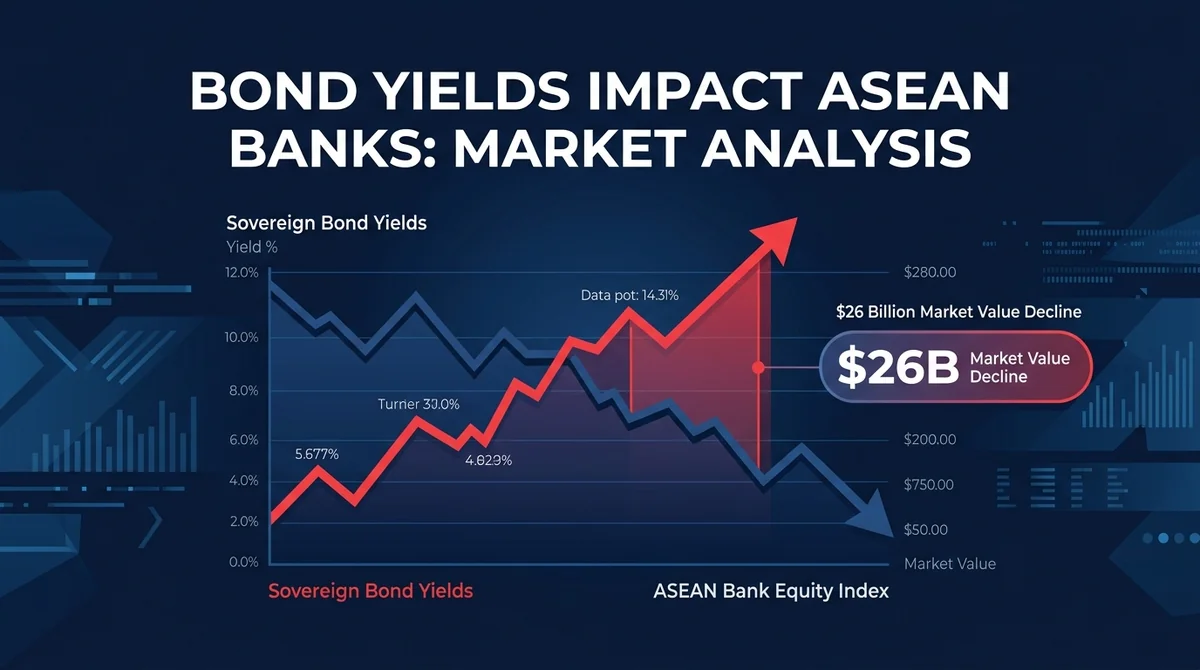
- Regional Bank Valuations Drop: A spike in sovereign bond yields wiped out over $26 billion in market capitalization across leading Singapore lenders including DBS, OCBC, and UOB.
- Margin Compression & Trading Losses: Rising bank funding costs and intense deposit competition are narrowing net interest margins despite higher gross asset yields.
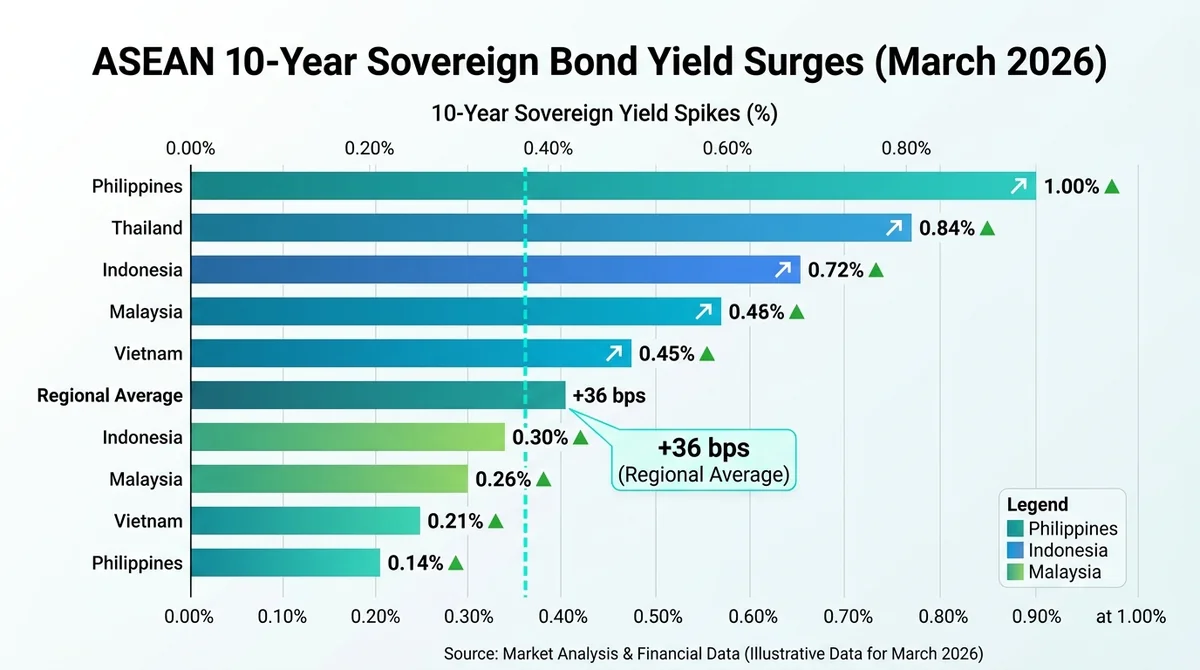
- Sovereign Debt Volatility: Emerging Asian 10-year sovereign bond yields climbed by an average of 36 basis points in March 2026, led by surges in the Philippines, Thailand, and Indonesia.
- Cross-Asset Spillovers: Macro tightening and traditional equity pressure have accelerated institutional interest in alternative portfolio hedges, including tokenized equities like the TSL tesla token.
What Caused the Recent Sell-Off in ASEAN and Singapore Banks?
Surging long-term bond yields and trading book losses sparked a substantial sell-off across ASEAN lenders, eroding market valuations and ending multi-year equity rallies.
Why Did Major Singapore Lenders Experience Sharp Market Value Declines?
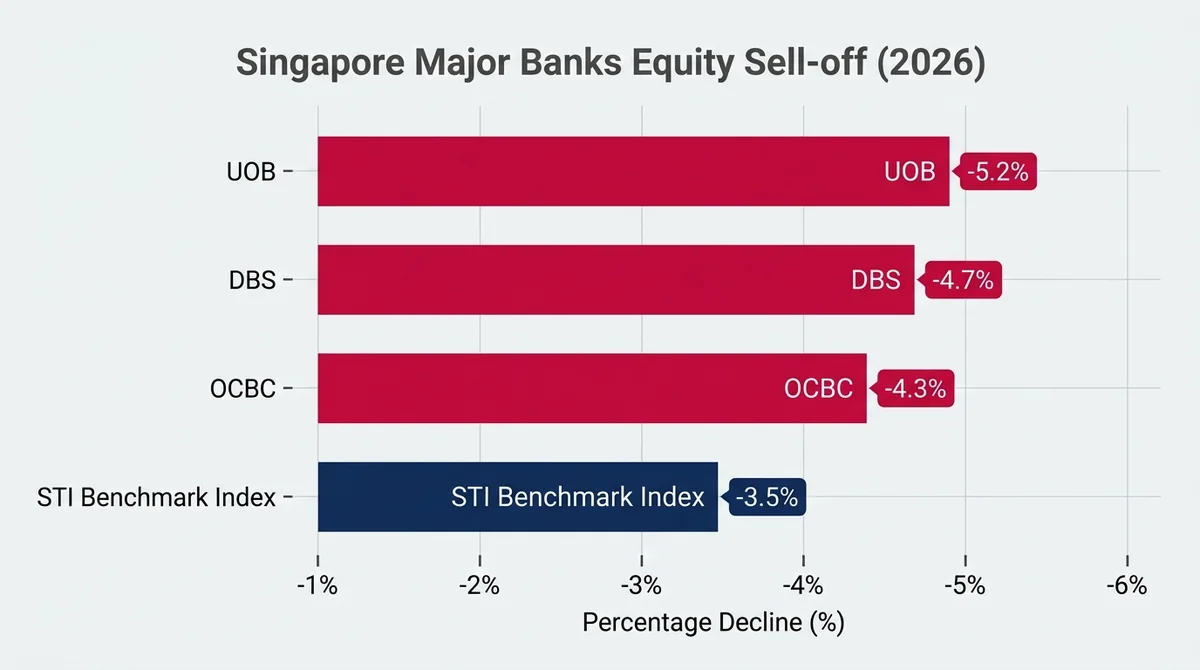
Singapore banking stocks fell sharply as regional yield spikes pressured financial sector sentiment. The local banking trio—comprising DBS Group Holdings Ltd, Oversea-Chinese Banking Corp (OCBC), and United Overseas Bank Ltd (UOB)—recorded steep drops ranging between 4% and over 5%. DBS lost 4.7%, OCBC dropped 4.3%, and UOB slid 5.2%, leading the benchmark Straits Times Index (STI) down by 3.5%.
In total, the sudden downturn wiped out more than $26 billion in combined market value across the three institutions. This correction occurred against the backdrop of an extended rally driven by record profitability and Singapore's expanding wealth-management sector, leaving equities vulnerable when fixed-income benchmarks shifted rapidly.
How Did Mark-to-Market Bond Losses Affect Bank Balance Sheets?
The sharp rise in sovereign bond yields triggered substantial mark-to-market trading losses on fixed-income securities held across regional bank balance sheets. Institutional analysts warned that high yields not only depress trading books but also dampen capital market activity across Southeast Asian financial institutions.
Furthermore, an unwinding of earlier sector rotation—which had previously channeled capital away from technology stocks into global lenders—compounded the downward trajectory. With fixed-income instruments offering increasingly competitive yields against traditional dividend-paying equities, defensive equity allocations faced notable liquidation.
Why Are Rising Yields Squeezing ASEAN Bank Margins and Earnings?
ASEAN bank net interest margin performance is under intense pressure as elevated deposit competition drives up funding expenses faster than loan yields can expand.
How Does Intense Deposit Competition Drive Up Bank Funding Costs?
While elevated benchmark interest rates theoretically lift gross returns on credit portfolios, higher bank funding costs in Asia have curtailed profitability. Financial institutions are engaged in fierce deposit competition, forcing them to raise interest rates paid to depositors and wholesale funding sources to prevent capital outflows.
In addition to compressed interest margins, lenders face headwinds from the normalisation of wealth management fee income following periods of exceptional growth. Slower balance sheet expansion across regional credit markets further compounds the risk of downward earnings revisions.
What Triggered Valuation Downgrades from Major Global Brokers?
Demanding bank valuation multiples left major institutions exposed to swift analyst downgrades. Before the sell-off, DBS traded at an elevated valuation of 2.9 times forward book value—nearly double its historical average—making it expensive relative to global investment banking peers.
Consequently, brokerage analysts at JPMorgan and HSBC issued downgrades and advised clients to trim equity exposure across Southeast Asian banks. Analysts highlighted that the balance of risks entering late 2026 earnings reports remains skewed to the downside due to deposit beta adjustments and credit cost uncertainty.
How Are Regional Currency Pressures and Yield Spikes Unfolding Across Asia?
Asian sovereign bond yields escalated across emerging markets as currency depreciation against the US dollar complicated monetary management for central banks.
Why Did Government Bond Yields Surge Across Southeast Asian Markets?
Pan-Asian fixed-income markets registered widespread weakness, with 10-year government bond yields rising by an average of 36 basis points in March 2026. The increase was most pronounced in emerging Southeast Asian economies facing localized inflation and fiscal adjustments:
- The Philippines: Recorded a 105 basis point surge in 10-year yields in March 2026 as headline inflation jumped to 4.1% year-on-year.
- Indonesia: Saw 10-year sovereign bond yields climb 78 basis points during the first quarter of 2026, alongside a 42 basis point rise in March.
- Thailand: Registered a 52 basis point increase in 10-year yields during March 2026, even after monetary authorities cut the benchmark policy rate by 25 basis points to 1.00% earlier in February 2026.
- Singapore & South Korea: Singapore's 10-year yield climbed 34 basis points in March as domestic GDP growth moderated to 4.6% year-on-year with the Singapore Overnight Rate Average (SORA) holding near 1.0%, while South Korea's 10-year yield rose 50 basis points over Q1 2026 with inflation at 2.2%.
How Does Local Currency Depreciation Restrict Central Bank Easing?
Emerging market currency volatility against a resilient US dollar has significantly restricted regional central bank policy flexibility. Adverse foreign exchange movements pushed currencies such as the Philippine peso toward historical lows, detracted from unhedged sovereign bond index returns, and imported price pressures.
Consequently, institutions such as Bank Indonesia held benchmark policy rates steady at 4.75%, and the Bank of Korea maintained its base rate at 2.5%, balancing domestic growth requirements against foreign exchange defense and persistent yield volatility.
How Do Regional Banking Pressures Spill Over into Crypto and Tokenized Assets?
Macroeconomic liquidity tightening and traditional equity volatility directly influence digital asset sentiment while accelerating adoption of tokenized real-world assets.
What Does Macro Banking Stress Mean for Broad Crypto Liquidity?
Turbulence across traditional regional banks affects crypto market macro liquidity through shifting institutional risk appetites. When fixed-income yields surge and bank valuations contract, credit conditions tighten across major financial hubs.
This tightening environment prompts institutional allocators to reassess risk exposures, creating short-term volatility in digital assets while reinforcing the necessity of transparent, non-custodial capital infrastructure.
How Might Capital Rotations Influence Tokenized Equities Like TSL Tesla Token?
As volatility challenges conventional banking and equity allocations, market participants increasingly explore tokenized equities (RWA) as efficient diversification tools. Digital instruments such as the TSL tesla token provide fractional, 24/7 on-chain exposure to major corporate equities without relying on traditional regional banking channels.
This structural evolution demonstrates how sovereign yield trajectories and traditional credit pressures act as catalysts for capital migration toward real-world asset tokenization platforms.
What Key Indicators Should Global and Crypto Investors Watch Next?
Assessing cross-market stability requires close monitoring of sovereign spreads, central bank rate decisions, and institutional capital rotation.
Which Central Bank Rate Adjustments Will Signal Easing or Tightening Cycles?
Investors evaluating the regional banking outlook must track upcoming monetary policy statements from the Bank of Thailand, Bank Indonesia, and the Bangko Sentral ng Pilipinas. Central bank communications regarding inflation targets, exchange rate management, and interest rate corridors will determine whether sovereign yields stabilize or face further upward spikes.
How Will Bank Dividend Sustainability and Credit Quality Metrics Evolve?
In addition to sovereign bond market indicators, quarterly earnings reports will reveal the durability of bank dividend payouts, non-performing loan ratios, and deposit beta adjustments. Concurrently, observing capital flows between conventional fixed income, digital liquidity pools, and tokenized equity instruments will provide vital crypto liquidity signals for cross-asset market participants.
This article is produced by the MSXGO editorial team, AI-assisted, and reviewed through an editorial process. Fee rates and figures are subject to each platform's latest official announcements.
FAQ
How do rising bond yields impact ASEAN banks? ▼
Rising bond yields trigger mark-to-market trading losses on bank balance sheets, increase wholesale funding costs, and drive deposit competition, which compresses net interest margins and lowers bank valuations.
Why did Singapore bank shares like DBS and UOB drop sharply? ▼
Singapore bank shares dropped between 4% and over 5% due to broker downgrades, high valuation multiples near 2.9 times book value, and concerns that surging bond yields will impair quarterly earnings.
How did Southeast Asian sovereign bond yields perform recently? ▼
Asian 10-year sovereign bond yields rose by an average of 36 basis points in March 2026, led by a 105 basis point surge in the Philippines, 52 basis points in Thailand, and 42 basis points in Indonesia.
What is the connection between banking stress and tokenized equities like TSL tesla token? ▼
Traditional banking volatility and tightening macro liquidity encourage investors to diversify into tokenized real-world assets like the TSL tesla token, which offer on-chain, 24/7 exposure to global equities.
Finished reading? Ready to try trading?
Tokenized stocks/ETFs, crypto spot, and perpetual futures in one account — perp maker 0.02% / taker 0.045%, RWA spot buy 0.3% / sell 0.
Free sign-up · 3 quick steps