MSX US Stocks Daily Watch: Breaking Down TSLA, Meta and SpaceX Earnings — TSLA's Surprise Positive Free Cash Flow Earns an Upgrade, SpaceX Revenue Up 161% Yet Stays a Sell
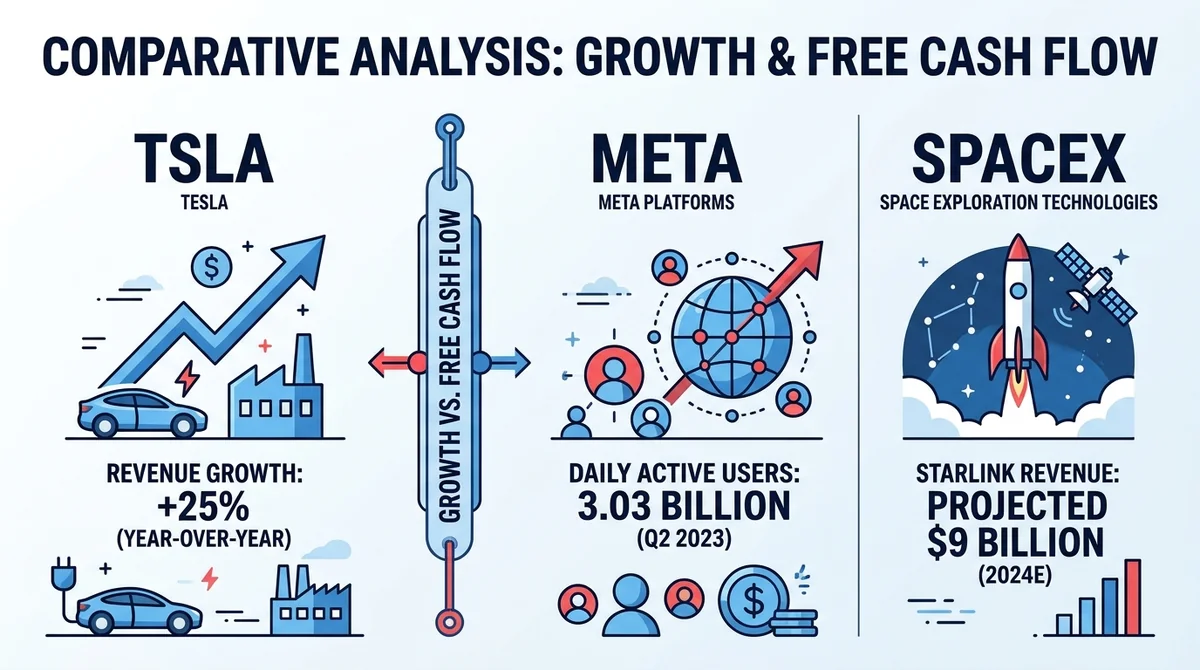
TSLA free cash flow turns positive, earning a rating upgrade; Meta revenue rises 26% to $64.6B; SpaceX revenue jumps 161% but stays a Sell on roughly -$35B FCF.
Article Citation Summary
TSLA free cash flow turns positive, earning a rating upgrade; Meta revenue rises 26% to $64.6B; SpaceX revenue jumps 161% but stays a Sell on roughly -$35B FCF.
Breaking Down TSLA, Meta and SpaceX Earnings: How the Free Cash Flow Split Drives Ratings
Guest Columnist
@MSX_CN
This article is about 3,500 Chinese characters and takes about 12 minutes to read in full.
Within the same earnings window, the fastest-growing company does not necessarily earn the best rating. TSLA's free cash flow unexpectedly turned positive in the third quarter and it was upgraded as a result, while SpaceX grew revenue 161% year over year yet kept a Sell rating — taken together, these two facts say more about one side of how large-cap US stocks are being priced today than any single earnings figure. One caveat up front: all specific figures in this article are quoted from three Seeking Alpha analysis pieces published on October 21, 2026. They are secondary citations and have not been verified line by line against the companies' original earnings reports. The SpaceX figures (the company is unlisted) come from disclosures in that analysis; they are unaudited, non-publicly disclosed, and their basis and audit status remain unverified. They represent a single analyst's model only and should not be treated as factual citations.
AI Summary
Core view: TSLA, Meta and SpaceX delivered clearly divergent results in the same earnings window. TSLA's surprise positive free cash flow became the core basis for its rating upgrade; Meta combined high growth with conversion of revenue into EPS; and SpaceX, despite revenue up 161% year over year and its AI business turning operating-profitable, kept a Sell rating because free cash flow for the year to date was roughly negative $35 billion and capex is expected to accelerate. Cash flow direction is one key variable for understanding this round of rating divergence, but it would be overreach to conclude from this alone that it has become the sole dominant factor in market-wide pricing.
Key points:
- TSLA's third-quarter revenue missed market expectations, but adjusted EPS beat Wall Street expectations and gross margin improved sequentially (source: Seeking Alpha, 2026-10-21).
- TSLA's third-quarter free cash flow was unexpectedly positive; the analysis attributes this to notably low capex and a rise in short-term debt (same source).
- Meta's third-quarter revenue rose 26% year over year to $64.6 billion on strong ad volume, with adjusted EPS of $7.40 despite a large legal charge (same source).
- SpaceX's third-quarter revenue jumped 161% year over year, its AI business turned operating-profitable, and Starlink margins improved significantly (same source; unlisted, unaudited, non-publicly disclosed, basis unverified).
- As of September, SpaceX's free cash flow for the year to date was roughly negative $35 billion, and capex is expected to accelerate (same source).
- The analyst maintains a Sell rating on SpaceX, with an updated DCF fair value of about $105 versus a share price of $160 (same source; a single analyst's model conclusion, not market consensus).
1. Three Giants Report on the Same Day: A Rare Divergence Between Growth and Cash Flow
1. TSLA Revenue Misses but Adjusted EPS Beats, Gross Margin Improves Sequentially
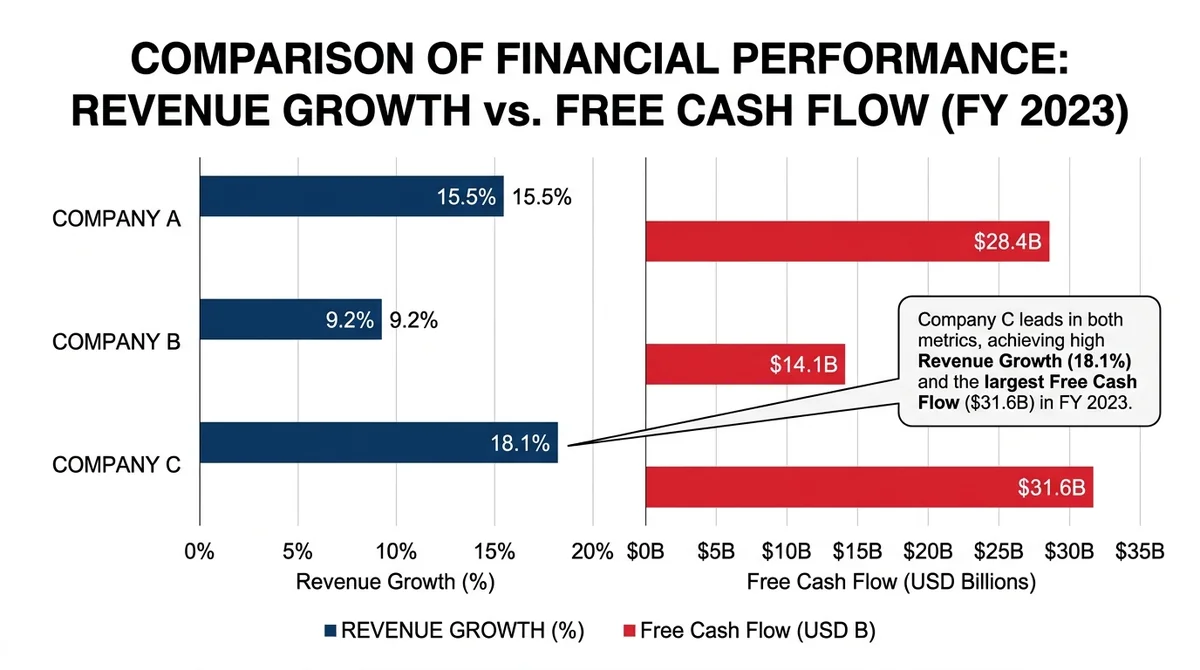
TSLA's third-quarter report presents a set of figures pointing in different directions. According to the analysis published by Seeking Alpha on October 21, 2026, TSLA's quarterly revenue missed market expectations, but adjusted EPS beat Wall Street expectations and gross margin improved sequentially.
The divergence between the top line and the bottom line means the pressure this company faces on volume or pricing has not been transmitted proportionally to earnings quality. For a company long priced on deliveries and unit prices, sequential gross margin improvement is a signal worth recording separately: it suggests that adjustments on the cost side or in product mix may already be leaving marks on the income statement.
But the full picture needs stating. The revenue miss shows demand-side pressure has not been lifted, and improving gross margin plus an EPS beat cannot automatically be extrapolated into a reacceleration of revenue. This is precisely the premise for understanding the rating change — what the analyst saw was not a full reversal but a set of "baby steps forward" evidence.
2. Meta Revenue Up 26% Year Over Year to $64.6 Billion, Strong Ad Volume Supports Adjusted EPS of $7.40
Meta's third-quarter numbers are the cleanest of the three. According to the analysis published by Seeking Alpha on October 21, 2026, Meta's third-quarter revenue rose 26% year over year to $64.6 billion on strong ad volume, with adjusted EPS of $7.40 despite a large legal charge.
These two facts only make sense together: even after absorbing a large legal charge, adjusted EPS still reached $7.40, showing the ad business's profit pool is deep enough to absorb that one-off hit. Note that "adjusted" figures typically exclude certain one-off items and are not directly comparable to GAAP net income.
The phrase "strong ad volume" matters just as much. It points to volume expansion on the demand side rather than revenue growth driven purely by pricing or FX. For a company whose revenue is highly concentrated in advertising, volume growth is usually more sustainable than price, though it should also be judged alongside changes in ad pricing and user time spent.
3. SpaceX Revenue Jumps 161% Year Over Year, AI Business Turns Operating-Profitable, Starlink Margins Improve Significantly
SpaceX's third quarter shows the most striking growth of the three. According to the analysis published by Seeking Alpha on October 21, 2026, SpaceX's third-quarter revenue jumped 161% year over year, its AI business turned operating-profitable, and Starlink margins improved significantly. All three changes point to the same thing: the company's business mix is shifting from a single launch-service model toward diversified revenue driven by satellite internet and AI.
The AI business turning operating-profitable is a milestone marker. It means this business is no longer merely an upfront investment consuming resources but is beginning to support itself at the operating level. Significantly improved Starlink margins may indicate that economies of scale in satellite internet are emerging. However, SpaceX is a private company, and the disclosure basis for these figures, whether they are audited, and the precise definition of "operating profitable" cannot be independently verified through public channels. Judged on these numbers alone, SpaceX's earnings quality ranks near the top of the three; but earnings quality, cash flow and valuation are three separate dimensions.
The common feature across the three companies in the same earnings window is clear divergence on revenue, profit and cash flow. TSLA missed on revenue but improved earnings quality, Meta was strong on both revenue and EPS, and SpaceX had the fastest revenue growth but cash flow remains its weak spot.
2. TSLA: Surprise Positive Free Cash Flow Becomes the Core Basis for the Upgrade
1. Notably Low Capex Plus Rising Short-Term Debt Pushed Free Cash Flow Unexpectedly Positive
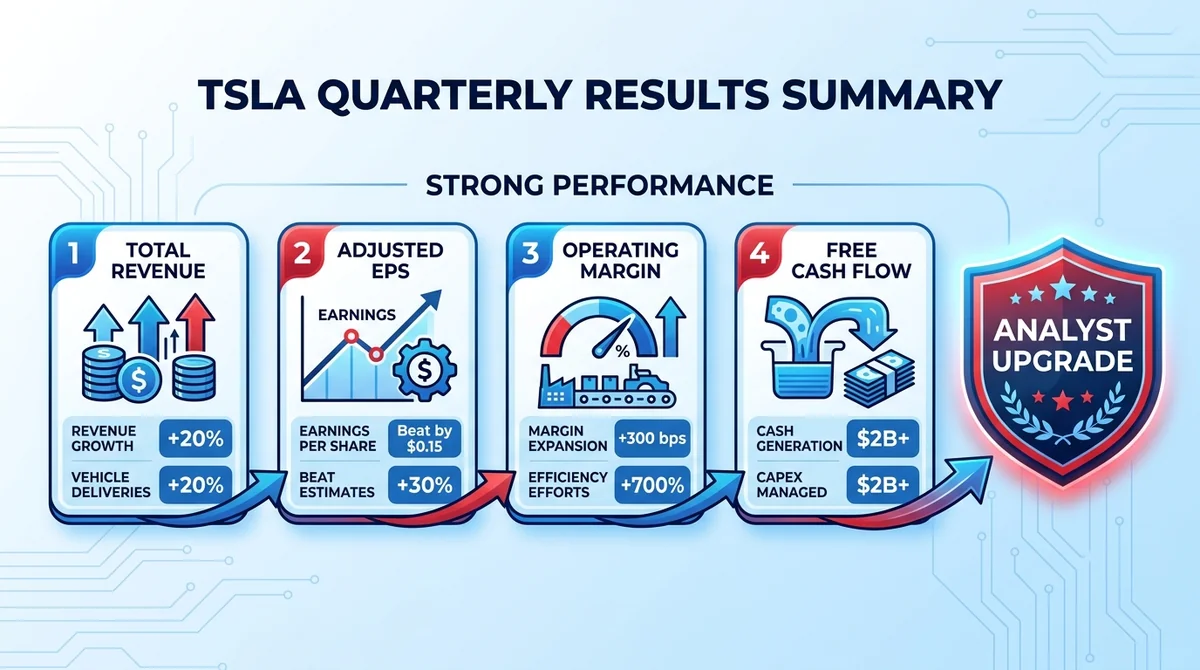
The most surprising number in TSLA's third quarter is not EPS but free cash flow. According to the analysis published by Seeking Alpha on October 21, 2026, TSLA's third-quarter free cash flow was unexpectedly positive, which the analysis attributes to notably low capex and a rise in short-term debt.
This fact needs to be read in two halves: low capex means lower cash outflows in the period; rising short-term debt means a cash inflow at the working-capital level. Together, they pushed free cash flow into positive territory.
This is exactly where caution is warranted. Low capex may reflect project timing or a deliberate pullback; the cash inflow from rising short-term debt is not in itself an improvement in operating cash generation. In other words, this positive figure contains both temporary factors and possibly structural improvement, but the mix between the two cannot be determined from a single quarter's data.
2. Sequential Gross Margin Improvement and an EPS Beat Form the "Baby Steps Forward" Fundamental Evidence
Only by putting the free cash flow turn positive together with sequential gross margin improvement and the adjusted EPS beat does a relatively complete evidence chain emerge. According to the analysis published by Seeking Alpha on October 21, 2026, TSLA's adjusted EPS beat Wall Street expectations and gross margin improved sequentially. Earnings quality and cash flow direction improving in the same quarter is the direct basis for the analyst's rating upgrade.
The phrase "baby steps forward" itself deserves attention. It describes marginal improvement, not a trend reversal. When multiple metrics of a company turn from negative to marginally positive at the same time, a rating change is reasonable; but interpreting that marginal improvement as a full bullish turn in fundamentals goes beyond what the data supports.
3. The Revenue Miss Shows Demand-Side Pressure Has Not Lifted; the Upgrade Is Not a Full Bullish Turn
The fact that TSLA's revenue missed market expectations is the one that most needs repeating throughout this report. According to the analysis published by Seeking Alpha on October 21, 2026, TSLA's third-quarter revenue missed market expectations. Revenue is a direct mapping of demand, and a revenue miss means demand-side pressure has not been lifted.
This upgrade should therefore be read as confirmation of marginal improvement in cash flow and earnings quality, not as a repricing of growth prospects. Whether the positive free cash flow this quarter can be sustained if capex picks up later will be the key test of whether this upgrade holds. This is explored further in Part 5.
3. Meta and SpaceX: Earnings Quality Versus Cash Flow in Reading US Stock Reports
1. Meta Delivers $7.40 Adjusted EPS Despite a Large Legal Charge, Highlighting Ad Business Resilience
Meta's report provides a clear comparison sample. According to the analysis published by Seeking Alpha on October 21, 2026, Meta's third-quarter revenue rose 26% year over year to $64.6 billion on strong ad volume, with adjusted EPS of $7.40 despite a large legal charge.
A large legal charge is a typical non-operating hit: it depresses current profit but does not directly change the operating capacity of the ad business. After absorbing that charge, adjusted EPS still reached $7.40, showing the ad business's profit pool is deep enough. Strong ad volume further suggests revenue growth may come from volume expansion rather than price alone. For the market, the takeaway is that high growth can coexist with solid earnings quality, provided the revenue source has economies of scale and pricing power.
2. SpaceX Revenue Up 161%, AI Business Turns Operating-Profitable, but Free Cash Flow for the Year to Date Is About Negative $35 Billion
SpaceX's report needs to be read as two separate statements. On the income statement, according to the analysis published by Seeking Alpha on October 21, 2026, SpaceX's third-quarter revenue jumped 161% year over year, its AI business turned operating-profitable, and Starlink margins improved significantly. On the cash flow statement, the same source shows that as of September, SpaceX's free cash flow for the year to date was roughly negative $35 billion, and capex is expected to accelerate.
The two statements point in completely opposite directions. Revenue growth, business lines turning profitable and margin improvement are income statement language; negative free cash flow and accelerating capex are cash flow statement language. For a company in a heavy-asset expansion phase, this combination is not unusual — it may mean the company is trading current cash for future capacity and revenue. But valuation models ultimately rest on cash flow, and the direction of cash flow is currently negative.
3. Expected Capex Acceleration Opens a Gap Between SpaceX's High Growth and Its Valuation
Expected capex acceleration is the key to understanding the SpaceX valuation debate. According to the analysis published by Seeking Alpha on October 21, 2026, SpaceX's free cash flow for the year to date was roughly negative $35 billion, and capex is expected to accelerate. If capex accelerates, the free cash flow gap could widen further in the near term rather than narrow.
With the same high growth, Meta converts it into EPS, while SpaceX converts it into capex and cash burn. This is not to say SpaceX's business model is worse, but that its current stage means growth must first pass through cash consumption. For valuation, this means high growth cannot be directly converted into a high valuation; the discount for capex and the cash gap must be deducted in between.
4. Valuation Disagreement: Why SpaceX Stays a Sell Despite Strong Results
1. Updated DCF Fair Value of About $105 Implies a Clear Premium to the $160 Share Price
SpaceX's rating disagreement can be summarized in two numbers. According to the analysis published by Seeking Alpha on October 21, 2026, the analyst maintains a Sell rating on SpaceX, with an updated DCF fair value of about $105 versus a share price of $160. Measured by these two numbers, the share price carries a clear premium to that DCF fair value.
Note: this is a single analyst's model output. DCF results are highly sensitive to discount rate and forward cash flow assumptions, and conclusions could differ significantly under different assumptions. SpaceX is also unlisted, so what the $160 "share price" refers to — a stake or a valuation basis — needs separate verification; the figure is unaudited, non-publicly disclosed, and represents a single analyst's model only, and should not be treated as a factual citation.
DCF model output depends heavily on cash flow assumptions. When a company's free cash flow is negative and capex is expected to accelerate, the model's discounted forward cash flows are significantly reduced, pulling fair value lower. The $105 figure is essentially the two facts of negative cash flow and accelerating capex translated into valuation language.
2. Negative Free Cash Flow Plus Accelerating Capex Directly Suppresses the DCF Valuation Center
The logic becomes clear once the valuation disagreement is reduced to cash flow. According to the analysis published by Seeking Alpha on October 21, 2026, as of September, SpaceX's free cash flow for the year to date was roughly negative $35 billion, and capex is expected to accelerate. Negative free cash flow means no positive cash available for discounting in the current period; accelerating capex means cash outflows could increase in coming periods.
When both hold at once, the DCF valuation center is suppressed from both sides: distributable cash flow in the numerator falls, and the risk premium in the denominator may rise. So even with revenue growth of 161%, the AI business turning operating-profitable and significantly improved Starlink margins, these income-statement highlights are still not enough under that model framework to offset the drag from cash flow and capex on valuation.
3. The Mismatch Between Earnings Quality and Valuation Is the Most Notable Difference Across These Three Reports
Viewed side by side, the mismatch is obvious. According to the analysis published by Seeking Alpha on October 21, 2026, TSLA was upgraded on surprise positive free cash flow, while SpaceX stayed a Sell despite 161% revenue growth. The former corresponds to cash flow turning positive; the latter to negative cash flow.
The same high growth received different pricing outcomes at the two companies. This suggests cash flow direction may be gaining weight in how the market currently prices large caps, but a comparison of two companies alone is not enough to prove this is a market-wide trend. The mismatch between earnings quality and valuation is partly a direct result of cash flow direction under the DCF framework, and partly a reflection of different analysts weighting the same set of facts differently.
5. Verification Signals to Track and Scenario Analysis
1. TSLA Scenario: Can Free Cash Flow Stay Positive Once Capex Rebounds?
TSLA's free cash flow turn positive rests on two conditions: notably low capex and rising short-term debt. According to the analysis published by Seeking Alpha on October 21, 2026, these two points are the main reasons free cash flow was unexpectedly positive this quarter. If capex rebounds later, current-period cash outflows will increase and the positive free cash flow may come under pressure.
The core signal to watch is therefore the pace of capex. If free cash flow stays positive even after capex rebounds, this quarter's improvement is more likely structural; if free cash flow turns negative again, this quarter's positive figure is more likely attributable to temporary factors. This judgment is not a share price forecast, only a path for testing the basis of the upgrade.
2. SpaceX Scenario: Will the Free Cash Flow Gap Widen Further as Capex Accelerates?
SpaceX's verification signal also centers on capex. According to the analysis published by Seeking Alpha on October 21, 2026, as of September, SpaceX's free cash flow for the year to date was roughly negative $35 billion, and capex is expected to accelerate. If capex accelerates as expected, the free cash flow gap could widen further in the near term.
The direction of the gap is key to valuation. If the gap widens, DCF fair value could move lower and the basis for the Sell rating would be reinforced; if the gap narrows, there is room for the valuation discount to repair. It should be stressed that the highlights — revenue up 161%, the AI business turning operating-profitable and significantly improved Starlink margins — still hold; they affect the long-term speed at which the gap converges, not the direction of current-period cash flow.
6. Three-Way Comparison and Key Differences
For easy horizontal comparison, the core metrics of the three companies are summarized below (all data quoted from the Seeking Alpha analysis published on October 21, 2026; SpaceX data are unaudited, non-publicly disclosed and their basis is unverified):
| Company | Revenue growth | Adjusted EPS | Free cash flow direction | Rating/valuation conclusion |
|---|---|---|---|---|
| TSLA | Missed market expectations | Beat Wall Street expectations | Unexpectedly positive | Upgraded |
| Meta | Up 26% year over year to $64.6 billion | $7.40 | Not disclosed | No rating change mentioned |
| SpaceX | Up 161% year over year | Not disclosed | About negative $35 billion for the year to date | Maintained Sell; DCF fair value about $105 vs share price of $160 |
The core difference in this quarter's reports is: TSLA was upgraded on cash flow turning positive, Meta stands out for high growth and earnings quality, and SpaceX, despite the fastest growth, was kept at Sell due to negative cash flow and accelerating capex. Cash flow direction is the key variable for understanding this round of rating divergence, but it would be overreach to conclude from this alone that it has become the sole dominant factor in market-wide pricing.
FAQ
Q1: Why did TSLA's third-quarter free cash flow unexpectedly turn positive?
According to the analysis published by Seeking Alpha on October 21, 2026, TSLA's third-quarter free cash flow was unexpectedly positive, which the analysis attributes to notably low capex and a rise in short-term debt; this is a secondary citation not verified against the original report.
Q2: How did TSLA's third-quarter revenue and EPS perform?
According to the analysis published by Seeking Alpha on October 21, 2026, TSLA's third-quarter revenue missed market expectations, but adjusted EPS beat Wall Street expectations and gross margin improved sequentially.
Q3: How much did Meta's third-quarter revenue grow?
According to the analysis published by Seeking Alpha on October 21, 2026, Meta's third-quarter revenue rose 26% year over year to $64.6 billion on strong ad volume, with adjusted EPS of $7.40 despite a large legal charge.
Q4: How fast did SpaceX's third-quarter revenue grow, and why does it remain a Sell?
According to the analysis published by Seeking Alpha on October 21, 2026, SpaceX's third-quarter revenue jumped 161% year over year, its AI business turned operating-profitable, and Starlink margins improved significantly; however, free cash flow for the year to date through September was roughly negative $35 billion and capex is expected to accelerate, so the analyst maintains a Sell rating, with an updated DCF fair value of about $105 versus a share price of $160. This is a single analyst's model conclusion, not market consensus; SpaceX is unlisted and the data are unaudited, non-publicly disclosed and their basis is unverified.
Q5: What is SpaceX's free cash flow for the year to date?
According to the analysis published by Seeking Alpha on October 21, 2026, as of September, SpaceX's free cash flow for the year to date was roughly negative $35 billion, and capex is expected to accelerate. SpaceX is unlisted, and the data are unaudited, non-publicly disclosed and their basis and audit status are unverified.
Q6: What are the core differences in this quarter's reports from TSLA, Meta and SpaceX?
The core difference is cash flow direction: TSLA's free cash flow unexpectedly turned positive and it was upgraded, Meta grew revenue 26% with solid earnings quality, and SpaceX grew revenue 161% but had free cash flow for the year to date of roughly negative $35 billion with capex expected to accelerate, so it was kept at Sell.
Sources
- https://seekingalpha.com/article/4956076-tesla-q3-baby-steps-forward-rating-upgrade?source=feed_all_articles
- https://seekingalpha.com/article/4956073-meta-the-best-megacap-to-own?source=feed_all_articles
- https://seekingalpha.com/article/4956058-spacexs-earnings-were-outstanding-but-its-still-a-sell?source=feed_all_articles
This article is produced by the MSXGO editorial team, AI-assisted, and reviewed through an editorial process. Fee rates and figures are subject to each platform's latest official announcements.
FAQ
Why did TSLA's third-quarter free cash flow unexpectedly turn positive? ▼
According to the analysis published by Seeking Alpha on October 21, 2026, TSLA's third-quarter free cash flow was unexpectedly positive, which the analysis attributes to notably low capex and a rise in short-term debt; this is a secondary citation not verified against the original report.
How did TSLA's third-quarter revenue and EPS perform? ▼
According to the analysis published by Seeking Alpha on October 21, 2026, TSLA's third-quarter revenue missed market expectations, but adjusted EPS beat Wall Street expectations and gross margin improved sequentially.
How much did Meta's third-quarter revenue grow? ▼
According to the analysis published by Seeking Alpha on October 21, 2026, Meta's third-quarter revenue rose 26% year over year to $64.6 billion on strong ad volume, with adjusted EPS of $7.40 despite a large legal charge.
How fast did SpaceX's third-quarter revenue grow, and why does it remain a Sell? ▼
According to the analysis published by Seeking Alpha on October 21, 2026, SpaceX's third-quarter revenue jumped 161% year over year, its AI business turned operating-profitable, and Starlink margins improved significantly; however, free cash flow for the year to date through September was roughly negative $35 billion and capex is expected to accelerate, so the analyst maintains a Sell rating, with an updated DCF fair value of about $105 versus a share price of $160. This is a single analyst's model conclusion, not market consensus.
What is SpaceX's free cash flow for the year to date? ▼
According to the analysis published by Seeking Alpha on October 21, 2026, as of September, SpaceX's free cash flow for the year to date was roughly negative $35 billion, and capex is expected to accelerate. SpaceX is unlisted, and the data's basis and audit status are unverified.
Finished reading? Ready to try trading?
Tokenized stocks/ETFs, crypto spot, and perpetual futures in one account — perp maker 0.02% / taker 0.045%, RWA spot buy 0.3% / sell 0.
Free sign-up · 3 quick steps