MSX US Stock Daily Watch: Alphabet Valuation Re-Rating: Cloud Supply Bottleneck at 17.33x P/E Ratio and 0.91x PEG, Analyst Upgrades to Strong Buy with $418.80 Price Target
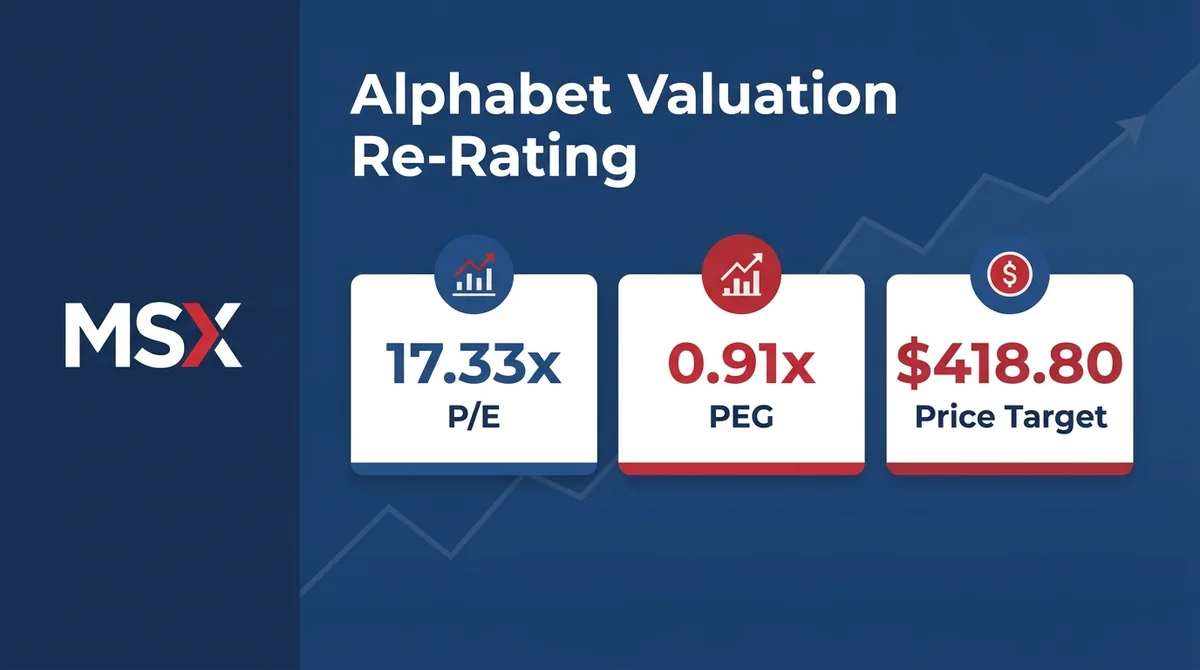
Seeking Alpha author says post-Q3 selloff cut GOOG to 17.33x P/E and 0.91x 3-year PEG, upgrades to Strong Buy with $418.80 target. We break down the methodology and key variables.
Article Citation Summary
Seeking Alpha author says post-Q3 selloff cut GOOG to 17.33x P/E and 0.91x 3-year PEG, upgrades to Strong Buy with $418.80 target. We break down the methodology and key variables.
MSX US Stock Daily Watch: Alphabet Valuation Re-Rating: Cloud Supply Bottleneck at 17.33x P/E Ratio and 0.91x PEG, Analyst Upgrades to Strong Buy with $418.80 Price Target
MSX Research Guest Columnist @MSX_CN 2026 This article is approximately 5,000 words and takes about 12 minutes to read
Note: The core figures and judgments in this article are cited from a signed Seeking Alpha article (October 31, 2026) and represent a single author's view, not cross-verified by Alphabet's official financial reports or third-party data sources. "Analyst" in this article refers specifically to the author of that article and does not represent Wall Street consensus.
The selloff Alphabet experienced after its Q3 FY2026 earnings release was described by the author of the Seeking Alpha article as pushing the company's valuation down to a 17.33x P/E ratio and a 0.91x three-year PEG. It was on this valuation basis that the author upgraded GOOG to Strong Buy and set a long-term bullish price target of $418.80. It should be noted upfront that these figures come from the author's methodology; this article treats them as propositions to be verified rather than confirmed facts.
AI Summary
Core View: According to the Seeking Alpha article, Alphabet's post-Q3 selloff was attributed to SPCX equity book losses, a $5.2 billion fine, TPU hardware inventory, and free cash flow pressure from AI capital expenditures, compressing the valuation to a 17.33x P/E ratio and a 0.91x three-year PEG. The article also states that Google Cloud's profit growth is still accelerating, with the real constraint on the supply side rather than the demand side. If this attribution holds, the nature of this re-rating is closer to "pricing the pace of investment" rather than "deterioration in operating quality"—but this conclusion relies on the author's methodology and awaits verification from financial data.
Key Elements:
- The Seeking Alpha article states that Alphabet experienced a selloff after its Q3 FY2026 earnings release, partly due to SPCX equity book losses, a $5.2 billion fine, TPU hardware inventory, and free cash flow pressure from AI capital expenditures.
- The article states that Alphabet's expanding AI compute capacity is driving accelerating profit growth at Google Cloud, but demand remains constrained by supply.
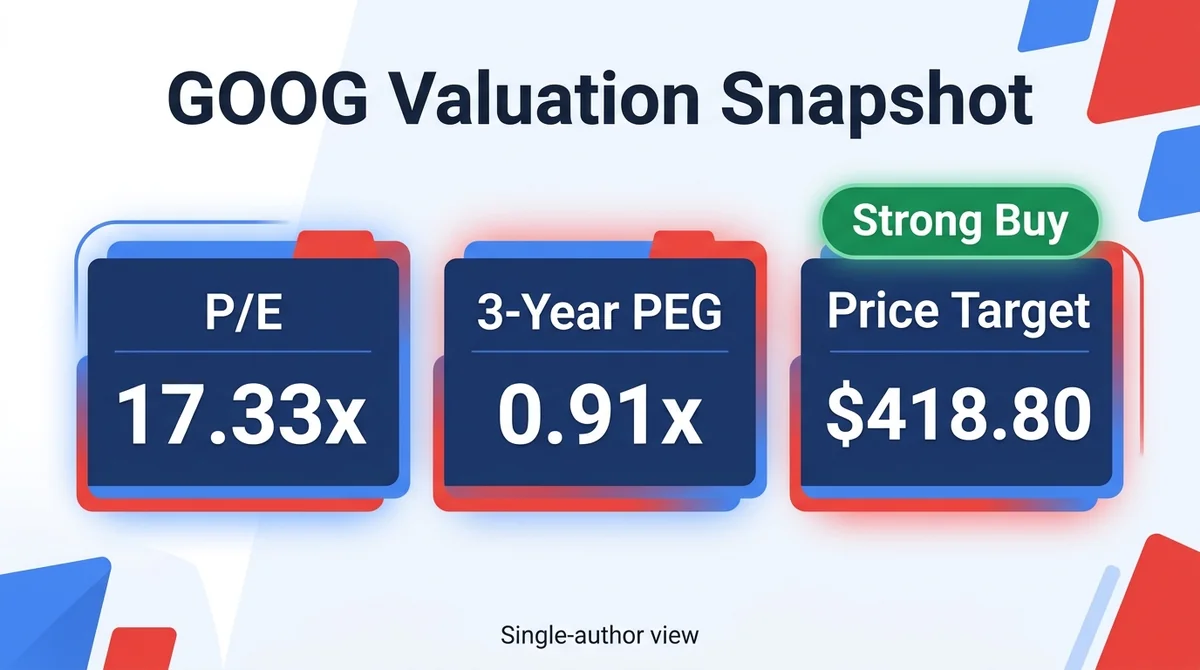
- The article notes that the decline brought GOOG's P/E ratio down to 17.33x and its three-year PEG to 0.91x; the author sets a long-term bullish price target of $418.80 and upgrades the rating to Strong Buy.
I. Post-Earnings Selloff Pushes Alphabet to a Valuation Range of 17.33x P/E Ratio and 0.91x PEG
1. GOOG Sold Off After Q3 FY2026 Earnings Release, with Book Losses and One-Off Charges Amplifying Noise
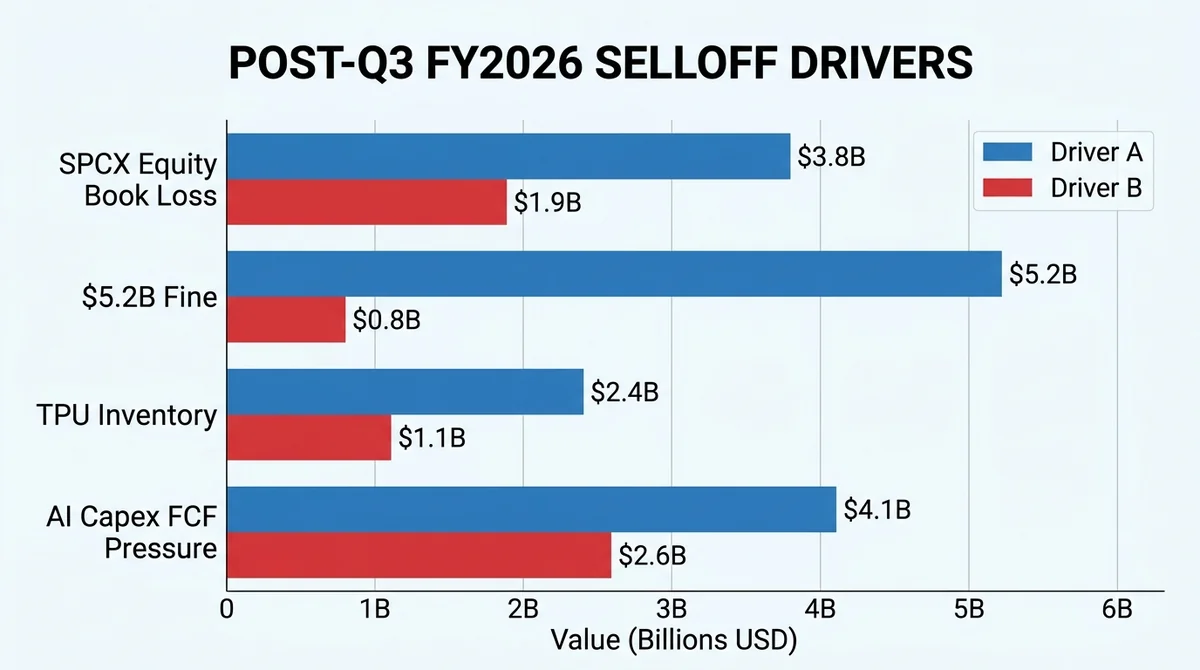
According to the Seeking Alpha article (October 31, 2026), Alphabet experienced a selloff after its Q3 FY2026 earnings release. The article attributes the trigger to a combination of several "noise items" in the report: SPCX equity book losses, a $5.2 billion fine, and free cash flow pressure from both TPU hardware inventory and AI capital expenditures. It should be noted that "the selloff was driven by these items" is the author's attribution judgment, not a directly observable causal relationship—post-earnings stock movements are also affected by guidance, market expectation gaps, and the broader market environment, and this article has not obtained data that distinguishes the weight of each factor.
From an accounting perspective, SPCX equity book losses represent fair value changes in equity holdings, and the $5.2 billion fine is a one-off charge; neither directly reflects the ongoing profitability of the core business. But "one-off" does not mean "negligible": the fine is a real cash outflow, and equity book losses may reverse in subsequent quarters. Their impact on valuation models needs to be handled separately and cannot simply be lumped into "noise."
2. A Fine of Around $5.2 Billion, TPU Hardware Inventory, and AI Capital Expenditures Together Suppress Free Cash Flow
More noteworthy than the one-off fine is the source of pressure on the free cash flow metric. The Seeking Alpha article lists TPU hardware inventory and AI capital expenditures as components of free cash flow pressure, from which it can be inferred that part of the free cash flow strain comes from investment in future compute supply rather than a pure contraction in operating cash flow. But this inference holds only if the article's breakdown of cash flow components is accurate and capital expenditures are indeed in a front-loaded investment phase. Neither point could be independently verified in this article.
The key judgment here is that the "nature" of free cash flow pressure matters more than its "magnitude." If the pressure comes from deteriorating operating cash flow, that is an operating quality issue; if it comes from front-loaded capital expenditures and inventory, that is an investment pace issue. The article's narrative points to the latter, but readers should note that whether capital expenditures translate into revenue depends on future compute delivery and customer adoption, and execution risk exists.
3. Valuation Compressed to 17.33x P/E Ratio and 0.91x Three-Year PEG
According to the article, the decline brought GOOG's P/E ratio down to 17.33x and its three-year PEG to 0.91x. A PEG below 1 typically means the market is pricing growth below its growth trajectory, which is the valuation basis for the author's subsequent rating upgrade.
It must be emphasized that methodology matters: P/E ratio and PEG readings are highly dependent on the earnings basis (GAAP vs. adjusted) and growth assumptions (the specific three-year earnings growth rate used). The article does not disclose the calculation details for 17.33x and 0.91x, and this article cannot verify them. If GAAP earnings including one-off items are used, the P/E ratio would be passively inflated; if adjusted earnings excluding noise items are used, the valuation would be lower. This methodological difference is precisely the core of the debate over this re-rating, and readers should not treat these two figures as the sole objective valuation anchor.
II. The Real Constraint on Accelerating Cloud Profit Growth Is on the Supply Side, Not the Demand Side
1. Expanding AI Compute Capacity Is Driving Accelerating Profit Growth at Google Cloud
The Seeking Alpha article states that Alphabet's expanding AI compute capacity is driving accelerating profit growth at Google Cloud. This judgment shifts the cloud growth engine from "demand-pull" to "supply-driven": in an environment where AI compute is in short supply, whoever can deliver compute capacity faster can recognize cloud revenue and profit faster.
From a profit structure perspective, cloud profit improvement typically comes from two directions: operating leverage from revenue scale expansion and optimization of unit compute costs through in-house compute (such as TPU). However, "in-house hardware improving unit economics" remains an inference rather than a proven conclusion—data on TPU depreciation, yield, and utilization are not disclosed in the source, and the actual magnitude of the cost advantage cannot be verified.
2. Demand Remains Constrained by Supply; the Pace of Compute Expansion Determines the Pace of Cloud Revenue Recognition
The article states that demand remains constrained by supply. If true, this means Google Cloud is not facing insufficient orders but insufficient speed in delivering compute and infrastructure. Under this structure, the cloud growth ceiling is determined not by customer demand but by the pace of compute expansion.
The impact of this constraint on valuation is two-sided: on one hand, a supply bottleneck means a visible growth ceiling, making it difficult for the market to assign a premium based on unlimited extrapolation; on the other hand, demand certainty is relatively high, and once compute is released, revenue elasticity may exceed linear expectations. However, "demand constrained by supply" is itself the author's statement, lacking quantitative support from order backlog or capacity utilization, and readers should treat it as an industry judgment to be verified.
3. A Supply Bottleneck Means Capital Expenditures Are Persistent Rather Than Cyclical
If the constraint is on the supply side, then AI capital expenditures are more likely to be persistent capacity building rather than a cyclical "restocking." By this logic, as long as demand remains constrained by supply, Alphabet has reason to continue investing in compute capacity, and free cash flow pressure may not disappear in the short term.
For the market, this judgment changes the valuation anchor: if capital expenditures are cyclical, one can expect a short-cycle path of "investment peaks—cash flow recovers—valuation recovers"; if they are persistent, a longer discounted cash flow window is needed, and short-term cash flow pressure is viewed as a necessary cost of long-term capacity building. Under the two frameworks, the same financial report would lead to different valuation conclusions—which is why this article believes the conclusion should be labeled as an inference.
III. Separating Noise Indicators from Operating Indicators Determines the Nature of This Re-Rating
1. SPCX Equity Book Losses and the Fine Are Non-Operating Noise Items
To judge the nature of the re-rating, the first step is to separate noise items from operating indicators. According to the article's methodology, SPCX equity book losses represent fair value changes in equity holdings, and the $5.2 billion fine is a one-off charge; neither reflects the ongoing profitability of the core business.
But "non-operating" does not mean "uninformative." The fine may reflect changes in the compliance or regulatory environment, and equity book losses may reflect portfolio quality; their implications for long-term valuation need separate assessment. If the market treats noise items as evidence of operating deterioration during the selloff, the valuation may be overly compressed; conversely, if the market has fully understood them as one-off, the low valuation may not necessarily be a mispricing.
2. TPU Hardware Inventory and AI Capital Expenditures Are Proactive Investment Items Pointing to Future Capacity
In contrast to noise items are proactive investment items. TPU hardware inventory and AI capital expenditures also suppress current free cash flow, but their nature is capacity building for future compute supply. The article lists these two items as sources of cash flow pressure while linking them to accelerating Google Cloud profit—the purpose of investment is output.
The significance of distinguishing the two is that after noise items clear, the valuation metric automatically recovers, whereas investment items need to be verified by future revenue and profit. The former is an accounting issue; the latter is an operating issue. If the market conflates the two, it may continue to suppress the valuation on "cash flow pressure" grounds even after noise items clear, creating an expectation gap; conversely, if investment items fail to produce output for a long time, the "investment" narrative will backfire on the valuation.
3. Free Cash Flow Pressure Is the Result of Investment Pace and Should Be Observed Together with Accelerating Cloud Profit
After separating noise items from investment items, the article's interpretation of cash flow pressure is that it is the result of investment pace, not a signal of deteriorating operating quality. Its core narrative treats free cash flow pressure and accelerating Google Cloud profit as two sides of the same investment cycle.
This methodology is meaningful but has blind spots: combined observation can easily obscure the question of whether investment is excessive. If the return on capital expenditures is below the cost of capital, the investment pace itself erodes value, and the narrative of "trading current cash flow for future supply" becomes a packaging for a value trap. Whether the judgment holds ultimately depends on whether incremental cloud revenue can cover incremental capital costs.
IV. Analyst Upgrades to Strong Buy and Sets a Long-Term Price Target of $418.80
1. Rating Upgraded from Previous Level to Strong Buy
Based on the above valuation and business judgments, the author of the Seeking Alpha article upgraded GOOG's rating to Strong Buy. The upgrade is based on a reassessment of the valuation range and business structure, not on expectations of a short-term stock rebound.
It should be clarified that this rating is a single analyst's view, not market consensus. Strong Buy reflects the author's judgment on the risk-reward ratio, not a commitment to short-term stock price movements. Readers should treat it as the output of an analytical framework, not a proxy for market consensus.
2. $418.80 Positioned as a Long-Term Bullish Price Target
The article sets a long-term bullish price target of $418.80. The key word is "long-term"—it corresponds to a scenario of compute supply release, accelerating cloud profit realization, and valuation recovery after noise items clear, not a price forecast for the next quarter.
From a valuation methodology perspective, any price target must be based on specific earnings assumptions and valuation multiples. The source material does not disclose the full derivation of the $418.80 target (earnings forecasts, multiple selection, time window), and this article cannot verify it, so it should be treated as a scenario output: if cloud profit accelerates as expected and cash flow pressure eases, there is a logical basis for recovery to this target; if supply release is delayed, the timing of realization may be pushed back.
3. Low P/E Ratio and Low PEG Form the Valuation Basis for the Rating Upgrade
The valuation basis for the rating upgrade is the combination of a 17.33x P/E ratio and a 0.91x three-year PEG. The author's logic can be summarized as: when valuation compression is driven by noise items and investment pace rather than deteriorating operating quality, the low valuation constitutes a range with a favorable risk-reward ratio.
The vulnerability of this logic is also obvious: a low valuation is only meaningful when growth is realized. If Google Cloud profit acceleration falls short of expectations, or if free cash flow pressure persists beyond market tolerance, the low valuation could turn into a "value trap." Therefore, the validity of the rating and price target ultimately depends on the verification variables in the next section.
V. Three Verification Variables to Track for the Re-Rating Logic to Hold
1. Whether Compute Supply Release Can Translate into Continued Acceleration of Google Cloud Profit
The first verification variable is the synchronization between compute supply release and accelerating cloud profit. The article states that demand remains constrained by supply, meaning the pace of compute delivery is a precondition for cloud revenue recognition. If compute capacity is released as planned, profit acceleration is likely to continue; if delivery is delayed, revenue recognition is pushed back, and the timing of valuation recovery is also delayed.
When tracking, attention should be paid to the match between the pace of compute capacity expansion and cloud revenue growth. Under a supply bottleneck, "delivery equals revenue," so marginal changes in compute delivery may foreshadow short-term cloud trends better than demand-side order data—but this judgment requires support from data such as capacity utilization, which the source does not currently provide.
2. Whether Free Cash Flow Pressure Eases as Capital Expenditure Pace Peaks
The second verification variable is the reversibility of free cash flow pressure. If TPU inventory and AI capital expenditures are front-loaded investments, cash flow pressure is expected to ease as capacity is delivered and revenue is recognized; if capital expenditures continue to increase due to supply bottlenecks, free cash flow may remain under pressure for a long time. The article treats the persistent rather than cyclical nature of capital expenditures as one implication of the supply bottleneck, meaning the timing of cash flow pressure relief may be later than market expectations.
For valuation, this variable determines how long a window the market uses to price AI investment: if pressure is reversible and the timing is visible, the recovery path is clear; if pressure persists and the timing is vague, the low valuation may last longer.
3. Whether the P/E Ratio and PEG Get Re-Priced After Noise Items Clear
The third verification variable is the repair of the valuation metric. SPCX equity book losses and the $5.2 billion fine are one-off factors; as they clear, the P/E ratio and PEG under an adjusted earnings basis may be re-priced. If the market is willing to adopt a basis excluding noise items, the "cheapness" of 17.33x and 0.91x will be more widely recognized; if the market continues to price on a GAAP basis, the recovery may be delayed.
Qualitative scenarios can be summarized as: if supply release goes smoothly, the re-rating continues; if supply is delayed, the low valuation may last longer. The three variables are not independent—compute delivery determines cloud profit, profit determines cash flow improvement, and cash flow improvement determines valuation metric repair; a delay in any link will propagate backward.
Final Thoughts
The Alphabet case shows that valuation compression during an AI capital expenditure cycle may come from the cash flow metric rather than the earnings metric. When free cash flow is pressured by capacity building, the market tends to substitute cash flow figures for earnings judgment in the reporting period, thereby misreading investment pace as operating deterioration. Whether the 17.33x P/E ratio and 0.91x PEG are precisely the result of this metric shift still needs to be verified by financial data.
The cloud supply bottleneck is both a growth ceiling and a source of capital expenditure persistence. Demand constrained by supply means a visible growth ceiling, but it also means that once compute is released, revenue and profit elasticity may exceed linear expectations. This structure of "visible ceiling, elastic upside" makes Alphabet's valuation difficult to command a premium based on unlimited extrapolation, yet also difficult to suppress at low levels for long—but this remains an inference, not a realized fact.
The 17.33x P/E ratio and 0.91x PEG constitute a low-valuation hypothesis that requires continuous verification, not a conclusion. The Strong Buy rating and $418.80 price target are a single analyst's scenario output under this hypothesis, and their validity depends on the realization of three variables: compute supply release, free cash flow relief, and valuation metric repair. In an AI capital expenditure cycle, the essence of valuation re-rating is the market pricing capacity building on a cash flow basis, and corrections to that pricing often lag behind capacity delivery.
Risk Warning: Macroeconomic conditions and the US stock market are highly volatile. This content is for academic and research observation reference of MSX Research only and does not constitute any investment advice. The core data in this article are cited from a single third-party article and have not been verified by company financial reports or independent data sources; readers should verify independently.
Invest in AI RWA
References
This article is produced by the MSXGO editorial team, AI-assisted, and reviewed through an editorial process. Fee rates and figures are subject to each platform's latest official announcements.
FAQ
Why did Alphabet experience a selloff after its Q3 FY2026 earnings release? ▼
According to the Seeking Alpha article, the selloff was partly attributed to SPCX equity book losses, a $5.2 billion fine, TPU hardware inventory, and free cash flow pressure from AI capital expenditures; however, this is the author's attribution and has not been independently verified.
What are GOOG's current P/E ratio and PEG? ▼
According to the Seeking Alpha article, the decline brought GOOG's P/E ratio down to 17.33x and its three-year PEG to 0.91x. These metrics are based on the article author's methodology, calculation details are not disclosed, and they need to be cross-verified with the company's official financial data.
What are the analyst's price target and rating for Alphabet? ▼
The author of the Seeking Alpha article sets a long-term bullish price target of $418.80 and upgrades the rating to Strong Buy. The price target and rating are a single analyst's view, not market consensus, and the derivation process is not disclosed in the source.
What is the main constraint on Google Cloud's growth? ▼
According to the Seeking Alpha article, Alphabet's expanding AI compute capacity is driving accelerating profit growth at Google Cloud, but demand remains constrained by supply, making the pace of compute and infrastructure delivery the core variable for cloud growth.
What is the source of Alphabet's free cash flow pressure? ▼
According to the Seeking Alpha article, free cash flow pressure comes from SPCX equity book losses, a $5.2 billion fine, TPU hardware inventory, and AI capital expenditures. The fine and book losses are non-operating items, while TPU inventory and AI capital expenditures are investment items for future compute supply.
Finished reading? Ready to try trading?
Tokenized stocks/ETFs, crypto spot, and perpetual futures in one account — perp maker 0.02% / taker 0.045%, RWA spot buy 0.3% / sell 0.
Free sign-up · 3 quick steps