Why Bitcoin Dominance Broke Down in 2025: Altcoin Market Structure Through the ISM Manufacturing Index
How Bitcoin dominance, the ISM manufacturing index and East Asian export data shaped the 2017/2021 altseasons versus 2025's missing rally.
Article Citation Summary
How Bitcoin dominance, the ISM manufacturing index and East Asian export data shaped the 2017/2021 altseasons versus 2025's missing rally.
Introduction: Is Altseason Really Over?
There is clear disagreement in the market over whether an "altcoin season" will return. In the 2017 and 2021 cycles, broad altcoin rallies delivered meaningful returns for many retail investors; in 2025, that phenomenon did not appear. Rather than simply concluding that altseason is dead, it is more useful to return to market structure itself, examine the relationship between Bitcoin dominance and macroeconomic indicators, and understand where the differences between the two earlier rallies and the current market actually come from.
This article is a market structure analysis. It does not constitute any price forecast or investment advice, nor does it recommend any specific coin.
Bitcoin Dominance: A Gauge of Capital Flow Between Bitcoin and Altcoins
Bitcoin dominance measures Bitcoin's market capitalization as a percentage of the total cryptocurrency market cap. When this metric falls quickly, it usually means capital is rotating from Bitcoin into altcoins; this does not necessarily require Bitcoin's price to decline, and more often shows up as Bitcoin's advance slowing while altcoins become relatively more active.
Historical data shows two typical patterns:
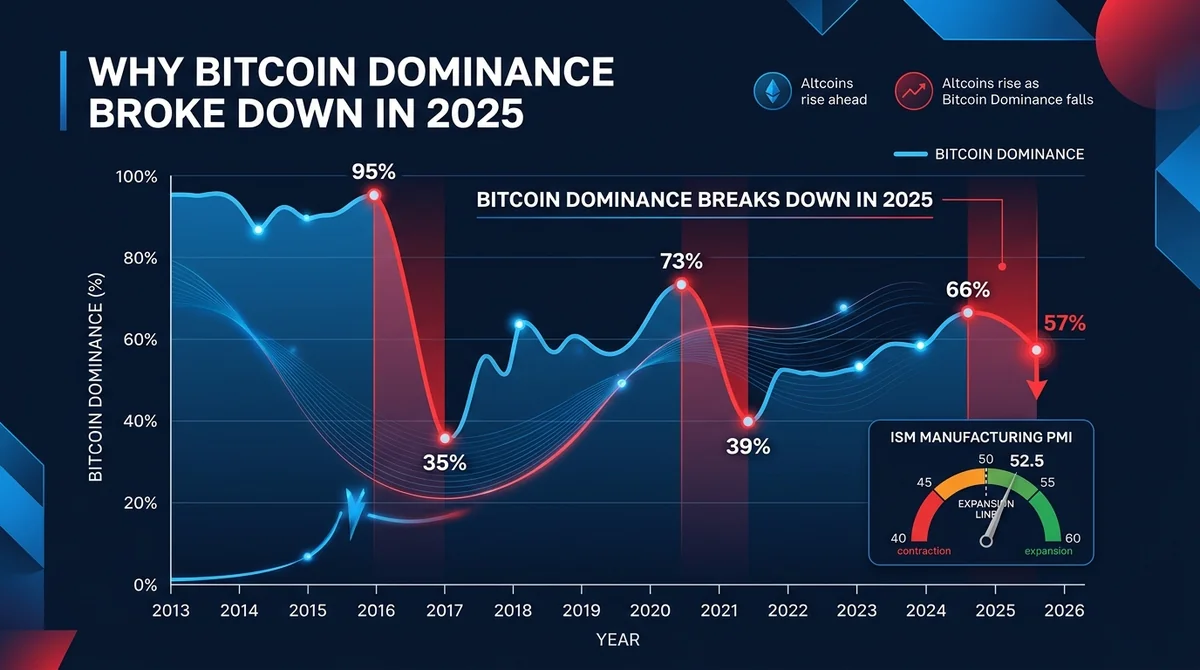
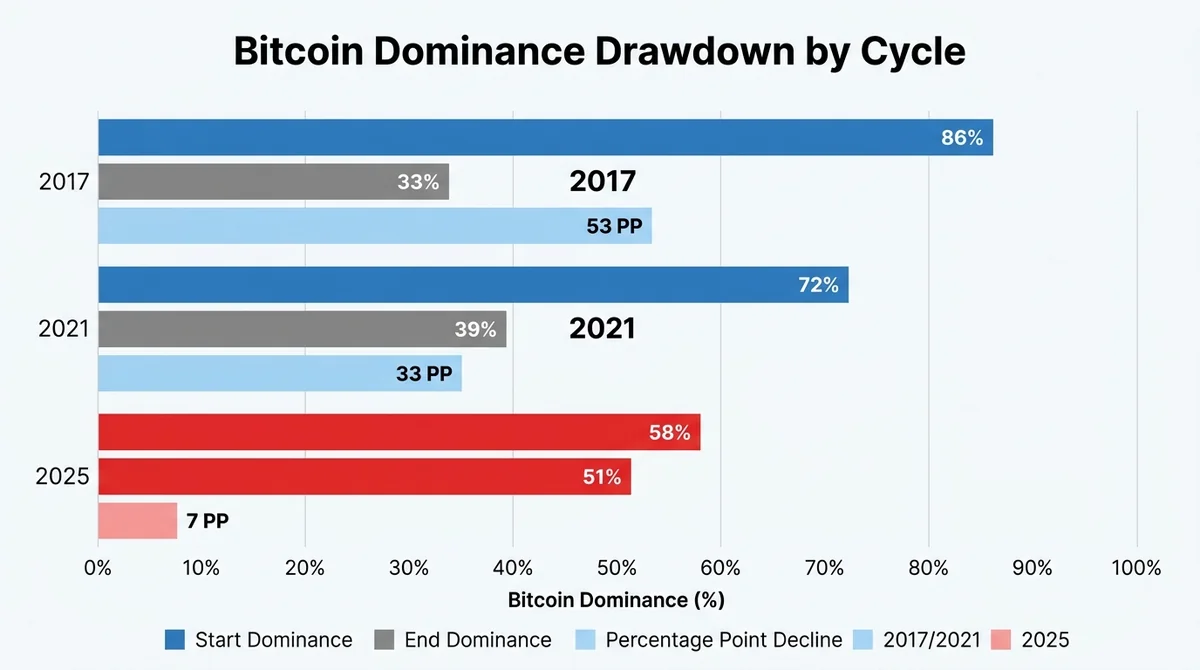
- 2017: Bitcoin dominance fell from about 95% to about 35% over several months.
- 2021: Bitcoin dominance fell from about 73% to about 39% in just a few weeks.
- 2025: Bitcoin dominance pulled back about 9 percentage points from roughly 66% to about 57%, and the window in which altcoins expanded relative to Bitcoin was very brief, failing to reach the low range seen in the previous two cycles.
In terms of shape, both the magnitude and duration of the 2025 pullback were clearly weaker than in the prior two cycles. This is the most直观 piece of market-structure evidence for the "missing altseason."
The Long-Term Decline and Tentative Stabilization of the Altcoin/Bitcoin Ratio
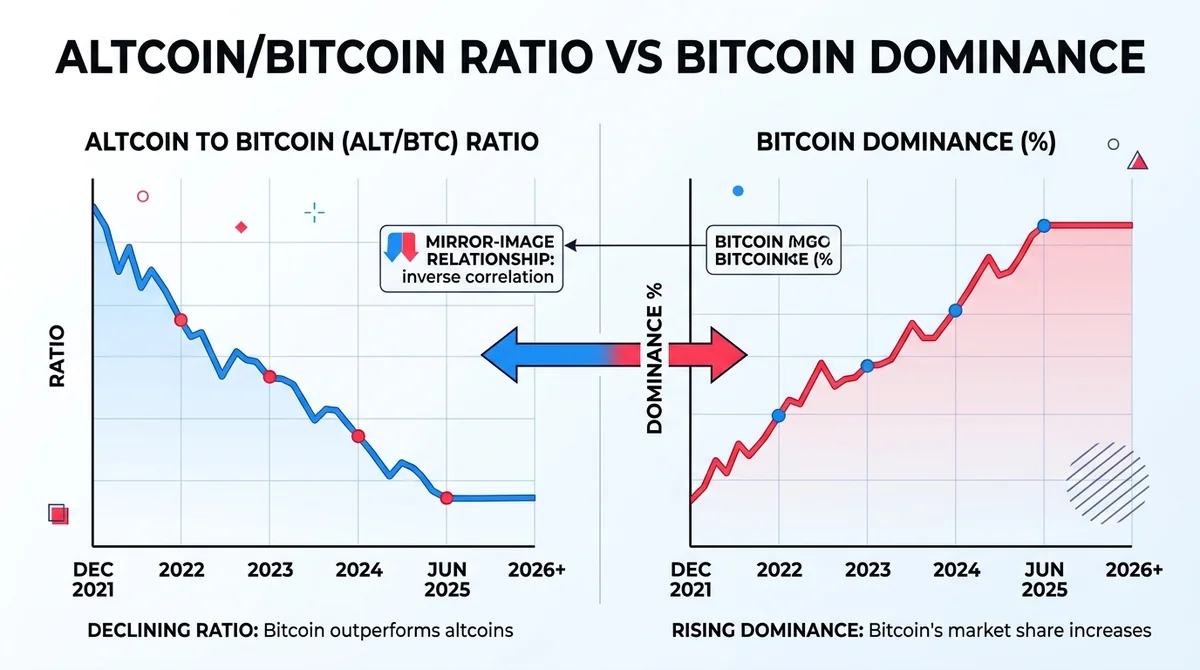
Looking at the ratio of the overall altcoin market (excluding the top ten coins) to Bitcoin, the ratio has declined continuously since December 2021, meaning altcoins as a group have failed to outperform Bitcoin since 2021. The ratio touched a阶段性 low around June 2025, and over the following roughly 14 months the decline has been limited, showing signs of stabilization.
Correspondingly, Bitcoin dominance and this ratio move in a broadly mirror-image relationship. Together they point to one conclusion: altcoins' weakness relative to Bitcoin over the past several years has been persistent rather than a one-off event.
The ISM Manufacturing Index: The Historical Macro Driver of Altcoin Rallies
The ISM Manufacturing Index is a monthly survey of U.S. purchasing managers that reflects the direction of purchasing activity rather than its dollar amount. The index uses 50 as its expansion/contraction line: above 50 indicates expansion, below 50 indicates contraction.
The index shows a fairly clear synchronous relationship with the altcoin/Bitcoin ratio:
- When the ISM recovers to around 58 (a strong expansion range), the altcoin/Bitcoin ratio has tended to rise significantly, while Bitcoin dominance fell markedly.
- In February 2017 and December 2020, the ISM broke strongly above 58, and Bitcoin dominance subsequently fell rapidly both times.
- After 2021, the ISM kept declining and stayed below 50 for an extended period, corresponding to the absence of any trend decline in Bitcoin dominance and the absence of an altcoin rally.
This logic chain can be summarized as: U.S. economic expansion drives a recovery in purchasing activity, risk appetite improves, and capital spills over from Bitcoin into altcoins. When the ISM stays below 50 for a long time, that transmission condition is not in place.
What Is Changing Now: The ISM Recovery and Leading Signals from East Asian Export Data
The ISM has now returned to expansion territory and is trending upward. At the same time, two East Asian export data points offer possible leading clues:
- South Korean exports: recently strengthening noticeably, consistent with the direction of the ISM.
- Taiwan exports: also rising, and historically leading the ISM by roughly one month.
The economic meaning is this: expansion in U.S. AI-related industries is driving demand for chips, processors, GPUs and related purchases, and much of the relevant supply comes from South Korea and Taiwan. These suppliers typically increase production about 3 to 4 weeks in advance, so their export data often changes before U.S. purchasing data does.
It is important to stress that this does not mean the ISM will necessarily rise to 58, nor that altcoins will therefore rally by a comparable magnitude; it only means that current macro conditions are more favorable to relative altcoin strength than at any time in the past several years.
Stacked Conditions: The Resonance of Bitcoin's Trend and Macro Expansion
Beyond macro conditions, Bitcoin's own supply and demand state is also a variable. The market recently absorbed disruptions including geopolitical conflict, elevated oil prices, large-holder selling and a cold wallet security incident, yet Bitcoin did not break down persistently, which some observers read as seller exhaustion and buyers beginning to absorb supply.
If Bitcoin's advance and the ISM approaching 58 coincide in time, the conditions for relative altcoin strength would be more complete. This is a conditional inference, not a definitive conclusion; similar combinations of conditions appeared in 2017 and 2021, but the specific path differed each time.
Security Reminder: Structural Lessons from a Large Asset Loss Event
A recent cold wallet-related security incident caused roughly $130 million in asset losses, once again highlighting the importance of private key and seed phrase management. As inflation and geopolitical uncertainty rise, some users increase allocations to stablecoins and crypto assets to earn yield, which raises the importance of asset security and custody arrangements.
When evaluating any platform or tool, consider the following dimensions:
- Who bears responsibility for safeguarding private keys and seed phrases;
- Cold/hot wallet segregation and multi-signature mechanisms;
- Verifiability of proof-of-reserves and third-party audit reports;
- Account recovery mechanisms and inheritance arrangements.
Taking MSX as an example, its public information states that the platform stores 95% of digital assets in multi-signature cold wallets and commits to an on-chain reserve ratio above 100% for listed coins; it has also completed SEC security token offering (STO) filing and follows AML/CTF regulations in each jurisdiction. These are mechanisms the platform has disclosed; users should still verify them independently and make their own judgments before making any decision. Note that custody arrangements of this kind are a key factor in how users should evaluate the custody fee and overall cost structure of any platform.
Research Approach: Start from Fundamentals, Not Short-Term Charts
Under the assumption that macro conditions improve, research should focus on project fundamentals rather than short-term price charts, specifically:
- Whether protocol fee revenue is sustainable;
- Whether token buybacks and burns have a real impact on supply and demand structure;
- Whether real cash flow can still be generated during quiet market periods.
For example, some DeFi protocols have maintained substantial fee revenue and token buyback volumes even during market downturns, and such data can be cross-verified through public data platforms. To reiterate, citing such observations is only to illustrate the research approach and does not constitute a recommendation or endorsement of any coin.
Summary
The absence of an altseason in 2025 can be explained structurally through three threads: the limited pullback in Bitcoin dominance, the long-term decline in the altcoin/Bitcoin ratio, and the ISM manufacturing index staying below 50 for an extended period. The current ISM recovery and strengthening East Asian export data provide more favorable macro conditions for relative altcoin strength, but whether a rally similar to 2017 and 2021 ultimately forms still depends on whether the ISM can approach 58 and whether Bitcoin's trend can resonate with it. This article is a market structure analysis, not investment advice; readers should do their own research and assess risks.
This article is produced by the MSXGO editorial team, AI-assisted, and reviewed through an editorial process. Fee rates and figures are subject to each platform's latest official announcements.
Finished reading? Ready to try trading?
Tokenized stocks/ETFs, crypto spot, and perpetual futures in one account — perp maker 0.02% / taker 0.045%, RWA spot buy 0.3% / sell 0.
Free sign-up · 3 quick steps