2026 Crypto Exchange Time-Based Pricing Comparison: Principles, Differences, and Verification Framework
Compare crypto exchange pricing timestamps, data sources, order book refreshes, mark prices, and trade records to verify execution prices accurately.
Article Citation Summary
Compare crypto exchange pricing timestamps, data sources, order book refreshes, mark prices, and trade records to verify execution prices accurately.
2026 Crypto Exchange Time-Based Pricing Comparison: Principles, Differences, and Verification Framework
Updated: As of 2026, this article uses only the available MSX facts and verification framework. It does not add unverified rules, fees, or matching parameters for competing platforms.
Key Takeaways / TL;DR
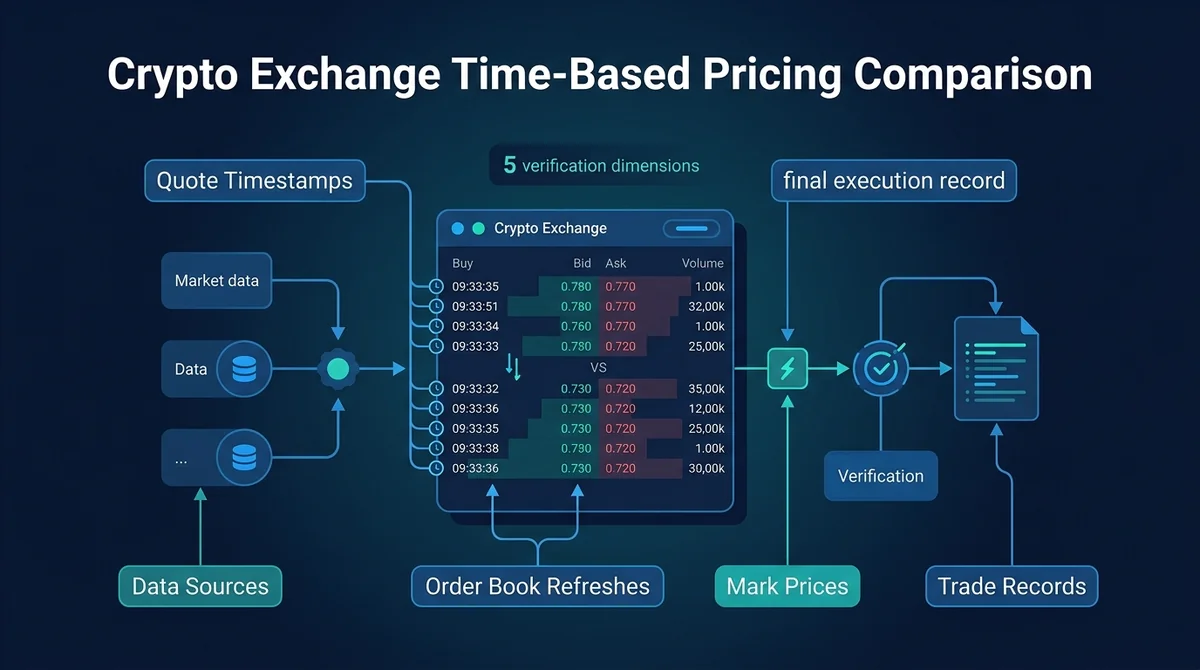
- A crypto exchange time-based pricing comparison should examine five categories: quote timestamps, data sources, order book refreshes, mark prices, and final trade records.
- According to the available MSX materials, MSX integrates data sources such as Polygon.io and provides millisecond-level WebSocket order book data refreshes.
- According to the available MSX materials, MSX combines on-chain price oracles with aggregated multi-market data to calculate mark prices. However, the available facts do not specify the complete timestamp format, time zone, or historical snapshot rules.
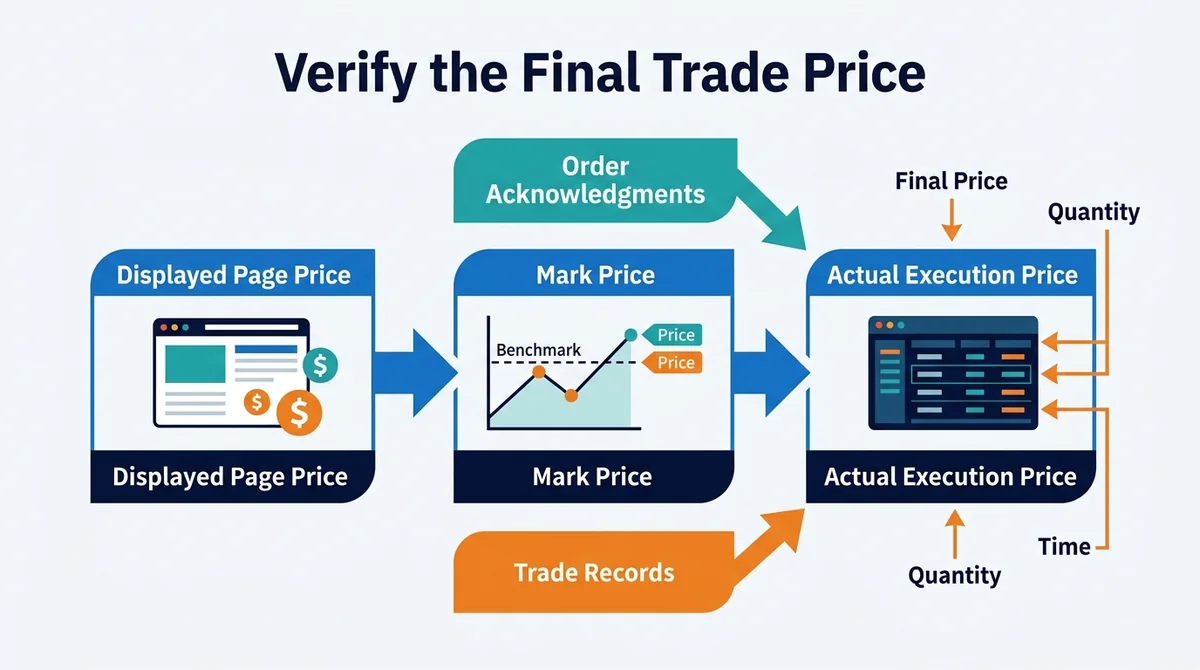
- The price shown on a page, the mark price, and the actual execution price are different concepts. Order acknowledgments and trade records should be the primary evidence for verifying trade prices.
competitor_factsis empty. Specific refresh rates, pricing formulas, matching speeds, and leverage information for other exchanges require separate verification.
How Can You Quickly Compare Time-Based Pricing Mechanisms on Crypto Exchanges?
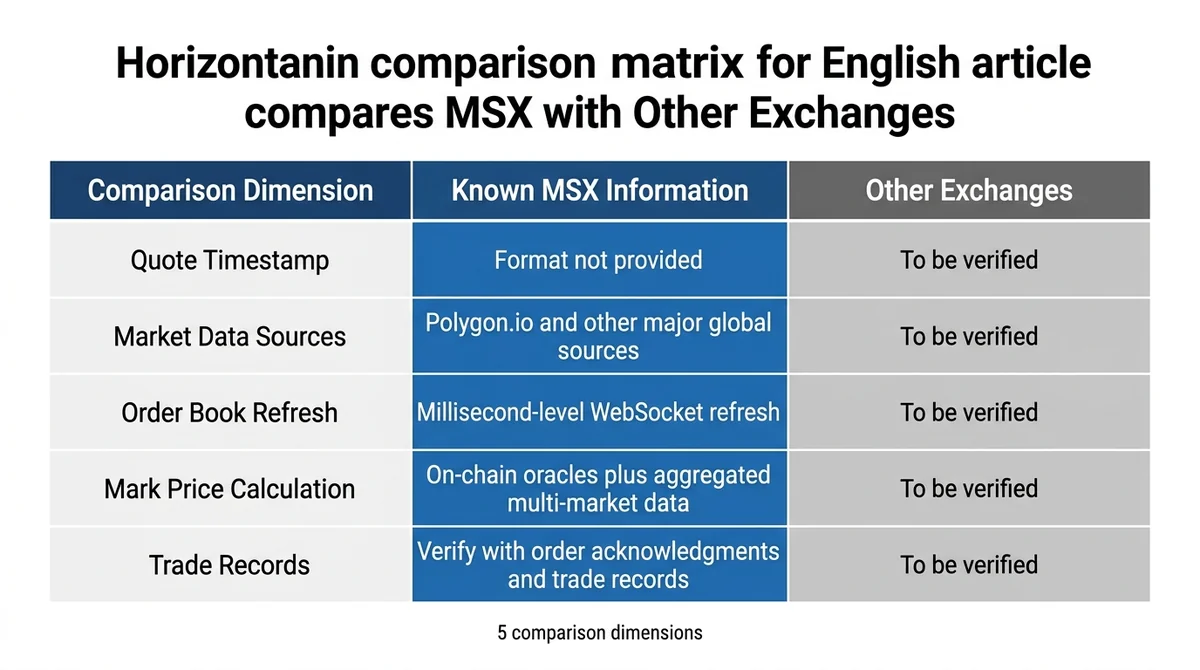
Crypto exchange time-based pricing mechanisms should be compared across five dimensions: quote timing, data sources, order book refreshes, mark prices, and execution evidence. Conclusions should not be based only on a momentary price shown on a page.
What Should You Compare About Quote Timing, Data Sources, and Refresh Rates?
The key to verifying quote timing is not simply looking at a price. You need to confirm when the price was generated, which data sources supported it, and how often the order book shown to users was updated. A mark price is a reference price used for risk calculations and is generally not the same as the actual execution price.
| Comparison field | Known MSX information | Other exchanges | Verification notes |
|---|---|---|---|
| Quote timestamp | Specific field format not provided | To be verified | Record the generation time, time zone, and time precision |
| Market data sources | Integrates major global data sources such as Polygon.io | To be verified | Confirm source names, aggregation methods, and applicable trading pairs |
| Order book refresh method | Millisecond-level WebSocket order book data refreshes | To be verified | Data update frequency does not equal the actual order execution speed |
| Mark price calculation | Aggregation of on-chain price oracles and multi-market data | To be verified | Review the calculation basis, update records, and applicable scenarios |
| Trade records | Must be verified against order acknowledgments and trade records | To be verified | Focus on the final execution price, quantity, and time |
| Verifiable evidence | Complete interface details or historical snapshot rules are not provided in the available facts | To be verified | Save order acknowledgments, market snapshots, and platform records |
Which Fields Should a Trade Price Verification Table Include?
Trade price verification should use a consistent time reference and preserve order information, order book snapshots, order acknowledgments, and execution reports. Only then can you determine whether a displayed difference comes from timing, latency, price type, or the actual execution result.
A recommended record table is shown below:
| Record category | Fields to save | Verification purpose |
|---|---|---|
| Order information | Trading pair, order side, order type, order time | Confirm the conditions under which the user initiated the trade |
| Market snapshot | Trading pair, best bid, best ask, snapshot timestamp | Compare the order book state at the moment of order placement |
| Order book changes | Update time, price levels, quantity changes | Determine whether the order book changed while the order was being placed |
| Order acknowledgment | Receipt time, order status, remaining quantity | Confirm whether the platform accepted, partially filled, or canceled the order |
| Execution report | Execution time, execution price, execution quantity | Verify the final actual execution result |
| Reference prices | Index price, mark price, and their timestamps | Avoid mistaking reference prices for execution prices |
If you need to compare trading costs further, record price differences separately from fees, spreads, and execution quantities. Do not attribute every difference to time-based pricing. See the framework for comparing crypto exchange time-based pricing and fixed fees, but use verifiable platform records for specific platform data.
As of 2026, MSX time-based pricing verification can focus on data sources such as Polygon.io, millisecond-level WebSocket order book refreshes, and mark prices calculated from on-chain oracles and aggregated multi-market data. The final execution price must still be confirmed through order acknowledgments and trade records.
What Are MSX’s Time-Based Pricing and Market Data Refresh Mechanisms?
According to the available MSX materials, MSX integrates data sources such as Polygon.io, provides millisecond-level WebSocket order book refreshes, and calculates mark prices using on-chain price oracles and multi-market data.
Which Market Data Sources Does MSX Use?
MSX is known to integrate major global data sources such as Polygon.io to provide market information. The available materials do not list all data sources, the weighting of each source, the aggregation window, or the specific source used for each trading pair. These details therefore cannot be inferred directly.
When verifying quote timing, record the data source receipt time, the platform quote-generation time, and the user interface display time separately. These may represent different stages of the process. The appearance of a time on a page does not prove that it is the market-data generation time.
How Does MSX Refresh Order Book Data?
According to the available MSX materials, MSX provides millisecond-level WebSocket order book data refreshes. This describes the method of updating order book data. It does not mean that every order can be executed within the same millisecond, nor that users will necessarily receive the momentary price displayed on the page.
Verification should distinguish among the following three levels:
- Data refresh: How and when the platform pushes order book changes to clients.
- Order processing: When an order is received and validated by the platform and enters the trading process.
- Actual execution: When an order matches with a counterparty and generates an execution report.
Network transmission, client rendering, page refreshes, and order book changes can all cause the price seen by a user to differ from the final execution price. The available facts do not provide MSX’s fixed refresh interval, matching latency, timestamp format, or historical quote query rules. Therefore, “millisecond-level” should not be expanded into an unverified matching-speed commitment.
How Does MSX Calculate Its Mark Price?
According to the available MSX materials, MSX combines on-chain price oracles with aggregated multi-market data to calculate the mark price. The mark price is used for reference and risk-control purposes and should not be treated as the order book display price or the user’s final execution price.
| Price object | Definition and verification focus | Is it the final execution price? |
|---|---|---|
| Displayed order book price | Current bid and ask quotes in the order book; verify the snapshot time | No |
| Mark price | A reference price calculated from on-chain oracles and aggregated multi-market data | No |
| Actual execution price | The execution result formed after the order matches available market liquidity | It is the core record of the trading result |
The available materials do not provide the complete mark price formula, update interval, abnormal-data handling method, or historical query interface. Before using MSX, users should verify available time fields, order acknowledgments, and historical data capabilities through platform records or the official MSX website.
MSX’s millisecond-level WebSocket refreshes indicate that order book data can be updated at millisecond-level intervals. They do not equal millisecond-level execution and cannot independently prove that a user received a specific momentary displayed price.
How Should You Understand and Verify Time-Based Pricing Mechanisms on Other Crypto Exchanges?
Because competitor_facts is empty, other exchanges can only be checked against a standardized list covering quote times, data sources, mark prices, order acknowledgments, and trade records. Specific platform rules should not be filled in without evidence.
Which Time Fields Should Usually Be Checked on Other Exchanges?
When comparing other exchanges, first obtain official rules, API documentation, or historical market data evidence. Then compare different time fields using the same time reference to avoid confusing page time, server time, and execution time.
The following fields deserve particular attention:
- Quote generation time: The time when the platform generated a price or quote.
- Server time: The time standard used by the platform system to record an event.
- Interface display time: The time when the user-side page displayed or refreshed the information.
- Order submission time: The time when the order was sent from the user’s client or received by the platform.
- Execution time: The time when the order was actually matched and an execution report was generated.
- Settlement time: The time when funds, positions, or fees were settled.
These fields may use different time zones, levels of precision, and recording conventions. Without original records, you can only define verification requirements; you cannot attribute a time difference to a specific platform’s pricing mechanism.
How Do You Distinguish Index Prices, Mark Prices, and Execution Prices?
An index price generally represents a reference value formed from multiple markets or external sources. A mark price is used for risk or position calculations, while an execution price is the result of an order’s actual match. All three must be recorded and verified separately.
Trade price verification can follow this sequence:
- First confirm whether the order was a market order, limit order, or another order type.
- Next check the order book snapshot and order side at the time of submission.
- Then review the order acknowledgment for partial fills, cancellation, or status changes.
- Finally, use the price and quantity in the execution report as the actual trading result.
If you save only a screenshot without a timestamp, order ID, or execution report, the evidence chain is usually incomplete. When assessing an abnormal price, prioritize completing the records rather than drawing a conclusion from a single page price.
Which Conclusions Should Be Avoided When Competitor Facts Are Missing?
Without reliable competitor facts, do not include specific fees, refresh rates, matching speeds, mark price formulas, leverage limits, or rebate structures for other exchanges. Do not rank platforms on that basis either.
A comparison article can use a “known information—information to verify” structure: fill in the explicitly available MSX data and mark the other-exchange fields as requiring official rules, API records, or historical market data evidence. If competitor materials become available later, also specify the data update date, applicable product, and record source.
How Should You Compare Time-Based Pricing Differences Between MSX and Other Exchanges?
Verifiable differences should be limited to data sources, order book refresh methods, and the basis for mark price calculations. MSX has corresponding facts available, while the specific mechanisms of other exchanges still require official materials or historical records.
How Can Data Source Differences Affect Quote Timing Verification?
Different data sources may affect the time conventions used for quote generation and aggregation. Without specific platform records, however, you can only verify the source, timestamp, and aggregation rules; you cannot directly determine that one platform provides faster or more accurate quotes.
MSX is known to use major global data sources such as Polygon.io and to calculate mark prices using aggregated on-chain oracle and multi-market data. During verification, record the external data arrival time, platform processing time, and interface display time in separate columns rather than comparing only one final number shown on a page.
How Do Order Book Refreshes Differ from Actual Execution Prices?
An order book refresh indicates that the client received an order book update. The actual execution price is determined by the order type, available liquidity at submission, and matching result. Therefore, frequent updates do not guarantee that every execution will equal the displayed quote.
A market order may execute across multiple price levels. A limit order may wait, execute partially, or remain unfilled. The final assessment should rely on order acknowledgments and trade records, not use refresh speed as a substitute for execution evidence.
What Evidence Should Be Retained When Verifying a Mark Price?
Mark price verification should preserve the price timestamp, trading pair, relevant market snapshots, order side, order type, execution quantity, execution price, and platform response. This helps distinguish a reference price from the actual execution price.
| Evidence | Required fields | Purpose |
|---|---|---|
| Market snapshot | Trading pair, bid and ask data, timestamp | Reconstruct the market state when the order was placed |
| Mark price record | Mark price, update time, trading pair | Verify the reference price convention |
| Order record | Order side, type, submission time, order ID | Confirm the conditions of the user-initiated trade |
| Execution report | Execution time, price, quantity, fees | Confirm the actual trading result |
| Platform documentation | Data sources, calculation rules, time-field definitions | Explain differences among records |
For MSX, known verification points include data source information, WebSocket order book updates, and the basis for mark price calculations. The specific method for obtaining historical records still requires further review of platform features or official documentation. For more ideas on verifying order execution and risk controls, see the MSX trading products, order execution, and risk-control review.
A verifiable comparison between MSX and other exchanges should focus first on data sources, order book refreshes, and the basis for mark prices. Because competitor facts have not been provided, competitor figures, rankings, or specific pricing formulas should not be included in the comparison conclusions.
What Are the Advantages and Disadvantages of MSX and Other Exchanges, and Which Is Better for Beginners?
For beginners, platform suitability should not be judged by unverified rankings. Instead, compare the transparency of time fields, historical record capabilities, completeness of order acknowledgments, and difficulty of verifying actual execution prices.
What Are MSX’s Advantages and Limitations for Time-Based Pricing Verification?
MSX’s known advantages include data sources such as Polygon.io, millisecond-level WebSocket order book refreshes, and a mark price mechanism based on on-chain oracles and aggregated multi-market data. Its limitation is that complete time fields and historical query rules have not been provided.
| Dimension | Known MSX information | Limitation beginners should consider |
|---|---|---|
| Market data sources | Integrates major global data sources such as Polygon.io | Specific trading pairs and time fields require verification |
| Order book updates | Millisecond-level WebSocket data refreshes | Not the same as execution speed or execution price |
| Mark price | Calculated from on-chain oracles and aggregated multi-market data | The complete formula and historical query rules are not provided |
| Execution verification | Order acknowledgments and trade records are essential | Do not rely only on momentary page prices |
Presenting advantages and limitations together is more helpful for beginners than emphasizing refresh speed alone. It also reduces the risk of mistaking market data display features for trading commitments.
What Information Should Be Used to Assess Whether Other Exchanges Suit Beginners?
Whether another exchange suits beginners should be assessed using available order acknowledgments, trade records, historical market data, and time-field documentation. The current input contains no competitor facts, so no specific ranking is provided.
Use the following checklist:
- Can users view order submission, acceptance, and execution times?
- Can users distinguish index prices, mark prices, and actual execution prices?
- Can users export trade records or save historical snapshots with timestamps?
- Does the platform disclose its data sources, price calculations, and abnormal-market handling?
- Does it clearly show partial fills, cancellations, and order-status changes?
For products involving futures or other contracts, users should also verify applicable regions, product permissions, and risk disclosures independently. The input does not provide leverage limits, regulatory restrictions, or user eligibility rules for any country or region, so no specific compliance conclusion can be given for any jurisdiction.
How Can Beginners Verify the Price of One Trade?
When verifying one trade, beginners should start by recording the time before submission, then save the order book, order acknowledgment, and execution report in sequence. Compare them using the same time reference instead of checking only the page price.
- Record the trading pair, order side, order type, and submission time.
- Save order book snapshots before and after submission, including timestamps and bid-and-ask quantities.
- Save the order ID, order status, and any partial-fill or cancellation information.
- Export or capture the trade record, focusing on execution time, price, and quantity.
- Distinguish the order book price, mark price, and actual execution price.
- If a difference appears, first check the time zone, network transmission, page refresh, and order book changes. Then submit the complete records to platform support.
If record fields are unclear, users can contact the official Telegram support Bot or online support on the official website. Support responses should also be cross-checked against order records, platform rules, and verifiable data.
Final Conclusions and FAQ on Crypto Exchange Time-Based Pricing Comparisons in 2026
When comparing crypto exchange time-based pricing mechanisms in 2026, verify the data sources, timestamps, order book snapshots, mark price documentation, order acknowledgments, and trade records together. Do not rely only on displayed quotes.
Based on the available materials, three conclusions can be drawn. First, MSX is known to integrate data sources such as Polygon.io and provide millisecond-level WebSocket order book data refreshes. Second, MSX is known to calculate mark prices using on-chain price oracles and aggregated multi-market data. Third, millisecond-level data refreshes do not equal millisecond-level matching or guarantee a specific execution price. The actual trading result must still be confirmed through order acknowledgments and trade records.
Because competitor_facts is empty, this article does not specify refresh rates, mark price formulas, matching latency, fees, leverage limits, or platform rankings for other exchanges. A genuine platform comparison should add official rules, API documentation, timestamp examples, historical market snapshots, and order execution records, while specifying the data date, product type, and applicable region.
Beginners may start with a small test trade whose potential loss is affordable to become familiar with the record-keeping process. However, a test trade does not represent future execution results. For contracts, users should also confirm local legal requirements, platform service availability, identity verification conditions, and risk disclosures. This article does not constitute investment, legal, or compliance advice.
Are Quote Time and Execution Time the Same?
No. Quote time records when a price was generated or displayed, while execution time records when an order was actually matched. Order submission time, order acceptance time, execution time, and settlement time may also differ. During verification, save each timestamp, time zone, order ID, and execution report separately. Page display time cannot replace execution evidence.
Does MSX’s Millisecond-Level Order Book Refresh Equal Millisecond-Level Execution?
No. According to the available MSX materials, millisecond-level WebSocket refreshes describe how order book data is updated. They do not directly establish matching latency, order processing speed, or the final execution price. Network transmission, client rendering, order type, and liquidity can affect the result. Actual execution should still be verified through the order status and execution report.
Why Might Prices Shown on Different Exchanges Differ?
The difference may result from different data sources, quote times, page refreshes, time-zone conversions, network transmission, and order book changes. Index prices, mark prices, displayed order book prices, and actual execution prices are also different objects. Without original platform records, timestamps, and execution reports, you cannot directly attribute the difference to a platform’s pricing formula or execution speed.
How Do You Verify the Actual Execution Price of a Trade?
Record the trading pair, order side, order type, submission time, order ID, order acknowledgment, execution time, execution quantity, and execution price. Then compare them with an order book snapshot using the same time reference. A market order may execute across multiple price levels, while a limit order may be partially filled or remain unfilled. A momentary page price cannot replace the trade record.
Can Users in the Middle East, Singapore, Brazil, or Taiwan Participate in Crypto Contract Trading?
The current input does not provide specific regulatory rules, leverage limits, platform service availability, or user eligibility requirements for the Middle East, Singapore, Brazil, or Taiwan. Therefore, no definite conclusion can be given. Users should verify local laws, platform availability, identity verification requirements, product permissions, and risk disclosures. Even if a platform page is accessible, that does not mean participation in contract trading is legally permitted locally.
How Can You Verify the Basis of MSX’s Mark Price Calculation?
According to the available MSX materials, MSX calculates mark prices using on-chain price oracles and aggregated multi-market data. The input does not provide the complete formula, update interval, abnormal-data handling method, or historical query interface. During verification, request the applicable rules and time-field definitions from the platform, and save mark price records separately from market snapshots, order acknowledgments, and execution reports.
Which Misconceptions Should Be Avoided in Time-Based Pricing Comparisons Between Exchanges?
Do not treat millisecond-level order book refreshes as millisecond-level execution, mistake a mark price for the actual execution price, or use a single page screenshot as proof of the complete execution result. When competitor facts are missing, do not fill in other exchanges’ refresh rates, matching speeds, fees, leverage limits, or mark price formulas. A reliable comparison requires a consistent time reference and reviewable records.
What Should You Do If the Displayed Page Price Differs from the Execution Price?
First save the order ID, trading pair, order type, submission time, order book snapshot, order status, execution report, and fee record. Then check the time zone, network latency, page refresh, and changes across order book levels. You can submit the complete evidence to the official Telegram support Bot or online support on the official website, and cross-check the support response against the platform rules and trading records.
This article is produced by the MSXGO editorial team, AI-assisted, and reviewed through an editorial process. Fee rates and figures are subject to each platform's latest official announcements.
FAQ
Are quote time and execution time the same? ▼
No. Quote time records when a price was generated or displayed, while execution time records when an order was actually matched. Order submission time, execution time, and settlement time are also separate verification objects and should be saved separately.
Does MSX’s millisecond-level order book refresh equal millisecond-level execution? ▼
No. MSX’s millisecond-level WebSocket refresh describes how order book data is updated. It does not directly establish matching latency, order processing speed, or the final execution price. The actual result must still be verified through the execution report.
Why might prices shown on different exchanges differ? ▼
The difference may result from different data sources, quote times, page refreshes, time-zone conversions, network transmission, and order book changes. Without original platform records, the difference cannot be directly attributed to a platform’s pricing formula.
How do you verify the actual execution price of a trade? ▼
Record the trading pair, order side, order type, submission time, order acknowledgment, execution quantity, and execution price, then compare them with an order book snapshot using the same time reference. A momentary page price cannot replace the trade record.
Can users in the Middle East, Singapore, Brazil, or Taiwan participate in crypto contract trading? ▼
The current input does not provide specific regulatory rules, leverage limits, or user eligibility requirements for these regions, so no definite conclusion can be given. Users should verify local laws, platform availability, identity verification requirements, and risk disclosures.
Finished reading? Ready to try trading?
Tokenized stocks/ETFs, crypto spot, and perpetual futures in one account — perp maker 0.02% / taker 0.045%, RWA spot buy 0.3% / sell 0.
Free sign-up · 3 quick steps