What's the Difference Between Spot Trading and Perpetual Futures? A Beginner's Guide
A clear breakdown of spot trading vs perpetual futures: long/short direction, perpetual futures leverage that magnifies gains and losses, risks, and how to combine both.
Article Citation Summary
A clear breakdown of spot trading vs perpetual futures: long/short direction, perpetual futures leverage that magnifies gains and losses, risks, and how to combine both.
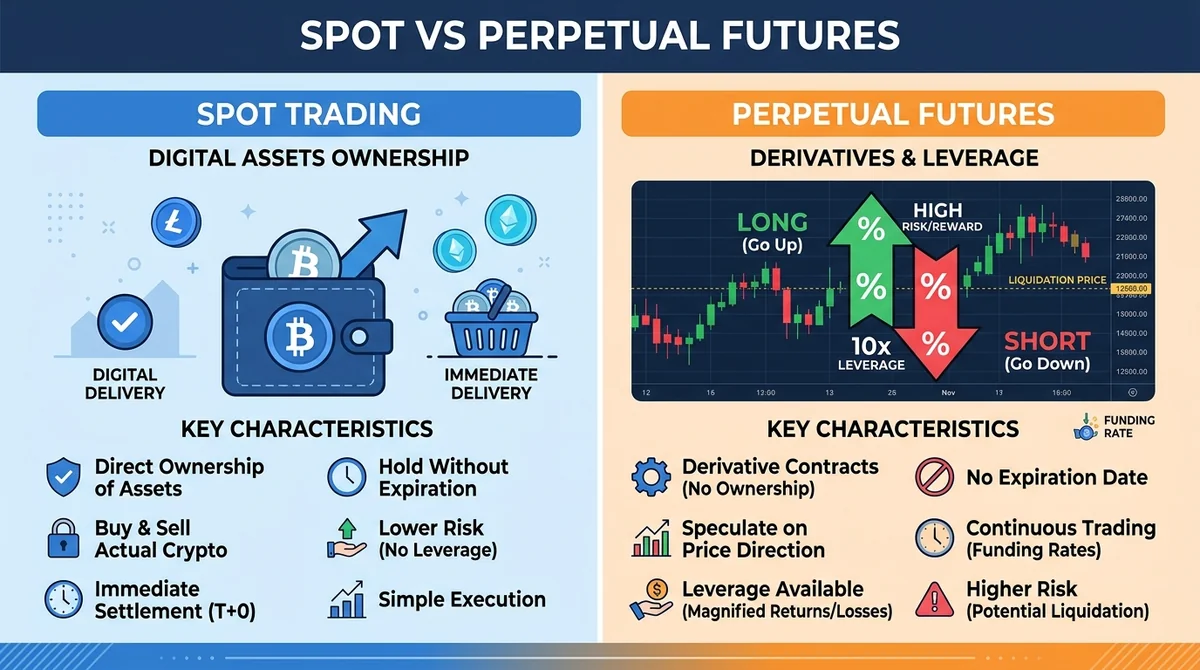
In crypto trading, spot trading and perpetual futures are the two most common ways to participate. The former means buying and holding an asset; the latter means trading the asset's price movements. Understanding how the two mechanisms differ is the first step every beginner must take before deciding which one to use.
What Is Spot Trading
If you have ever bought crypto and stored it in a wallet, you have already used spot trading. The core logic of spot trading is straightforward: you buy an asset at the current market price, ownership of the asset transfers to you, and you can hold it long term or sell it at some point in the future.
The characteristics of spot trading can be summarized as:
- The object of the trade is the asset itself; buying means holding;
- Profit and loss come from the asset's price rising or falling, with no directional betting instrument involved;
- No leverage is involved, so forced liquidation does not occur (aside from the risk of the price going to zero).
What Are Perpetual Futures
Perpetual futures work differently from spot. They do not involve buying and holding an asset; instead, you trade the asset's price movement—that is, you form a view on where the price is heading and open a position accordingly.
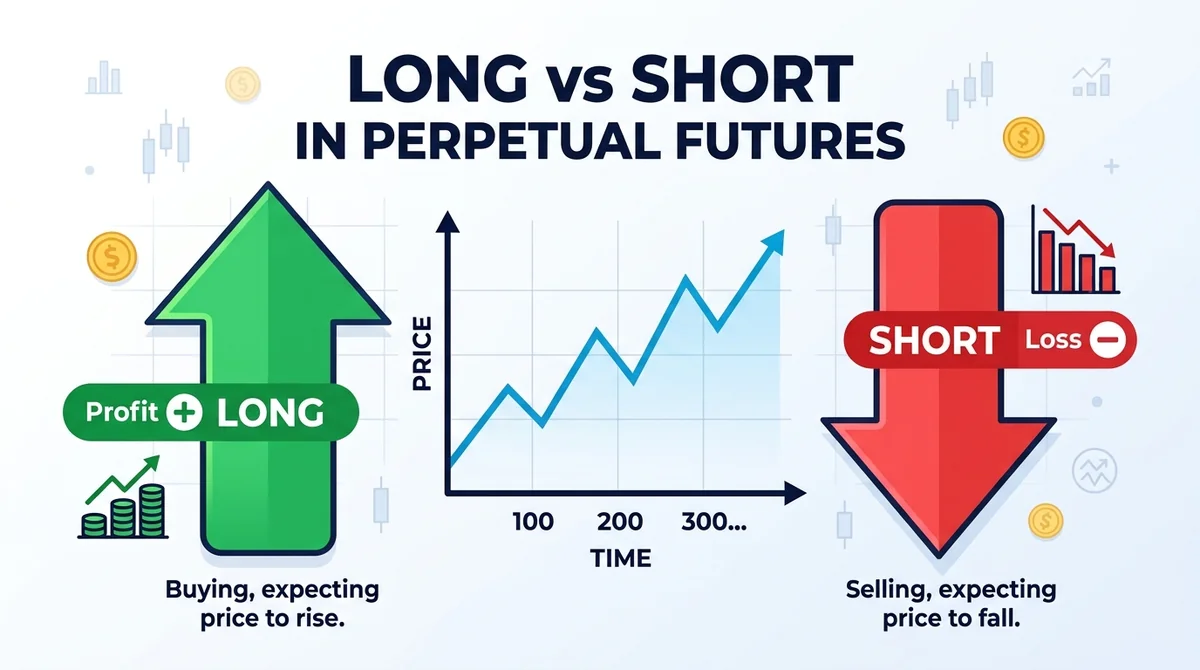
In perpetual futures, traders can choose two directions:
- Long: open a long position when you expect the price to rise;
- Short: open a short position when you expect the price to fall.
This means that whether the market goes up or down, there is potential for profit as long as your direction is correct; conversely, if your direction is wrong, you will incur a loss.
How Perpetual Futures Leverage Magnifies Gains and Losses
Perpetual futures typically let traders choose a leverage multiple. Leverage works by amplifying market exposure—that is, controlling a larger position size with a smaller amount of margin.
Leverage is a double-edged sword: while it magnifies potential gains, it magnifies potential losses by the same proportion. Therefore, fully understanding the risks that perpetual futures leverage brings is a necessary prerequisite before starting any form of futures trading. The relationship among position size, margin level, and market volatility directly determines an account's ability to withstand risk.
Key Differences Compared
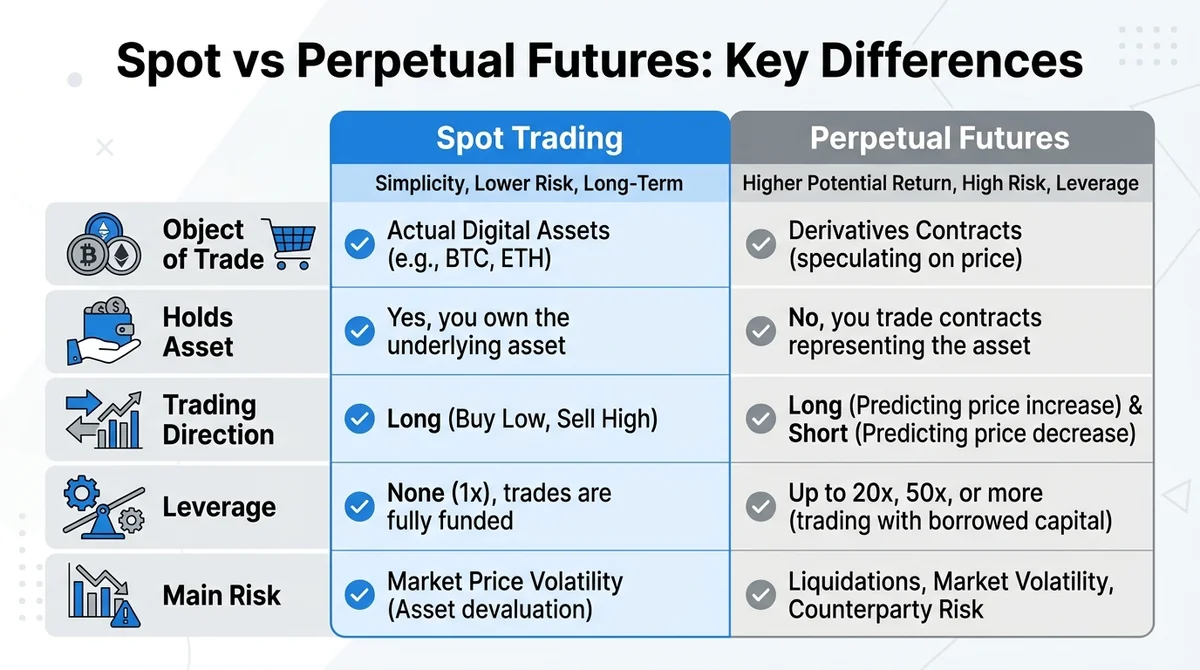
| Dimension | Spot Trading | Perpetual Futures |
|---|---|---|
| Object of trade | The asset itself | The asset's price movement |
| Holds the asset | Yes | No |
| Trading direction | Long only (buy first, sell later) | Can go long or short |
| Leverage | Not involved | Selectable multiple, magnifies gains and losses |
| Main risk | Price decline | Wrong direction combined with leverage magnifying losses |
How to Combine Spot and Perpetual Futures
For many traders, perpetual futures are not a substitute for spot investing but another tool that runs alongside spot. Each approach has its own use cases, and which one to choose depends on your personal investment goals and trading strategy:
- If you want to hold an asset long term and capture price appreciation, spot trading is the more direct approach;
- If you need to hedge position risk or act on short-term price direction, perpetual futures provide directional tools that spot does not offer;
- The two can also be used together, combined by traders according to their own risk preferences.
Risk Disclaimer
Whether you choose spot or perpetual futures, keep the following in mind:
- In futures trading, both gains and losses are magnified by leverage in equal measure—make sure you understand the risks before entering;
- Any trading decision should be based on your own research and does not constitute investment advice;
- Control your position size reasonably to avoid losses you cannot bear from a single misjudgment.
Spot trading and perpetual futures are not opposites but two tools serving different needs. Only by understanding how their mechanisms differ and what risks each carries can you make the right choice for your own goals.
This article is produced by the MSXGO editorial team, AI-assisted, and reviewed through an editorial process. Fee rates and figures are subject to each platform's latest official announcements.
Finished reading? Ready to try trading?
Tokenized stocks/ETFs, crypto spot, and perpetual futures in one account — perp maker 0.02% / taker 0.045%, RWA spot buy 0.3% / sell 0.
Free sign-up · 3 quick steps