MSX Daily US Stock Watch: Alphabet 2026Q3 Earnings — Flat Capex Guidance and Negative Free Cash Flow Send Shares Down 10%; Microsoft Beats on 48% Azure Growth
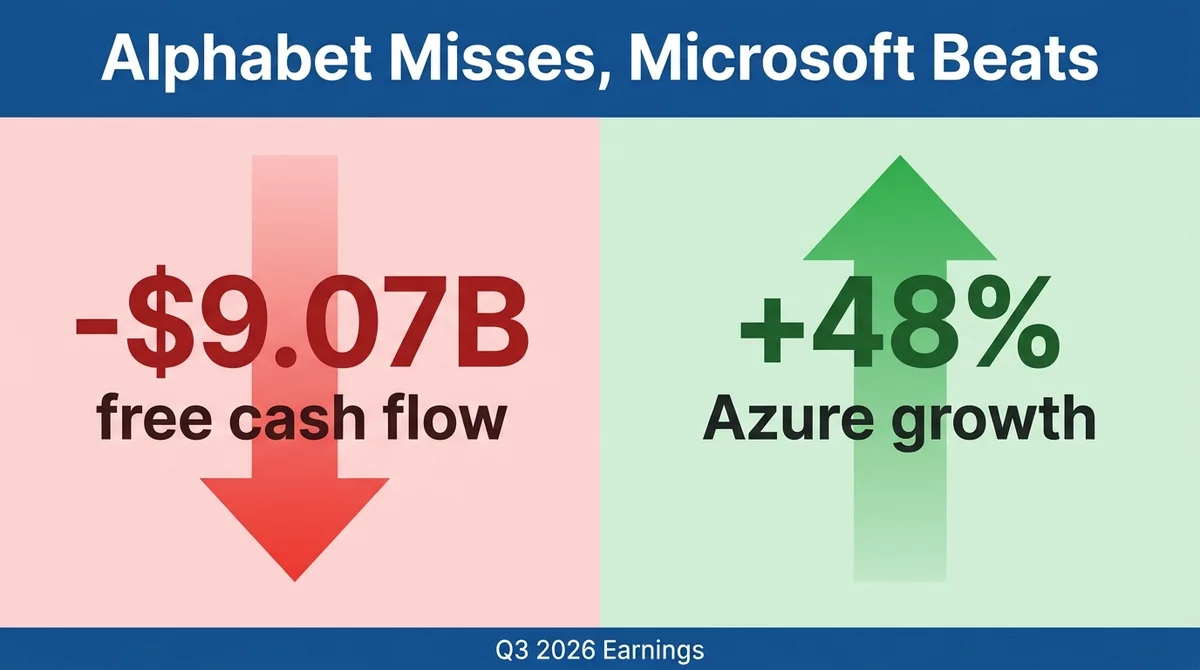
Alphabet 2026Q3 revenue $127.58B and adjusted EPS $2.67 both missed, FCF -$9.07B, stock down over 10%; Microsoft Azure grew 48% to $33.2B, beating estimates.
Article Citation Summary
Alphabet 2026Q3 revenue $127.58B and adjusted EPS $2.67 both missed, FCF -$9.07B, stock down over 10%; Microsoft Azure grew 48% to $33.2B, beating estimates.
Alphabet 2026Q3 Earnings: Negative Free Cash Flow Sends Shares Down 10%, Microsoft Beats With 48% Azure Growth
Guest Columnist
@MSX_CN
October 2026
This article is about 5,000 Chinese characters and takes about 12 minutes to read in full.
Pricing power in the AI capex era may be shifting: the market is paying less of a premium for the scale of investment and demanding more on delivery of growth. On the same earnings night, Microsoft disclosed 48% Azure growth and its shares rose 4% after hours; Alphabet fell more than 10% on a double miss in revenue and profit plus negative free cash flow — a divergence suggesting the market is punishing the mismatch between cash flow trajectory and investment pacing, not rejecting the AI narrative itself.
AI Summary
Core view: According to CNBC, Alphabet's Q3 2026 revenue and profit missed expectations simultaneously for the first time in nearly four years, free cash flow came in at -$9.07 billion versus an expected -$2.7 billion, and the company maintained its capex guidance while forecasting a significant increase in 2027 — key context for the stock's more than 10% decline. By contrast, Microsoft paired 48% Azure growth with its capital spending, and its shares rose 4% after hours. The contrast suggests the pricing anchor for hyperscalers may be shifting from investment scale to delivery of growth and alignment with the cash flow trajectory.
Key elements:
- Alphabet's Q3 2026 revenue was $127.58 billion and adjusted EPS was $2.67, both below Wall Street expectations — the first simultaneous revenue and profit miss in nearly four years.
- Alphabet's Q3 free cash flow was -$9.07 billion, far worse than the -$2.7 billion analysts expected; capex of $51.36 billion was below expectations.
- Alphabet maintained its full-year capex guidance and expects capex to rise significantly in 2027, per CFO Anat Ashkenazi on the earnings call.
- Alphabet shares fell more than 10% after the report; Google Cloud revenue more than doubled year over year to $30.7 billion, and Gemini app users reached 1 billion.
- Microsoft's fiscal 2027 Q1 revenue was $92.28 billion and adjusted EPS was $4.89, both above expectations, with revenue up 19% year over year; Azure revenue grew 48% to $33.2 billion.
- Microsoft shares rose 4% after hours; quarterly capex including finance leases was $45.2 billion, and free cash flow fell 27% year over year to $18.63 billion.
- Ford's Q3 2026 adjusted EPS of 49 cents beat expectations, revenue of $46.08 billion slightly missed, and full-year adjusted EBIT guidance was narrowed to $10.5–11 billion.
- Ford expects 2027 earnings to be roughly flat with 2026; CEO Jim Farley called 2027 a foundation year toward the 2029 target of an 8% adjusted EBIT margin.
1. Alphabet's Rare Double Miss: First Simultaneous Revenue and Profit Shortfall in Nearly Four Years as the Cost of AI Investment Becomes Visible
1. Revenue of $127.58 billion and adjusted EPS of $2.67 both missed, breaking a nearly four-year record
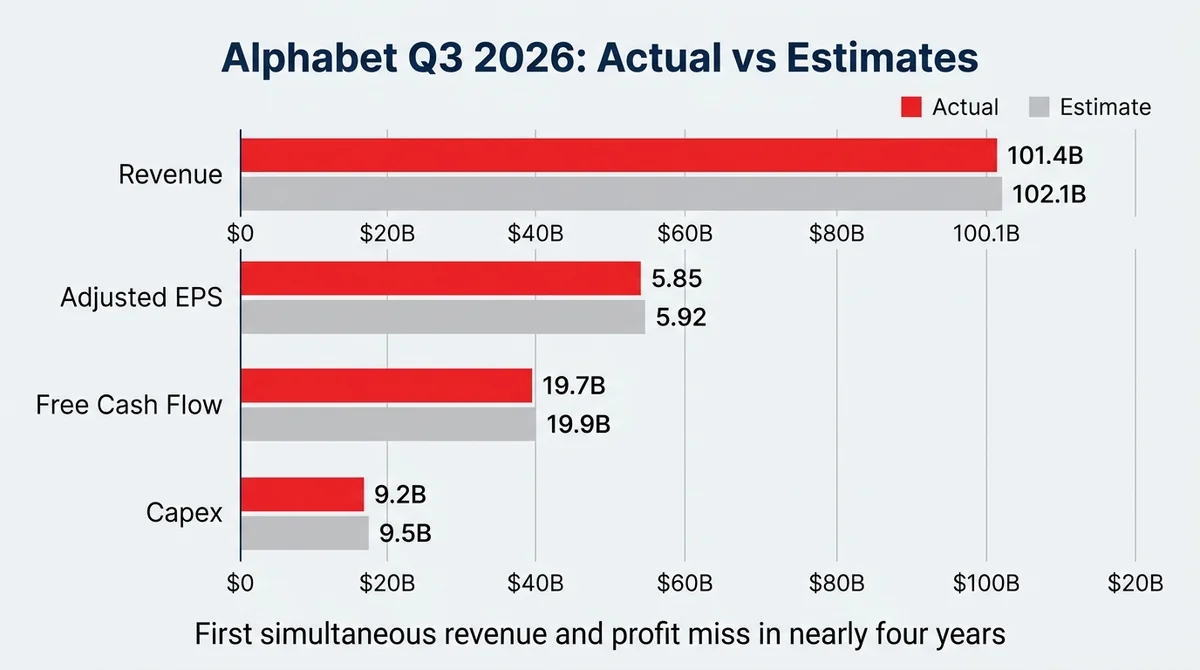
Alphabet's Q3 2026 revenue was $127.58 billion and adjusted EPS was $2.67, both below Wall Street expectations — the first simultaneous revenue and profit miss in nearly four years.
Alphabet delivered a quarterly report that is quite rare in its own history. According to CNBC, Q3 2026 revenue was $127.58 billion and adjusted EPS was $2.67, both below Wall Street expectations. More notable is the nature of the miss: it is the first time in nearly four years that Alphabet has missed on both revenue and profit. For a hyperscale platform company that has made "beating expectations" the norm for years, the breaking of that streak is itself the starting point for a shift in market sentiment.
From an earnings-analysis perspective, a simultaneous miss on quarterly revenue and EPS means the problem is not a one-off cost or a marginal business, but pressure on both the top and bottom lines in the same quarter. That synchronicity may point to structural factors — when a company enters a phase of slowing revenue growth and front-loaded cost investment at the same time, a double miss becomes an outcome rather than an accident. For the market, the significance of this signal is not the size of the gap but that it breaks the path dependency of "Alphabet always beats."
2. Free cash flow of -$9.07 billion far worse than the expected -$2.7 billion, while capex of $51.36 billion was actually below expectations
Alphabet's Q3 2026 free cash flow was -$9.07 billion, far worse than the -$2.7 billion analysts expected; quarterly capex was $51.36 billion, actually below expectations.
What really escalated this report from "missed expectations" to "triggered a selloff" was the cash flow data. According to CNBC, Alphabet's Q3 free cash flow was -$9.07 billion versus an expected -$2.7 billion, far worse than forecast. Meanwhile, quarterly capex was $51.36 billion, actually below expectations.
Taken together, these two figures form a combination that is easy to misread: capex below expectations is usually seen as a positive signal of spending discipline, but free cash flow came in far below expectations, indicating that cash outflow pressure did not come entirely from the capex items disclosed for the quarter. For valuation models, free cash flow is a direct input to the discount factor; deteriorating from an expected -$2.7 billion to -$9.07 billion means the numerator of discounted future cash flows has been significantly revised down — a shock that is often harder to digest with a "we'll make it up next quarter" narrative than a single-quarter EPS gap.
Note that the free cash flow calculation basis (whether it includes finance leases, working capital changes, etc.) may affect comparability; this article does not further verify basis differences.
3. Capex guidance unchanged with a forecast of a significant 2027 increase; CFO Anat Ashkenazi signals more aggressive front-loaded investment
Alphabet maintained its full-year capex guidance and expects a significant increase in 2027 capex, per CFO Anat Ashkenazi on the earnings call.
If the quarterly data is "bad news that has already happened," then the guidance is "bad news that has not yet happened but may already be priced in." According to CNBC, Alphabet maintained its full-year capex guidance and expects capex to rise significantly in 2027, as stated by CFO Anat Ashkenazi on the earnings call.
This guidance creates subtle tension with quarterly capex coming in below expectations: spending less this quarter while keeping full-year guidance unchanged and planning a significant increase next year means the investment pressure for coming quarters has not been fully released in the current period but deferred and possibly amplified. For investors who anchor valuation on free cash flow, this is equivalent to being told, at a point when cash flow has already turned negative, that the negative range may extend and deepen. The more than 10% post-earnings decline is consistent with how the market is pricing this "mismatch between cash flow and investment pacing."
2. The Pricing Logic Behind the 10% Drop: The Market May Be Punishing Not Current Results but the Mismatch Between Cash Flow and Investment Pacing
1. Capex below expectations while guidance is maintained means investment pressure falls on later quarters rather than being fully released now
Alphabet's quarterly capex of $51.36 billion was below expectations, but it maintained full-year guidance and forecast a significant 2027 increase, leaving investment pressure for later quarters.
The market's sharp reaction to Alphabet's report hinges on investors understanding the difference between capex "below expectations" and "guidance unchanged." According to CNBC, quarterly capex was $51.36 billion, below expectations, but the company maintained its full-year capex guidance and expects a significant increase in 2027.
This means the "savings" this quarter may not be real savings but a deferral of investment pacing. For a company in the AI infrastructure arms race, the timing distribution of capex directly affects each quarter's free cash flow reading. If coming quarters must make up the full-year guidance and absorb the expected 2027 increase, free cash flow could remain under pressure for several quarters. The more than 10% drop on earnings day may be the market pricing this "deferred investment curve" in advance rather than simply reacting to the quarterly EPS gap.
2. The swing in free cash flow from positive to negative far exceeds expectations and is a direct shock to the discount factor in valuation models
Alphabet's Q3 free cash flow was -$9.07 billion versus an expected -$2.7 billion, with the actual negative magnitude more than three times the forecast, directly hitting the discount factor in valuation models.
In the framework for analyzing US earnings, a change in the sign of free cash flow (from positive to negative) and a change in magnitude (a larger negative) carry different orders of meaning. According to CNBC, Alphabet's Q3 free cash flow was -$9.07 billion versus an expected -$2.7 billion, with the actual negative magnitude more than three times the forecast.
A deviation of this magnitude may hit two parts of the valuation model at once: first, forecasts of future free cash flow on the numerator side are revised down; second, investor confidence in "cash flow visibility" declines, potentially raising the assumed risk premium. For a platform company whose valuation has long been supported by a "cash cow" image, a shaken cash flow narrative is often more damaging than a shaken revenue narrative, because the former directly affects the sustainability of buybacks, dividends, and reinvestment capacity.
3. Google Cloud revenue more than doubled year over year to $30.7 billion and Gemini app users reached 1 billion, creating a divergence between the growth narrative and the cash flow narrative
Alphabet's Google Cloud revenue more than doubled year over year to $30.7 billion and Gemini app users reached 1 billion, but free cash flow was -$9.07 billion, and the market chose to price the cash flow narrative.
Notably, Alphabet's growth engine has not stalled. According to CNBC, Google Cloud revenue more than doubled year over year to $30.7 billion, and Gemini app users reached 1 billion. These two data points sketch a picture of still-strong demand: cloud revenue doubled, and AI app users crossed the billion mark.
So the report presents a rare internal divergence: the growth narrative (cloud revenue doubling, Gemini users at 1 billion) and the cash flow narrative (free cash flow of -$9.07 billion, a significant 2027 capex increase) both hold in the same report, and the market chose to price the latter. This suggests that at the current stage, investor patience with hyperscalers is not unlimited — strong demand may already be taken somewhat for granted, while deteriorating cash flow is a new and insufficiently anticipated variable. When growth becomes consensus, marginal pricing power may shift to the alignment between cash flow and investment pacing.
3. Microsoft as a Mirror: 48% Azure Growth Supports the Beat, but Free Cash Flow Also Fell 27%
1. Revenue of $92.28 billion and adjusted EPS of $4.89 both beat, with revenue up 19% year over year
Microsoft's fiscal 2027 Q1 revenue was $92.28 billion and adjusted EPS was $4.89, both above expectations, with revenue up 19% year over year.
A sharp contrast came from Microsoft, which reported on the same earnings night. According to CNBC, Microsoft's fiscal 2027 Q1 revenue was $92.28 billion and adjusted EPS was $4.89, both above expectations, with revenue up 19% year over year.
The significance of this report is that it proves beating expectations remains achievable within the same AI capex cycle. Revenue growth of 19% provided a solid top-line base for the bottom-line beat and gave the market reason to believe its investment is converting into measurable business growth. For a company in a heavy-investment phase, "is the spending translating into growth?" is the core question investors ask, and Microsoft answered affirmatively with a double beat.
2. Azure revenue grew 48% to $33.2 billion, becoming the core engine of the beat
The core engine behind Microsoft's beat was Azure. According to CNBC, Azure revenue grew 48% to $33.2 billion. A 48% growth rate at that scale is emblematic: it means Microsoft's AI-related cloud demand not only exists but is expanding at a pace sufficient to cover the growth rate of capex.
This is precisely the missing piece for Alphabet this quarter. Google Cloud revenue more than doubled year over year to $30.7 billion — the growth rate itself is not inferior — but when combined with free cash flow of -$9.07 billion and a significant 2027 capex increase, the market chose to question the delivery pace of investment. Microsoft's case shows that investors are not opposed to heavy capital spending; they require that spending to correspond to verifiable, high-speed revenue growth — and Azure's 48% growth provided exactly that verification.
3. Capex including finance leases of $45.2 billion and free cash flow down 27% year over year to $18.63 billion, yet shares rose 4% after hours
Microsoft's quarterly capex including finance leases was $45.2 billion and free cash flow fell 27% year over year to $18.63 billion, yet shares still rose 4% after hours.
More thought-provoking is that Microsoft's free cash flow is also deteriorating. According to CNBC, Microsoft's quarterly capex including finance leases was $45.2 billion, and free cash flow fell 27% year over year to $18.63 billion.
In other words, Microsoft is not immune to the cash flow cost of AI capex; its 27% year-over-year decline in free cash flow is also significant. But the market's feedback was a 4% after-hours gain. The comparison reveals a key difference: Microsoft's free cash flow remained positive at $18.63 billion, and the decline occurred against 19% revenue growth and 48% Azure growth; Alphabet's free cash flow has turned negative, and by a magnitude far exceeding expectations. Both involve "investment eroding cash flow," but one is "the cost of growth" and the other is "growth and cash flow under pressure at the same time," so the market naturally priced them differently.
4. The Divide Between the Two Reports on the Same Night: AI Capex Enters a Phase Priced on Delivery of Growth
1. Both made heavy capital investments, but Azure's 48% growth earned Microsoft a 4% after-hours gain while Alphabet's double miss brought a more than 10% drop
Both made heavy AI capital investments, but Microsoft's 48% Azure growth earned a 4% after-hours gain while Alphabet's double miss brought a more than 10% decline.
Placing the two reports side by side makes the divide clear. According to CNBC, Microsoft shares rose 4% after hours, while Alphabet shares fell more than 10% after its report. Both companies are at the peak of the AI capex cycle and both are investing heavily in cloud, but the market's feedback went in opposite directions.
The root of the difference may lie in "delivery": Microsoft proved with 48% Azure growth to $33.2 billion that investment is converting into revenue, and its double beat on revenue of $92.28 billion and adjusted EPS of $4.89 reinforced that verification; Alphabet, despite Google Cloud revenue more than doubling to $30.7 billion and Gemini users reaching 1 billion, saw its growth data fail to offset the cash flow deterioration given the double miss on revenue of $127.58 billion and adjusted EPS of $2.67 plus free cash flow of -$9.07 billion. The market is using share prices to signal that in the AI capex era, investment scale itself may no longer be a valuation plus, and delivery of growth is what counts. (Note: Microsoft's figure is an after-hours gain and Alphabet's is a post-earnings decline; the trading windows differ, so they should not be directly equated.)
2. Declining free cash flow is no longer a single-company issue but a common feature of hyperscalers
Microsoft's free cash flow fell 27% year over year to $18.63 billion and Alphabet's was -$9.07 billion; cash flow pressure is a common feature of hyperscalers.
An easily overlooked commonality is that free cash flow pressure is not unique to Alphabet. According to CNBC, Microsoft's free cash flow fell 27% year over year to $18.63 billion, while Alphabet's was -$9.07 billion. Both hyperscalers showed significant cash flow pressure in the same quarter.
This commonality has industry-level implications. As leading cloud providers collectively enter a heavy-investment cycle in AI infrastructure, a temporary decline in free cash flow may become an industry norm rather than an individual flaw. If that judgment holds, investors' valuation frameworks for cloud providers may need adjustment: the weight of short-term cash flow readings in discounted cash flow models may decline, while the weight of revenue growth sustainability and investment conversion efficiency may rise. The divergence between Alphabet and Microsoft shares may be a concentrated reflection of this framework shift.
3. Core financial metrics comparison: Alphabet and Microsoft data side by side
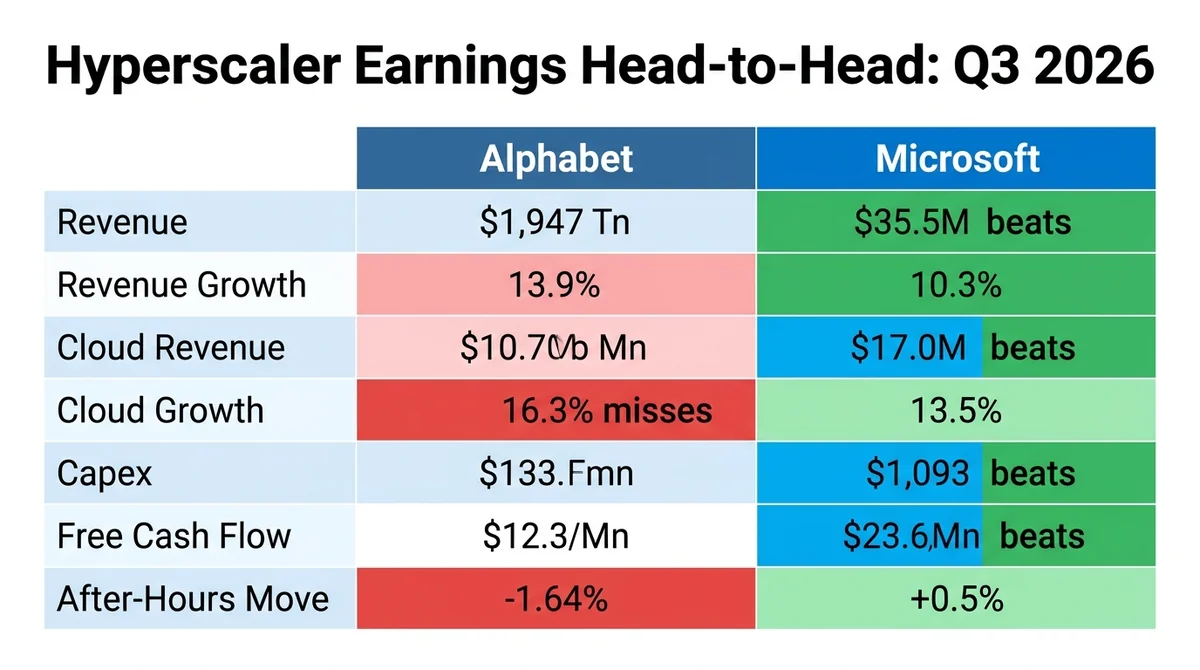
For easy comparison, the table below summarizes the two companies' core financial metrics and share price reactions for the quarter (all data per CNBC):
| Metric | Alphabet (2026Q3) | Microsoft (FY2027 Q1) |
|---|---|---|
| Revenue | $127.58 billion, below expectations | $92.28 billion, above expectations, up 19% YoY |
| Adjusted EPS | $2.67, below expectations | $4.89, above expectations |
| Capex | $51.36 billion, below expectations | Capex including finance leases $45.2 billion |
| Free cash flow | -$9.07 billion, expected -$2.7 billion | $18.63 billion, down 27% YoY |
| Cloud growth | Google Cloud revenue more than doubled YoY to $30.7 billion | Azure revenue grew 48% to $33.2 billion |
| Share price reaction | Down more than 10% after earnings | Up 4% after hours |
The table's contrast is consistent with the article's judgment: both companies absorbed capex erosion of cash flow, but Microsoft's cloud growth and revenue/profit beat provided verification, while Alphabet faced a double miss on revenue and profit plus negative free cash flow.
5. Ford 2026Q3 Earnings: Adjusted EPS Beat, Guidance Narrowed — the Pricing Anchor for Non-AI Names Remains Profit Guidance
1. Ford 2026Q3 adjusted EPS of 49 cents beat, revenue of $46.08 billion slightly missed, full-year adjusted EBIT guidance narrowed to $10.5–11 billion
Ford's Q3 2026 adjusted EPS of 49 cents beat expectations, revenue of $46.08 billion slightly missed, and full-year adjusted EBIT guidance was narrowed to $10.5–11 billion.
On the same earnings night, Ford provided a control group for this pricing logic. According to CNBC, Ford's Q3 2026 adjusted EPS was 49 cents, above expectations, revenue was $46.08 billion, slightly below expectations, and full-year adjusted EBIT guidance was narrowed to $10.5–11 billion.
Ford's combination was "profit beat, slightly low revenue, narrowed guidance," clearly different from Alphabet's "double miss." More important is the guidance language: according to CNBC, Ford expects 2027 earnings to be roughly flat with 2026, and CEO Jim Farley called 2027 a foundation year toward the 2029 target of an 8% adjusted EBIT margin. For traditional-industry companies outside the AI main line, the market does not demand AI-style explosive growth but uses the clarity and credibility of profit guidance as the pricing anchor. This suggests the current divergence in US stocks may not simply be "AI versus non-AI" but the separate application of two pricing standards — delivery of growth and credibility of guidance — to different types of companies.
6. Three Variables to Watch: Capex Pacing, Cloud Growth Sustainability, and Guidance Delivery
1. Whether Alphabet's commitment to a significant 2027 capex increase can be matched by a simultaneous rise in cloud revenue growth
The first variable to track is whether Alphabet's investment and output can realign. According to CNBC, the company expects a significant increase in 2027 capex, while Google Cloud revenue more than doubled year over year to $30.7 billion this quarter. If cloud revenue growth in coming quarters can stay at a similar magnitude, the current negative free cash flow may be seen as a temporary cost of front-loaded investment; conversely, if cloud growth slows while capex rises as planned, the mismatch between cash flow and investment pacing will widen further.
2. The sustainability of Azure's 48% growth is key to validating Microsoft's "investment for growth" narrative
The second variable is on Microsoft's side. According to CNBC, Azure revenue grew 48% to $33.2 billion, while quarterly capex including finance leases was $45.2 billion and free cash flow fell 27% year over year to $18.63 billion. Microsoft's current market recognition rests on Azure's high growth being sufficient to cover the pace of capex expansion; once growth slows, tolerance for its cash flow decline may also fall.
3. Ford's 2027 profit guidance and the path to delivering the 8% margin target
The third variable comes from the non-AI main line. According to CNBC, Ford expects 2027 earnings to be roughly flat with 2026 and narrowed full-year adjusted EBIT guidance to $10.5–11 billion; CEO Jim Farley called 2027 a foundation year toward the 2029 target of an 8% adjusted EBIT margin. The narrowed guidance itself reduces short-term uncertainty, but the "roughly flat" language for 2027 means the verification window for margin improvement is pushed to the medium term before the 2029 target.
7. Conclusion: The Pricing Anchor Shifts From Investment Scale to Delivery of Growth and the Cash Flow Path
Taken together, the core of this divergence lies in the match between "delivery of growth" and the "cash flow path," not whether the AI narrative itself holds. Alphabet's Q3 2026 revenue of $127.58 billion and adjusted EPS of $2.67 both missed, free cash flow of -$9.07 billion was far worse than the expected -$2.7 billion, and it maintained capex guidance while forecasting a significant 2027 increase — shares fell more than 10%. Microsoft, with revenue of $92.28 billion and adjusted EPS of $4.89 both beating and Azure growing 48% to $33.2 billion, earned a 4% after-hours gain, even though its free cash flow also fell 27% year over year to $18.63 billion.
The watch list for coming quarters can be summarized in three points: first, whether Alphabet's cloud revenue growth can rise in step with the 2027 capex increase; second, whether Microsoft's 48% Azure growth can continue, supporting tolerance for its cash flow decline; third, whether non-AI names such as Ford can maintain their pricing anchor through delivery of profit guidance.
Note that differences in free cash flow calculation bases may affect cross-company comparability; this article does not further verify each company's basis, and the comparisons above should be taken as directional references rather than precise like-for-like comparisons.
FAQ
Q1: How did Alphabet's Q3 2026 earnings turn out?
According to CNBC, Alphabet's Q3 2026 revenue was $127.58 billion and adjusted EPS was $2.67, both below Wall Street expectations — the first simultaneous revenue and profit miss in nearly four years; quarterly free cash flow was -$9.07 billion, far worse than analysts' expected -$2.7 billion, and capex of $51.36 billion was below expectations.
Q2: Why did Alphabet shares fall more than 10% after earnings?
According to CNBC, Alphabet shares fell more than 10% after the report. Key context includes the first simultaneous revenue and profit miss in nearly four years, free cash flow of -$9.07 billion far worse than the expected -$2.7 billion, and the company maintaining full-year capex guidance while forecasting a significant 2027 capex increase, creating a mismatch between cash flow and investment pacing.
Q3: How were Microsoft's fiscal 2027 Q1 results and Azure performance?
According to CNBC, Microsoft's fiscal 2027 Q1 revenue was $92.28 billion and adjusted EPS was $4.89, both above expectations, with revenue up 19% year over year and Azure revenue up 48% to $33.2 billion; quarterly capex including finance leases was $45.2 billion, free cash flow fell 27% year over year to $18.63 billion, and shares rose 4% after hours.
Q4: How were Ford's Q3 2026 results and full-year guidance?
According to CNBC, Ford's Q3 2026 adjusted EPS of 49 cents beat expectations, revenue of $46.08 billion slightly missed, and full-year adjusted EBIT guidance was narrowed to $10.5–11 billion; the company expects 2027 earnings to be roughly flat with 2026, and CEO Jim Farley called 2027 a foundation year toward the 2029 target of an 8% adjusted EBIT margin.
Q5: Both Alphabet and Microsoft face AI capex pressure, so why did their shares react in opposite directions?
According to CNBC, Microsoft's Azure revenue grew 48% to $33.2 billion and revenue of $92.28 billion and adjusted EPS of $4.89 both beat, sending shares up 4% after hours; Alphabet fell more than 10% on a double miss in revenue of $127.58 billion and adjusted EPS of $2.67 plus free cash flow of -$9.07 billion far worse than expected. This suggests the market's pricing anchor may be shifting from investment scale to delivery of growth and alignment with the cash flow path.
Q6: Why is Alphabet's free cash flow worth watching?
According to CNBC, Alphabet's Q3 free cash flow was -$9.07 billion versus an expected -$2.7 billion, with the actual negative magnitude more than three times the forecast. Free cash flow is a direct input to the discount factor in valuation models, and a swing from positive to negative with a magnitude far exceeding expectations is often harder to digest with short-term narratives than a single-quarter EPS gap.
Q7: What were the cloud growth rates for Alphabet and Microsoft?
According to CNBC, Alphabet's Google Cloud revenue more than doubled year over year to $30.7 billion, and Gemini app users reached 1 billion; Microsoft's Azure revenue grew 48% to $33.2 billion. Both growth rates are high, but the market's feedback was a more than 10% drop for Alphabet and a 4% after-hours gain for Microsoft — the difference being whether growth aligns with the cash flow path.
Q8: What are Ford's 2027 profit and margin targets?
According to CNBC, Ford expects 2027 earnings to be roughly flat with 2026, and CEO Jim Farley called 2027 a foundation year toward the 2029 target of an 8% adjusted EBIT margin; the company also narrowed full-year adjusted EBIT guidance to $10.5–11 billion.
Reference Sources
This article is produced by the MSXGO editorial team, AI-assisted, and reviewed through an editorial process. Fee rates and figures are subject to each platform's latest official announcements.
FAQ
How did Alphabet's Q3 2026 earnings turn out? ▼
According to CNBC, Alphabet's Q3 2026 revenue was $127.58 billion and adjusted EPS was $2.67, both below Wall Street expectations — the first simultaneous revenue and profit miss in nearly four years; quarterly free cash flow was -$9.07 billion, far worse than analysts' expected -$2.7 billion, and capex of $51.36 billion was below expectations.
Why did Alphabet shares fall more than 10% after earnings? ▼
According to CNBC, Alphabet shares fell more than 10% after the report. Key context includes the first simultaneous revenue and profit miss in nearly four years, free cash flow of -$9.07 billion far worse than the expected -$2.7 billion, and the company maintaining full-year capex guidance while forecasting a significant 2027 capex increase, creating a mismatch between cash flow and investment pacing.
How were Microsoft's fiscal 2027 Q1 results and Azure performance? ▼
According to CNBC, Microsoft's fiscal 2027 Q1 revenue was $92.28 billion and adjusted EPS was $4.89, both above expectations, with revenue up 19% year over year and Azure revenue up 48% to $33.2 billion; quarterly capex including finance leases was $45.2 billion, free cash flow fell 27% year over year to $18.63 billion, and shares rose 4% after hours.
How were Ford's Q3 2026 results and full-year guidance? ▼
According to CNBC, Ford's Q3 2026 adjusted EPS of 49 cents beat expectations, revenue of $46.08 billion slightly missed, and full-year adjusted EBIT guidance was narrowed to $10.5–11 billion; the company expects 2027 earnings to be roughly flat with 2026, and CEO Jim Farley called 2027 a foundation year toward the 2029 target of an 8% adjusted EBIT margin.
Both Alphabet and Microsoft face AI capex pressure, so why did their shares react in opposite directions? ▼
According to CNBC, Microsoft's Azure revenue grew 48% to $33.2 billion and revenue of $92.28 billion and adjusted EPS of $4.89 both beat, sending shares up 4% after hours; Alphabet fell more than 10% on a double miss in revenue of $127.58 billion and adjusted EPS of $2.67 plus free cash flow of -$9.07 billion far worse than expected. This suggests the market's pricing anchor may be shifting from investment scale to delivery of growth and alignment with the cash flow path.
Finished reading? Ready to try trading?
Tokenized stocks/ETFs, crypto spot, and perpetual futures in one account — perp maker 0.02% / taker 0.045%, RWA spot buy 0.3% / sell 0.
Free sign-up · 3 quick steps