MSX US Stock Daily Watch: Tesla-SpaceX Merger Rumor at $3.7 Trillion Valuation—Synergy Doubts and Governance Concentration Risk; IBB Biotech Up 24% YTD with 24 Holdings Doubling
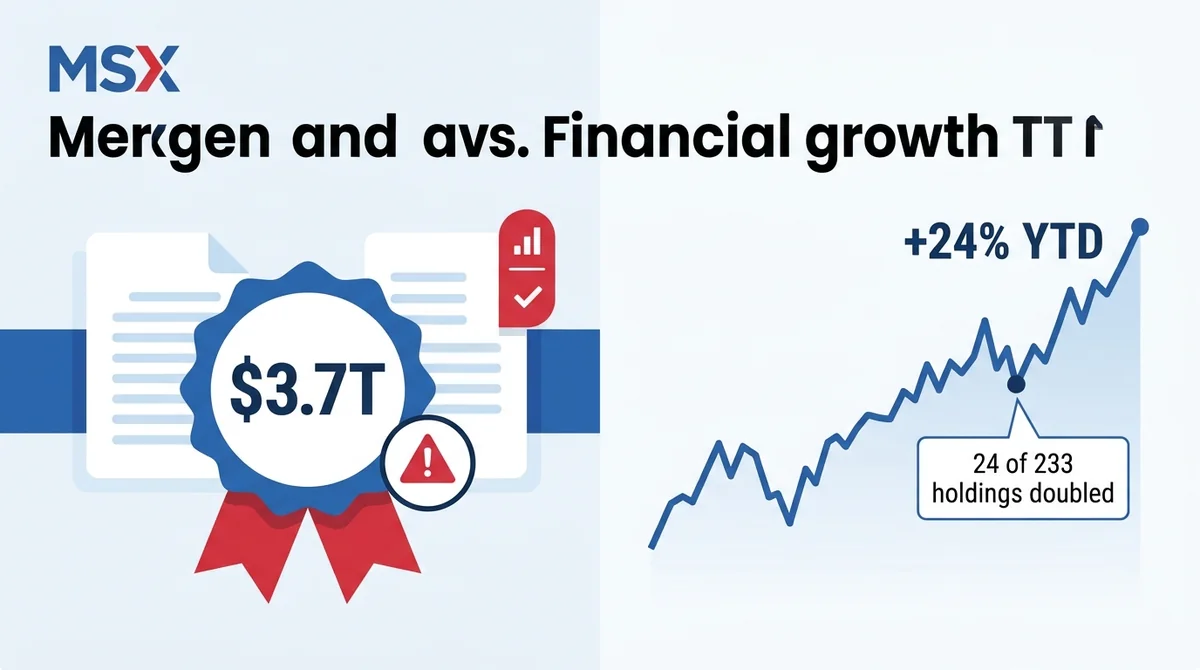
Tesla-SpaceX $3.7T merger rumor raises financial, governance and strategy concerns; IBB up 24% YTD as of Oct 23, 2026, with 24 of 233 holdings doubling.
Article Citation Summary
Tesla-SpaceX $3.7T merger rumor raises financial, governance and strategy concerns; IBB up 24% YTD as of Oct 23, 2026, with 24 of 233 holdings doubling.
MSX US Stock Daily Watch: Tesla-SpaceX Merger Rumor at $3.7 Trillion Valuation—Synergy Doubts and Governance Concentration Risk; IBB Biotech Up 24% YTD with 24 Holdings Doubling
MSX Research
Guest Columnist
@MSX_CN
October 25, 2026
This article is about 4,900 words and takes about 12 minutes to read.
Valuation is never the most expensive part of a deal—governance is. As the market discusses a roughly $3.7 trillion merger rumor as an established narrative, what is actually being priced is the organizational complexity and decision-making concentration of the two companies. On the same timeline, the iShares Biotechnology ETF (IBB) offers another way to think about valuation: a 24% year-to-date gain, 24 of 233 holdings doubling, and a top gainer up 587%. It does not rely on scale-driven mergers to tell a story; instead, it relies on clinical trial results, M&A activity, and an innovation cycle supported by technologies such as genomics, mRNA, and AI. The contrast between these two asset types forms the main thread of this edition of MSX US Stock Daily Watch: whether valuation pricing power is shifting from scale narratives to governance structure and innovation quality is worth continued observation.
AI Summary
Core view: The controversy over the rumored roughly $3.7 trillion merger between Tesla and SpaceX is not about transaction details, but about whether synergies truly exist and whether governance concentration risk is being underestimated. Meanwhile, IBB rose 24% year to date as of October 23, 2026, with 24 of its 233 holdings doubling during the year and its top gainer up 587%, indicating that the biotech sector is in a new innovation cycle. Together, these two sets of facts point to the same proposition: the market's scrutiny of valuation is shifting from scale expansion to governance structure and innovation quality.
Key elements:
- Tesla and SpaceX are rumored to be considering a merger at a valuation of about $3.7 trillion, raising major financial, governance, and strategic concerns (Source: Seeking Alpha, October 24, 2026).
- Analysis notes that Tesla and SpaceX already collaborate deeply, so the incremental synergies from a merger are questionable, while complexity and concentration risks would be amplified (Source: Seeking Alpha, October 24, 2026).
- The iShares Biotechnology ETF (IBB) rose 24% year to date as of October 23, 2026, after gaining 28% for all of 2025 (Source: CNBC, October 24, 2026).
- 24 of IBB's 233 holdings more than doubled year to date, with the top gainer up 587% (Source: CNBC, October 24, 2026).
- Analysts say biotech is in a new innovation cycle, driven by clinical trial results, M&A activity, and technologies such as genomics, mRNA, and AI (Source: CNBC, October 24, 2026).
1. The $3.7 Trillion Merger Rumor Surfaces: The Valuation Narrative for Tesla and SpaceX Has Run Ahead of the Transaction Facts
1. Rumor core: a proposed Tesla-SpaceX merger at a valuation of about $3.7 trillion
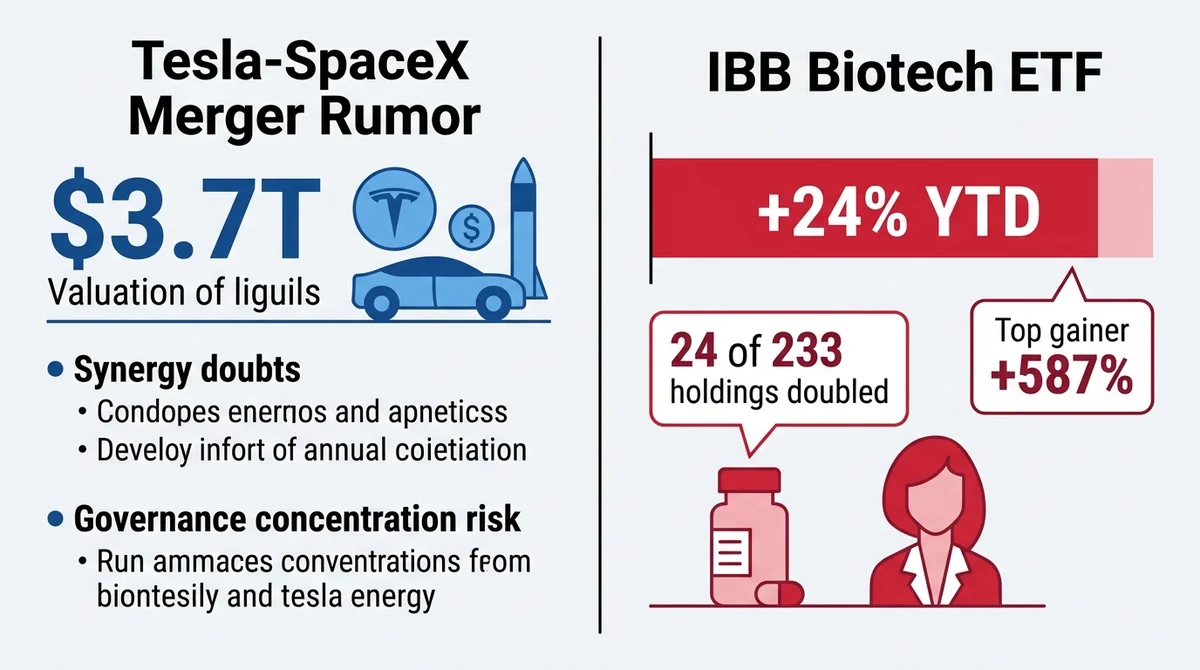
The most closely watched event this edition is a rumor that Tesla and SpaceX are considering a merger at a valuation of about $3.7 trillion. According to analysis published by Seeking Alpha on October 24, 2026, the rumor has already raised major financial, governance, and strategic concerns. It should be emphasized that the public information so far consists only of rumors and analytical opinions; no transaction terms, timetable, or other specific details have been verified. In other words, the $3.7 trillion figure is currently more of a narrative anchor than a transaction pricing outcome.
For the market, the importance of this rumor lies not in whether it will materialize in the near term, but in the fact that it places two entities that originally belonged to different asset classes and different investor structures into the same valuation framework. Tesla is a publicly listed company priced by the public market, while SpaceX has long been in the private market. When the two are discussed on a merged basis, investors are forced to answer a question they did not previously have to answer: does the sum of the two companies' values really equal $3.7 trillion, or is that number itself merely a product of the scale narrative?
2. Doubts center on finance, governance, and strategy rather than transaction details
Interestingly, the doubts surrounding this rumor have not remained at the level of transaction details—there are no terms and no timetable, so details are inherently impossible to discuss. According to the same source, concerns center on three levels: financial, governance, and strategic. The financial level involves the compatibility of the two companies' balance sheets and cash flow structures; the governance level involves the distribution of decision-making power in the combined entity; and the strategic level involves the prioritization of each company's business focus.
This structure of doubt itself suggests that the market's approach to scrutinizing mega-mergers may be changing. In the past, scale was often seen as support for valuation—a larger revenue base and a broader business footprint often supported higher multiples. But when the merging parties already have deep business ties, the marginal valuation gain from scale may diminish, while the friction costs of governance and strategy rise. The reason $3.7 trillion has become the focus of controversy is precisely that it amplifies both this diminishing marginal benefit and rising friction at the same time.
2. Synergies Questionable While Complexity Rises: The Merger's Incremental Value Is Overestimated and Concentration Risk Underestimated
1. The two companies already collaborate deeply, leaving limited room for incremental synergies
The most direct challenge to the merger logic comes from the question of whether synergies are real. According to Seeking Alpha's analysis on October 24, 2026, Tesla and SpaceX already collaborate deeply, and the incremental synergies from a merger are questionable. The key word in this judgment is "incremental"—if the two companies have already formed deep collaboration in supply chains, technology, talent, and other areas, then converting that collaboration from contractual form to equity form may add quite limited value.
This also explains why the $3.7 trillion valuation faces scrutiny. The valuation premium in merger transactions is usually built on the synergy assumption that "1+1>2"; when the incremental portion of synergies is compressed, the valuation premium loses its firmest support. The market can accept paying for real synergies, but it has difficulty accepting paying twice for synergies already covered by existing partnerships.
2. The merger amplifies organizational complexity and governance concentration, not operating efficiency
Corresponding to questionable synergies is rising cost. The same analysis argues that a merger would amplify complexity and concentration risk. Complexity comes from the叠加 of organizational scale, business lines, and decision-making chains; concentration risk comes from decision-making power converging on fewer nodes. For a combined entity spanning multiple highly regulated industries such as automobiles, energy, aerospace, and communications, the rise in these two costs is structural rather than cyclical.
From a market perspective, this means the net present value of the merger could be negative: incremental synergies are limited, while incremental complexity and concentration risk clearly rise. If this judgment holds, then what the $3.7 trillion valuation implies is not value created by the merger, but a premium the market places on the scale narrative itself. For investors, what really needs to be tracked is not whether the transaction is announced, but the quantitative definition of synergies and the specific design of governance arrangements in any subsequent disclosures—these two are the core variables determining valuation reasonableness.
3. IBB Up 24% YTD: Biotech Is in a New Innovation Cycle, with 24 Holdings Doubling Confirming Sector Breadth
1. IBB up 24% YTD as of October 23, 2026, after a 28% gain for all of 2025
In contrast to the controversy over the merger rumor is the steady performance of the biotech sector. According to a CNBC report on October 24, 2026, the iShares Biotechnology ETF (IBB) rose 24% year to date as of October 23, 2026, while its full-year 2025 gain was 28%. Two consecutive years of double-digit gains suggest this is more of a sustained sector move than a brief rebound.
For the market, the significance of the 24% figure lies not only in absolute returns but also in how it is composed. Biotech is a classic event-driven sector with extreme single-stock volatility; steady index-level gains usually mean the rally is not being driven by a few heavyweight stocks alone but has a broader participation base. This is more directly confirmed by the holdings distribution data.
2. 24 of 233 holdings doubled YTD, with the top gainer up 587%
According to the same CNBC report, 24 of IBB's 233 holdings more than doubled year to date, with the top gainer up 587%. Twenty-four doubling stocks account for about one-tenth of the 233 holdings, a ratio that is uncommon in broad-based indices; the 587% top gain indicates extremely strong single-stock elasticity within the sector.
This distribution—"steady index, dramatic single stocks"—is typical of innovation-cycle-driven markets. Clinical trial results are binary: the valuation gap between success and failure is enormous, so extreme divergence appears at the single-stock level; but as long as there are enough success cases, the index level can show a moderate upward shape. The existence of 24 doubling stocks is precisely the quantitative expression of this "breadth": the rally is not propped up by one or two stocks, but by a group of companies benefiting simultaneously from the upcycle.
3. Clinical trial results, M&A activity, and technologies such as genomics, mRNA, and AI jointly drive the innovation cycle
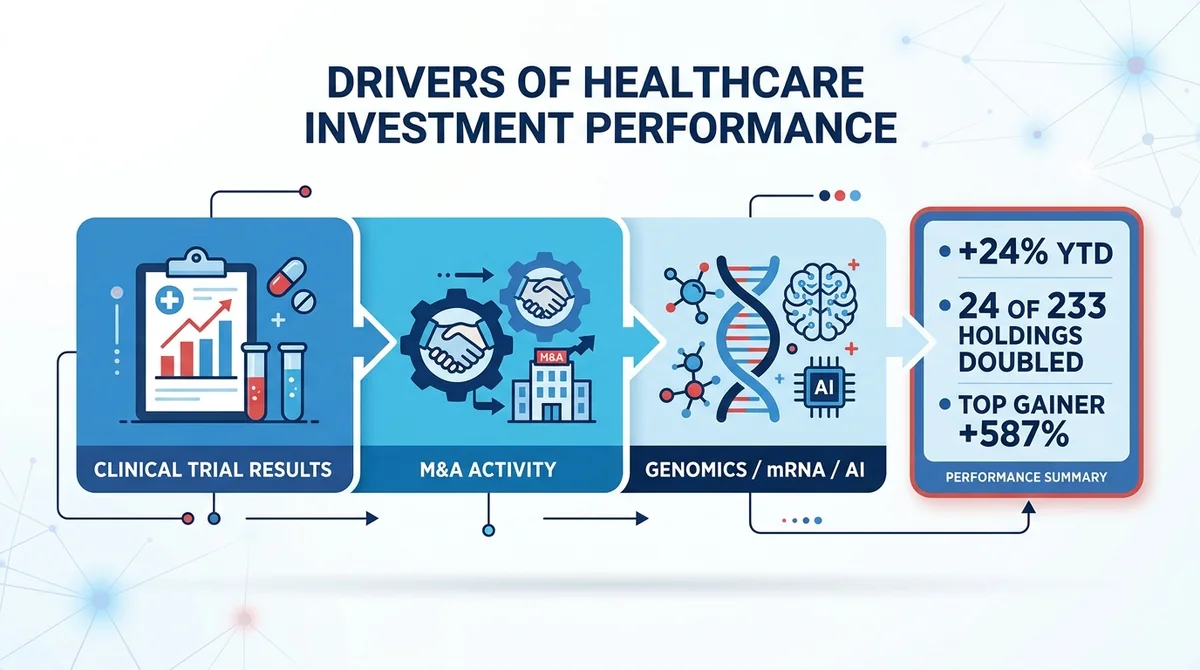
According to CNBC, analysts say biotech is in a new innovation cycle, driven by clinical trial results, M&A activity, and technologies such as genomics, mRNA, and AI. These three drivers are different in nature: clinical trial results are event catalysts, M&A activity is a capital exit channel, and genomics, mRNA, and AI are iterations of underlying technology platforms. Together, they may form a self-reinforcing loop—technology platforms raise R&D success rates, successful cases attract M&A capital, and M&A exits in turn feed a new round of R&D investment.
From a market perspective, if this loop holds, it means the biotech rally has some basis for sustainability rather than being merely a recovery in risk appetite. Of course, the other side of the innovation cycle is that failure risk always exists; the binary nature of clinical trials will not disappear because of an upcycle. Therefore, sector-level breadth data reflects the health of the rally better than the gain of any single stock.
4. The Common Proposition for Both Asset Types: Valuation Pricing Power May Be Shifting from Scale Narratives to Governance and Innovation Quality
1. Mega-mergers tell valuation through scale; biotech tells valuation through the innovation cycle
Placing the two sets of facts side by side reveals that they answer the same question: what kind of narrative can support valuation. The Tesla-SpaceX merger rumor uses a scale narrative—the combined size, footprint, and imaginative space of the two companies form the basis for $3.7 trillion; IBB's 24% YTD gain uses an innovation-cycle narrative—clinical trials, M&A, and technology platforms form the cash flow basis for valuation.
The reliability of the two narratives is not the same. Verification of the scale narrative depends on the transaction closing and synergies being delivered, and neither can be verified under current information conditions; verification of the innovation-cycle narrative is already partly reflected in the data—24 doubling stocks and a 587% top gain are market outcomes that have already occurred. This may be the most noteworthy contrast of this edition: while the scale narrative is still being questioned at the rumor stage, the innovation-cycle narrative has already given its answer through holdings distribution.
2. Governance concentration and innovation sustainability become two sides of the same coin
A deeper common point lies in governance. One of the core concerns about the merger rumor is governance concentration risk, meaning decision-making power converging on fewer nodes; the biotech sector rally, by contrast, depends precisely on dispersed innovation entities—233 holdings and 24 doubling stocks show that value creation is distributed across a large number of independent companies. The former is concentration, the latter is dispersion; together they form the two ends of the governance structure spectrum.
The market's attitude toward these two ends may be becoming more discerning. For concentrated structures, the market is beginning to demand greater governance transparency and clearer quantification of synergies; for dispersed structures, the market uses breadth data to test the authenticity of the innovation cycle. This means valuation pricing power may be shifting from "how big is the scale" to "is governance sound and is innovation sustainable." This shift will not happen overnight, but the two sets of facts in this edition already provide clear footnotes.
Final Thoughts
This edition's two main threads appear to be one cold and one hot, but in fact they point to the same restructuring of valuation logic. The rumored roughly $3.7 trillion merger between Tesla and SpaceX pushes the valuation question of mega-deals from "how much increment can scale bring" to "are synergies real and is governance controllable." Meanwhile, IBB's 24% YTD gain as of October 23, 2026, with 24 of 233 holdings doubling and a 587% top gain, demonstrates another kind of valuation support—an innovation cycle driven jointly by clinical trial results, M&A activity, and technologies such as genomics, mRNA, and AI.
For mega-deal rumors, the reasonable attitude is to return to synergy authenticity and governance structure rather than the valuation number itself. $3.7 trillion is a narrative anchor, not transaction pricing; before specific details such as transaction terms and timetable are verified, any inference based on that number is only an assumption. The analysis's points—"already collaborating deeply, incremental synergies questionable, rising complexity and concentration risk"—are the substantive content that can be discussed at present.
For the biotech sector, 24 doubling stocks and a 587% top gain point to the breadth of structural opportunities, not the certainty of any single name. The sustainability of the innovation cycle ultimately still depends on the continuation of clinical trial results and M&A activity, as well as the pace of iteration in technology platforms such as genomics, mRNA, and AI.
Where the two threads converge is the migration of valuation pricing power: from scale narratives to governance and innovation quality. The impact of this migration on the market may not immediately show up in index levels, but it will continue to show up in how capital prices different governance structures and innovation quality. Going forward, verified information should be the basis, and excessive inference about transaction details that have not materialized should be avoided.
Risk disclosure: Macroeconomic conditions and the US stock market are highly volatile. This content is provided solely for academic and research observation reference by MSX Research and does not constitute any investment advice.
Invest in AI RWA Finance
Reference Sources
This article is produced by the MSXGO editorial team, AI-assisted, and reviewed through an editorial process. Fee rates and figures are subject to each platform's latest official announcements.
FAQ
What is the rumored valuation of the Tesla-SpaceX merger? ▼
According to Seeking Alpha's analysis on October 24, 2026, Tesla and SpaceX are rumored to be considering a merger at a valuation of about $3.7 trillion, raising major financial, governance, and strategic concerns. Public information so far consists only of rumors and analytical opinions; no transaction terms, timetable, or other specific details have been verified.
Why do analysts question the synergies of a Tesla-SpaceX merger? ▼
Analysis notes that Tesla and SpaceX already collaborate deeply, so the incremental synergies from a merger are questionable; at the same time, a merger would amplify complexity and concentration risk. Limited synergies and rising complexity together form the core challenge to the reasonableness of the roughly $3.7 trillion valuation.
How has the IBB biotech ETF performed in 2026? ▼
According to a CNBC report on October 24, 2026, the iShares Biotechnology ETF (IBB) rose 24% year to date as of October 23, 2026, after gaining 28% for all of 2025.
How many IBB holdings have doubled year to date? ▼
According to CNBC, 24 of IBB's 233 holdings more than doubled year to date, with the top gainer up 587%.
What factors are driving the new innovation cycle in the biotech sector? ▼
According to CNBC, analysts say biotech is in a new innovation cycle, driven by clinical trial results, M&A activity, and technologies such as genomics, mRNA, and AI.
Finished reading? Ready to try trading?
Tokenized stocks/ETFs, crypto spot, and perpetual futures in one account — perp maker 0.02% / taker 0.045%, RWA spot buy 0.3% / sell 0.
Free sign-up · 3 quick steps