MSX US Stocks Daily Watch: Palantir's Revenue Mix Turns — US Commercial Revenue Up 148%, Overtakes Government for the First Time; Q3 Revenue Tops $2B and Full-Year Guidance Raised
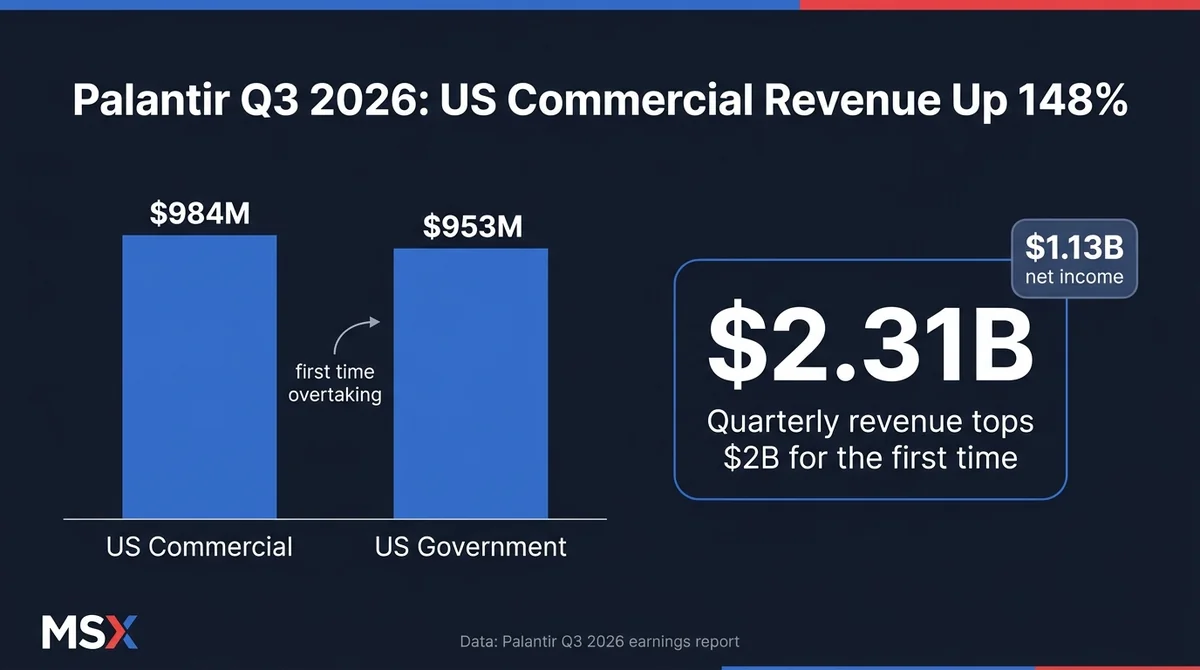
Palantir Q3 2026: adjusted EPS 44 cents, revenue $2.31B, both above estimates. US commercial revenue rose 148% to $984M, topping government for the first time.
Article Citation Summary
Palantir Q3 2026: adjusted EPS 44 cents, revenue $2.31B, both above estimates. US commercial revenue rose 148% to $984M, topping government for the first time.
MSX US Stocks Daily Watch: Palantir's Revenue Mix Turns — US Commercial Revenue Up 148%, Overtakes Government for the First Time; Q3 Revenue Tops $2B and Full-Year Guidance Raised
MSX Research
Guest Columnist
@MSX_CN
November 2026
This article is about 4,000 Chinese characters; reading the full text takes about 12 minutes
With a quarterly report in which revenue topped $2 billion for the first time, US commercial revenue grew 148% year over year and overtook government business for the first time, Palantir turned the question of "whether AI software demand can be converted into revenue" into a sample that can be tested against financial numbers. On the same trading day, Alphabet posted its worst single-day performance since its 2004 listing, with nearly $500 billion in market value wiped out (per Seeking Alpha), a reminder that, for earnings reports alike, differences in the speed of delivery are pushing individual US stocks onto sharply different pricing tracks. Unless otherwise noted, all data below comes from CNBC's coverage of Palantir's Q3 2026 earnings report.
AI Summary
Core view: Palantir's Q3 2026 results beat market expectations, with revenue exceeding $2 billion for the first time and net income more than doubling to $1.13 billion. US commercial revenue rose 148% year over year to $984 million, surpassing US government revenue ($953 million, up 96%) for the first time, and the company simultaneously raised its full-year guidance. These numbers point to a shift in its growth engine from the government side to the commercial side. By contrast, Alphabet posted its worst single-day performance since its 2004 listing after its earnings report, with nearly $500 billion in market value wiped out, while EVgo was constrained by the pace of its NACS connector retrofits — signs that the rhythm of earnings delivery is widening the divergence among US stocks.
Key elements:
- Palantir reported Q3 2026 results: adjusted EPS of 44 cents, above the market expectation of 41 cents; revenue of $2.31 billion, above the expected $2.18 billion.
- Palantir's Q3 US commercial revenue rose 148% year over year to $984 million, exceeding US government revenue of $953 million (which grew 96% year over year) for the first time.
- Palantir's Q3 revenue nearly doubled year over year, topping $2 billion for the first time; net income more than doubled to $1.13 billion (44 cents per share), versus about $476 million (18 cents per share) a year earlier.
- Palantir raised its full-year guidance, expecting 2026 US commercial revenue to "exceed" $3.56 billion, Q4 revenue of about $2.65 billion and full-year revenue of about $8.53 billion.
- Alphabet's shares fell sharply after its Q3 earnings release, posting their worst single-day performance since its 2004 listing, with nearly $500 billion in market value wiped out.
- EVgo's partnership with TSLA doubled its addressable market and is expected to boost charging-station traffic, but slow progress on NACS connector retrofits limits the immediate benefits from TSLA owners.
1. Palantir's Q3 Results Beat Expectations: Revenue Tops $2 Billion for the First Time, Net Income Doubles
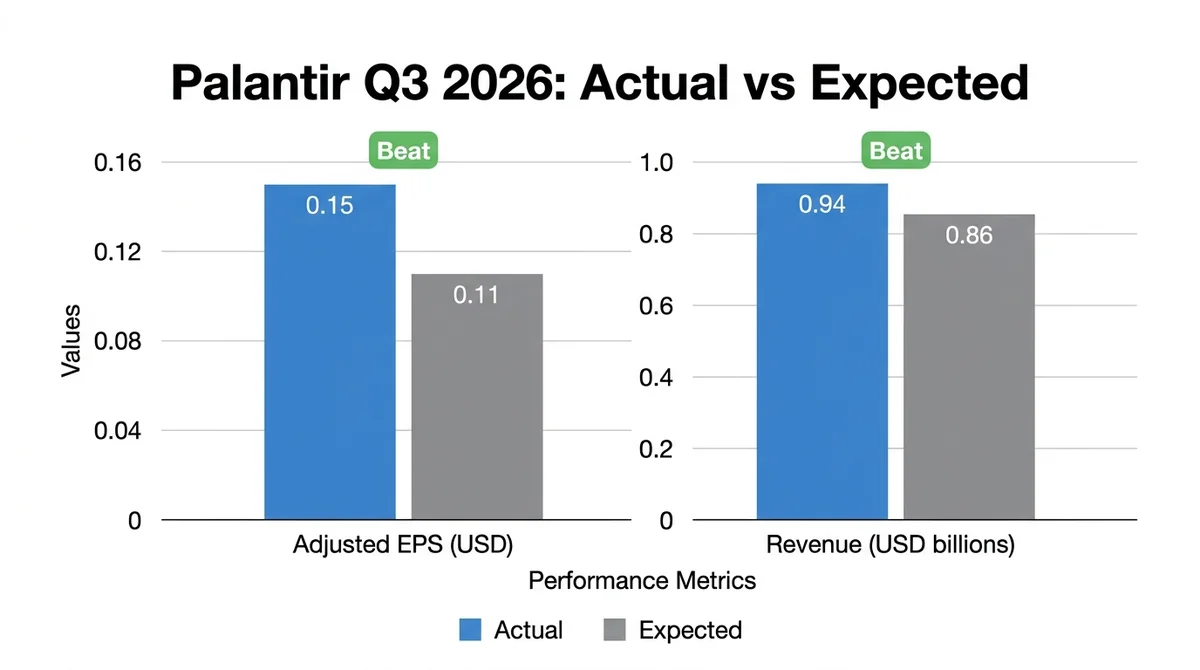
Palantir's Q3 report, released on November 2, 2026, delivered a scorecard that cleared market expectations on both revenue and profit. According to CNBC, the company's adjusted EPS was 44 cents, above the market expectation of 41 cents; revenue was $2.31 billion, above the expected $2.18 billion. For an AI software company already priced at a high valuation by the market, beating expectations is not rare in itself; what is noteworthy is that the beat appeared on both the EPS and revenue lines.
1. Adjusted EPS of 44 cents and revenue of $2.31 billion, both above market expectations
Adjusted EPS of 44 cents versus an expected 41 cents, and revenue of $2.31 billion versus an expected $2.18 billion. It should be noted that the specific basis of the market expectations (whether adjusted, and whether consistent with the company's adjusted basis) is not specified in the source; this is presented only as stated in the source. Whether such a modest beat can be regarded as "repeatable" still needs verification in subsequent quarters; a single quarter is not enough to prove a trend.
2. Net income more than doubles to $1.13 billion, sharply amplifying earnings elasticity
According to CNBC, Palantir's Q3 net income more than doubled to $1.13 billion (44 cents per share), versus about $476 million (18 cents per share) a year earlier. Net income rising from about $476 million to $1.13 billion means the company's margin structure is improving alongside revenue expansion. Note, however, that the source does not disclose whether net income includes one-off items or investment gains, nor why "adjusted EPS" and "net income per share" are both 44 cents; readers should not directly infer the magnitude of operating leverage from this.
3. Revenue nearly doubles year over year, crossing the $2 billion mark for the first time
According to CNBC, Palantir's Q3 revenue nearly doubled year over year, topping $2 billion for the first time. Revenue nearly doubling year over year, combined with crossing the $2 billion mark for the first time, forms the most intuitive narrative of this report: the company's revenue base is expanding faster than the traditional enterprise software industry. The symbolic significance of the $2 billion round number is that Palantir's revenue scale has entered a range that can support larger government and commercial contracts, but whether the scale already constitutes a competitive moat remains an inference rather than a fact.
2. US Commercial Revenue Up 148%, Overtaking Government Business for the First Time as the Revenue Mix Turns
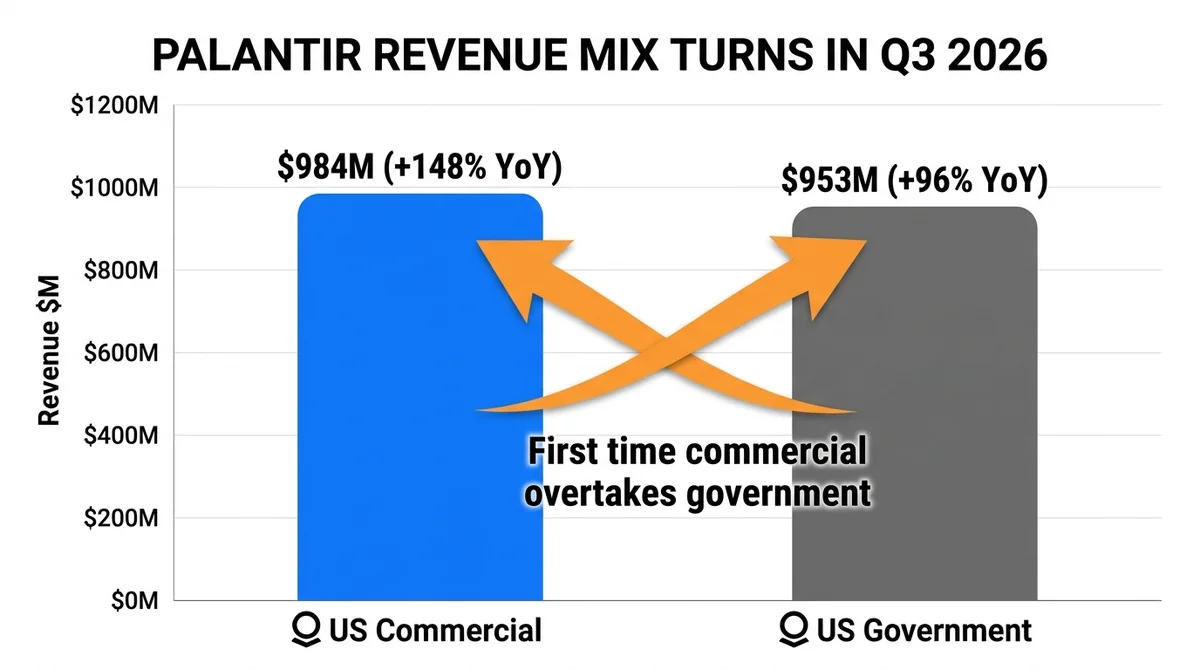
If the revenue and profit beats answer "how fast growth is," then the change in revenue mix answers "where growth comes from." The most notable fact about Palantir this quarter is that US commercial revenue exceeded US government revenue for the first time.
1. US commercial revenue of $984 million, up 148% year over year, overtaking the government segment for the first time
According to CNBC, Palantir's Q3 US commercial revenue rose 148% year over year to $984 million. A 148% year-over-year growth rate would be an outlier for any large enterprise software company, and the fact that it occurred at a stage when the company's revenue base is already substantial suggests that demand release on the commercial side is not a linear ramp. The absolute scale of $984 million also means the US commercial business is already large enough to support a revenue line comparable in size to the government business on its own.
2. US government revenue of $953 million, up 96% year over year — growth is hardly weak either
It is important to stress that the commercial side's overtaking was not built on a government-side stall. According to CNBC, US government revenue was $953 million, up 96% year over year. A near-doubling growth rate in the government business itself shows that Palantir's traditional base is still expanding. In other words, this quarter's structural change is closer to "both legs are running, and the commercial leg is running faster" rather than "one leg replacing the other." This distinction is crucial for judging the sustainability of growth: the stability of the government business provides a floor, while the high growth of the commercial business provides a ceiling.
3. Commercial growth outpacing government growth means the growth engine is shifting
Commercial revenue exceeding government revenue is a turning point in Palantir's revenue mix. From the perspective of growth quality, commercial customers' purchasing decision cycles are usually shorter than government contracts, and revenue recognition is more closely tied to current-period demand, which means a higher commercial share could reduce the lag in the company's overall revenue. But the commercial side also means greater competitive exposure and shorter contract cycles; if commercial growth slows later, the "dual-engine" revenue mix could turn into "dual volatility." This is worth tracking continuously when assessing the achievability of the full-year guidance.
3. Full-Year Guidance Raised: US Commercial Revenue Targeted Above $3.56 Billion, Q4 Revenue Around $2.65 Billion
Beating expectations in a quarterly report is only a single-quarter result; guidance is the company's own pricing of the future. Palantir also raised its full-year guidance this quarter, allowing the earnings beat and forward guidance to corroborate each other.
1. The company expects 2026 US commercial revenue to "exceed" $3.56 billion
According to CNBC, Palantir raised its full-year guidance and expects 2026 US commercial revenue to "exceed" $3.56 billion. Using the wording "exceed" rather than giving a range may imply high internal visibility into the commercial pipeline, but this is an inference. Combined with the fact that Q3 US commercial revenue was $984 million, up 148% year over year, the full-year target of more than $3.56 billion implies that the commercial side needs to sustain a relatively high growth rate in Q4 — a reflection of the company's confidence and also the assumption most easily tested in subsequent quarters.
2. Q4 revenue guidance of about $2.65 billion, full-year about $8.53 billion
According to CNBC, Palantir's Q4 revenue guidance is about $2.65 billion, with full-year revenue of about $8.53 billion. The Q4 guidance is further above Q3's actual revenue of $2.31 billion, indicating that the company does not view this quarter's beat as a one-off pulse but has incorporated it into a path of continued sequential growth. The full-year revenue target of about $8.53 billion also provides the market with a relatively clear anchor for calibrating expectations for the 2027 growth slope.
3. The guidance raise reinforces expectations for sustained high commercial growth
The guidance raise and the Q3 earnings beat corroborate each other. For pricing, the significance of the guidance raise is that it partly converts the question "is this quarter's beat sustainable?" into "does the company itself believe it is sustainable?" — and Palantir answered affirmatively with its raised numbers. Of course, guidance is ultimately the company's own judgment; if Q4 commercial revenue growth slows markedly from Q3's 148%, the market may still reassess the commercial growth slope.
4. The Same Trading Day's US Stock Picture: Alphabet's Worst Day Since 2004, EVgo's NACS Retrofits Still Underway
Putting Palantir back into the overall picture of the November 2, 2026 trading day reveals a more tension-filled scene: for earnings reports alike, market reactions can be diametrically opposite.
1. Alphabet plunges in a single day after earnings, nearly $500 billion in market value wiped out
According to Seeking Alpha, Alphabet's shares fell sharply after its Q3 earnings release, posting their worst single-day performance since its 2004 listing, with nearly $500 billion in market value wiped out. A platform giant listed for more than two decades posting its worst single-day performance ever shows that post-earnings pricing depends more on the gap between results and market expectations than on whether results are good or bad in absolute terms. The scale of nearly $500 billion in market value wiped out also suggests that once the expectation gap in large tech stocks is released, the shock could spill over to the index level. It should be noted that the report was published on the day of the earnings release; the specific decline, the source of the expectation gap and the method for calculating the market value loss were not disclosed in the source, and the relevant figures are pending verification.
2. EVgo expands its addressable market via the TSLA partnership, but NACS connector retrofits are slow
According to Seeking Alpha, EVgo's partnership with TSLA doubled its addressable market and is expected to boost charging-station traffic, but slow progress on NACS connector retrofits limits the immediate benefits from TSLA owners. The source is a preview of EVgo's Q3 earnings, and the related judgments are analytical opinions rather than realized results. This case provides a sample of the gap between a "partnership narrative" and "execution progress": a doubling of the addressable market is a narrative-level positive, while the pace of connector retrofits is the revenue-level variable. The time lag between the two is often the source of stock price volatility.
3. Divergence in individual stock performance intensifies, with earnings becoming a core pricing variable
Palantir strengthening after earnings, Alphabet plunging after earnings and EVgo constrained by retrofit progress formed a stark divergence on the same trading day. This divergence shows that in the current market environment, earnings may be an important variable in individual stock pricing, but the claim that they "replace macro narratives as the core variable" is an inference, and a single trading day's sample is not enough to support a trend conclusion.
5. Software and Platform Stocks Diverge Through Single-Quarter Earnings: The Speed of Growth Delivery Affects Valuation Tolerance
The three companies above belong to different sectors, but their earnings reactions point to the same pricing logic: the market's tolerance for valuation may be related to the speed at which growth is delivered.
1. Palantir delivers growth through an earnings beat and raised guidance
Palantir's adjusted EPS and revenue both beat expectations, and it raised its full-year guidance. Its case shows that when a company can use current-period numbers to prove its previous growth narrative, the market may be more willing to support its high valuation. US commercial revenue growing 148% year over year and overtaking government business for the first time further strengthens the factual basis of the "growth engine shift" narrative.
2. Alphabet's single-day plunge shows expectation gaps can also be priced violently
Alphabet's shares posted their worst single-day performance since their 2004 listing after earnings, with nearly $500 billion in market value wiped out. This fact reminds the market that even for a company of enormous size and diversified businesses, once there is a gap between earnings and expectations, the intensity of pricing will not weaken because of the company's scale. For software and platform stocks as a whole, this means volatility risk during earnings season is rising.
3. The EVgo case suggests the pace of partnership execution matters more than the partnership itself
EVgo's partnership with TSLA expands its addressable market, but slow progress on NACS connector retrofits limits immediate benefits. The partnership itself is a narrative; the pace of execution is what drives cash flow. Only if retrofit progress accelerates later can the economic value of the partnership gradually show up on the revenue side; before then, the market is more likely to price execution progress than partnership scale.
Final Thoughts
Viewed on a longer timeline, Palantir's quarterly report records not just an earnings beat but a change in revenue mix: US commercial revenue rose 148% year over year to $984 million, exceeding US government revenue of $953 million for the first time, while the company raised its full-year guidance to US commercial revenue "exceeding" $3.56 billion and full-year revenue of about $8.53 billion. Revenue topping $2 billion for the first time and net income doubling to $1.13 billion provide a profit-side footnote to this change. Whether this structural change can continue still needs verification in subsequent quarters.
On the same trading day, Alphabet's worst single day since its 2004 listing, with nearly $500 billion in market value wiped out, and EVgo being constrained by the pace of NACS connector retrofits form the counter-reference for this narrative. Together they show that current pricing of US software and platform stocks may be highly related to the speed and rhythm of growth delivery rather than the grandeur of the narrative itself.
Three things are worth watching going forward: first, whether Palantir's commercial revenue growth can continue in Q4 and whether the full-year guidance can be delivered on schedule; second, whether the visibility of the commercial pipeline behind the "exceed" $3.56 billion wording in the guidance can stand up to scrutiny; and third, whether divergence among individual stocks will further intensify during the earnings-heavy disclosure window. The answers to these questions will determine how far this earnings-driven divergence rally can go.
Risk warning: Macroeconomic conditions and the US stock market are highly volatile. This article is provided solely for academic and research observation reference by MSX Research and does not constitute any investment advice.
References
This article is produced by the MSXGO editorial team, AI-assisted, and reviewed through an editorial process. Fee rates and figures are subject to each platform's latest official announcements.
FAQ
What were Palantir's Q3 2026 revenue and EPS? ▼
According to CNBC, Palantir's Q3 2026 adjusted EPS was 44 cents, above the market expectation of 41 cents; revenue was $2.31 billion, above the expected $2.18 billion, marking the first time revenue topped $2 billion. The methodology behind those market expectations is not specified in the source.
Did Palantir's US commercial revenue exceed government business for the first time? ▼
According to CNBC, yes. Palantir's Q3 US commercial revenue rose 148% year over year to $984 million, exceeding US government revenue of $953 million for the first time; the latter grew 96% year over year.
How did Palantir's Q3 net income perform? ▼
According to CNBC, Palantir's Q3 net income more than doubled to $1.13 billion (44 cents per share), versus about $476 million (18 cents per share) a year earlier. The source does not disclose whether net income includes one-off items.
What is Palantir's full-year 2026 guidance? ▼
According to CNBC, Palantir raised its full-year guidance, expecting 2026 US commercial revenue to "exceed" $3.56 billion, Q4 revenue of about $2.65 billion and full-year revenue of about $8.53 billion.
How did Alphabet's stock perform after its earnings report? ▼
According to Seeking Alpha, Alphabet's shares fell sharply after its Q3 earnings release, posting their worst single-day performance since its 2004 listing, with nearly $500 billion in market value wiped out. The report was published on the day of the earnings release; the specific decline and the method for calculating the market value loss were not disclosed, and the relevant figures are pending verification.
What is the progress of EVgo's partnership with TSLA? ▼
According to Seeking Alpha's Q3 earnings preview, EVgo's partnership with TSLA doubled its addressable market and is expected to boost charging-station traffic, but slow progress on NACS connector retrofits limits the immediate benefits from TSLA owners. This judgment is an analytical opinion and has not yet shown up in realized results.
Finished reading? Ready to try trading?
Tokenized stocks/ETFs, crypto spot, and perpetual futures in one account — perp maker 0.02% / taker 0.045%, RWA spot buy 0.3% / sell 0.
Free sign-up · 3 quick steps